




Inside the Bolt EV
While the new battery deserves credit for the car’s +200-mile range, systems optimization, careful motor design and proprietary CAE tools were equally important.
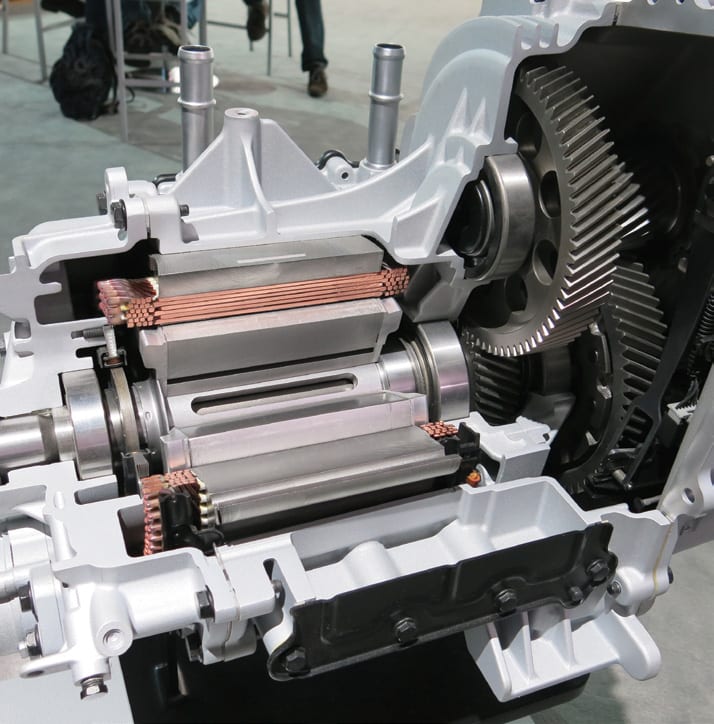
Cutaway propulsion systems displayed at motor shows attract engineers faster than free beer and pizza. So perhaps it wasn’t surprising when Matthias Mueller, the newly-promoted chairman of Volkswagen Group, and his five-man entourage charged into the Chevrolet stand during the 2016 Detroit auto show.
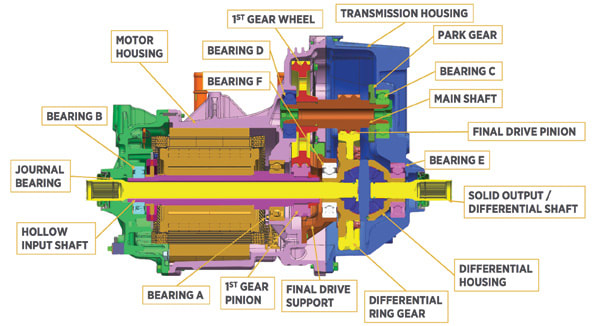
“Hier ist es,” (here it is) said Mueller’s assistant, pointing to the 2017 Bolt EV propulsion module unveiled earlier that day. The dark-suited VW execs huddled closely around the cutaway property, its traction motor and large helical gearset in full view through the artfully milled aluminum case. One of Mueller’s lieutenants — who may have studied the Chevy module already — listed some design high-lights while Mueller listened attentively. A fellow carrying a notepad made a technical sketch while another snapped close-up photos.
Within ten minutes they departed. The author and Steve Poulos, GM’s veteran chief engineer of electric-propulsion systems, stepped back to the cutaway. We picked up our own discussion from before the interlopers arrived.
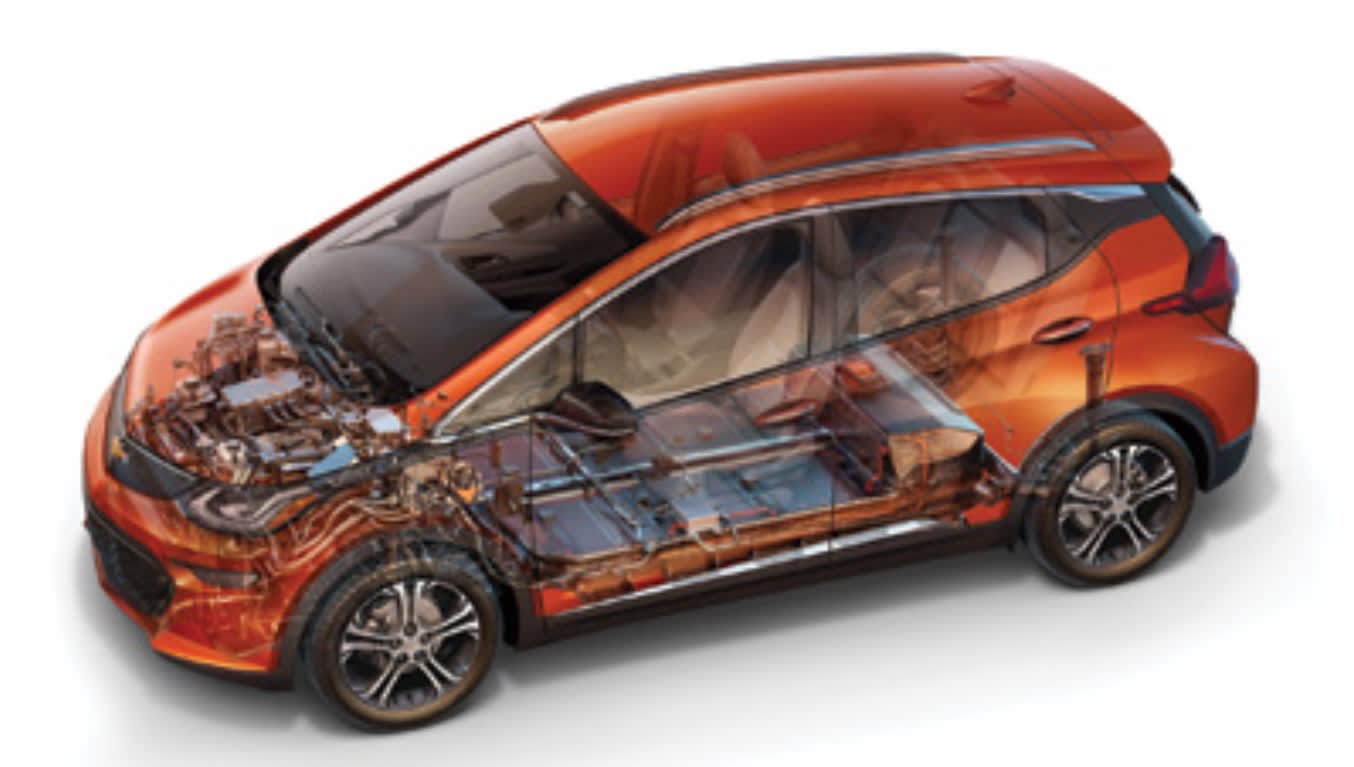
“That’s not the first competitor to visit us today,” Poulos noted. “We knew we’d get some interest.” Such understatements from the engineering team a year ago foreshadowed numerous awards to come for the newly-minted Bolt EV, including 2017 North American Car of the Year. As the first production battery-electric vehicle to deliver more than 200 mi (322 km) range at a price less than $40,000, the Bolt EV proves the strategic collaboration between GM Global Propulsion and LG Electronics Vehicle Components is an EV development force. The LG Corp. group was established in 2014 to co-develop the Bolt powertrain and other subsystems. Much of their triumph has been credited to the Bolt’s
battery pack, featuring a new nickel-rich Li-ion NMC chemistry which gives greater heat tolerance without impacting battery life, according to Bill Wallace, GM’s director of global battery systems. Larger cells with more surface area deliver a 40-kW gain over the previous Spark EV pack. Nominal energy is increased more than 3X, from 18.4 kW·h on Spark EV to more than 60 kW·h for Bolt, with only a doubling of battery mass.

It’s a significant increase in both gravimetric (Watt-hours/kg) and volumetric (kilowatts/L) energy (see table). Its high thermal mass — the pack weighs 959 lb/435 kg — means temperature swing during operation is single-digit minimal. There isn’t much wasted heat, which helps improve the amount of energy recuperated during the Bolt EV’s “single-pedal” lift-off deceleration and regen braking. Automotive Engineering editors call it “the small-block V8 of battery packs.”
Motor design details
But systems optimization of the battery, e-motor, gearing power control and thermal management is the bigger story behind Bolt EV, Poulos noted.
“We looked at numerous ways to optimize the motor to achieve peak [97%] efficiency,” he said, “because the more efficient we make the motor, the less battery we need to carry to achieve our 200-miles range.” Designed in-house at GM, the motor program found the ideal magnet location in the rotor to break up frequencies and squeeze out as much torque density as possible.

The neodymium iron boron (NdFeB, or NIB) magnets are placed deep within the rotor in a two layer ‘V’ arrangement, assymetrically between adjacent poles to minimize torque ripple and radial force. A double-layer arrangement of magnets and barriers offers design flexibility and boosts motor performance at higher speed. The bar-wound stator construction is a GM e-motor trademark that provides high slot-fill, improved thermal performance and higher efficiency, the engineers said.
Poulos’s team also realized the permanent-magnet motor needed to spin significantly faster than that of the Spark EV to produce the power needed for the larger, heavier Bolt and its much-higher performance targets. The new motor’s 8,810 rpm peak is nearly twice as high as that of the Spark motor. It runs on slightly lower current for more efficiency. Peak torque is less than the Spark motor but axle torque is higher due to a higher (7.05:1 vs. 3.87) final drive ratio.
That helped reduce the propulsion unit’s weight (167 lb/76 kg, most of which is the 150-kW motor) and package volume. The drive unit’s compact design allowed it to be located precisely in the vehicle centerline, which enabled identical-length axle shafts. The result was minimized torque steer, reduced integration cost and greater manufacturing efficiency.
Additionally, the single-speed gear-set architecture created advantages in the park system loading. Also, the split lines between the end cover and motor housing and between the motor and gearbox housings increase structural rigidity. This in turn enables the motor assembly to be manufactured as a separate stand-alone unit and allows motor-compartment maintenance without disassembling the entire drive unit.
GM’s unique analysis tool
The lubrication system in this electronic-automatic propulsion device is a combination of pressurized and gravity feed/flow. It uses a 12-V variable speed pump mounted outside of the transmission housing. The low-pressure pump will only run when out of Park or Neutral and vehicle speed is detected. The 12-V pump also helped optimize filter position and minimized ATF volume inside the drive unit, which helped reduce cost, mass and drag/spin losses, Poulos noted.
Key to the propulsion system meeting and in some ways exceeding its design targets was a proprietary CAE program, said Poulos. “We input all the different maneuvers we want to design this motor to do — various drive cycles, climbing a grade, 0-60-mph acceleration, passing maneuvers, etc. — to generate thousands of points on the torque-speed map.”
Without the unique analysis tool, the thousands of combinations would require far more time to sort out. The program then breaks the map into zones and prioritizes them according to their importance to the car’s performance. It then generates a ‘center of gravity’ for each representative point.
“Then we do a Design of Experiments and a whole series of design variables and it gives us the optimum,” explained Poulos, who is now chief engineer of GM’s fuel cell activity. “We keep adding these points until the data converges into an answer that doesn’t change.”
Added Tim Grewe, GM director of general electrification, “It’s a very powerful technique we developed internally to ensure we have no more iron, copper, size and mass than we need to meet our performance requirements.
“From a customer-pleasing point of view, this program goes way beyond the cycle, which we also weighed into the calculation to determine what to optimize,” Grewe said. “It tells us quite precisely that we’ve optimized the motor for every drive cycle without compromising something that disappoints the customer.”
More From SAE Media Group
Off-Highway Engineering
FEV Simplifies Off-Highway Electrification
Automotive Engineering
ZF Introduces Complete E-Drive System for Passenger, Commercial Vehicles
Automotive Engineering
First Drive: 2027 Mercedes-Benz CLA Hybrid
Automotive Engineering
Transforming Propulsion with Tula’s Digital-Control Magic
Tech Briefs
EV vs. ICE: How Does Wire Harness Design Differ?
Automotive Engineering
Bosch Debuts New CV-Specific Electric Motor and Inverter
Off-Highway Engineering
Miserly Power Systems
Automotive Engineering
EV Motor Development Is on the Move
Off-Highway Engineering
AxleTech Develops Electric Independent Suspension Concept for Vehicles Up to 58,000-lb GCWR
Automotive Engineering
Schaeffler Electrifies Its Fuel-Efficiency Demonstrator, Aims for 35 Mpg Combined Rating
Off-Highway Engineering
Volvo CE Previews ConExpo 2023 Display
Automotive Engineering
Brunswick Launches All-Electric Marine Outboard
Off-Highway Engineering
Variable Transmission Platform

Automotive Engineering
Electrifying ‘The Ultimate Driving Machine’
Automotive Engineering
Hub-Motoring in Lordstown’s Novel Endurance
Automotive Engineering
The Soft Underbelly of The EV Transition
Automotive Engineering
Bosch’s EV Efficiency Upgrade: Continuously Variable Transmissions
Off-Highway Engineering
Reshaping the Mobile-hydraulic Ecosystem
Off-Highway Engineering
ZM Trucks Starts Production in Fontana, California
Tech Briefs
Are In-Wheel Motor Systems Catching On?
Automotive Engineering
Bridging the Power Gap with 48 Volts
Automotive Engineering
Toyota Stretches SUV Line-Up with World Debut of Grand Highlander
Automotive Engineering
2019 Chevrolet Silverado 2.7L

Motion Design
Best Practices to Optimize Motor Selection
Off-Highway Engineering
CONEXPO 2023 Image Gallery
Automotive Engineering
Tuning the 2024 Corvette E-Ray for Exceptional Drivability
Automotive Engineering
VW’s New E-Golf May Lead the Way to Lithium-Air Power
Tech Briefs
High-Power Direct Borohydride Fuel Cells
Top Stories
INSIDERManufacturing & Prototyping
 How Airbus is Using w-DED to 3D Print Larger Titanium Airplane Parts
INSIDERManned Systems
 FAA to Replace Aging Network of Ground-Based Radars
NewsTransportation
 CES 2026: Bosch is Ready to Bring AI to Your (Likely ICE-powered) Vehicle
NewsSoftware
 Accelerating Down the Road to Autonomy
EditorialDesign
 DarkSky One Wants to Make the World a Darker Place
INSIDERMaterials
 Can This Self-Healing Composite Make Airplane and Spacecraft Components Last...
Webcasts
Defense
 How Sift's Unified Observability Platform Accelerates Drone Innovation
Automotive
 E/E Architecture Redefined: Building Smarter, Safer, and Scalable...
Power
 Hydrogen Engines Are Heating Up for Heavy Duty
Electronics & Computers
 Advantages of Smart Power Distribution Unit Design for Automotive...
Unmanned Systems
 Quiet, Please: NVH Improvement Opportunities in the Early Design...
