




Democratizing Hybrid Technologies
Engineers continue to wring efficiency and mass out of their latest electrified propulsion systems with the aim of mainstreaming the technology.
Would you buy a new plug-in hybrid car if the price was 75% less than retail? If so, then hop a plane to Amsterdam because the Dutch have a deal for you.
To jump-start the sale of PHEVs, thus assisting its multi-million-euro investment in national vehicle-charging infrastructure, the Netherlands government is offering the richest purchase incentive of its kind in the world — 75% of the vehicle’s MSRP, noted Dr. Francois Badin, Director of Vehicle Electrification at IFPEN, a French research organization studying future transportation issues.
With its gasoline priced at the equivalent of $7/gal U.S., among the highest in Europe, the Netherlands should be naturally fertile ground for hybrid sales without the hefty purchase subsidy. And indeed, in 2013 its 5.5% PHEV market penetration led the continent. But “such high levels of purchase and use incentives,” as Dr. Badin told the 2015 SAE Hybrid and EV Symposium audience, are unsustainable as the industry takes its next steps toward greater vehicle electrification.
Fifteen years after the Honda Insight and Toyota Prius created the global hybrid-electric vehicle market, many observers wonder why HEVs of all types have yet to enter the automotive mainstream. Even in the U.S., fuel economy has risen to among the top 3 important factors for vehicle purchase, according to Frost & Sullivan Transportation Research VP Veerender Kaul. Gasoline-electric hybrids are now the second most preferred type of propulsion system, next to conventional gas engines, Kaul said.
And despite the new era of relatively cheap hydrocarbon fuel, the major OEMs are approving a variety of hybrid programs aimed at meeting the stringent U.S. 54.5-mpg and EU 95 g CO2/km fleet requirements looming within the next two product cycles.

“Only with electrification technologies will automakers be able to meet the 2025 standards,” noted Kevin Layden, Ford’s Director of Electrified Powertrain Engineering, at the SAE International event in February. He challenged engineers to “drive cost and risk out of the system” while finding electrification applications across vehicle segments and platforms.
“We’ve got to democratize and standardize the technology,” Layden asserted, including adopting common vehicle-charging interfaces such as that currently led by the SAE J1772. “Everybody’s got to get behind one standard; if not, we take away the reason to buy an electrified vehicle,” he reasoned.
48-V bang for the buck
To meet rising electrical demands within the vehicle — including electrically-augmented turbochargers designed to reduce emissions, sophisticated new chassis controls, and electric HVAC, coolant and lubricant pumps, and power steering — Tier 1s are developing 48/12-V dual voltage systems that deliver a modicum of brake-energy recuperation for improved fuel efficiency with greater on-board electric power potential. The opportunity afforded by these systems, which are expected to deliver 10-12 kW, is more efficient packaging and mass than a 300-400-V full hybrid at much lower investment.
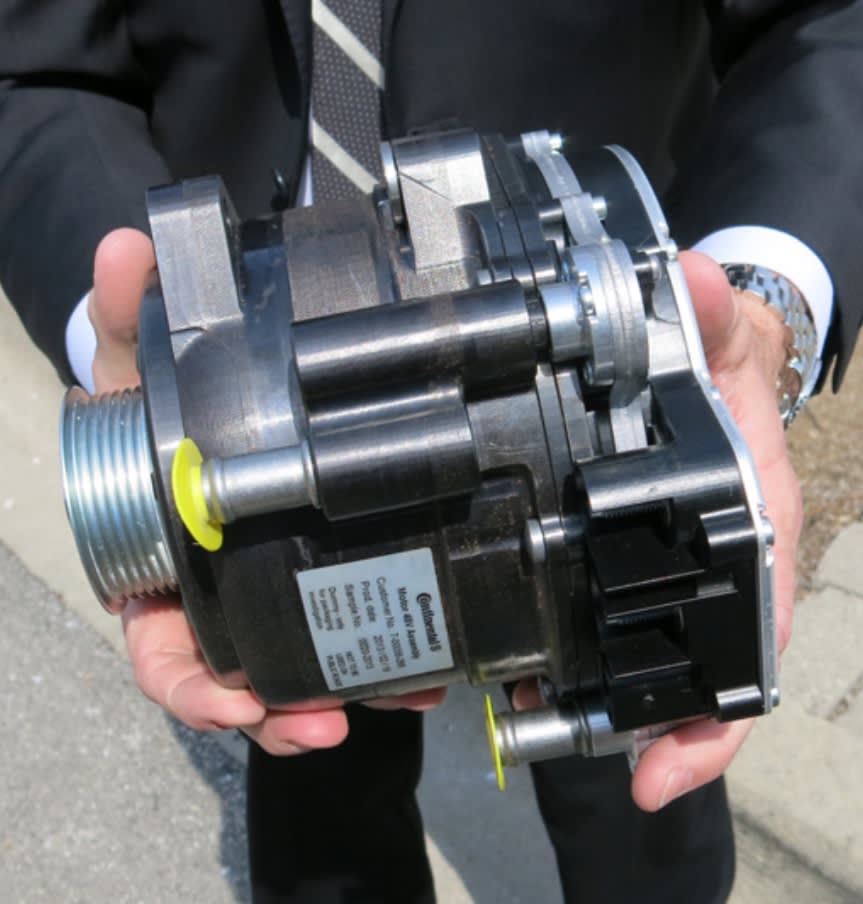
The OEMs “are talking dollars per gram of CO2 reduction,” observed Juergen Wiesenberger, Director of Hybrid Electric Vehicle Engineering at Continental North America. He told Automotive Engineering that his company’s new 48-V system, a P1-type belt-driven starter/generator module (BSG), will enter production at two OEMs in the 2016 time frame.
48-V mild hybrids enable powertrain engineers to vary load and push the engine into more optimum brake-specific fuel consumption (BSFC) points, at a cost that is approximately 25% of a high-voltage “full” hybrid, experts note. Continental’s compact system will provide a 10-13% reduction in CO2 emissions on the NEDC cycle, and 7-10% on the new WLTC cycle, Wiesenberger said. It features a liquid-cooled induction machine rated at 5 kW permanent/13 kW peak, designed and built in house, with an integrated DC-DC inverter (to eliminate connector cables) and a lithium-ion battery that’s almost as small as a typical 12-V unit.

The BSG unit weighs 12 kg (26.4 lb) and is engaged and decoupled with Schaeffler clutches. Conti engineers are aiming for capability that will enable the vehicle to creep along in dense, slow traffic on electric drive alone. Wiesenberger said the next generation of 48-V systems will include ISGs — integrated starter-generator — where the electric machine is fitted within the driveline.
Beyond that, the industry sees big potential in “predictive” engine energy management systems that incorporate vehicle GPS and traffic-congestion data to optimize the electrical energy available via the BSG and regen braking, according to real-time driving conditions. One such system in development is Continental’s so-called eHorizons suite of sensors and processors.
The eHorizon concept continuously transmits the data “packets” of key information to the powertrain and chassis controllers via the vehicle’s CAN bus. An eHorizon control unit integrated in the vehicle precisely calculates vehicle position using the GPS, wheel speed, and gyroscope data. The map data is then continuously transmitted in a standardized format to the various subsystem control devices through the CAN bus. The individual control units then recreate the virtual road image using a data-reconstructing program.
With this digital-map preview of a 3-to-4 mi (4.8 to 6.4 km) operating range, the engine and transmission control units and energy-storage systems (hybrid battery packs) can optimize their respective functions. For example, when approaching a long grade the vehicle will “know” then it needs to prepare to discharge the battery for more acceleration. As the vehicle begins a long downhill descent the system will anticipate receiving recuperated energy.
The 48-V working voltage delivers an optimum balance of electric current, voltage level and potential CO2 reduction, without the shock protection (and related cost) required of systems rated above 60-v, noted Dr. Mazen Hammoud, Ford’s Chief Engineer for Electrified Powertrain Systems.
He told the SAE Hybrid and EV Symposium audience that despite an almost complete lack of electric-only drive capability, 48-V systems such as those under development at Ford can capture up to about 60% of available brake energy. The systems also help provide strong stop-start capability — more than 3% increased engine-off time versus a 12-V stop-start in real-world driving conditions, he said, with engagement within 450-500 ms.
“In terms of dollars-per-percent-of-efficiency improvement, the mild HEV is as good as a full hybrid in certain driving cycles, such as urban and parcel delivery,” Dr. Hammoud, an SAE Fellow, explained.
Electric drive axles, torque-vectoring AWD systems, and fast-response e-turbos are being investigated by industry engineers as 48-V systems reach the production stage. On an e-turbo-equipped Ford Focus mule, development engineers “have seen a 40-50-g reduction in CO2 with no reduction in performance,” he reported.
Gen-2 E-REV details
At the SAE Hybrid and EV Symposium, veteran GM engineers Tim Grewe, Pete Savagian, and Steve Tarnowski, along with young gun Sinisa Jurkovic, dove deep into details of the 2016 Chevrolet Volt’s second-generation propulsion system. Based on new technical papers presented at the 2015 SAE World Congress, the Volt presentations were one of the star audience attractions, as some engineers revealed to Automotive Engineering. The presentations showed how General Motors used the rich customer data gained from 70,000 first-gen Volt owners to further improve the efficiency and reduce cost of the unique extended-range electric (E-REV) drive system.
Tarnowski, Senior Manager, Electrification New Products, noted that the Gen-2 system’s greater efficiency, coupled with vehicle-efficiency improvements and a regular pattern of daytime charging established by Gen-1 Volt drivers, are projected to increase the total miles of all-electric driving from 74% on the first-gen car to 80% on the 2016 model. Initial engine starts are expected to be reduced by 77%, a 7% improvement over the previous car.
The greater percentage of all-electric “e-trips” — those without an engine start — are projected to contribute to a significant reduction in the percentage of smog-forming emissions that occur within the first minute of engine operation, said Tarnowski. He noted that E-REVs are capable of producing “significantly less real-world smog-forming emissions” compared with equivalent PHEVs or conventional powertrains, while adding that reduced cold-start emissions on E-REVs and PHEVs are not yet accounted for in the U.S. EPA’s “smog-score” rating that’s printed on new-vehicle window stickers.
Tarnowski advocates an “ESA (engine-start avoidance)” utility factor as an industry standard metric for hybrid types. He said an updated smog-score system would use a “smog multiplier” that weights cold-start and running emissions, respectively.
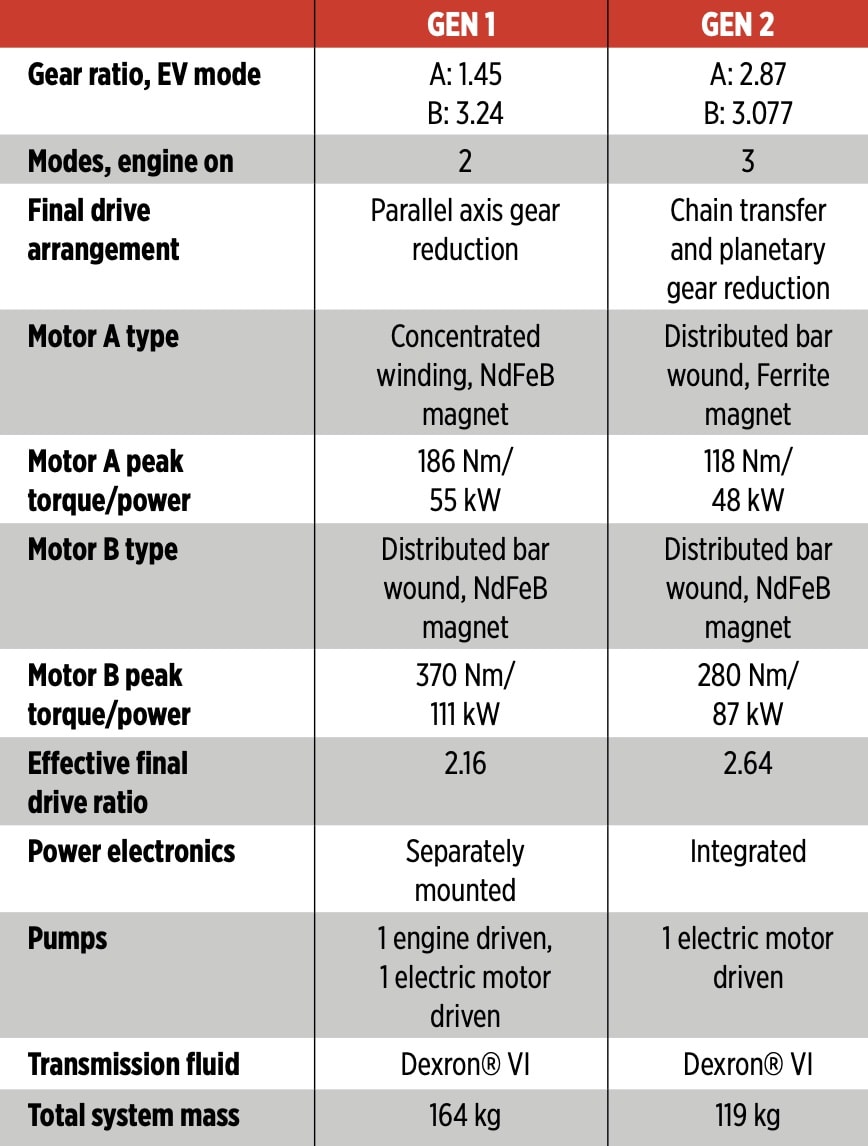
Savagian, GM’s Electric Drive Engineering Director, Grewe, the General Electrification Engineering Director, and Jurkovic, Electric Power Conversion Controls Engineering Manager, detailed the heart of the Gen-2 Volt: its new 5ET50 Voltec propulsion unit and inverter module. One of the top “wants” of the previous car’s owners was increased EV-only driving range beyond the 35-mi (56-km) average of the Gen-1 car. This data drove development of more battery energy-storage (18.4 kW·h capacity vs. 16.5 kW·h).
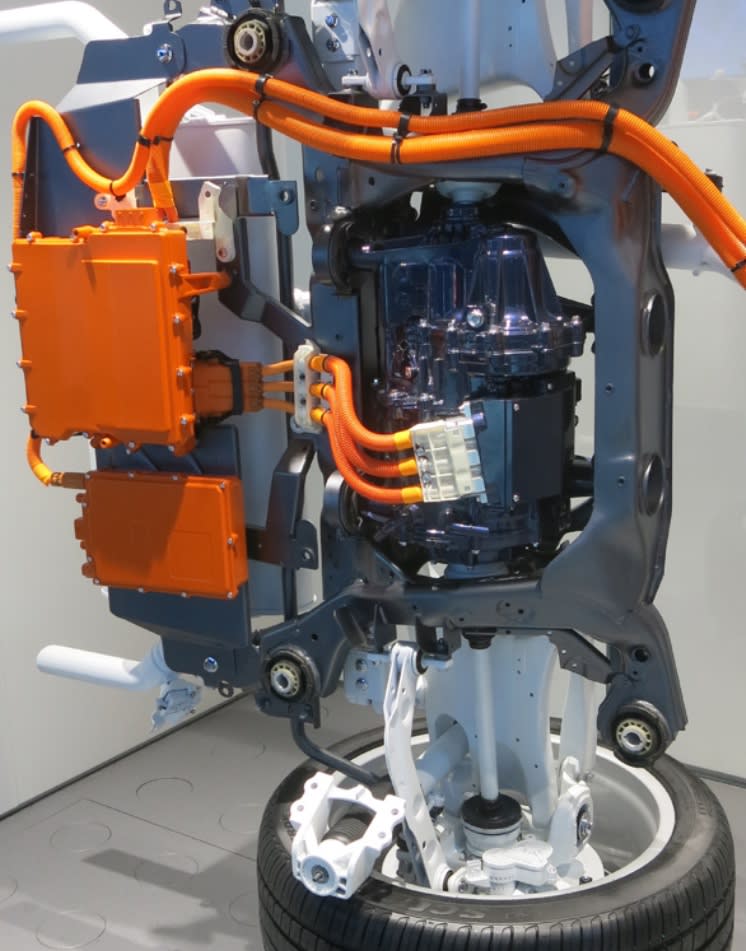
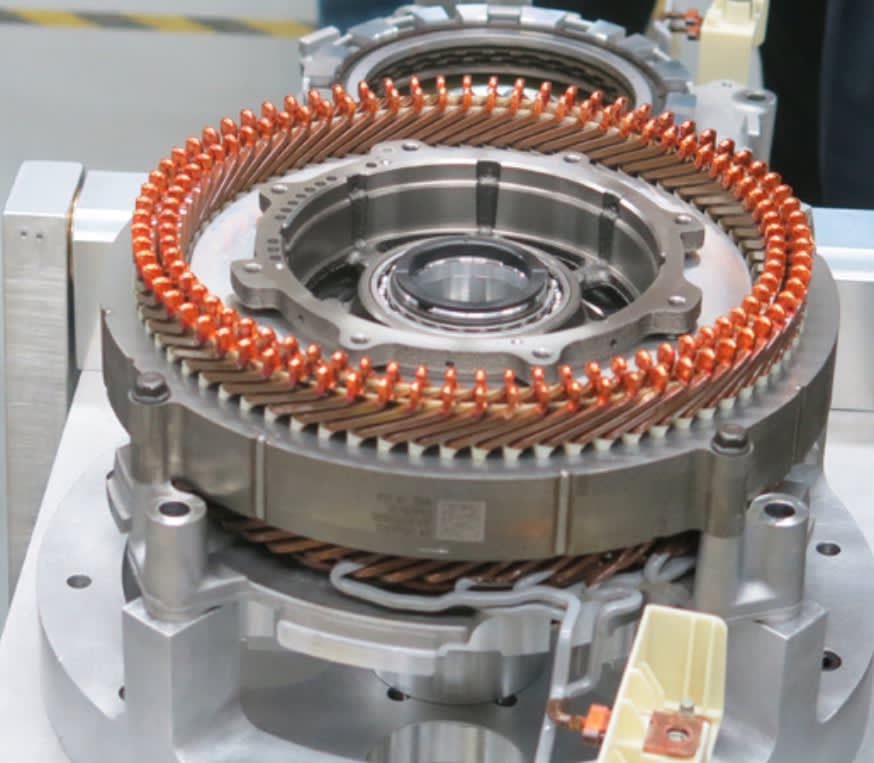
Developing the all-new twin-motor Voltec drive system, engineers achieved a 60% volume reduction in the power electronics and inverter (10.4 L vs. 13.1 L) compared with the previous 4ET50 unit, along with a 5-12% efficiency gain overall and a 2% increase in motor efficiency when the electric machines are operating as generators. Jurkovic noted that total mass of rare-earth materials was reduced by 60%; the rare-earth-free Motor A uses a GM proprietary ferrite multi-barrier magnet technology. The decision “was made way back in the program when neodymium prices were skyrocketing,” he said.
A key enabler of the more efficient and compact TPIM is its “Viper” automotive-grade IGBT package developed by Delphi. The electronics use double-sided cooling within a structurally robust, friction-stir-welded (FSW) clamshell housing. “The double-sided design gives two times the amount of current per die,” Savagian told the SAE audience. The FSW construction adapted by Delphi replaces glue-and-screw processes with a 45% smaller footprint, fast-change tooling, 3-D force monitoring, 50% shorter process time, and 40% power savings, he said.
Savagian added that the more rigid housing was required because the new Volt’s ICE uses direct fuel injection which brings electronics-killing high-frequency vibrations up to six times more intense than the previous non-DI engine.
All of these developments highlight the intensity of hybrid-electric vehicle engineering activity that’s essential to meeting regulatory and customer requirements, while also driving down cost.
More From SAE Media Group
Battery & Electrification Technology
Ultracapacitor Solutions to Address Energy-Storage Needs of Vehicles
Automotive Engineering
ICE and Hybrid-Electric Propulsion Show Staying Power
Automotive Engineering
Extending the ICE Age: Ford’s Dave Filipe Has Some Powerful Choices to Make
Off-Highway Engineering
Thor Lets Campers Go Further Off Grid With Electric Embark RV
Off-Highway Engineering
FEV Simplifies Off-Highway Electrification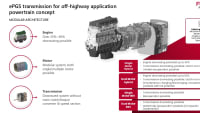
Automotive Engineering
Toyota, Mazda, Subaru Agree Carbon Is ‘Enemy' with Internal Combustion Engine Announcement
Automotive Engineering
Transforming Propulsion with Tula’s Digital-Control Magic
Automotive Engineering
LEAF Turns to the 2020s
Automotive Engineering
Welcome to the Automotive Engineering Podcast
Off-Highway Engineering
ZM Trucks Starts Production in Fontana, California
Off-Highway Engineering
CONEXPO 2023 Image Gallery
Automotive Engineering
Electrifying ‘The Ultimate Driving Machine’

Automotive Engineering
Prodrive Helps Fast-Track Ford’s New PHEV Van Program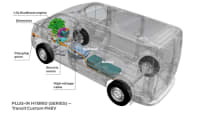
Off-Highway Engineering
Quantron Launches 12-M Battery-Electric Bus; Fuel-Cell Variant to Follow
Off-Highway Engineering
eCitaro to Replace Conventional City Buses
Automotive Engineering
VW’s New E-Golf May Lead the Way to Lithium-Air Power
Off-Highway Engineering
Hyundai CE Debuts Hydrogen and Electric Excavators at Bauma 2022
Automotive Engineering
Stellantis Goes All-In on EVs
Automotive Engineering
Toyota Stretches SUV Line-Up with World Debut of Grand Highlander

Off-Highway Engineering
Nikola Producing Battery-Electric Trucks, Fuel-Cell EVs Coming
Off-Highway Engineering
Hydrogen Shows Increased Commercial Interest
NASA Spinoff
Bringing Hybrid Power to the Rescue
Automotive Engineering
2019 Vehicle Technology Review
Off-Highway Engineering
Hybrids Are Having a Moment
Automotive Engineering
2017 Hyundai Ioniq Offers Three Electrified Powertrains
Battery & Electrification Technology
Can Solid-State Batteries Commercialize by 2030?
Top Stories
NewsSensors/Data Acquisition
 Microvision Aquires Luminar, Plans Relationship Restoration, Multi-industry Push
INSIDERRF & Microwave Electronics
 A Next Generation Helmet System for Navy Pilots
INSIDERWeapons Systems
 New Raytheon and Lockheed Martin Agreements Expand Missile Defense Production
NewsAutomotive
 Ford Announces 48-Volt Architecture for Future Electric Truck
INSIDERAerospace
 Active Strake System Cuts Cruise Drag, Boosts Flight Efficiency
ArticlesTransportation

Webcasts
Aerospace
 Cooling a New Generation of Aerospace and Defense Embedded...
Energy
 Battery Abuse Testing: Pushing to Failure
Power
 A FREE Two-Day Event Dedicated to Connected Mobility
Automotive
 Quiet, Please: NVH Improvement Opportunities in the Early Design Cycle
Electronics & Computers
 Advantages of Smart Power Distribution Unit Design for Automotive &...
Unmanned Systems
 Sesame Solar's Nanogrid Tech Promises Major Gains in Drone Endurance