




AI Influence on ICE Design
Experts offer their outlook on the future of heavy-duty internal combustion engines, and of course artificial intelligence will play a role.

Internal combustion engines will continue to be the prime power for key sectors of the global economy. Future engine designs will be heavily influenced by artificial intelligence (AI) and the ecosystem of engine operation. New combustion strategies will deliver more efficiency and lower emissions, while hybrid technology and renewable fuels will be a substantial influence. These are among the key conclusions made by Allen Schaeffer, executive director of the Engine Technology Forum, during the “Engine Design for the Next 20 Years” webinar hosted by Truck & Off-Highway Engineering.
Schaeffer was joined on the expert panel by Venu Gupta, who leads engine product strategy and power solutions planning at John Deere, and Mihai Dorobantu, Ph.D., director of technology, planning and government affairs for Eaton’s Mobility Group. The webinar is now available on-demand here .
“Over the next 20 years, advanced engine technology must continue to evolve as it is expected to remain the prime mover for key sectors of the economy,” Schaeffer said. “It will be largely influenced by artificial intelligence both in the design of the engine and in managing the task and operations of the engine within the ecosystem that it operates, which will likely include autonomous operations. We see this in some forms today, particularly in the construction sector with connected jobsites and machines feeding vast amounts of data to enable real-time decision-making and optimization.”
Continuous improvement of diesel
The diesel engine is trending towards 50% plus brake thermal efficiency. Engine design will continue to build on past progress in virtually eliminating emissions, Schaeffer said, and making steady gains in engine efficiency. “We can expect continued incremental improvements in efficiency through both existing and new technologies.”

Engine downsizing and improving power density are two trends that are picking up steam. Continuous development to increase power density pushes the BMEP of these engines from the low to mid-twenties, Deere’s Gupta said. “So that basically puts an emphasis on the overall structural requirement for the engine, ranging from the peak cylinder pressure, cylinder heads, crankshafts and so on.”
“The trend is towards a more powerful machine, but the machine or the vehicle cannot get bigger,” Gupta said. “This is driving activity in terms of how we downsize the diesel-engine footprint so we can offer higher power density and then also offer a down-speeding opportunity to increase the efficiency of the engine at the same time.”
Systems integration is a significant technology lever, according to Eaton’s Dorobantu. “That is facilitated by advanced controls and software,” he said. “It typically results with doing more functions with less physical components rather than just piling on more and more hardware. This deep integration of functions is an important consideration for the future of the diesel engine.”
The experts also expect the use of technologies like cylinder deactivation, start/stop technology and variable valve timing to become more standard. For example, Volvo Trucks recently introduced a new generation of its I-Roll technology, adding engine stop/start technology to cut fuel consumption and CO2 emissions. A claimed world first in the heavy-duty truck industry, the new feature is now offered on the Volvo FH and FH Aero with the 13-liter diesel engine.
Developed in-house, Volvo’s new stop/start engine feature is enabled by constantly monitoring road data and road curvature information. The engine will be turned off temporarily when an oncoming downward slope is identified along the route. Activated at speeds above 60 km/h (37 mph), I-Roll with engine stop/start will reportedly be able to cut up to one percent of fuel and CO2 emissions, depending on enabling conditions such as topography and ambient temperature.
Future designs will reflect greater optimization of the engine to fit the task, “aided by energy storage and electric motor assist to cover infrequent peak power requirements,” Schaeffer said. “We are also already seeing expanding use of new combustion strategies where gasoline engine designs mimic diesel engines as a means to achieve diesel-like efficiency but with fewer emissions.”
“Future heavy-duty engine design will also continue to incorporate circular-economy principles enabling their remanufacturing and associated savings in energy and raw materials,” Schaeffer said, noting that new design software tools will greatly facilitate this feature. “So as you design a new engine, you’re already thinking about the life of that engine down the road, maybe in 500,000 miles, a million miles.”
Fuels diversification
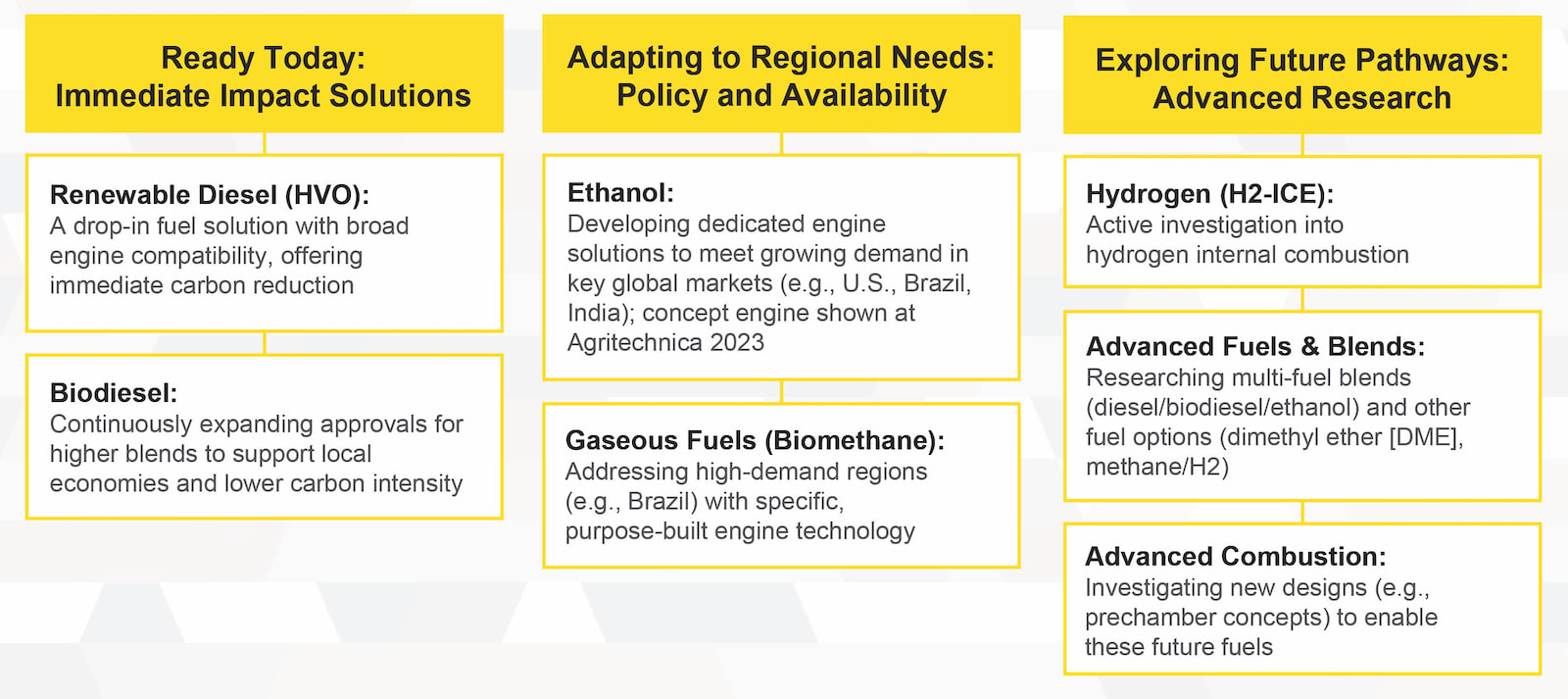
Fuel will play a key part in influencing future engine design, the expert panelists agreed, with more blends of renewable fuels and other fuels like hydrogen becoming available.
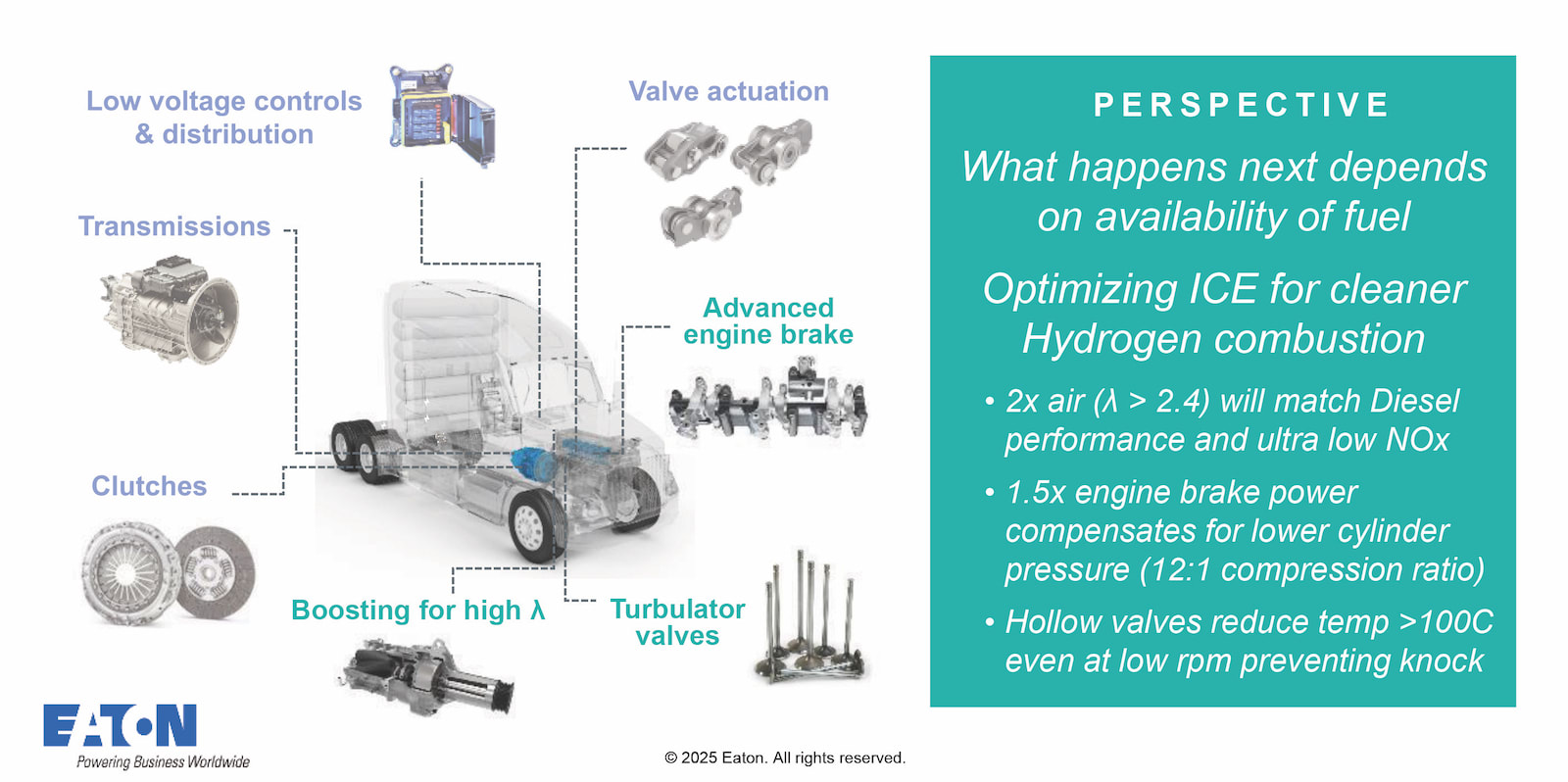
“It’s true that hydrogen costs today are very far away from diesel parity, measured in useful energy at the wheels to perform the job,” Dorobantu said. “The availability of hydrogen is also by no means a done deal. It is also true that ten years ago, hydrogen was synonymous with fuel cells. But in the last five years or so, hydrogen combustion has become a reality from a technology perspective.”
Hydrogen as a fuel is carbon-free, which makes it an attractive sustainable option, but it comes with challenges in terms of performance and NOx. “It is fundamentally limited by the low compression ratio,” Dorobantu said. “We need very high-pressure hydrogen to have high-pressure combustion. The internal combustion engine applications are low pressure right now, they’re spark ignited, similar to natural gas type of technologies.”
Engineers are converging on ways to address these limitations. “Recent solutions include highly boosted solutions. These allow these engines to reach 18 to 20-plus [bar] BMEP in operations and the rapid response that we expect of powertrains,” Dorobantu said. “But more importantly, in the presence of high lambda, we can guarantee low NOx combustion, even to the point where EGR becomes unnecessary, and perhaps a three-way catalyst or a very simple SCR-based aftertreatment system are viable ultralow NOx solutions. So the extra boosting is just an example of how systems-level integration helps fight the growing cost of added technology.”
Another example is low-temperature valves, which help to mitigate hydrogen combustion pre-ignition issues. “This is a technology that we’re transferring from gasoline engines,” Dorobantu said. “But the technical nugget is how to move the coolant inside the valves at a low engine speed, like 1000 rpm, rather than the gasoline at high speed.”
There are alternative and renewable fuels that can be used today with existing designs. For example, John Deere’s engines are currently approved for 100% renewable diesel. Its current lineup is also approved for 100% biodiesel usage for lower-tier engines with no aftertreatment systems.
“We’re continuously advancing this journey,” Gupta said. “Just until recently, our Tier 4 systems were approved for a 20% biodiesel blend. We have now announced that our engines are capable of using a 30% biodiesel blend.”
Diversity also exists regarding fuel availability based on a specific region. Ethanol, for example, is a relevant fuel in the U.S., Brazil, and is “strongly emerging” in India, Gupta said. In response to these demands, John Deere displayed one of its first ethanol concept engines at the 2023 Agritechnica trade show in Hanover, Germany. “We are now working to bring those engines into vehicle solutions,” he said.
John Deere continues to evaluate new pathways. “We are investigating as an industry collaboration on how best we can blend diesel, biodiesel and ethanol to trade off some of the fuel properties that each of these offer and understand how viable a solution like that is in meeting customer needs,” Gupta said.
Best of both worlds
The internal combustion engine is not immune to the developments in the electrification industry, Gupta said, noting that the “benefits of both worlds can be combined to offer the highest efficiency and best solution possible to the customer.”
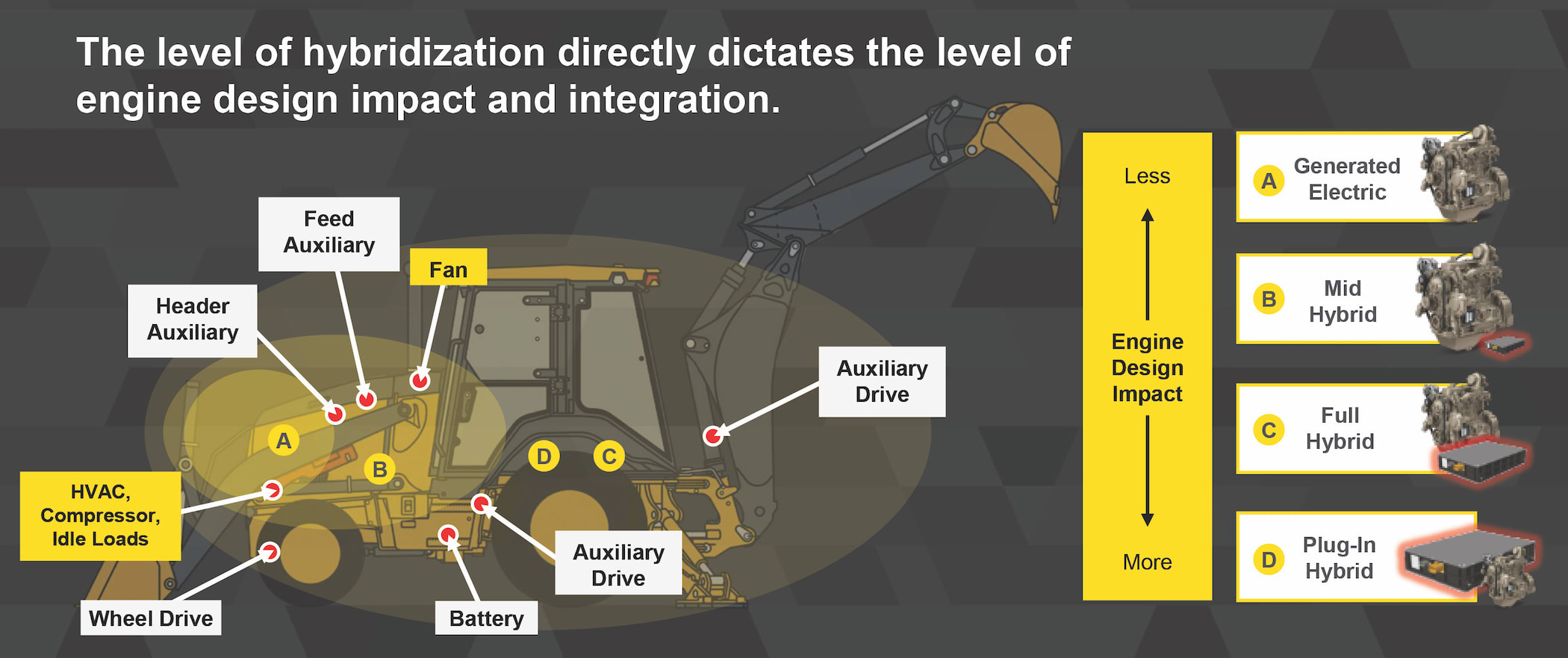
Hybridization can range anywhere from a “relatively simple” motor generator or an e-flywheel addition to the diesel engine, Gupta said, to having a larger battery that powers all the auxiliaries and the vehicle movement.
“To mount a motor generator or an e-flywheel, it is basically optimizing the engine design to use one of the auxiliary PTOs,” he explained. “On the other hand, when you have a battery being the primary power supply for the vehicle, the internal combustion engine will have to be right-sized so it can assist the battery and overall vehicle productivity needs. So, instead of being a bolt-on as an afterthought, these design aspects are being integrated into the next generation of diesel engines that you’re seeing in the marketplace and from Deere.”
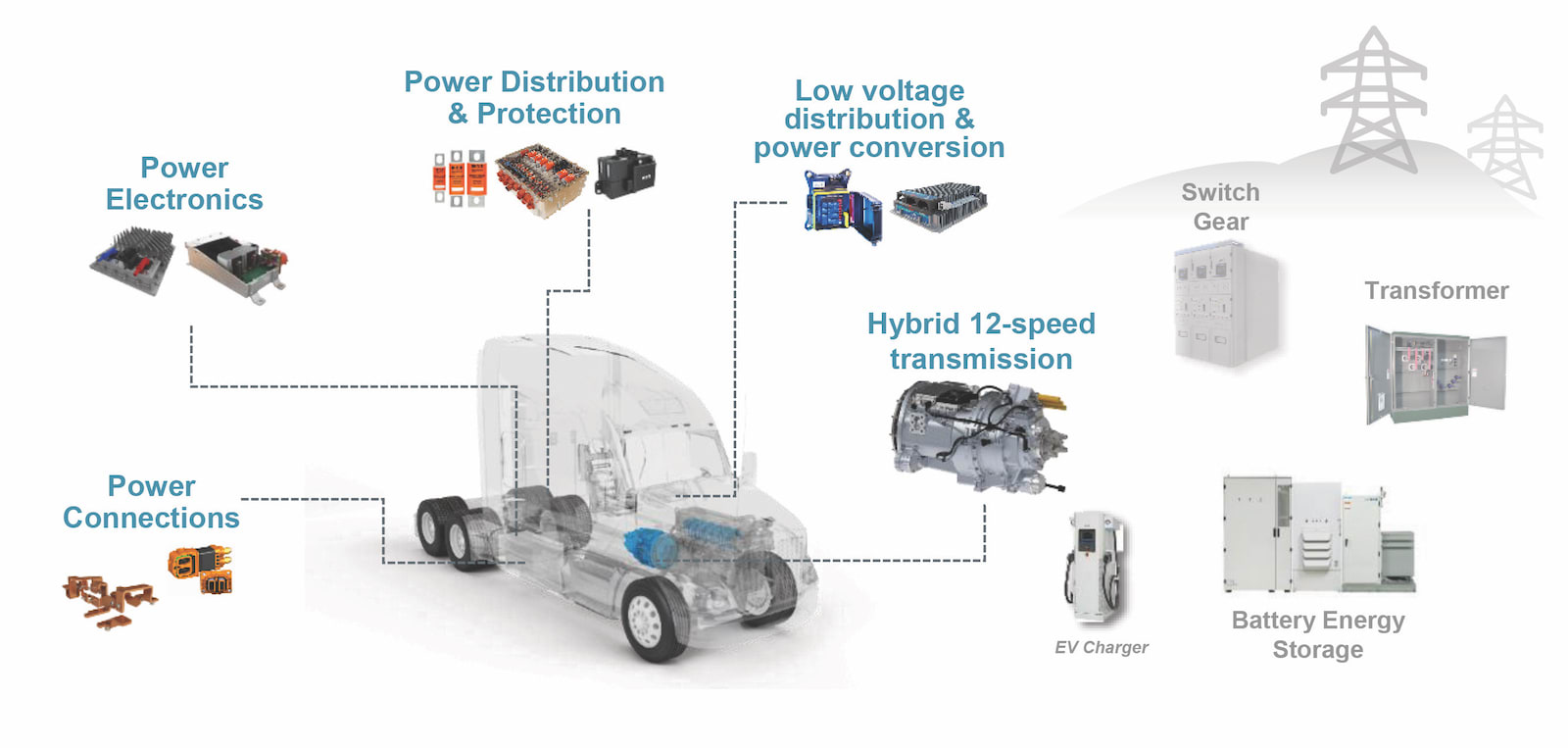
Cost, of course, is still an issue with hybrid technology, Eaton’s Dorobantu said, but hybridization offers advantages, such as zero-emissions driving at a fraction of the battery cost of a fully electric vehicle. Another advantage, he said, is that it “transforms the internal combustion engine into an electric generator on wheels.”
“At the end of the day, trucks of tomorrow can be thought of as electrical generators that can easily export 100 to 200 kilowatts of electrical power,” Dorobantu said, noting that the military has begun employing this functionality for mobile forces. “They see two advantages: no need to haul, install and pack up electrical generators in the field and to provide an easily accessible source of high voltage for the devices that they use. I think that really has an application in commercial vehicles as well.”
He said the simplest example would be ePTOs that make use of the batteries and onboard generation to be more efficient than using hydraulics or the limited power of mechanical devices. “Adding electrical power conversion to the truck and interfacing it with the grid provides export capability, added functions, like providing grid services, powering work sites or charging other electric vehicles,” Dorobantu said.
The digital powertrain
Connectivity is another critical aspect for the engine to remain a viable, competitive “digital powertrain” solution into the future, according to Deere’s Gupta.
“The engine controller has to adapt to be able to satisfy the vehicle needs,” he said. “So, to enable connectivity, enable autonomy, now the ECU has to communicate with the vehicle at a much faster rate and transform a much bigger data pack. To enable these functionalities, the ECUs will have to start looking at other communication protocols to increase that bandwidth like CAN-FD, Ethernet and then features like over-the-air software to reduce the downtime and improve the serviceability of these machines.”
Machine learning and embedded AI (on-board/off-board) will be key for predictive failure analysis. “How we incorporate that into the overall engine controller design becomes very critical in enabling the efficiency and serviceability of these engines with advanced diagnostics and prognostics,” Gupta said.
Control strategies need to evolve to be adaptive as well. Intelligent engine controls will optimize power flow for complex hybrid systems and manage new alternative-fuel combustion profiles. “As the market evolves, whether it is into specific regional relevance or into a specific vehicle need, the control systems have to adapt so that they can help reduce the overall development time,” Gupta said.
As connectivity increases, so do cybersecurity concerns. “As these machines become more and more connected and smarter, we have to protect our customers’ data,” Gupta said. “We have to protect our customers’ operations and offer cybersecurity systems through these engine designs or the engine controller designs. These control systems will continue to evolve to offer these critical cybersecurity features.”
Regulatory considerations
Regulations are an area where there’s a significant growth opportunity, Schaeffer said.
“While engine designs have evolved substantially, the policies that govern them, such as emissions standards, have not,” he said. “New paradigms must be considered; perhaps ones that focus on environmental performance of tasks and work-related activity rather than a continued singular focus on individual engine performance. Regulatory approaches should be updated to reward integration of engine-based strategies like hybrids in off-road machines that are only captured today in the on-road vehicle certification process.”
Regulations also unlock investments in infrastructure, and uncertainty can paralyze companies’ appetite to invest, Dorobantu said. “Product has to be launched in 2027. Big regulatory change, and it’s not clear what those regulations are going to look like in the U.S.,” he said. “The longer-term effect, a lack of clear, technology-driving regulations is putting a damper on some of the investments because it’s just adding uncertainty to where the market is going.”
Standards and regulations can help the industry navigate the diverse fuels landscape, Dorobantu added. “It’s great that the industry has more choices, but that comes again with added costs and more infrastructure constraints. This is where standards and regulations could be really helpful. Even though none of us want some external entity to pick the winners and the losers in terms of technologies, because we’ve seen that gone bad, the lack of standards is now becoming a barrier. We do need to make some choices, and those choices then can help drive the new technologies.”
More From SAE Media Group
Off-Highway Engineering
JCB Debuts Clean-Sheet Hydrogen Combustion Engine
Off-Highway Engineering
Solving Problems and Seeking Big Ideas for Commercial Vehicles
Off-Highway Engineering
Combustion Engines Carry on in Construction
Off-Highway Engineering
Developing an Alternative Engine Concept
Off-Highway Engineering
FEV Simplifies Off-Highway Electrification
Off-Highway Engineering
Hybrid Powertrains in the Product Mix
Off-Highway Engineering
Many ICE Paths Lead to Reduced Emissions
Tech Briefs
Making Diesel Engines Nearly Emission-Free
Off-Highway Engineering
Volvo CE Not Letting up on Electric
Off-Highway Engineering
Cummins Aims to Boost Heavy-Duty Diesel Efficiency to 55%
Off-Highway Engineering
SwRI Rolls out Hydrogen Demonstration Truck
Off-Highway Engineering
Deutz Equips Telehandlers with Hybrid and Fully Electric Powertrains
Off-Highway Engineering
Electrification and the Other “E” – E-Fuels
Automotive Engineering
Advancing the OP Engine on Three Fronts
Automotive Engineering
Off-Highway Hybrids Are Entering Prime Time
Automotive Engineering
VW’s New E-Golf May Lead the Way to Lithium-Air Power
Off-Highway Engineering
Caterpillar Unveils New C13D Off-Highway Engine Platform
Automotive Engineering
Time for Hydrogen
Off-Highway Engineering
FPT Tech Day Reveals Cursor X Concept, Other 4.0 Innovations
Automotive Engineering
Mazda Plots Wankel-powered Range Extenders, HCCI Mild Hybrids
Off-Highway Engineering
Hitting the Gas on Hydrogen Tech for Commercial Trucks

Off-Highway Engineering
Developing Next-Gen Diesels to Last Decades
Automotive Engineering
Keeping Combustion in the Conversation
Off-Highway Engineering
Mahle and Partners Develop Super-Efficient Engine for Stationary Power
Off-Highway Engineering
All Options on the Table
Automotive Engineering
Mahle’s Pre-Chamber MJI Technology Is Sparking Ignition Advances
Automotive Engineering
New Aramco Research Center in Detroit to Advance Fuels and Engine Development

Off-Highway Engineering
Mahle, Liebherr Develop Active Pre-Chamber for Hydrogen ICE
Top Stories
INSIDERDesign
 How Airbus is Using w-DED to 3D Print Larger Titanium Airplane Parts
NewsAutomotive
 Microvision Aquires Luminar, Plans Relationship Restoration, Multi-industry Push
INSIDERRF & Microwave Electronics
 A Next Generation Helmet System for Navy Pilots
ArticlesDesign
 CES 2026: Bosch is Ready to Bring AI to Your (Likely ICE-powered) Vehicle
Road ReadyAutomotive
 2026 Nissan Sentra Review: Putting the Pieces Together
NewsUnmanned Systems

Webcasts
Power
 Hydrogen Engines Are Heating Up for Heavy Duty
Electronics & Computers
 Advantages of Smart Power Distribution Unit Design for Automotive...
Transportation
 Quiet, Please: NVH Improvement Opportunities in the Early Design...
Energy
 Battery Abuse Testing: Pushing to Failure
Connectivity
 A FREE Two-Day Event Dedicated to Connected Mobility
Aerospace
 SiPhog Technology: Enabling GPS‑Independent Flight for Uncrewed Aerial...