




Developing Next-Gen Diesels to Last Decades
John Deere’s newest combustion engines are designed to accommodate alternative fuels and evolving technologies as requirements demand.
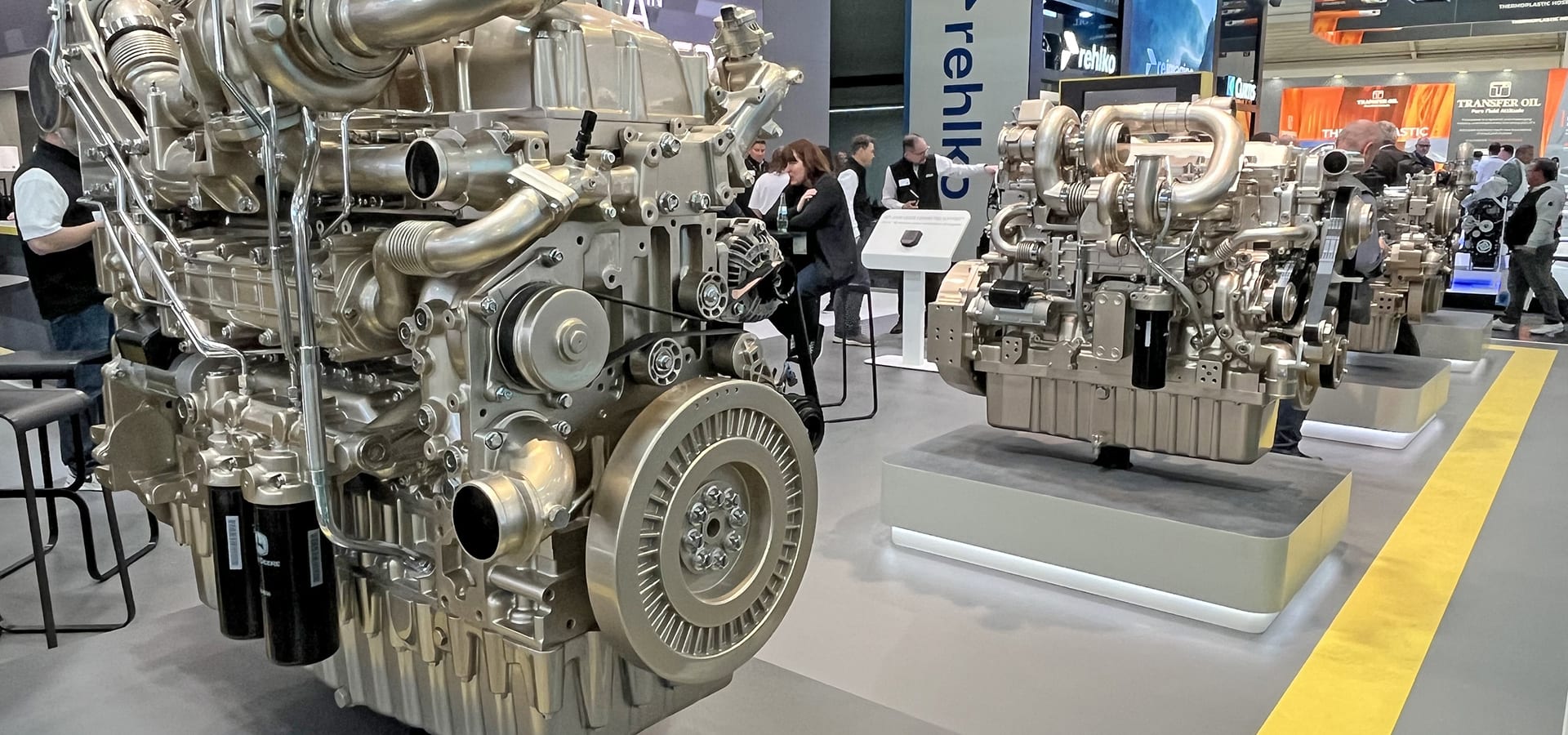
Approaching the John Deere Power Systems (JDPS) exhibit at the Bauma 2025 tradeshow in Munich, Germany, a lineup of next-generation internal combustion engines served as sentinels of sorts, greeting any visitors before they could view the other technologies on display, including new, more compact Kreisel Electric high-voltage batteries.
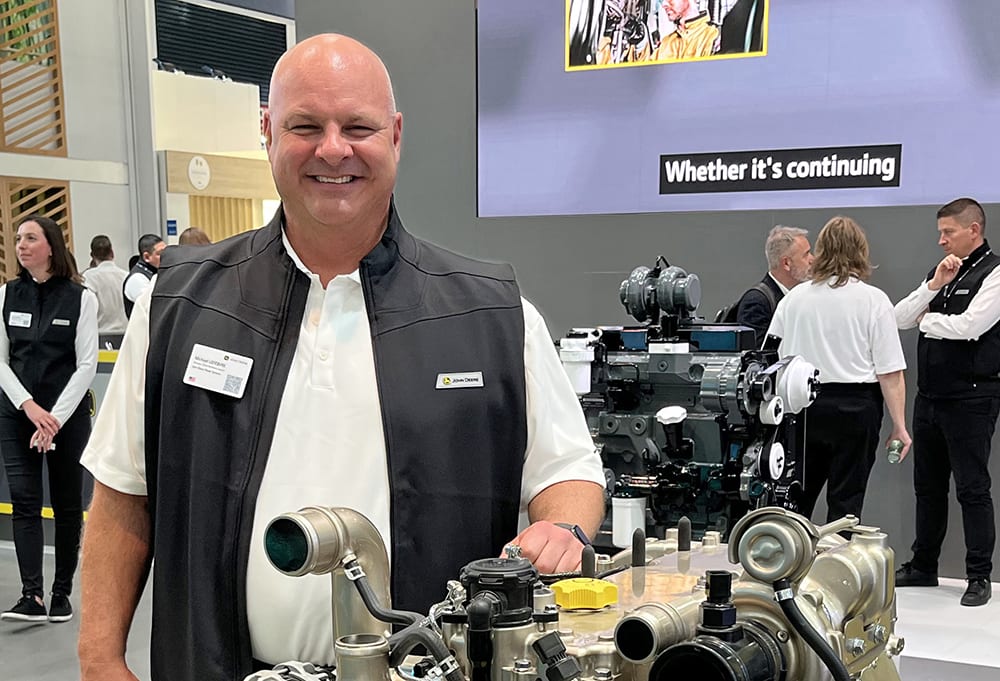
This prominent location underscores the prominence that diesel and alternative-fueled combustion engines will maintain in the off-highway vehicle sector for years to come.
“Our perspective around diesel engine development, especially in very high-power-need vehicles, it’s going to be around for quite some time,” Michael Lefebvre, manager of global marketing and product strategy at JDPS, told SAE Media in Munich. “We’re investing heavily in engines on this entire power range.”
That lineup on display at Bauma included already-available clean-sheet engines, the JD14 and JD18, which extended Deere’s power range beyond what it previously offered, and an “evolution” engine in the JD9, which features new aftertreatment packaging developments and calibration efficiency improvements.
The manufacturer’s newest engine, the JD4, was also present. Also a clean-sheet design, the engine is expected to be available in about a year and a half, Lefebvre said at Bauma in April.
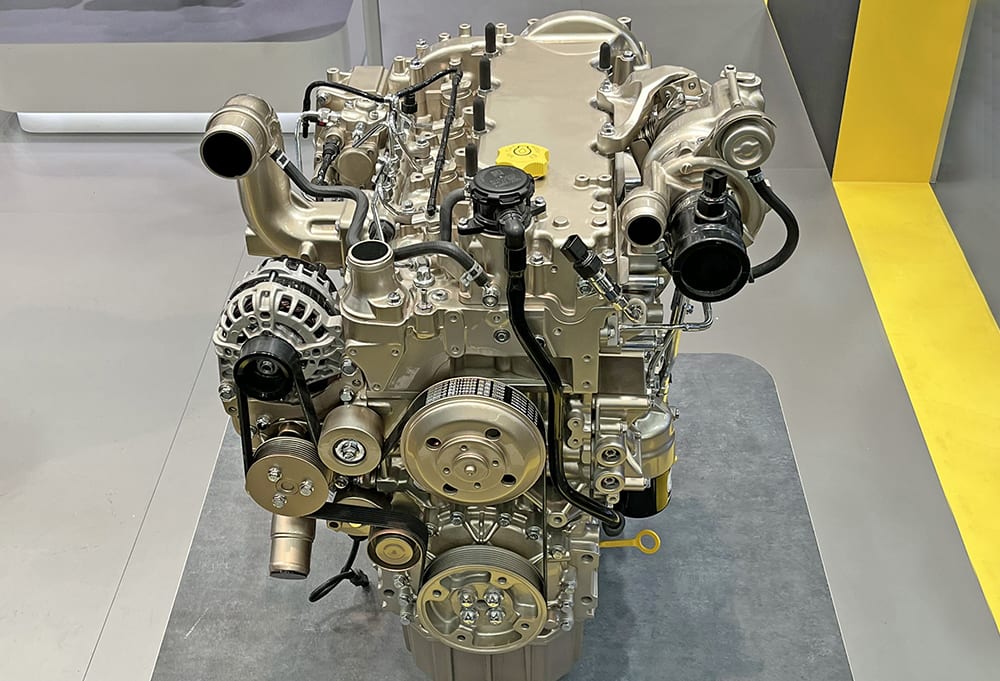
“It’s much more compact, much more fuel efficient, much more volume efficient in all of our partner vehicles and in all the applications we sell in the OEM market as well,” he said. “We’ve had a pretty consistent architectural approach that’s scalable. So, you can see we’ve spent some significant money in the diesel engine area. We do see a need for these for at least the next decade or two.”
Future-proof engine design
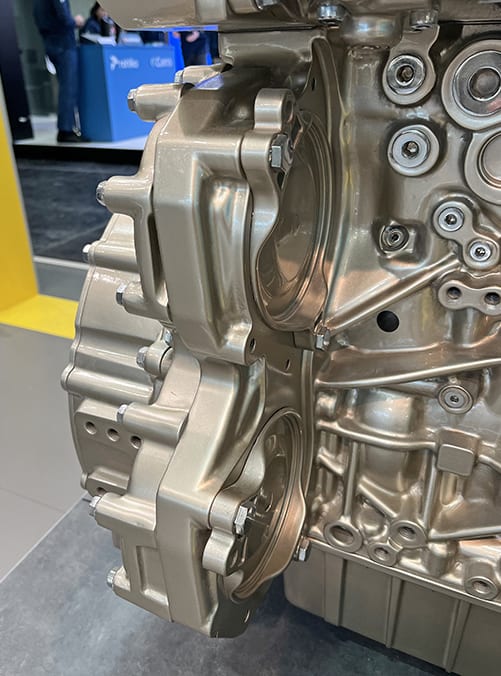
The JD4 engine program “began in earnest” in late 2022, Lefebvre said. As of the Bauma tradeshow in April, Deere was in the process of building durability engines and putting them in dozens of test vehicles.
“We do extensive durability testing in our own vehicles and with some customers before they go out the factory to the general public,” he said. “We try very hard to find what we call the ‘corner conditions,’ the lowest temperatures, the highest vibrations, and make sure that we’re teasing out the things that need to be dealt with.”
The JD4 is an overhead cam engine with a much higher-pressure fuel system, replacing a cam-in-block engine that’s been in service for 20-30 years. To ensure a next-generation engine stays relevant for the coming decades, the development team must consider a design that can accommodate technologies that may be needed to meet future emissions and fuel efficiency requirements. “A lot of packaging elements we need to plan ahead for, even if they’re not built into the engine currently,” Lefebvre said.
All the next-generation engines that JDPS develops are intended to run, with modifications, on spark-ignited fuels, he added. “When we talk about renewable fuels, we’ll talk about gaseous fuels, we’ll talk about compression ignition. We talk about hybrid. And it’s region by region.”
Hydrogen combustion is a focus area, particularly in Europe. “Of course, my team’s closely watching the market dynamics and when it will make sense from an infrastructure perspective,” Lefebvre said. “It’s out there still, but it’s absolutely something we’re monitoring.”
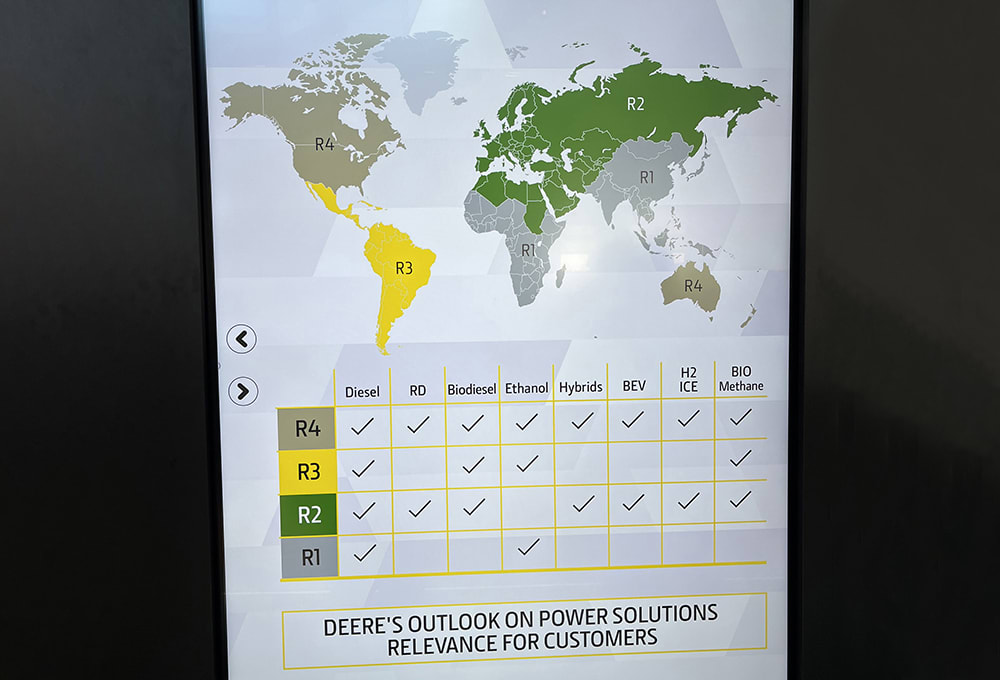
John Deere develops its own power electronics, which helps when engineering hybrid solutions. Developers of the next-generation engines made accommodation for a range of hybrid applications. “It’s mostly on where do we send the power? In the old days, we would just send the power out the flywheel. Now we’ve got a lot of ways power can come to and from the engine,” Lefebvre said.
“In the JD4, we’re replacing an engine that has one aux drive pad with an engine that has three, with a lot more power output,” he continued. “So even if you’re not doing a full-on high-voltage hybrid, you can see mild hybrids with lower voltage where you’ll take the power off the accessory drive to power a cabin cooler or something like that. The intent is to make sure that the engines can accommodate both mild hybridization electrification as well as high-voltage battery hybrid vehicles.”
Another technical detail that results in reduced service needs for the new JD4 are hydraulic lash adjusters. “We’ve not had that on a small engine like this in the past,” Lefebvre said. “The large engines now have them as well, but we used to have to adjust the lash in the valvetrain system. It’s all hydraulic now, so no adjustments required. It’s similar to automotive, but hard to make it last as long as our engines run. This engine now has that system.”
Software and big data
Telematics and connected support are a big part of the Deere value proposition, according to Lefebvre. Over-the-air engine software updates are one of those offerings that help to reduce downtime for customers. But an area that is growing the most, he said, is providing what Deere calls “expert alerts.”
“We’re pretty unique in developing at the base level our own engine software,” Lefebvre said. “It’s a lot of time and effort to do that rather than buying it from an off-the-shelf vendor, but it also gives you sort of these base sensor inputs. And with those, with big data now, we’re able to see if there are parts that need to be, let’s say, prognostically changed, especially with customers that have very high hour-usage.
“When we start to see wear out of parts, we’re able to develop expert alerts that say, ‘Hey, you’ve got 7,000 hours on this part; in the next 1,500 hours we need to schedule the change,’” he continued. “Our customers really appreciate that, because they don’t want that to happen when they don’t plan it; they don’t want any part failure. We continue to add more and more expert alerts based on things we learn in big data in the field from this telematics.”
With an emphasis on software development, the workforce at Deere has shifted over the past couple of decades to bolster its expertise. “If we’d had this conversation 20 years ago, I would’ve said, ‘yeah, it’s really growing.’ If we’d had this conversation 10 years ago, I would say, ‘wow, it has really grown.’ Now, I would say we’re at a critical mass with software development around the company and within power systems,” Lefebvre said. “But it’s a big part of our R&D expenses. We put a lot of time and effort into software development and into ECU manufacturing. We manufacture our own controllers in addition to the software development.”
No shortage of work
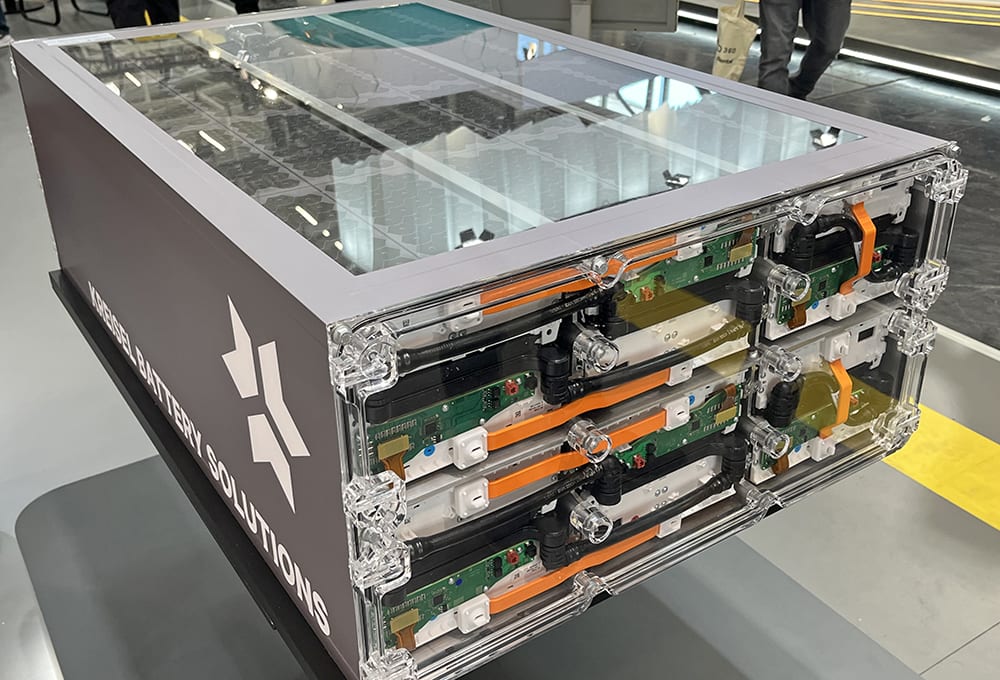
The JDPS exhibit also spotlighted the Kreisel KBE.59.750M battery, a new and more compact version of what the company showed at the last Bauma in 2022, its KBP63 battery.
“The lifecycles of battery development go much faster than engines,” Lefebvre said. “Deere [and Wirtgen] have quite a few battery-electric projects that are being introduced. This is the basis of a lot of those vehicles.”
The battery portfolio also supports Deere’s hybrid-electric developments under way in construction and the agriculture industry. “And we have ongoing conversations with quite a few OEMs,” he said.
Are hybrid-electric machines becoming more popular? “What we’re finding now is just sort of slicing the market application by application — there’s thousands of them. Some of them have very cyclical duty cycles. In those cases, hybrids are great, where there’s this natural regeneration for a battery,” Lefebvre said. “It can make even a large dump truck, for example, use a smaller engine, and you can be much more efficient and constantly be regenerating battery power. The more cyclical an application is, the better it is for hybrid.”
For compact equipment, Deere is focused on utilizing battery-electric systems. “And for standard production class, hard work, full-on duty cycle, it’s big engines – it’s going to be there for a long time, like for a combine or something where you’re really high on the duty cycle and load factor and it never lets up,” Lefebvre said.
“There’s no shortage of work going on,” he added. “It’s like, ‘hey, which one are you going to pick?’ We gotta do ’em all.”
More From SAE Media Group
Off-Highway Engineering
Hydrogen ICE Is Heating Up
Off-Highway Engineering
Combustion Engines Carry on in Construction
Off-Highway Engineering
JCB Debuts Clean-Sheet Hydrogen Combustion Engine
Off-Highway Engineering
Liebherr Goes All in on Hydrogen Fuel
Off-Highway Engineering
Hybrids Are Having a Moment
Off-Highway Engineering
Shell Details Upcoming Engine-Oil Developments
Off-Highway Engineering
Westport Awarded LNG Development Program
Off-Highway Engineering
Hexagon Bullish on CNG for Long-Haul Trucks
Off-Highway Engineering
Hybrid Powertrains in the Product Mix
Off-Highway Engineering
Deutz Equips Telehandlers with Hybrid and Fully Electric Powertrains
Automotive Engineering
Off-Highway Hybrids Are Entering Prime Time
Off-Highway Engineering
Electric Mobile Machines Won’t Abandon Hydraulics
Off-Highway Engineering
Fuel-Cell Power for Monster Mining Trucks in GM, Komatsu Deal
Automotive Engineering
Executive Insights: BorgWarner VP and CTO Hakan Yilmaz
Off-Highway Engineering
Kohler Doubles down on ICE Development
Automotive Engineering
The Complexity of Vehicle Connectivity
Off-Highway Engineering
Diesel in Distress
Automotive Engineering
Hydrogen Storage in a Box!
Off-Highway Engineering
Regulatory Landscape Challenges Commercial-Vehicle Engine Development
Off-Highway Engineering
All Options on the Table
Off-Highway Engineering
Innovation Still Industry's 'Lifeblood' During Pandemic
Off-Highway Engineering
Designs on a Diverse Powertrain Future
Off-Highway Engineering
Engine Developers Increase Efforts to Decrease Fuel Usage
Off-Highway Engineering
Volvo Charts Its Path Towards Zero Emissions
Off-Highway Engineering
Mahle Amps up Its Electrification R&D
Off-Highway Engineering
Bosch Sees Two Paths Forward for On-Road Hydrogen Trucks
Off-Highway Engineering
Hydrogen’s Humming in Power Generation
Off-Highway Engineering
Case Launches ‘Industry First’ Electric Backhoe Loader
Off-Highway Engineering
Hydrogen ‘Inevitable’ for Commercial Vehicles
Off-Highway Engineering
Daimler and Linde Announce Liquid-Hydrogen Refueling Technology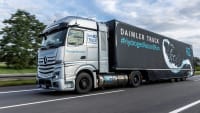
Top Stories
NewsSensors/Data Acquisition
 Microvision Aquires Luminar, Plans Relationship Restoration, Multi-industry Push
INSIDERRF & Microwave Electronics
 A Next Generation Helmet System for Navy Pilots
INSIDERWeapons Systems
 New Raytheon and Lockheed Martin Agreements Expand Missile Defense Production
NewsAutomotive
 Ford Announces 48-Volt Architecture for Future Electric Truck
INSIDERAerospace
 Active Strake System Cuts Cruise Drag, Boosts Flight Efficiency
ArticlesTransportation

Webcasts
Aerospace
 Cooling a New Generation of Aerospace and Defense Embedded...
Energy
 Battery Abuse Testing: Pushing to Failure
Power
 A FREE Two-Day Event Dedicated to Connected Mobility
Automotive
 Quiet, Please: NVH Improvement Opportunities in the Early Design Cycle
Electronics & Computers
 Advantages of Smart Power Distribution Unit Design for Automotive &...
Unmanned Systems
 Sesame Solar's Nanogrid Tech Promises Major Gains in Drone Endurance