




Designs on a Diverse Powertrain Future
Perkins details range of development efforts to power future off-highway machines, from clean-sheet diesel to hybrid-electric and hydrogen combustion.
Many manufacturers in the construction and mining vehicle sectors have tabbed the Bauma trade show in April as the venue for major product debuts. Perkins is one of those, though it provided select media an overview of its latest powertrain developments and projects at a pre-Bauma briefing in early February.
Hydrogen and hybrids were a large part of the discussion at the London media event, but Perkins began the day expounding on good old diesel-engine development. The company’s engineers are still working hard to strengthen – and streamline – its diesel portfolio, all while readying new platforms for other fuels and applications.
“The need for diesel power is here to stay for a long while,” Andy Curtis, customer solutions director at Perkins, said flatly. “But with that, we also need the ability to ensure our products run on alternative fuels.”
Future-proof engine platforms
James Gardiner, global product marketing manager, detailed the latest ICE developments for the Perkins brand of engines. “Part of the fundamental cornerstone is optimizing the current engine range that we have. We need to continuously develop those as we go forward. Part of what we’re investing in today for the ‘optimized engine’ helps provide the building blocks for the future, get better rationalization and also support the energy transition as we go forward.”
Drop-in replacement fuels include up to 100% HVO (hydrotreated vegetable oil) across all engine ranges. All highly regulated engines – those for U.S. EPA Tier 4 Final and EU Stage V, for example – are up to B20 compatible. “We continue to invest in these as we go through our new products and our iterations of product development. So, for example, the 2200 Series range [for less-regulated and unregulated countries] is already at B100 compatibility. That’s off-the-shelf,” Gardiner said. “As a future development, we’ll continue to bring further bio with diesels into the platform, especially as the legislation and the markets demand that.”
Gardiner shared an evolution-versus-revolution approach to Perkins’ diesel-engine development. The company is continually investing in its product ranges and making incremental improvements. But there are times when its engineers, drawing extensively from what it has learned from customers and the information gathered from fleets of engines in the field, are tasked to start from scratch.
“We look at going back to the base engine – the block design, the head design to improve airflow using new technologies like variable geometry turbos, the emissions architecture, how we can maximize power density, new displacements, which then means a whole new centerline engine,” Gardiner said. “These are not evolutions; these are new products using the latest technology, looking at the markets, looking at how the customers use their machines. There’s a lot of investment that goes into these ground-up engine platforms.”
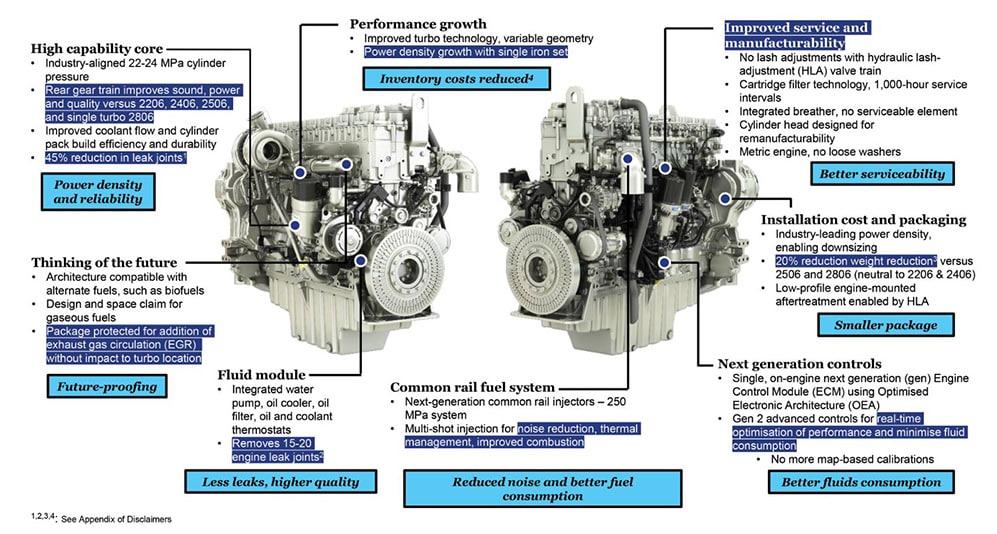
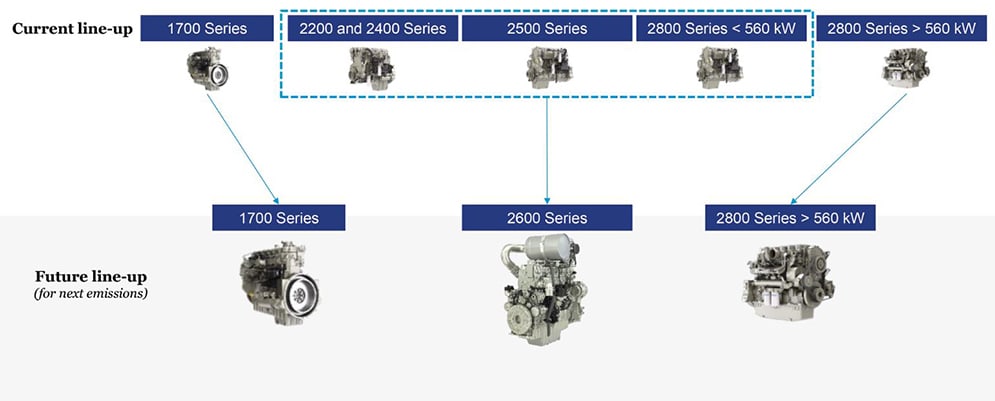
This so-called “revolution” involves two recent engine platforms. Perkins launched the 2.8-/3.6-L 904 Series in October 2023 and has already made and shipped over 100,000 examples. The newest product in the portfolio is the 12.9-L 2600 Series engine. These clean-sheet designs are built to be future-proof – putting the building blocks in place for future technologies like hydrogen variants and other gaseous and sustainable fuels. Gardiner noted that modifications would still need to be made to the cylinder head and piston strategies, for example, prior to accommodating some alternative fuels.
Future emissions regulations are also considered as part of the engine’s building blocks. “When we’re designing the emissions for Stage V/Tier 4 Final, we’re also making it ready for some of the future emissions. At the moment, we’re trying to avoid EGR [exhaust gas recirculation] with some of the specs on this, but we’re placeholding that because it’s likely to come when we go to Stage VI/Tier 5 and beyond,” Gardiner said. “Electrification will be part of this as well because we can downsize and leverage having hybrids with battery backup or a different power supply.”
Power density for the 2600 Series is improved and reportedly “industry leading,” approaching 40 kW/L (53.5 hp/L), which allows customers to downsize their engines, Gardiner said. The new engine offers 20% more power than the current 13-L, at 515 kW (690 hp), 25% better low-speed torque, and better cold-temperature performance due to new architecture and control features.
The 2600 Series premiered in 2023. SAE Media was present for the launch event and detailed the engine as the cover story for the December 2023 issue. The story also appears online here.
Pilot engines are available and operating with customers in the U.S. and Europe on a range of applications. Commercial production is set to begin in 2026 at the company’s plant in Seguin, Texas.
Drop-in hydrogen hybrid unit
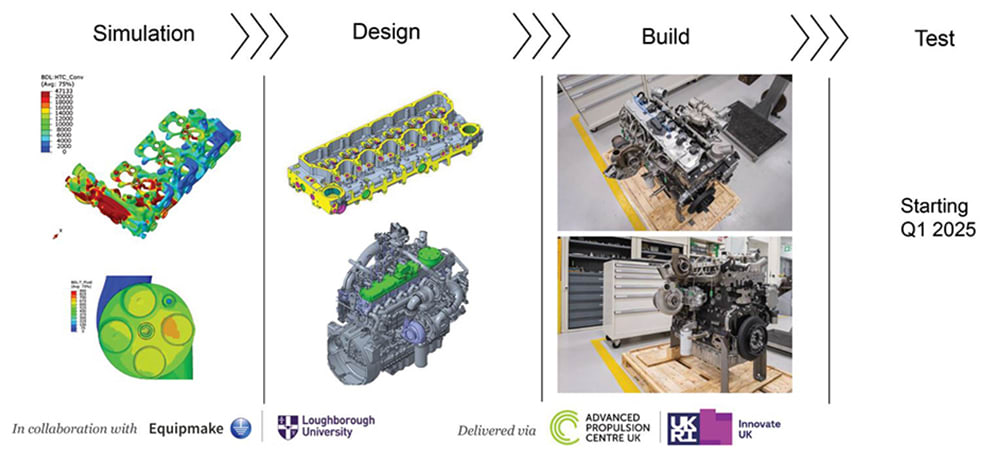
Perkins announced a collaboration with Equipmake and Loughborough University’s Mechanical, Electrical and Manufacturing Engineering School in October 2023. The goal was to develop and produce an advanced multi-fuel “drop-in” hybrid integrated power unit. Not many details were released back then, other than Project Coeus would integrate hybrid-electric components and advanced controls with a 7-L Perkins 1200 Series industrial power unit, enabling operation on hydrogen fuel initially. Other lower-carbon fuels will be supported as well, such as ethanol, methanol and bio-methane.
About 15 months into the three-and-a-half-year project, Perkins provided an update on how development is progressing. “It would be nice if the [energy transition] pivot was to a single fuel, but that isn’t going to happen” because of global diversity in feedstock availability, said Paul Moore, who’s accountable for product strategy and technical leadership of Caterpillar’s off-highway Integrated Powertrain solutions and services. “This is a challenge for us as a combustion engine manufacturer. We must have an ability to deal with these different fuel types in the future.”
Moore noted that because the off-highway industry is highly diverse and consists of many smaller-volume OEMs, many barriers exist for integrating complex advanced systems. That’s where a drop-in, multi-fuel solution is helpful. “This is at the heart of Coeus,” he said. “How do we develop a strategy that can effectively allow customers to use these different fuel types with minimal disruption to their products?”
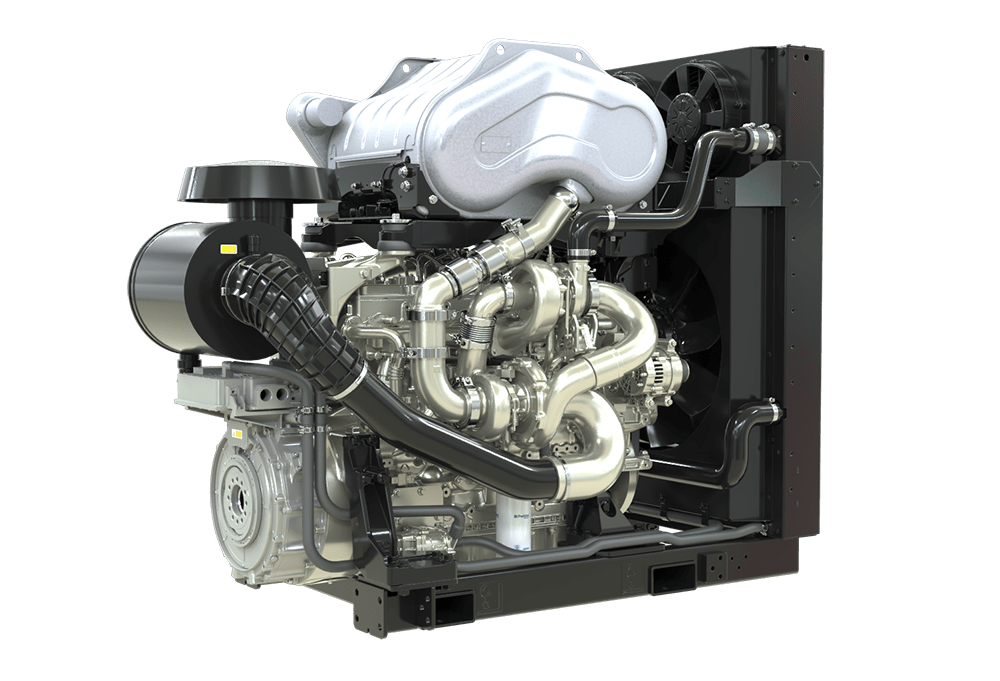
A spark-ignited engine is the basis for the integrated power unit and is required to effectively use the different fuels. “That’s something we don’t have today. It requires a different engine design [to accommodate the spark plug] – a different cylinder head architecture. The way the airflow needs to move around the cylinder is different with a gaseous fuel that’s spark ignited,” Moore said. “The different fuels [some gaseous, some liquid] have different needs as well. We’ve tried to come up with an architecture that gives us the most flexibility to adapt to them. The trick is doing that without having to have very different cylinder heads.”
Loughborough University supports the project through advanced engine analytics and emissions control. It also provides advanced optical diagnostics on in-cylinder flow and gas-injection dynamics. Edward Long, senior lecturer at the university, noted that control of flow structures involves two aspects – the mixing side where fuel and air mix uniformly before spark, and what the flow is doing as the spark is ignited and burns through.
“Control of those flow structures is really important,” Long said. “You can do that through a number of small tweaks to get that structure how you want it to be. Different fuels, different requirements, different time scales of delivery, so there are control parameters you can do while keeping a common architecture in a lot of the areas.”
Following the simulation and design phases of the project, procurement and engine build began in the latter half of 2024. The first hydrogen spark-ignited engine on the 1206 platform was being prepped for physical testing as of the February media event in London. Testing will involve two different configurations – port fuel injection (PFI) and direct injection (DI). “The head architecture we’ve developed allows us to run both,” Moore said.
“In a year, we’ve essentially gone from clean sheets of paper to having our first prototype engine built and ready to test,” he added. “We still have to get some good data off of it over the next three to six months.”
Moore noted that the performance characteristics of all those fuels is physically different. That’s where the hybrid system comes into play. “We think developing an integrated hybrid system to work alongside that combustion engine is an effective strategy to mitigate those performance differences. It allows us to provide that same user experience in regards to power and, more importantly, torque response, compared to diesel engines,” he said. “Hydrogen engines always need to run lean, so load acceptance is the challenge. That’s why the hybrid system is a fundamental part.”
Efficiency gains are another benefit of the hybrid system, Moore added. In parallel to the hydrogen-engine testing, the team will be installing the prototype hybrid system that Equipmake is developing and delivering in Q1/Q2 this year, he said. The hybrid system will be running on a diesel engine for development purposes by the end of 2025. By Q3 2026, the goal is to fit the complete integrated power unit into a real-world customer application, which is still to be determined.
Hybrid-electric system development
The hybrid-electric system is being designed to minimize integration effort and be transparent to the customer. “How this integrates to the engine to minimize packaging [size] has been foundational to the collaboration,” Moore said.
The motor generator unit (MGU) and integrated inverter for Project Coeus are new developments from Equipmake. The UK-based engineering specialist is designing the motor and inverter around specs set by Perkins, but Ian Foley, CEO at Equipmake, could not share what they are yet.
“We don’t have a range of motors and inverters that we’re going out to sell. We work with companies that have specific requirements,” Foley told SAE Media, noting previous work with an electric aircraft company developing a bespoke motor. “This Coeus project fits right in our sweet spot.”
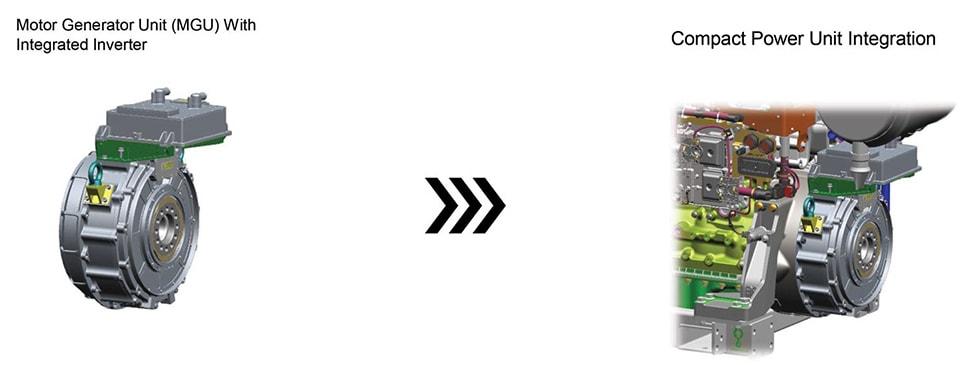
Moore also commented on the hybrid-system specs. “We’re still iterating a little bit on that. To give that consistent performance, we need to understand what the capability of the hydrogen engine is to then understand, ‘Well, how much of that do we need to make up with the hybrid system?’” he said. “We’ve got our initial requirements which we’re sizing the motors around today, but we’re going to learn a lot when we get the engine in the test cell. Because what we don’t want to do is over-engineer it and oversize things.”
The Gen 2 motor design is coming later this year. “That Gen 2 design could be different depending on what we learn in the lab,” Moore said. “It wouldn’t be a fundamental redesign, but [rather] changes to things like motor windings and optimization of magnetic material, which will allow us to have just the right size machine.”
Perkins has developed hybrid-electric technology in the past. Its Pathfinder hybrid telehandler was built in 2021 as a learning tool, and work continues on it. “We took out the 75-kW engine that was in there before, replaced it with a single-fluid 55-kW engine, added a 20-kW motor generator unit along with a 4-kWh battery,” said Paul Muller, technical sales manager at Perkins. “It’s got a clutch system, so it allows us to run completely electrically.”
Perkins is using this Pathfinder machine to test out some of the control system software that it now is using on the Coeus project. “As we’ve been developing the software, this has become a testbed that allows us to try out some of it,” Muller said. “Projects lead into one another; they’re linked.”
Even after the extensive pre-Bauma presentation in February, Perkins held back on providing all the product-development details. The company promises that a “disruptive project” will be revealed at the Munich trade show in April. Stay tuned.
More From SAE Media Group
Off-Highway Engineering
JCB Debuts Clean-Sheet Hydrogen Combustion Engine
Automotive Engineering
Off-Highway Hybrids Are Entering Prime Time
Off-Highway Engineering
Shell Details Upcoming Engine-Oil Developments
Off-Highway Engineering
Hybrids Are Having a Moment
Automotive Engineering
Extending the ICE Age: Hyundai Optimizing Engines and Fuels
Off-Highway Engineering
Liebherr Goes All in on Hydrogen Fuel
Off-Highway Engineering
SwRI Rolls out Hydrogen Demonstration Truck
Off-Highway Engineering
Deutz Takes Open Approach to Propulsion
Off-Highway Engineering
Developing Next-Gen Diesels to Last Decades
Automotive Engineering
Keeping Combustion in the Conversation
Off-Highway Engineering
Hydrogen ICE Is Heating Up
Off-Highway Engineering
Kohler Doubles down on ICE Development
Off-Highway Engineering
JCB Prepared to Meet EU Stage V Emissions
Automotive Engineering
Engine Researchers: 50% Gasoline-Engine Efficiency in Sight
Off-Highway Engineering
Deutz Equips Telehandlers with Hybrid and Fully Electric Powertrains
Automotive Engineering
The IC Future Points to More Downsizing, Lean Mixtures
Automotive Engineering
Mahle Reveals ‘Fits All’ Modular and Scalable Integrated Hybrid Powertrain
Off-Highway Engineering
AGCO Goes Clean and Green with CORE75 Engine
Off-Highway Engineering
FPT Tech Day Reveals Cursor X Concept, Other 4.0 Innovations
Off-Highway Engineering
HD Hyundai Rolls out a Slew of New Machines
Off-Highway Engineering
In Pursuit of a Dedicated Hydrogen ICE for Heavy-Duty Vehicles
Automotive Engineering
Porsche Partners to Develop 3D-Printed Pistons
Automotive Engineering
2020 Ford Super Duty Debuts All-New 7.3-Liter Pushrod V8, 10-Speed Automatic
Off-Highway Engineering
Navistar’s ‘Ground Up’ Approach to All-New Diesel Engine
Off-Highway Engineering
Could This Infinitely Variable Compression Mechanism Be the Next Piston Engine Game-Changer?
Automotive Engineering
Internal Combustion: Once More, with Feeling
Off-Highway Engineering
Caterpillar Unveils New C13D Off-Highway Engine Platform
Off-Highway Engineering
Kubota Engine High on HVO, Hydrogen and Hybrids
Off-Highway Engineering
Transmission Talk: Eaton Discusses Its Portfolio of Commercial Gearboxes
Off-Highway Engineering
Mecalac Targets Building Sites in Cities for Fully-Electric E12 Excavator
Top Stories
NewsSensors/Data Acquisition
 Microvision Aquires Luminar, Plans Relationship Restoration, Multi-industry Push
INSIDERRF & Microwave Electronics
 A Next Generation Helmet System for Navy Pilots
INSIDERWeapons Systems
 New Raytheon and Lockheed Martin Agreements Expand Missile Defense Production
NewsAutomotive
 Ford Announces 48-Volt Architecture for Future Electric Truck
INSIDERAerospace
 Active Strake System Cuts Cruise Drag, Boosts Flight Efficiency
ArticlesTransportation

Webcasts
Aerospace
 Cooling a New Generation of Aerospace and Defense Embedded...
Energy
 Battery Abuse Testing: Pushing to Failure
Power
 A FREE Two-Day Event Dedicated to Connected Mobility
Automotive
 Quiet, Please: NVH Improvement Opportunities in the Early Design Cycle
Electronics & Computers
 Advantages of Smart Power Distribution Unit Design for Automotive &...
Unmanned Systems
 Sesame Solar's Nanogrid Tech Promises Major Gains in Drone Endurance