




Transmission Talk: Eaton Discusses Its Portfolio of Commercial Gearboxes
Eaton aims to offer a full range of medium- and heavy-duty transmissions for the commercial truck market.
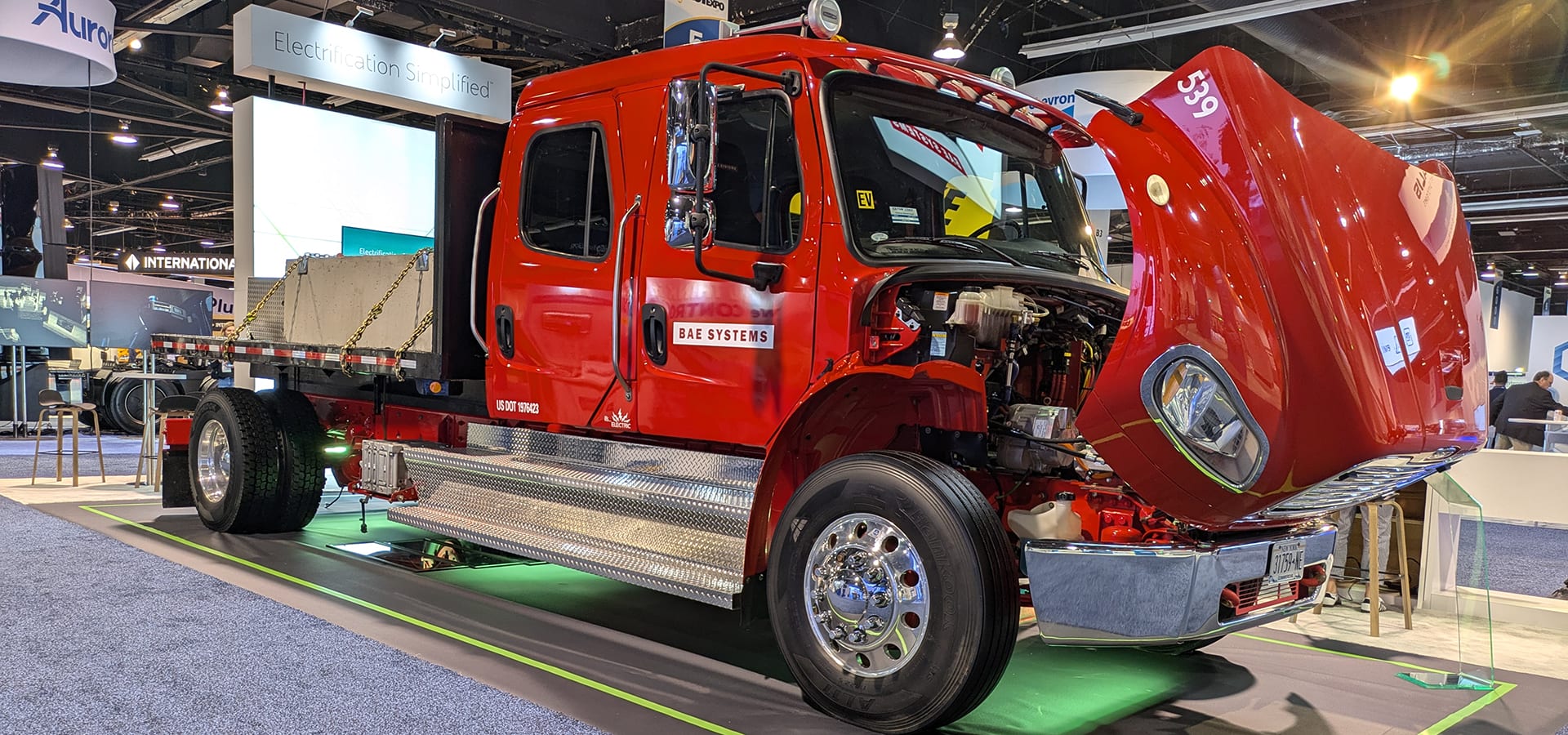
Last summer, SAE Media was invited to Eaton’s proving grounds in Marshall, Michigan, to test drive an electric truck the company had built in collaboration with BAE Systems. The truck was a showcase not only of BAE’s powertrain control technology, but also of Eaton’s new multi-speed heavy-duty EV transmission.
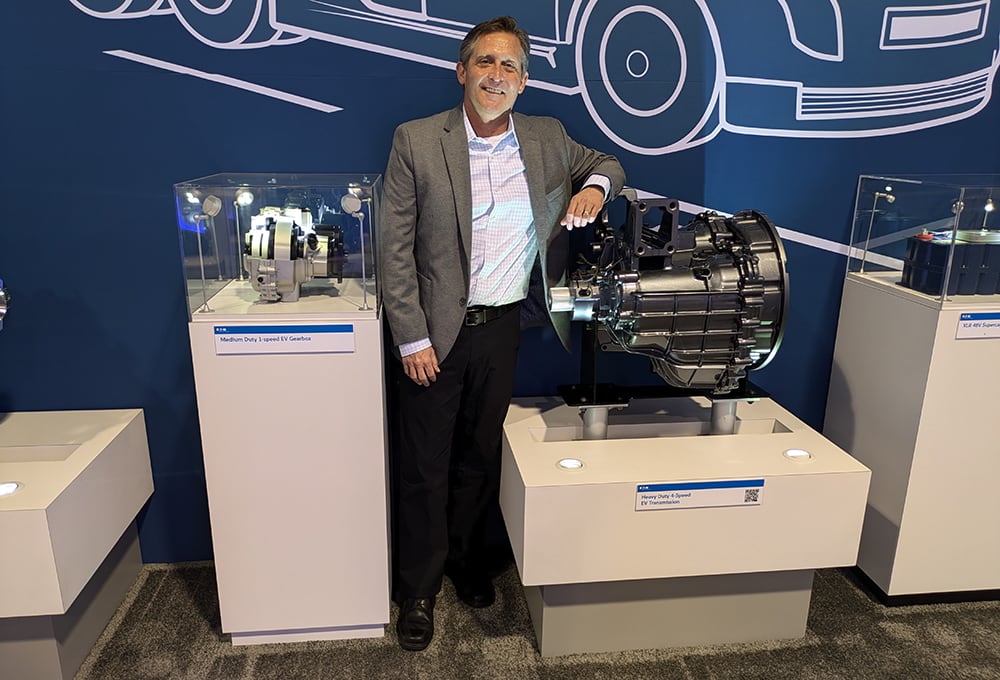
That truck was on display at the 2025 ACT Expo, as was Eaton’s transmission. SAE Media was granted an interview at ACT Expo with Scott Adams, SVP of technology and global products for Eaton, to further discuss the company’s portfolio of multi- and single-speed medium- and heavy-duty transmissions as well as other upcoming driveline offerings.
Q: What are the differences between the medium- and heavy-duty markets for multi-speed EV gearboxes?
A: Our medium-duty four-speed has been in production for close to a decade now. Asia has been our best market for that transmission. We’ve used them for both hybrids and EVs and sell them mostly in China and southeast Asia, mostly for buses. Direct drive units can still work in those applications, but you’d still need bigger motors. Anywhere there’s hills, like Taiwan and Indonesia, the multi-speed transmission is the better choice. On the heavy-duty side, our customers were asking for higher torque and GVW ratings. That led us to launch the four-speed. It’s a global product, and we have a couple of customers already lined up for that unit.
Q: In addition to EVs and hybrids, are you seeing demand for the heavy-duty four-speed in other applications as well?
A: We have a couple of customers that are using that transmission in conjunction with fuel cells. One in China for the Australian market and another customer that has their fuel cell truck on display here at the Expo. They’ve taken about 80 transmissions so far, and we just launched it last fall. Most of the demand from that customer is for short distance delivery. They have both ICE and EVs and were using a two-speed EV transmission that just wasn’t working for them. About 18 months ago, we started working with them on a prototype build with the four-speed and they decided to switch to our product.
Q: So not only do you have EV applications for that four-speed, but then you’re also getting demand from the fuel cell side.
A: Exactly, in a fuel cell application, when you move away from a direct drive unit you reap all the same benefits of motor downsizing in a fuel cell like you would in an EV. Plus, the transmission still costs less from a total system perspective.
Q: Are there still cases where a single-speed gearbox is the answer?
A: Absolutely. For medium duty, there’s plenty of cases where you really don’t need multispeed. As much as we’d love to sell them the four-speed, sometimes the customer has an application that just doesn’t need it. There’s definitely a segment.
Q: How close are you to bringing your single-speed medium-duty unit to production?
A: Our unit is still in validation right now, but we’ll have it ready pretty soon. Most likely within the next 18 months or so. It’s a really efficient package that will work with a smaller motor that can run at higher speeds. We’re trying to give that broader portfolio to the customers more options.
Q: What’s an application for that heavy-duty four-speed that a customer has asked for that was not expected?
A: We continue to get asked about different features. That unit has a PTO on it, and we ran into some limitations with a PTO on an EV because the motor doesn’t run as fast as a diesel engine. We’re getting asked, how can we use that PTO at lower speeds and are there other reduction gears we can actually use to speed up the output? The motor is not going to run faster, but there are things we can do to allow the PTO to run faster. So, we’re fielding those sorts of questions. For example, if you’re dumping concrete, that’s an application where you need good control at low speeds. But you also need a machine that’s just got a little bit more speed to operate the machine at the required rate.
Q: What other questions are you fielding from customers on the transmission side?
A: We get asked about the first gear reduction. You can’t cover every part of the market, so we did a global market assessment when we picked the ratios of that transmission to try to cover as much of the market we felt we could without having multiple geartrains. We plan to release cybersecurity and functional safety in the next couple of years, too, but we wanted to get the product out quickly. We’ll continue to add features as that product matures.
Q: Is there anything else coming on the transmission side from Eaton that we should be looking out for?

A: We announced last year that our Brazil team is launching new six-, eight- and ten-speed automated manuals. We will be launching those products both in Brazil and the ten-speed in India in the next 12 to 24 months. It’s a second-generation family of automated manuals with lower cost, better controls faster and more sophisticated shifting.
Q: What details can you share with us about the differential side of Eaton’s business?
A: Something we found as we started to engage with the customers on these e-lockers is that the fluid that they use is shared with the motor and the high-speed gear reduction system. It’s a lot lower viscosity fluid, almost like water. Our ICE differentials, whether they’re mechanical locking, e-lockers or LSDs like the EV Truetrac, use a thicker oil. We had to adapt our design to manage that lower viscosity fluid as well as the higher impact ratings that you get with an EV motor.
It took a little while to get that product development going, but we’ve already launched seven programs, and we tailored our differential product portfolio to the point where each of the major products now have an EV version tailored for that lower viscosity fluid. The higher impact rating and getting lubrication around all the gears is a lot harder when you’ve got lower viscosity fluids, so there were a lot of different things that we had to adapt that portfolio for.
More From SAE Media Group
Off-Highway Engineering
Eaton and BAE Gear up a New Electrified Truck
Off-Highway Engineering
Truckin’ on Hydrogen
Automotive Engineering
Millbrook’s New California EV Testing Facility
Automotive Engineering
Gearing EVs for Greater Efficiency
Off-Highway Engineering
Upswing in Outsourced EV Testing
Off-Highway Engineering
Gasoline Fuels Growing Number of Commercial Vehicles
Automotive Engineering
Bollinger Motors Reveals Second-Gen Class-3 EV Prototypes
Automotive Engineering
ICE and Hybrid-Electric Propulsion Show Staying Power
Automotive Engineering
ZF Shifts EV Transmission Efficiency up a Gear
Off-Highway Engineering
Volvo Reveals New VNL with SuperTruck Influence
Automotive Engineering
Making the Torque-Transfer Transition
Automotive Engineering
GKN Demos ETwinster, World’s-First 2-Speed Torque-Vectoring BEV Transmission
Automotive Engineering
BorgWarner Tech Center Adds Testing Muscle, Engineering Resources
Off-Highway Engineering
Volvo CE Previews ConExpo 2023 Display
Off-Highway Engineering
Freightliner’s Medium-Duty Makeover
Automotive Engineering
Extending the ICE Age: Ford’s Dave Filipe Has Some Powerful Choices to Make
Off-Highway Engineering
Toyota Launches Second-Gen Fuel-Cell Class 8
Off-Highway Engineering
Hybrids Are Having a Moment
Automotive Engineering
Actuating Hybrid and EV Efficiency
Off-Highway Engineering
EV Startup Prepares to Enter Commercial Market with Novel EAxle
Automotive Engineering
BorgWarner Demos Next-Step Electrification Components
Off-Highway Engineering
ZF Premieres AxTrax 2 Electric Axle Platform at ACT Expo
Off-Highway Engineering
Hyundai’s Fuel-Cell Dreams Remain Xcient
Off-Highway Engineering
REE Unveils P7-C Chassis Cab at ACT Expo
Off-Highway Engineering
Detailing Kenworth’s Sleek SuperTruck 2
Off-Highway Engineering
Pump and Motor Series
Off-Highway Engineering
Navistar’s ‘Ground Up’ Approach to All-New Diesel Engine
Automotive Engineering
Top Transmission Engineers Project Big Future for E-Axles, Advanced Motors
Automotive Engineering
Powering Back to the Future
Off-Highway Engineering
Medium-Duty Engines, Transmissions Shift Focus to Software
Top Stories
NewsRF & Microwave Electronics
 Microvision Aquires Luminar, Plans Relationship Restoration, Multi-industry Push
INSIDERAerospace
 A Next Generation Helmet System for Navy Pilots
INSIDERDesign
 New Raytheon and Lockheed Martin Agreements Expand Missile Defense Production
INSIDERMaterials
 How Airbus is Using w-DED to 3D Print Larger Titanium Airplane Parts
NewsPower
 Ford Announces 48-Volt Architecture for Future Electric Truck
ArticlesAR/AI

Webcasts
Electronics & Computers
 Cooling a New Generation of Aerospace and Defense Embedded...
Automotive
 Battery Abuse Testing: Pushing to Failure
Power
 A FREE Two-Day Event Dedicated to Connected Mobility
Unmanned Systems
 Quiet, Please: NVH Improvement Opportunities in the Early Design Cycle
Automotive
 Advantages of Smart Power Distribution Unit Design for Automotive &...
Energy
 Sesame Solar's Nanogrid Tech Promises Major Gains in Drone Endurance