




Porsche Partners to Develop 3D-Printed Pistons
Working with Mahle and Trumpf, Porsche is using additive manufacturing to increase engine power and efficiency for its range topping 911 GT2 RS.

Additive manufacturing (AM), aka 3D printing, is not new to Porsche. The German manufacturer heavily leverages AM processes in prototyping, and since May 2020, in production for customizable portions of seats available in its 911 and 718 models. Porsche Classic also uses AM to produce plastic, steel and alloy spare parts no longer available, such as the clutch lever in the 959. For the first time however, working with suppliers Mahle and Trumpf, highly-stressed driveline components – in this case pistons in the horizontally-opposed 6-cyl. engine for Porsche’s flagship 911 GT2 RS – are being produced via AM.
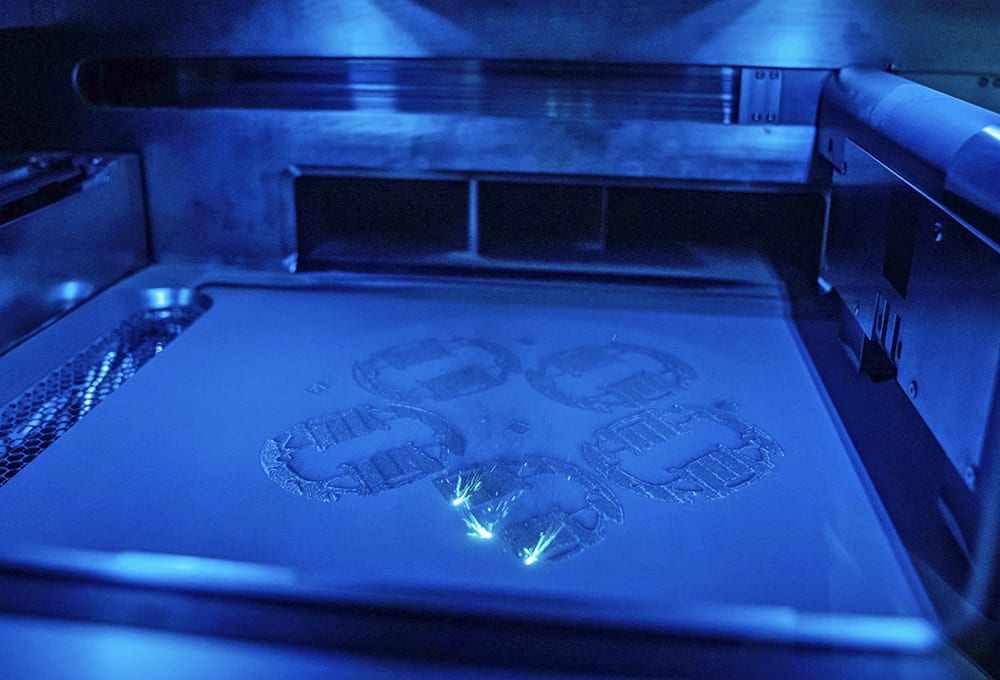
According to Porsche, it expects to further leverage AM abilities for low-volume series products such as the GT2 RS, as well as for motorsports. The AM process permits the GT2 RS pistons to be manufactured with a structure optimized for acting loads, resulting in a 10% weight savings versus the series-production forged pistons. The 3D-printed pistons also permit an integrated and closed cooling duct to be built into the piston crown, a cavity that could not have been produced by conventional methods.
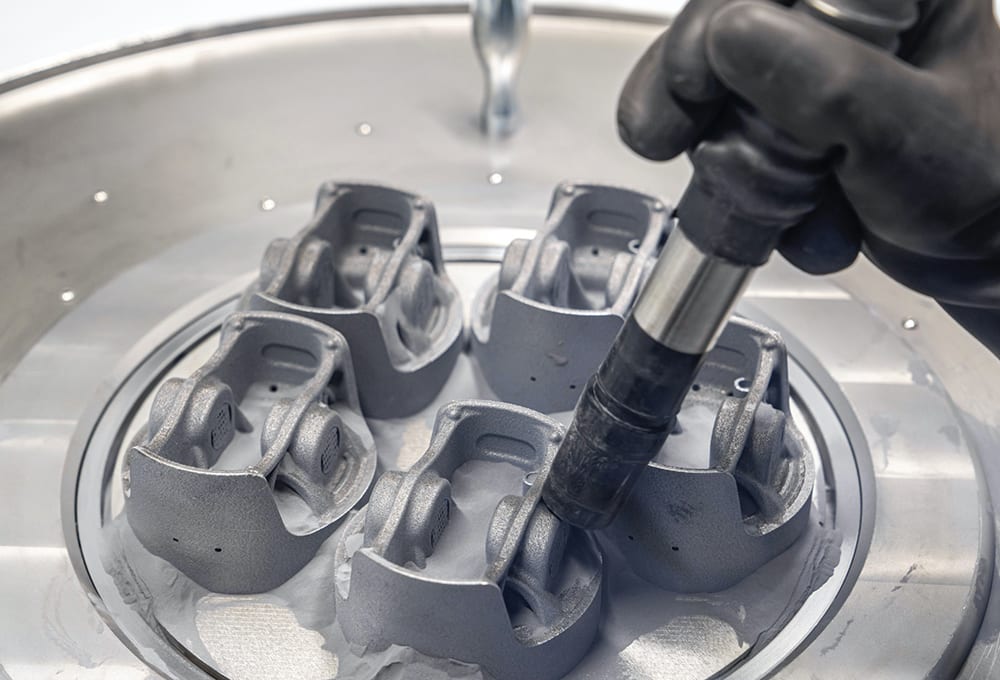

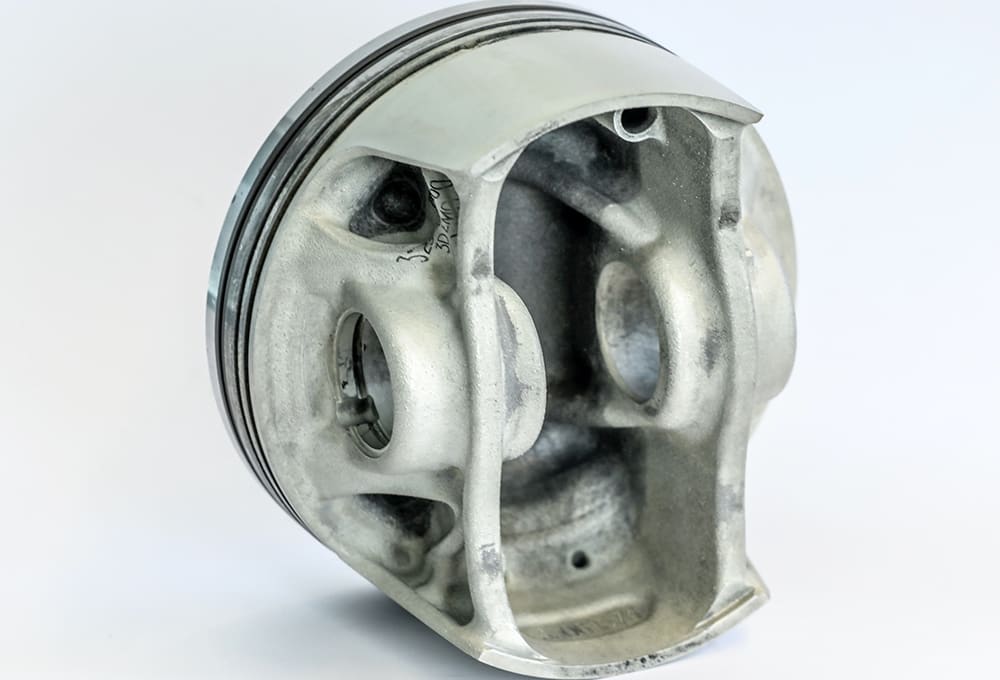
“Thanks to the new, lighter pistons, we can increase the engine speed, lower the temperature load on the pistons and optimize combustion,” explained Frank Ickinger from Porsche’s advance drive development department. “This makes it possible to get up to 30 more horsepower from the 700 PS [690 hp] biturbo engine, while at the same time improving efficiency.”
Porsche credits the layer-by-layer AM process for allowing the new piston architecture. The pistons for the 911 GT2 RS were manufactured from high-purity metal powders using the laser metal fusion (LMF) process. LMF uses a laser beam to heat and melt the powder surface to precisely correspond to the component’s contour. Initiated with partners Mahle and Trumpf, the project also uses measurement technology developed by optics specialist Zeiss to verify the integrity of the pistons.
Pistons have been identified as a prime candidate for AM. In addition to Mahle and Trumpf’s work with Porsche, supplier IAV has showcased 3D-printed pistons, as well as advanced-materials specialists such as Oerlikon for the manufacture of pistons for heavy-duty diesel engines. For now, the process shows the most potential for components in low-volume applications.
More From SAE Media Group
Off-Highway Engineering
Mahle Advances 3D Printing Capabilities
Tech Briefs
Using 3D Printing to Strengthen Jet Engines
Off-Highway Engineering
Bosch Invested in Large-Scale Metal 3D Printing
Automotive Engineering
New Ampere EV Motor Aims for Power, Torque Benchmarks


Automotive Engineering
Designing for 200 BMEP and 22,000 Rpm
Aerospace & Defense Tech Briefs
SAE International Issues, Revises Technical Reports for Aerospace Engineering
Automotive Engineering
3D Printing Scales-Up
Automotive Engineering
Casting Around for Lightweighting Solutions
Aerospace & Defense Tech Briefs
Additive Manufacturing
Automotive Engineering
Demand up for Composite-Grade, High-Performance Plastics Across Aerospace, Automotive

Off-Highway Engineering
Designs on a Diverse Powertrain Future
Off-Highway Engineering
Liebherr Reveals ‘Hybrid’ CFRP Cylinders and Parallel-Pump Concept
Automotive Engineering
Mercedes-AMG Extracts World-Record Power from New Four-Cylinder Engine

Aerospace & Defense Tech Briefs
GE Aviation and DM3D to Ramp up 3D-Printed Fan Blade Production for GE9X Engine
Aerospace & Defense Tech Briefs
Evaluation of Additively Manufactured Ultrahard Steels
Medical Design Briefs
3D Printing Method Builds Structures with Two Metals
Aerospace Manufacturing and Machining
Why Heat Exchanger Manufacturers Need to Rethink Design and Fabrication
Automotive Engineering
Engine Researchers: 50% Gasoline-Engine Efficiency in Sight
Automotive Engineering
Charting the ICE Future with Mahle’s Martin Berger
Tech Briefs
3D-Printed Composites for High-Temperature Uses
Automotive Engineering
The IC Future Points to More Downsizing, Lean Mixtures
Aerospace & Defense Tech Briefs
Roush to Support the Aerospace Industry with the King of Metal 3D Printers
Off-Highway Engineering
Schaeffler Optimizes Rolling Bearings for Hydraulic and Axle Drives
Top Stories
NewsSensors/Data Acquisition
 Microvision Aquires Luminar, Plans Relationship Restoration, Multi-industry Push
INSIDERRF & Microwave Electronics
 A Next Generation Helmet System for Navy Pilots
INSIDERWeapons Systems
 New Raytheon and Lockheed Martin Agreements Expand Missile Defense Production
NewsAutomotive
 Ford Announces 48-Volt Architecture for Future Electric Truck
INSIDERAerospace
 Active Strake System Cuts Cruise Drag, Boosts Flight Efficiency
ArticlesTransportation

Webcasts
Aerospace
 Cooling a New Generation of Aerospace and Defense Embedded...
Energy
 Battery Abuse Testing: Pushing to Failure
Power
 A FREE Two-Day Event Dedicated to Connected Mobility
Automotive
 Quiet, Please: NVH Improvement Opportunities in the Early Design Cycle
Electronics & Computers
 Advantages of Smart Power Distribution Unit Design for Automotive &...
Unmanned Systems
 Sesame Solar's Nanogrid Tech Promises Major Gains in Drone Endurance