




Mahle Advances 3D Printing Capabilities
Its new 3D printing center in Stuttgart aims to accelerate prototype production with an eye toward establishing processes for industrial series production.
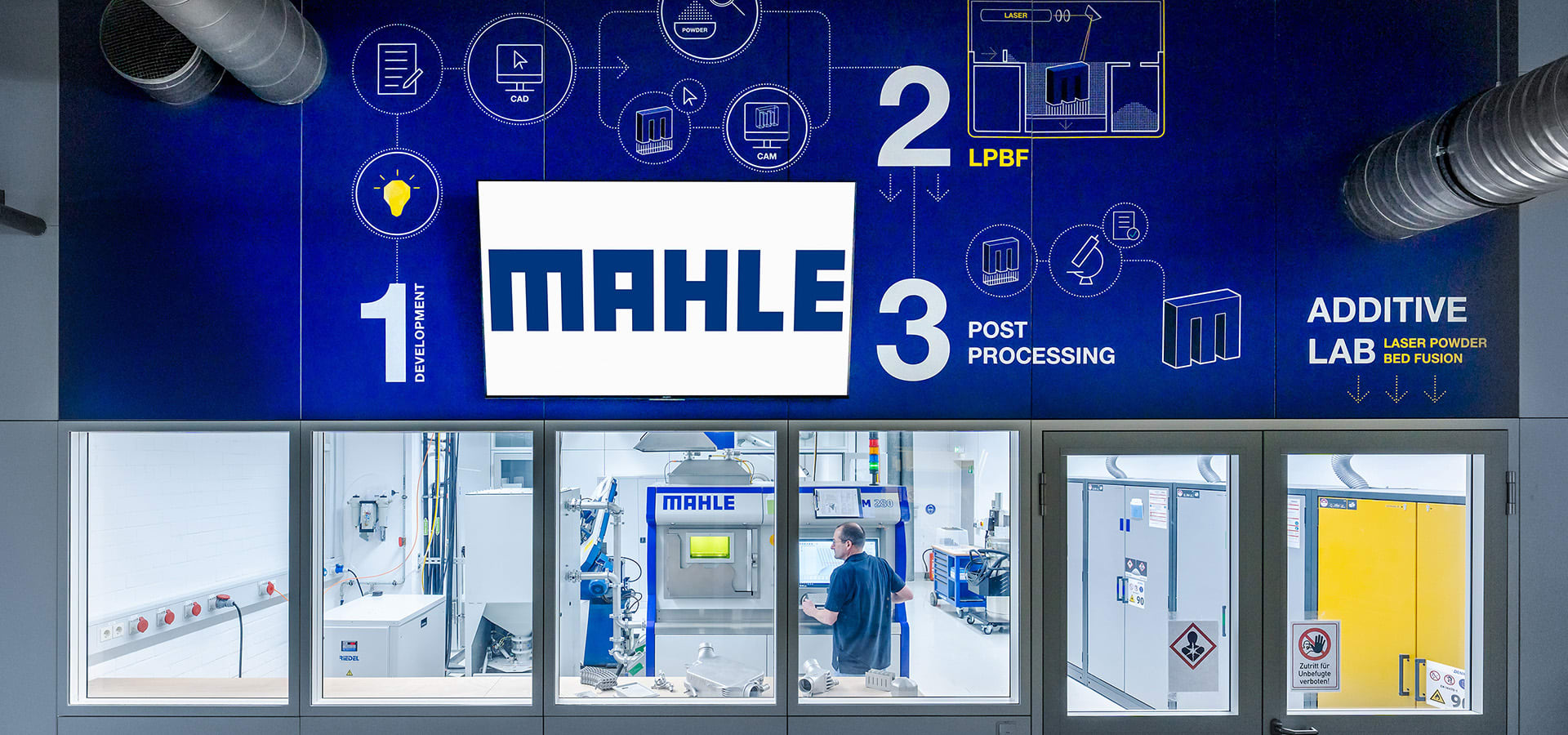
Slashing the time to produce prototypes for complex components, from several months to a few days, explains in part why Mahle’s technology group decided to build a new facility for additive manufacturing (AM) processes at its Stuttgart headquarters. The 3D printing center houses the printers, powder preparation module, testing laboratory and a blasting system for finish machining the components to satisfy internal prototype production as well as automotive and commercial-vehicle customer orders.
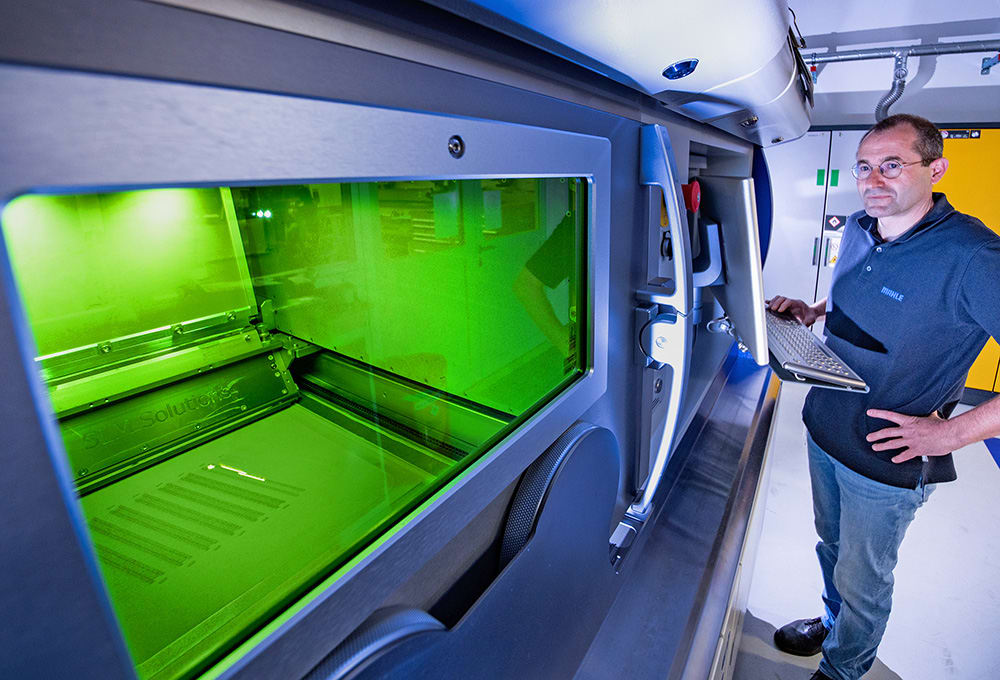
“The development of new systems and components has to be much faster today than it was a few years ago, especially when it comes to e-mobility,” Andreas Geyer, head of Process Technologies in Central Research at Mahle, said during a recent press event introducing Mahle’s new AM capabilities. “We are boosting the performance of our existing portfolio through possibilities in production design.”
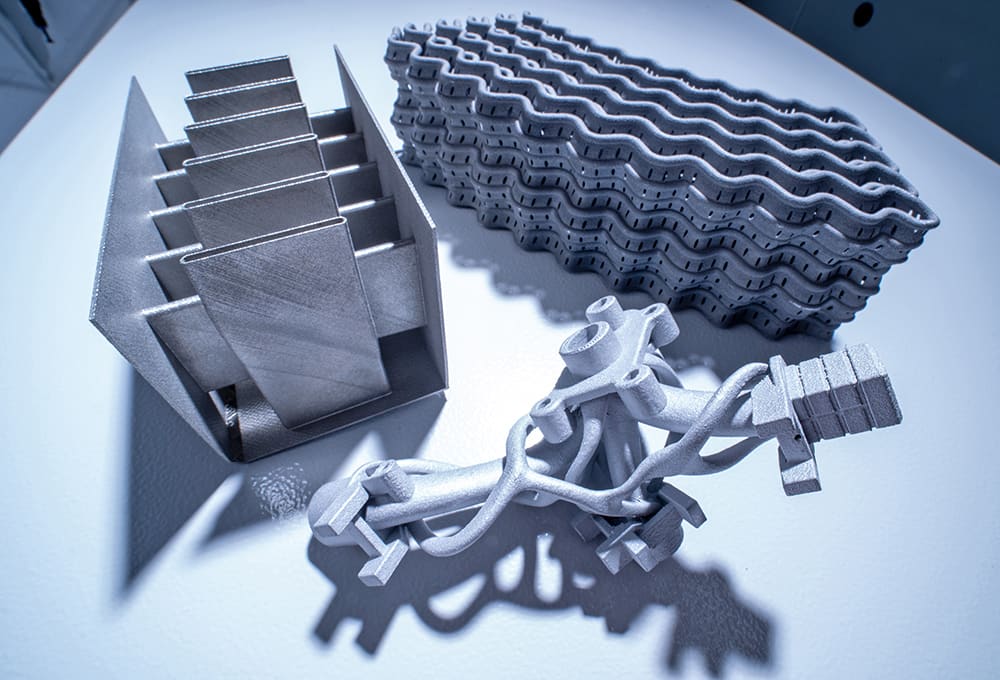
The other main reason for opening such a facility is to enable 3D printing for series production that meets the strict standards of the mobility industry. The focus is on developing and qualifying manufacturing processes for components in thermal management, mechatronics and electronics – for example, to produce transmission and electric motor housings, charge air coolers, oil filter housings and heat exchangers, as well as structural elements, mounting devices and connections.
“We want to be prepared today to find out how we can use an integrated 3D printing [development process] according to automotive standards for later large-scale production,” Geyer said. “This opens up completely new possibilities in product development and manufacturing, because these processes can be used to produce high-performance components that cannot be manufactured using conventional methods.”


The center processes two standard metal materials: aluminum-silicon-magnesium (AlSi10Mg) and stainless-steel 1.4404 alloys. Mahle 174+ aluminum alloy, suitable for pistons in truck diesel engines with high loads, also was adapted to AM. In addition, a couple of plastics materials can be used on Mahle’s network of 3D printers, Geyer said. “Copper is a material that might be used in the future, but currently aluminum is the important material for heat exchangers,” he added.
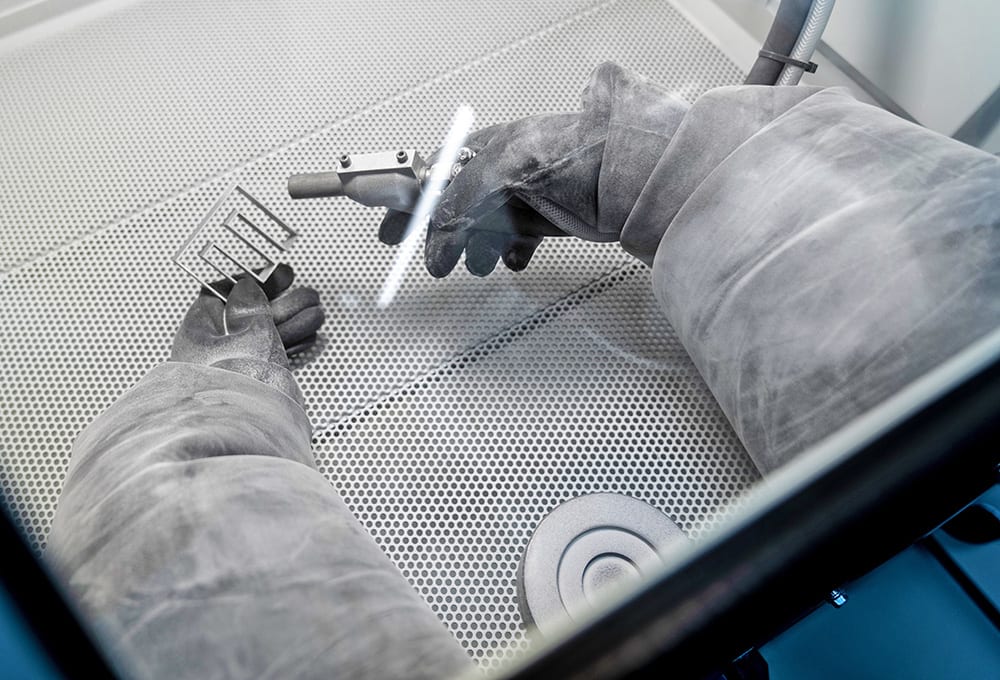
Laser powder bed fusion is used to form the component layer by layer. Mahle currently can manufacture components up to around 30 x 30 x 40 cm (11.8 x 11.8 x 15.7 in). After the printing process is complete, the finished parts are separated from the base plate and finish-machined by hand by specially trained staff.
In a joint project with Porsche and Trumpf last year, Mahle engineers successfully produced and tested high-performance parts such as pistons and charge air coolers for the Porsche 911 GT2 RS. “This was one of the milestones that also led to our decision to establish our own 3D printing center with our own printers,” Geyer said.
The project proved expected advantages of the 3D printing process – namely the elimination of expensive production tools and the ability to create structures otherwise too complex to produce. “Computer-aided topology optimization, which is modeled on natural structures, adds material only at stress points,” Geyer said. “This is how it adapts the structure precisely to the load.”
Commercial vehicles also can benefit from the new center. “Certainly with respect to the heat exchanger, we’re currently intensively working on various projects in the field of thermal management. And of course, commercial vehicles in conjunction with alternative drives are a focal area,” Geyer said.
More From SAE Media Group
Automotive Engineering
3D Printing Scales-Up
Off-Highway Engineering
Bosch Invested in Large-Scale Metal 3D Printing
Automotive Engineering
German OEMs Flex 3D Manufacturing Muscle
Automotive Engineering
Casting Around for Lightweighting Solutions
Automotive Engineering
Porsche Partners to Develop 3D-Printed Pistons
Tech Briefs
Using 3D Printing to Strengthen Jet Engines
Automotive Engineering
New Ampere EV Motor Aims for Power, Torque Benchmarks
Automotive Engineering
Gearing Dana for the EV Future
Aerospace & Defense Tech Briefs
SAE International Issues, Revises Technical Reports for Aerospace Engineering
Automotive Engineering
How 3D Printing Could Add Efficiency to EV Power Electronics
Off-Highway Engineering
EOS Releases Four New Metal Materials for Series Additive Manufacturing
Aerospace & Defense Tech Briefs
SAE International Extends Call for Abstracts, Seeks Submissions for AeroTech Conference
Off-Highway Engineering
Making Strides in Sustainable Transportation
Tech Briefs
Metal 3D Printing for Complex Heat Exchangers
Aerospace & Defense Tech Briefs
Equispheres Accelerates Additive Manufacturing Innovation with $5M from Lockheed Martin
Aerospace Manufacturing and Machining
Why Heat Exchanger Manufacturers Need to Rethink Design and Fabrication
Aerospace & Defense Tech Briefs
Evaluation of Additively Manufactured Ultrahard Steels
Aerospace & Defense Tech Briefs
SAE International Issues First Technical Standards for Aerospace Additive Manufacturing
Off-Highway Engineering
Moving Metal AM Forward
Aerospace & Defense Tech Briefs
Finding the Perfect Aluminum for Additive Manufacturing
Automotive Engineering
Air- or Water-Cooling Resistors for EVs: The Case for H2O
Automotive Engineering
Charting the ICE Future with Mahle’s Martin Berger
Off-Highway Engineering
Thermal Challenges of Electric Commercial Vehicles
Off-Highway Engineering
Mahle’s Hydrogen Focus Spans Fuel Cells, ICEs
Off-Highway Engineering
MELD Exploits Plastic Deformation of Metals with Non-Melt Additive Manufacturing
Off-Highway Engineering
ZF Premieres AxTrax 2 Electric Axle Platform at ACT Expo

Top Stories
NewsSensors/Data Acquisition
 Microvision Aquires Luminar, Plans Relationship Restoration, Multi-industry Push
INSIDERRF & Microwave Electronics
 A Next Generation Helmet System for Navy Pilots
INSIDERWeapons Systems
 New Raytheon and Lockheed Martin Agreements Expand Missile Defense Production
NewsAutomotive
 Ford Announces 48-Volt Architecture for Future Electric Truck
INSIDERAerospace
 Active Strake System Cuts Cruise Drag, Boosts Flight Efficiency
ArticlesTransportation

Webcasts
Aerospace
 Cooling a New Generation of Aerospace and Defense Embedded...
Energy
 Battery Abuse Testing: Pushing to Failure
Power
 A FREE Two-Day Event Dedicated to Connected Mobility
Automotive
 Quiet, Please: NVH Improvement Opportunities in the Early Design Cycle
Electronics & Computers
 Advantages of Smart Power Distribution Unit Design for Automotive &...
Unmanned Systems
 Sesame Solar's Nanogrid Tech Promises Major Gains in Drone Endurance