




Kubota Engine High on HVO, Hydrogen and Hybrids
Kotaro Shiozaki details the engine maker’s diversified path to carbon neutrality.

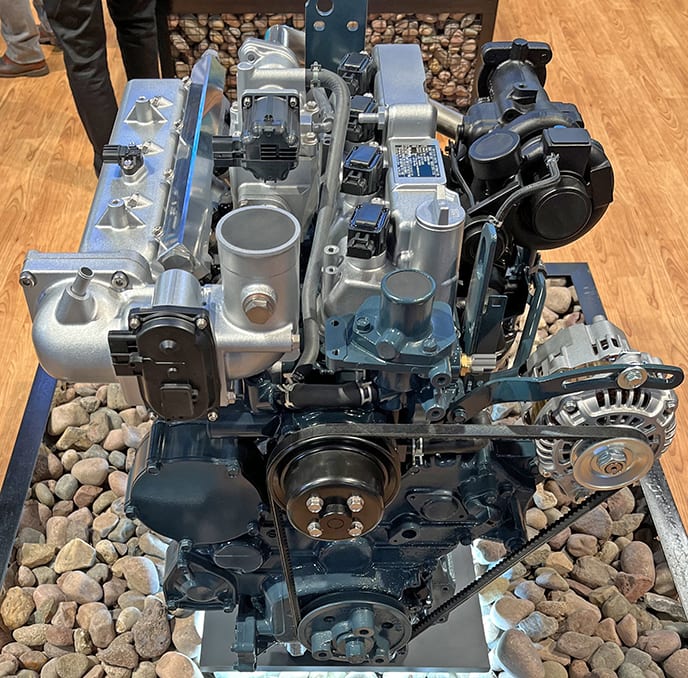
As part of its path to carbon neutrality, Kubota Engine engineers have developed a new 3.8-liter hydrogen engine that was introduced at CONEXPO 2023 in Las Vegas. The 4-cylinder spark-ignited engine employs port fuel-injection and provides 85 kW (114 hp), which is the output required for a 45-kVA generator, the company notes.

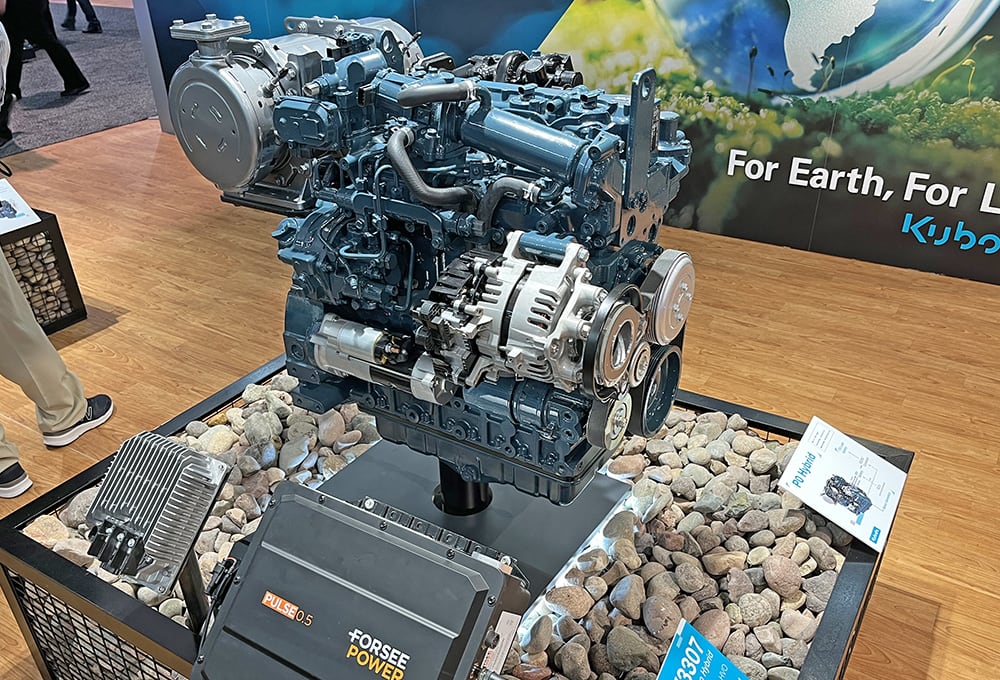
Kotaro Shiozaki, PR manager, Industrial Engine at Kubota Corp., said that hybrid powertrains also are an effective solution for reducing CO2 from industrial engines, and he’s confident they will be more than just an interim solution. Kubota displayed three hybrid solutions: a P0 micro-hybrid that will be available later this year, a P1 hybrid that provides brief periods of motor assist when high output is required and a P2 hybrid engine scheduled for production in 2025 that offers electric-motor drive.
All Kubota diesel engines in Europe are approved to use paraffin-based fuels — gas to liquid (GTL) and hydrotreated vegetable oil (HVO) fuels — that comply with European standard EN15940. The company announced that HVO now is approved for use in its diesel engines in the U.S., enabling a CO2 emissions reduction of up to 90% with no engine modifications, Shiozaki said. He spoke with SAE Media in Las Vegas about these technologies and discussed Kubota’s plans to bring them to market.
Tell me about Kubota’s hydrogen engine.
This is really based on what we have today from the spark-ignited engines. Achievability of the [hydrogen] engine is not so difficult, I would say. The most concern is twofold: one is the procurement of a hydrogen infrastructure and the second is emissions regulations. The regulation is based on the type of fuel — today we don’t have regulations for the hydrogen, that’s why we cannot sell this product in the market yet. So once those two aspects are solved, then we believe we’ll be ready.
[While SAE Media was talking with Shiozaki, California Air Resources Board (CARB) reps came to check out the hydrogen engine.] You can actually witness that they are trying to understand what we can do. And then we are [encouraging] them to set up the regulations. We need to have the regulations.
Though hydrogen is cleaner, there still are emissions.
NOx. NOx can be handled with the SCR [selective catalytic reduction], which is already available. We have a variety of options. Again, back to the applications, if you have X amount of NOx allowed then we can fit whatever we have today. I believe aftertreatment systems will be involved, but maybe less than with diesel because it doesn’t emit CO2 and almost no particles (PM).
Are you testing your hydrogen engine in the real world?

Most of the development is happening within Kubota in Japan. Another part of the development needs to be coworking with the machine manufacturers. When it comes to matching between the applications, it’s local. So, if the customer is located in the U.S., we have a U.S. resource to help the customer to match up the engine to the application.
What applications are you targeting?
This past September we made an announcement with Denyo, a leading genset company in Japan. We believe the genset [an engine-generator combination] can be a good application to start with hydrogen engines. The genset does not move around; it could sit on-site so we can have a big fuel tank nearby. And then maybe next is tractors or excavators.
What is your outlook for hydrogen engines?
It’s up to the applications, but we believe this will be a good alternative solution to replace diesels. It will probably take five to eight or maybe 10 years. Again, back to how soon the infrastructure will be ready.
Are hybrids a good interim solution?
Yes, interim and also permanent. These engines are covering the use of HVO, which is already carbon-neutral. So, if customers or the owner of the machine are able to procure HVOs, then they are done with carbon-neutral. In that case, I’d say it’s a permanent solution. In some countries like Scandinavian, HVO is already popular. For commercial use, they can procure it. In the U.S., I think it’s starting up. You can’t buy it at a gas station around the corner, but if you’re in the commercial business, then you can have [an avenue] to procure it.
What are Kubota’s plans for future diesel development?
We are still working on it — on new combustion and injection technologies. As you see, the base technology of hybrid or hydrogen is based on diesel [and SI] technologies. Whatever we are improving with the diesel engines can be transferred to the hybrid or the hydrogen engines, so there’s no reason for us to stop doing the research on diesel.
More From SAE Media Group
Off-Highway Engineering
Developments in Engine-Based Gensets
Off-Highway Engineering
Zeroing in on Zero-Carbon Fuels
Off-Highway Engineering
Perkins Tackles Decarbonization of Off-Highway Machines
Off-Highway Engineering
Many ICE Paths Lead to Reduced Emissions
Off-Highway Engineering
Global Emissions Regs Demand Differing Engine Strategies
Off-Highway Engineering
Off-Highway Emissions Set to Get Stricter
Automotive Engineering
WCX 2025: Dumarey Launches U.S. Subsidiary for Better ICEs
Off-Highway Engineering
Hydrogen ICE Is Heating Up
Off-Highway Engineering
New Biodiesel Strains Offer Measurable Gains
Automotive Engineering
Extending the ICE Age: Hyundai Optimizing Engines and Fuels
Off-Highway Engineering
Kohler Doubles down on ICE Development
Off-Highway Engineering
Maintaining Protection for Next-Gen HD Engine Lubricants
Off-Highway Engineering
Hybrid Powertrains in the Product Mix
Automotive Engineering
GM’s Diesel-Emissions Strategy for 95 G/km and Beyond
Off-Highway Engineering
Advancing Aftertreatment
Automotive Engineering
Keeping Combustion in the Conversation
Off-Highway Engineering
Response to More-Rigid NOx and GHG Regs
Off-Highway Engineering
Renewable Propane, Ultra-Low NOx Engines Set Standards for Propane Autogas Innovations
Off-Highway Engineering
Liebherr Goes All in on Hydrogen Fuel
Automotive Engineering
2019 HEICE Symposium Kicks off Week of Valuable Engineering Insights
Off-Highway Engineering
Volvo Charts Its Path Towards Zero Emissions
Off-Highway Engineering
Cummins, Tula Test ‘Dynamic’ Cylinder Deactivation for Diesels
Off-Highway Engineering
Propane Powers Ahead for Medium Duty Sector
Off-Highway Engineering
Cummins’ New Mid-Displacement Turbos Quieter and More Efficient
Off-Highway Engineering
Integrating Ultra-Low NOx Technology Presents Challenges
Off-Highway Engineering
Hydrogen’s Humming in Power Generation
Off-Highway Engineering
Study: Excessive Real-World NOx Emissions from HD Diesel Pickups
Off-Highway Engineering
Regulatory Landscape Challenges Commercial-Vehicle Engine Development
Automotive Engineering
The Electrofuels That Reduce Amazon’s Fleet Emissions
Off-Highway Engineering
Combustion Engines Carry on in Construction
Top Stories
NewsRF & Microwave Electronics
 Microvision Aquires Luminar, Plans Relationship Restoration, Multi-industry Push
INSIDERAerospace
 A Next Generation Helmet System for Navy Pilots
INSIDERDesign
 New Raytheon and Lockheed Martin Agreements Expand Missile Defense Production
INSIDERMaterials
 How Airbus is Using w-DED to 3D Print Larger Titanium Airplane Parts
NewsPower
 Ford Announces 48-Volt Architecture for Future Electric Truck
ArticlesAR/AI

Webcasts
Electronics & Computers
 Cooling a New Generation of Aerospace and Defense Embedded...
Automotive
 Battery Abuse Testing: Pushing to Failure
Power
 A FREE Two-Day Event Dedicated to Connected Mobility
Unmanned Systems
 Quiet, Please: NVH Improvement Opportunities in the Early Design Cycle
Automotive
 Advantages of Smart Power Distribution Unit Design for Automotive &...
Energy
 Sesame Solar's Nanogrid Tech Promises Major Gains in Drone Endurance