




Solving Problems and Seeking Big Ideas for Commercial Vehicles
PACCAR’s Phil Stephenson previews SAE COMVEC 2025 and offers insights into powertrain diversification, the role of AI, a software-defined future and the importance of people.
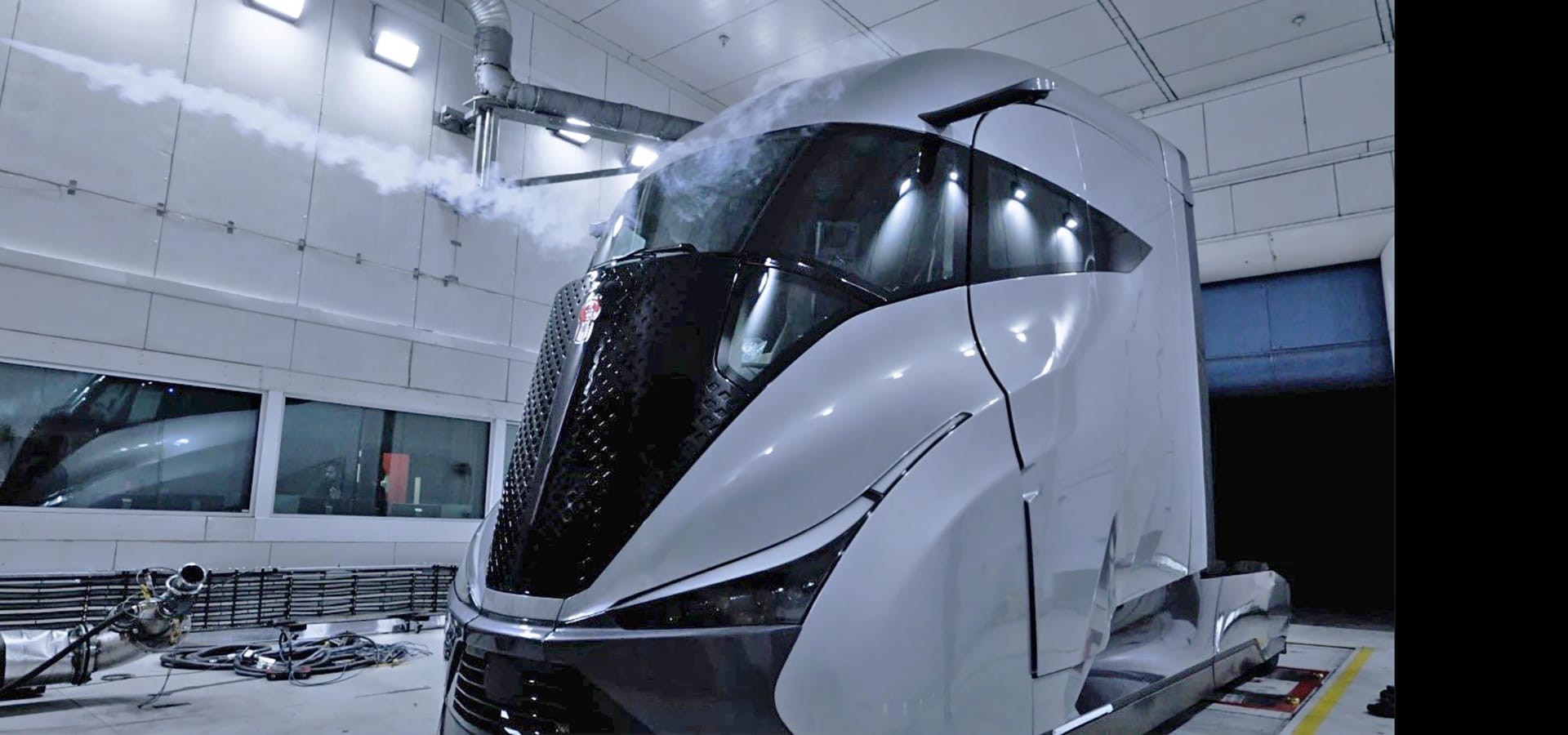
Advancing technology to solve challenges involving regulation, compliance, autonomy, electrification, combustion engines and other areas is an obvious focus of SAE International’s flagship gathering for the commercial vehicle and off-highway industries, COMVEC 2025 . But advancing people, which is vital to navigating this challenging environment, is a particular focal point for this year’s engineering event being held in Schaumburg, Illinois, in September.

Workforce development is just as critical as technology development, stresses Phil Stephenson, general manager of PACCAR Technical Center, where he leads a team of engineers, technicians, mechanics, scientists and business leaders. Stephenson is serving as the executive chair of SAE COMVEC 2025, which carries the theme “Advancement, Empowerment & Exploration: Shaping the Future Together.”
“While technology plays an important role in advancement, the most important element in engineering is the people themselves,” Stephenson said. “Empowerment covers aspects of people development, from continuous learning, to reaching out broadly to find the next generation of engineers and technicians and ensuring that industry and academia are welcoming and supportive of all who aspire to grow.”
Exploration, he said, means seeking the next big ideas and finding ways to make practical use of future technology for the betterment of the world. The three days of COMVEC will explore these themes through keynote presentations, panel discussions, technical sessions and informal networking opportunities.
“I’m very excited to see it all play out,” Stephenson said. He discusses a range of workforce and technology topics in this Q&A with SAE Media.
What types of engineers are in demand for commercial vehicles of the future?
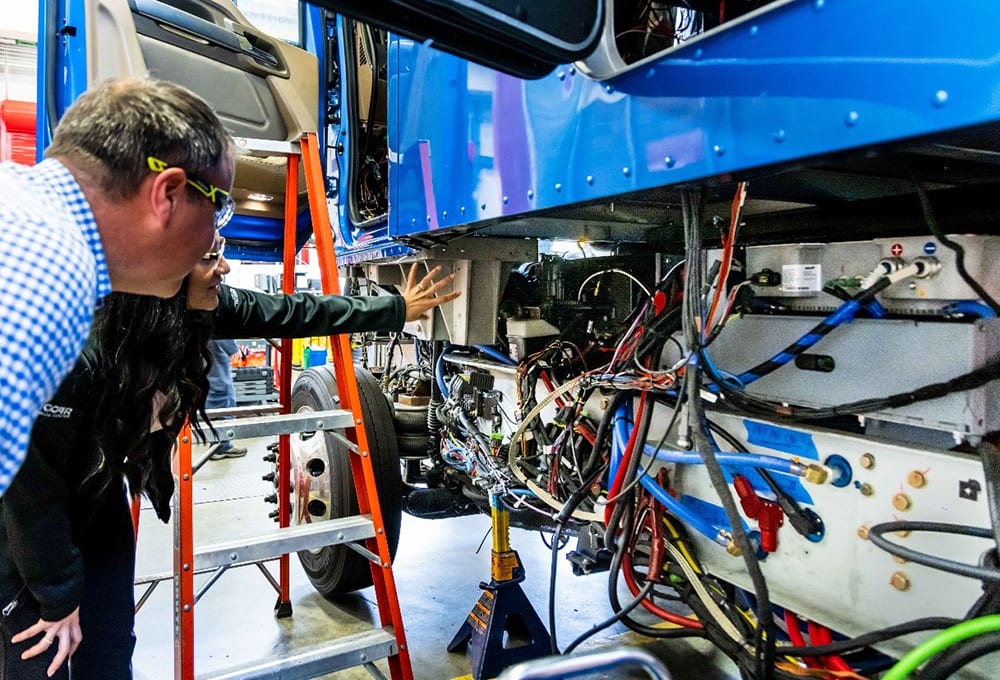
While the technical challenges our engineers tackle are changing with increasing product complexity, many keys to success for our employees have remained the same. We continue to seek and hire people with strong cross-functional skills who can work across the company to solve complex and dynamic problems with teams located around the world. Of course, electrification, connectivity, autonomy and other emerging technologies drive engineers to think about problems at a systems level and use advanced tools like simulation and data analysis in ways that are quite different to decades past.
Tied to the workforce ecosystem, how can technicians/mechanics be better prepared to service these advanced commercial vehicles?
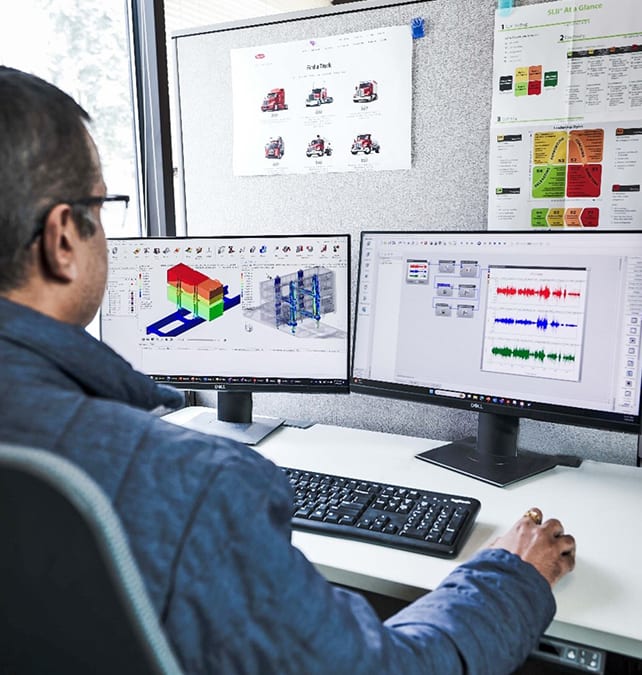
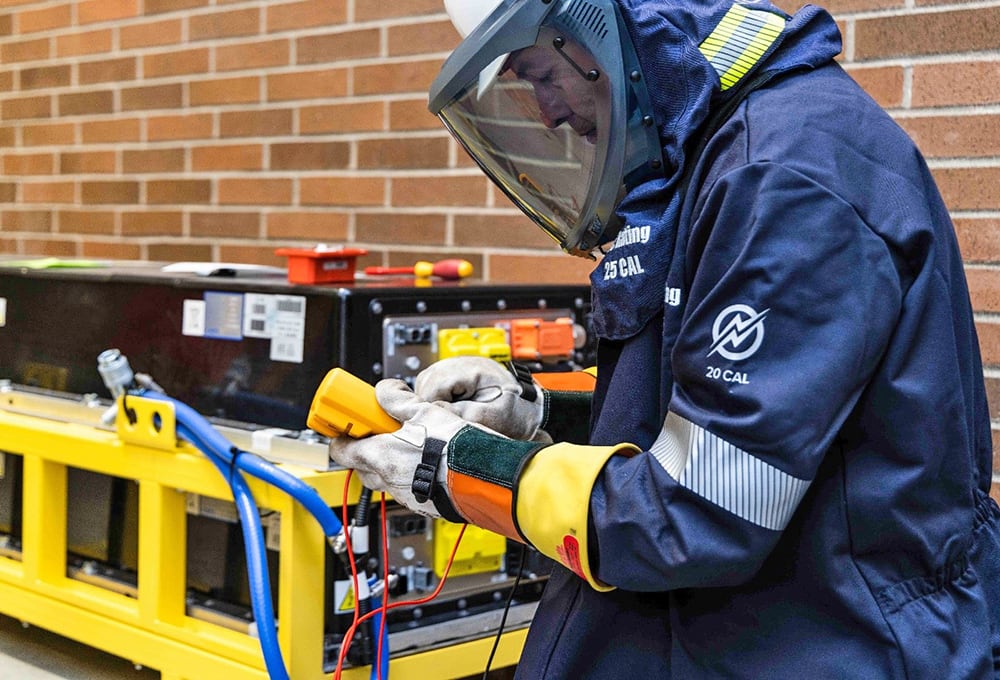
As the technology in commercial vehicles continues to become more complex, it is incumbent upon manufacturers to provide tools, documentation and training materials to enable technicians and mechanics to work on these vehicles. In addition to these specific items, continuing education, for example in the fundamentals of on-vehicle electronic networking or high-voltage safety, is also important. We have been working with technical schools extensively to support education of new and experienced technicians and mechanics. The SAE’s leadership in automotive standards is also an excellent basis for continuing education of new and experienced technicians and engineers.
Internal combustion engines have been under attack, so to speak, for the past decade, but appear to be gaining momentum again with H2-ICE, low-carbon fuels and hybridization. How do you see it playing out in the next 10-20 years?
Because commercial vehicles are used in such a variety of ways, the optimum powertrain varies widely with the vehicle application. Constraints such as fueling/charging infrastructure, emissions regulation and uptime present a multi-objective optimization problem to powertrain developers. The internal combustion engine is an excellent example of engineering continuous improvement. When one looks at the extremely low particulate and NOx emissions of modern diesel engines and considers that these improvements have been made simultaneously with reductions in CO2 emissions, it is clear that ICE will continue to have a future in commercial vehicle powertrains for the foreseeable future.
We are, however, at the point of diminishing returns in engine-only improvements, which means that future powertrain development will likely need to incorporate system-level enhancements, such as hybridization. The ability to operate an engine at its most efficient point by leveraging an electric motor and battery system offers significant promise, and significantly reduces constraints associated with electrical charging infrastructure. The ability to recapture braking energy is another efficiency enhancement. Since CO2 emissions are a key focus, options which reduce the net CO2 emissions, either through renewable fuels or low or no carbon fuels such as hydrogen can also enable the internal combustion engine to continue to meet future requirements.
The future will benefit from a wide variety of powertrain technologies, and there will not be a one-size-fits-all solution. Battery-electric commercial vehicles are finding their initial niche in applications including local pickup and delivery, refuse and mining, for example, while long-haul trucking will likely be predominantly an ICE application. The future of commercial powertrain will be quite diverse for the next decades.
Last year’s COMVEC devoted several sessions to the topic of software-defined commercial vehicles. Has any progress been made in the year since?
The benefits of moving from a hardware-centric approach to a software-centric approach are driving ever increasing investments in the transportation sector. At the same time, it is also becoming clear that the transition from a signal-based domain controller architecture to a service-based central and zonal controller architecture is a journey that will evolve over time. And it is likely that different OEMs will have different priorities when it comes to which areas of the vehicle to target first, such as ADAS functionality or cabin-related systems. But it is safe to say that all OEMs have this as a priority and are either making concrete plans or actively working on major electronics updates supporting a software-defined future.
What is your vision for the role of AI in the commercial vehicle/off-highway industries?
Artificial intelligence comes in multiple forms, of course, from machine-learning analysis tools widely used today to increase our effectiveness at root cause finding in complicated multi-variate problems; to the use of Large Language Models for more effective voice recognition and AI-agents in many areas of the transportation business. On the development side, we are only scratching the surface, but text-to-code software generation looks to be a growing opportunity for speeding function development.
Cybersecurity becomes a greater concern as software and connectivity increase. How can the industry better protect against cyber incidents?
Effective cybersecurity needs to include both prevention and mitigation. Prevention on the product side is a layered approach that includes vehicle firewalls, secure onboard communication, and encrypted device programming. Threat monitoring and addressing of discovered vulnerabilities is also key to this. With all vehicles now connected, mitigation also needs to include over-the-air update capabilities to enable rapid corrections. But since most cybersecurity issues still start with some sort of person-dependent access, it is really up to all of us to maintain vigilance towards unauthorized connections through simple email phishing to utilizing poorly secured or simple-to-guess passwords.
What keeps you awake at night?
There are many answers to this question, but one thing that does keep me thinking constantly relates to product validation. Because of the long-life expectation and the variety of applications of our products, and due to the growing application of new technologies on our trucks, our ability to develop product validation methods must also advance to keep up with product development. We need to continue to develop tests which are accelerated so that we find failure modes much faster than a customer would, but the tests must be representative of the variety of applications. The application of simulation tools, connected vehicle data analysis, and testing at component, system, vehicle and fleet level are key ways that we are working to ensure that our validation keeps up with our development efforts.
And what excites you most about the industry today?
I continue to find it exciting to work in an area of automotive engineering, where the customer needs are so diverse and the opportunity to apply engineering problem-solving skills is so rich and rewarding. Our customers buy our products to use as tools in their business, and they expect durability, uptime, convenience and quality. Whether we are working on powertrain development, vehicle aerodynamics, customer experience and ergonomics, or a myriad of other topics, we have amazing tools at our fingertips to define, design, simulate, test and validate the best possible products for our customers. Since commercial vehicles play such a key role in the support of national economies, engineers can be very proud of the contribution our work continues to make every day.
More From SAE Media Group
Off-Highway Engineering
Many ICE Paths Lead to Reduced Emissions
Off-Highway Engineering
Regulatory Landscape Challenges Commercial-Vehicle Engine Development
Off-Highway Engineering
Deutz Equips Telehandlers with Hybrid and Fully Electric Powertrains
Automotive Engineering
Tula’s DMD Promises Gains in EV Efficiency
Off-Highway Engineering
Innovation Still Industry's 'Lifeblood' During Pandemic
Off-Highway Engineering
Clarios Brings AI to Idle Management for Heavy Trucks
Off-Highway Engineering
Hybrid Powertrains in the Product Mix
Off-Highway Engineering
Delphi Injects Life into Diesel
Off-Highway Engineering
Combustion Engines Carry on in Construction
Off-Highway Engineering
Advancing Aftertreatment
Off-Highway Engineering
Advances in Virtual Powertrain Development
Off-Highway Engineering
‘Heavy’ Topics on Tap for WCX18
Off-Highway Engineering
Cummins Unveils PowerDrive Hybrid-Electrics, Euro 7 Diesel Concept
Off-Highway Engineering
Cummins CTO Sees Increasing Power Source Diversification, Digital Innovation
Automotive Engineering
Hydrogen Storage in a Box!
Automotive Engineering
Off-Highway Hybrids Are Entering Prime Time
Off-Highway Engineering
Zeroing in on Zero-Carbon Fuels
Off-Highway Engineering
Off-Highway Emissions Set to Get Stricter
Off-Highway Engineering
Startups Emerge as Accelerators for Commercial-Vehicle Technologies
Automotive Engineering
Gearing Dana for the EV Future
Aerospace & Defense Tech Briefs
Air Mobility Innovations Take Center Stage at Aerospace Systems and Technology Conference
Automotive Engineering
Tata Steel Europe Innovates to Retain the Automotive Materials Lead
Automotive Engineering
Charting the ICE Future with Mahle’s Martin Berger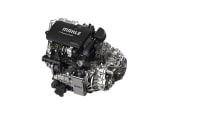
Off-Highway Engineering
Challenges and Opportunities of Electrifying Off-Highway Machines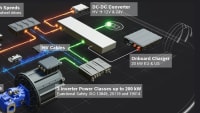
Automotive Engineering
The Electrofuels That Reduce Amazon’s Fleet Emissions
Off-Highway Engineering
New Biodiesel Strains Offer Measurable Gains
Off-Highway Engineering
Cummins, Tula Test ‘Dynamic’ Cylinder Deactivation for Diesels
Aerospace & Defense Tech Briefs
Industry Invited to Participate in AeroTech Aerospace and Defense Technical Program
Off-Highway Engineering
Hydrogen ‘Inevitable’ for Commercial Vehicles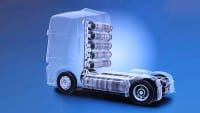
Off-Highway Engineering
How Battery Technology Will Drive Truck Electrification
Top Stories
NewsSensors/Data Acquisition
 Microvision Aquires Luminar, Plans Relationship Restoration, Multi-industry Push
INSIDERRF & Microwave Electronics
 A Next Generation Helmet System for Navy Pilots
INSIDERWeapons Systems
 New Raytheon and Lockheed Martin Agreements Expand Missile Defense Production
NewsAutomotive
 Ford Announces 48-Volt Architecture for Future Electric Truck
INSIDERAerospace
 Active Strake System Cuts Cruise Drag, Boosts Flight Efficiency
ArticlesTransportation

Webcasts
Aerospace
 Cooling a New Generation of Aerospace and Defense Embedded...
Energy
 Battery Abuse Testing: Pushing to Failure
Power
 A FREE Two-Day Event Dedicated to Connected Mobility
Automotive
 Quiet, Please: NVH Improvement Opportunities in the Early Design Cycle
Electronics & Computers
 Advantages of Smart Power Distribution Unit Design for Automotive &...
Unmanned Systems
 Sesame Solar's Nanogrid Tech Promises Major Gains in Drone Endurance