




Volvo CE Not Letting up on Electric
Melker Jernberg admits that wider spread adoption of battery-electric machines has been lackluster but still believes the EV transformation is inevitable.

Volvo Construction Equipment made a big statement at Bauma 2025 by displaying an all-EV lineup and revealing a new electric articulated hauler to boot. The company has come a long way since the 2019 event when it unveiled its first two commercial electric machines, said Melker Jernberg, president of Volvo CE. “Today we are leaders in many different segments when it comes to electrification,” he said.
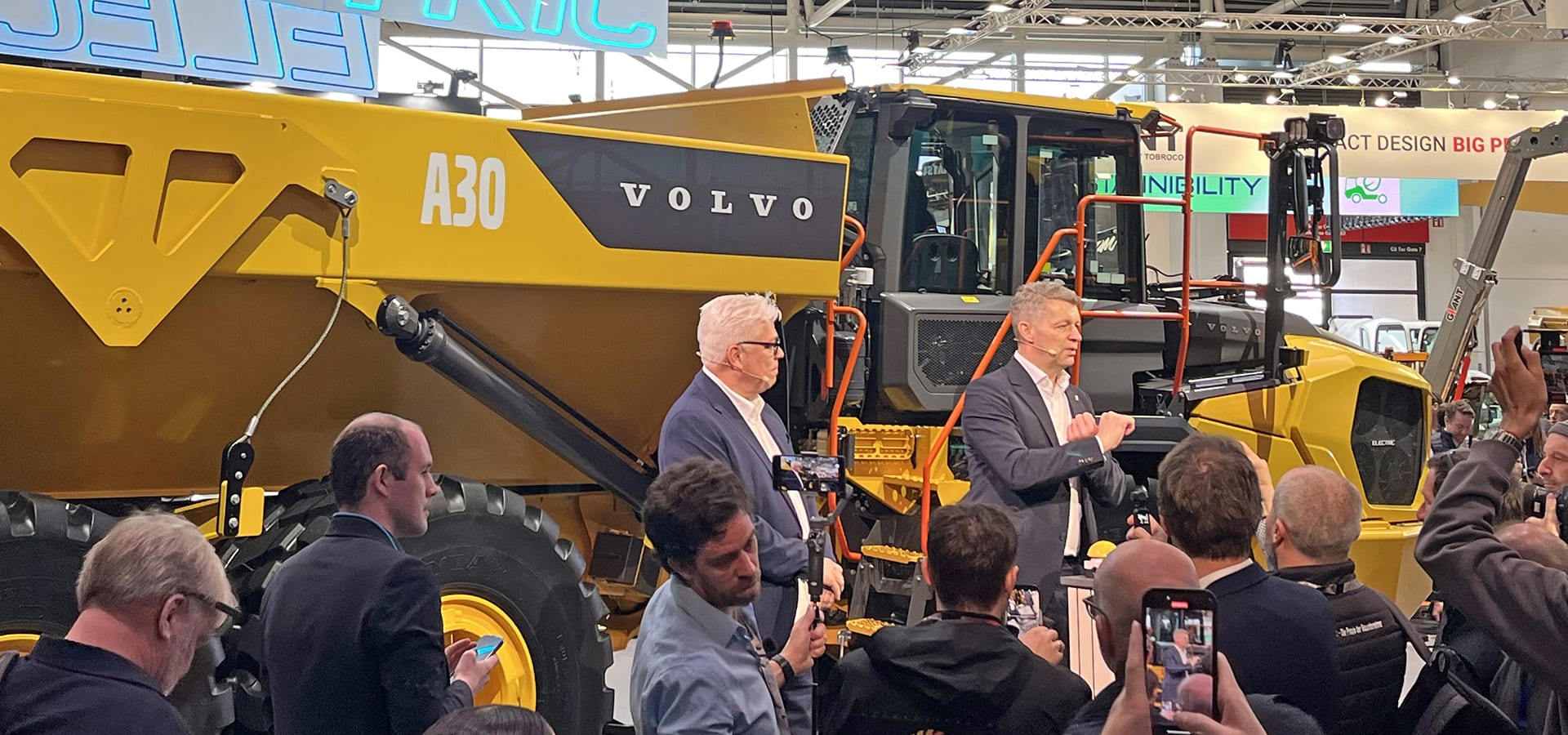
Jernberg helped to drop the curtain on a claimed “world first” EV, the A30 electric articulated hauler. Five “cubes” of 600V Li-ion batteries provide 270 kWh of usable energy (450 kWh installed) and a runtime of 4 to 4.5 hours. A 350-kW charger can charge the machine to between 20-80% in one hour. Delivery of A30 and A40 electric haulers will start in Europe in 2026 for selected customers, “then we’ll ramp up for all other markets in 2027 and 2028,” he said.
Jernberg answered questions about Volvo CE’s electrification and product strategy during a Bauma press conference.
When we look at the industry going forward, do you see a single solution – battery-electric is the only way to go?
The answer is clearly no. The transformation [to battery electric] is underway. Unfortunately, slower than expected, slower than needed, slower than wanted. We have decided that we need to continue to lead the way when it comes to sustainable solutions for transport, for construction, for infrastructure, etcetera. To make that happen, we need different technology solutions.
Can you characterize the EV market and tell us where adoption is and where you want it to be?

If you take this over a longer time, this will be a bump in the road, I’m quite sure about that. We have so many use cases where it’s not only about the CO2 [emissions] – this is a fantastic business case. If you do the TCO calculation, you will not buy that diesel version in many cases...But it depends on the electricity, too. As well as the technology it’s also that we need to start to put demand on green electricity. But this [shift to electric] will happen because it’s much better.
What about customers who aren’t ready to go electric?
Not yet, maybe. We are quite sure that internal combustion engines will continue to play an extremely big role in our industry. And that’s the reason why we continue to invest heavily in that technology. We have done so over the years, and we have proven over and over again how much efficiency we can gain in the ICE. Also to optimize the combustion engine of course for renewable fuels, biodiesel, HVO, etcetera.
How about hydrogen fuel cells?
Hydrogen fuel cells in the construction industry – will it play a role or not? I’m quite sure it will. There will be segments, [certain] applications where that will be a better solution than battery electric. But I think it’s also fair to say, given the infrastructure and maturity, we are focusing more short-term on the battery-electric solutions.
When it comes to product, what can customers expect? Any new launches that are noteworthy?
2024 and 2025, that has been our biggest launch years ever. We’re talking about 80 new models – that’s one-third of our entire portfolio. We’re launching a totally new range of excavators, a new range of articulated haulers, some new rigid haulers, and on top of that a number of battery-electric [machines] of different size classes. We are investing a lot in both the product and the services. I must say I’m extremely proud of what the team has achieved when it comes to fuel efficiency and productivity also on the diesel machines. The new hauler is [around] 15% better when it comes to fuel efficiency.

How do you help customers gain peace of mind to invest in new technologies?
There’s always some kind of risk when starting to invest in new technologies – from a customer perspective, CapEx, OpEx, procedural risk and all these kinds of things. We have a service, Volvo Financial Services, that helps a lot in these discussions to derisk and help the customers.
There are also other ways of doing business, especially when it comes to new technologies. We work with short- and long-term rental [companies], but we also now globally have been quite successful with many customers with what we call Equipment as a Service (EaaS), which is a pay-per-use model. Not perfect for everyone but for many it’s a win-win-win situation, because it’s guaranteed uptime with lower risk but with really good products.
More From SAE Media Group
Automotive Engineering
Honda’s Hydrogen Progress
Automotive Engineering
Handicapping the ‘Race Toward Zero’
Off-Highway Engineering
Hydrogen ‘Inevitable’ for Commercial Vehicles
Off-Highway Engineering
Volvo Charts Its Path Towards Zero Emissions
Automotive Engineering
Time for Hydrogen
Off-Highway Engineering
Danfoss and Sany Extend Electrification of Off-Highway Machines
Off-Highway Engineering
Volvo’s Ambitious Goal: 50% Zero-Emission Trucks by 2030
Off-Highway Engineering
Hyundai CE Debuts Hydrogen and Electric Excavators at Bauma 2022
Automotive Engineering
Hydrogen Industry Vet Says Fuel Cells Still a ‘Go’
Automotive Engineering
Hydrogen Storage in a Box!
Off-Highway Engineering
Battery of Issues Surrounds Large-Vehicle Electrification
Off-Highway Engineering
Bauma the Big One in 2025
Off-Highway Engineering
Mahle Amps up Its Electrification R&D
Off-Highway Engineering
Batteries Not the Only Route to EV Efficiency
Off-Highway Engineering
Freudenberg to Deliver Batteries, Fuel-Cell Stacks
Off-Highway Engineering
Case Launches ‘Industry First’ Electric Backhoe Loader
Automotive Engineering
Making H2 Fuel Cells Happen
Off-Highway Engineering
GM Nikola Tie-Up Sparks Worldwide Hydrogen Fuel Cell Interest
Off-Highway Engineering
Paccar Reveals New and Future Tech at CES 2018
Off-Highway Engineering
Narrower Focus, Bigger Payoff for Commercial EVs
Off-Highway Engineering
GM Hydrotec Boss Readies Fuel Cells for Commercial Deployment
Automotive Engineering
BMW Reapproaches Hydrogen
Off-Highway Engineering
Nikola Producing Battery-Electric Trucks, Fuel-Cell EVs Coming
Off-Highway Engineering
Battery Innovation Key for Commercial and Off-Highway EVs
Off-Highway Engineering
Hybrids Are Having a Moment
Off-Highway Engineering
Hybrid Powertrains in the Product Mix
Off-Highway Engineering
Hydrogen Lightens the Load for Heavy Trucks
Off-Highway Engineering
Electric Mobile Machines Won’t Abandon Hydraulics
Off-Highway Engineering
All Options on the Table
Off-Highway Engineering
Hyundai Reveals Compact Electric Excavator Prototype
Top Stories
NewsRF & Microwave Electronics
 Microvision Aquires Luminar, Plans Relationship Restoration, Multi-industry Push
INSIDERAerospace
 A Next Generation Helmet System for Navy Pilots
INSIDERDesign
 New Raytheon and Lockheed Martin Agreements Expand Missile Defense Production
INSIDERMaterials
 How Airbus is Using w-DED to 3D Print Larger Titanium Airplane Parts
NewsPower
 Ford Announces 48-Volt Architecture for Future Electric Truck
ArticlesAR/AI

Webcasts
Electronics & Computers
 Cooling a New Generation of Aerospace and Defense Embedded...
Automotive
 Battery Abuse Testing: Pushing to Failure
Power
 A FREE Two-Day Event Dedicated to Connected Mobility
Unmanned Systems
 Quiet, Please: NVH Improvement Opportunities in the Early Design Cycle
Automotive
 Advantages of Smart Power Distribution Unit Design for Automotive &...
Energy
 Sesame Solar's Nanogrid Tech Promises Major Gains in Drone Endurance