




Powertrain Testing: Coping with Complexity
With increasing use of electrical components to extend the performance of conventional combustion engines, powertrain development has never been more complicated. The good news is that test and development engineers are harnessing advanced simulation techniques and computer processing to develop the most efficient and fun powertrains ever.

Despite the good news of falling oil prices worldwide, the pressure remains for automakers to deliver efficient powertrains.
“You can call it the road to 2020,” explained Joe Strelow, Manager, Test Systems for AVL, in an interview with Automotive Engineering. “It not just regulations [such as CAFE in the U.S.]; there is a lot of new competition in the wings. I see a lot of renewed energy in the traditional OEMs to bring advanced technologies into their vehicles and generate the same excitement as new entrants to this industry.”

That means powertrain consulting firms like AVL need to adjust both tools and practices.
“Not that many years ago, our business was built around three main components of the powertrain — the engine, the transmission, and a single control unit, typically for the engine,” he said. Now it is based on five components. These include the engine and transmission as before, and now electric motors, batteries, and a complex network of multiple electronic control units, or ECUs, controlling individual components.

Just within a powertrain dynamometer test cell, this new world has meant changes. Combinations of electric motors working in synchronization with the engine mean multiple sources of torque that need to be controlled. Batteries now need sophisticated emulation.
“For example, no one cared about batteries before; now with the rise of 48-volt systems you need to simulate state-of-health and state-of-charge,” he said. This is to understand durability and drivability on electric components like start/stop devices. “Having that thing start and drive away very cleanly and smoothly is a drivability issue that was not traditionally done on engine test beds,” he said.
Simulation and testing — complementary intersection
One of the key elements in containing the growing complexity while reducing cost and test time is increasing CAE (computer-aided engineering) simulation, according to Strelow.
“There is a value point at the intersection where simulation and testing meet, and quietly AVL has put together the tools to satisfy a lot of these difficult development tasks,” he explained. These include vehicle simulations as well as modeling driver behavior. “[We need to find out] how the car is going to pull away from a stop light when the driver just mashes his foot to the floor because he feels the car is not even running — he panics — versus the person who just eases away,” he explained.
To help put driver behavior in the test cell, AVL developed parameterized driver models. Combined with sophisticated vehicle dynamics, their simulation system allows engineers to understand powertrains as they are installed on vehicles and used by drivers.
“Using simulation has always been around, but it has intensified,” agreed Marek Tatur, Director of Test Operations for FEV, speaking exclusively to Automotive Engineering. The increasing power of software and computers now makes CAE simulation more effective than ever. “For brand new powertrain developments — clean-sheet development — we use plenty of CAE that includes combustion simulations, thermal simulation of operating fluids in the engine, and where possible, mechanical simulation mapping out mechanical and thermal limits,” he explained.

As the development program progresses into test, simulation remains important — sometimes in surprising ways. Tatur noted that engineers always verify their CAE simulation results by comparing with test data. As you might expect, they do not always match. After decades of development, he finds that simulations are trustworthy, when correlated with high quality test data.
“Typically, if we are sure the input data to the simulation model is high quality and the test data do not match the simulation model, a problem with hardware components has likely occurred,” he explained. “For example, it might be a malfunctioning turbocharger or some other critical component.”
Performance increases — engines and computers
Another trend that Tatur observes with his customers is more interest in performance, somewhat in keeping with lower fuel prices. Nevertheless, regulatory pressures on fuel economy remain. He observed that gasoline engines have made some remarkable leaps over the past years, with maximum torque levels meeting or even exceeding those of modern diesel powertrains.
“We have observed a very clear trend towards increased power density. As the displacements of new engines go down, specific performance has gone up, for both gasoline and diesel,” he said. “That means we have to adapt our test field accordingly, accommodating higher performance at the upper end of the scale, but still being able to accommodate low displacement engines that have very high specific power. They oftentimes exhibit large torsional vibrations that we have to account for. We have learned how to handle those by developing tools that use advanced multi-body system analysis focusing specifically on driveline layouts.”
Tatur also noted that with the challenges in future tailpipe emissions regulations and onboard diagnostic requirements represent a growing demand on development cycle durations and equipment accuracy. With monitors tracking the performance details of both engine and aftertreatment systems, the ideal starting point is when the engine and aftertreatment systems are fully calibrated.
“However, the resulting product development duration is unacceptable,” he said, requiring parallel development with HIL (hardware-in-loop) — or micro-HIL — based simulation.
Electronics and computers
This speaks to the importance of electronics in today’s powertrain development programs, reflected in the primary degree held by Mitch Monroy, Business Unit Director for Test Services for IAV. His Electrical Engineering degree stands out among a field once dominated by mechanical types.

“I am more focused on electronics, especially the electronic control module, combining it with hardware and testing it as if it were in the car,” he explained to Automotive Engineering. Besides delivering test stands for developing control systems to OEMs and Tier 1s, his group also helps develop models for the controllers, ensuring a proper balance between fidelity and speed. These test stands are in effect simulation laboratories, allowing customers to develop and optimize controller strategies and calibrations.
With increasing electrification of the powertrain, a big challenge (among many) is data communication between ECUs.
“There is an ECU for the powertrain, one for the ABS, ECUs for various body controls, the electric motor, battery — more than 50 for some luxury models,” said Monroy. “All effect the powertrain today, and that communications is an area where the customer can get very concerned.”
This is another reason why simulations, especially model-based simulations, are so important, according to Monroy, because of the opportunity it gives to run a significant amount of tests. “In a real vehicle that is more difficult to do in a timely and cost effective manner,” he said.
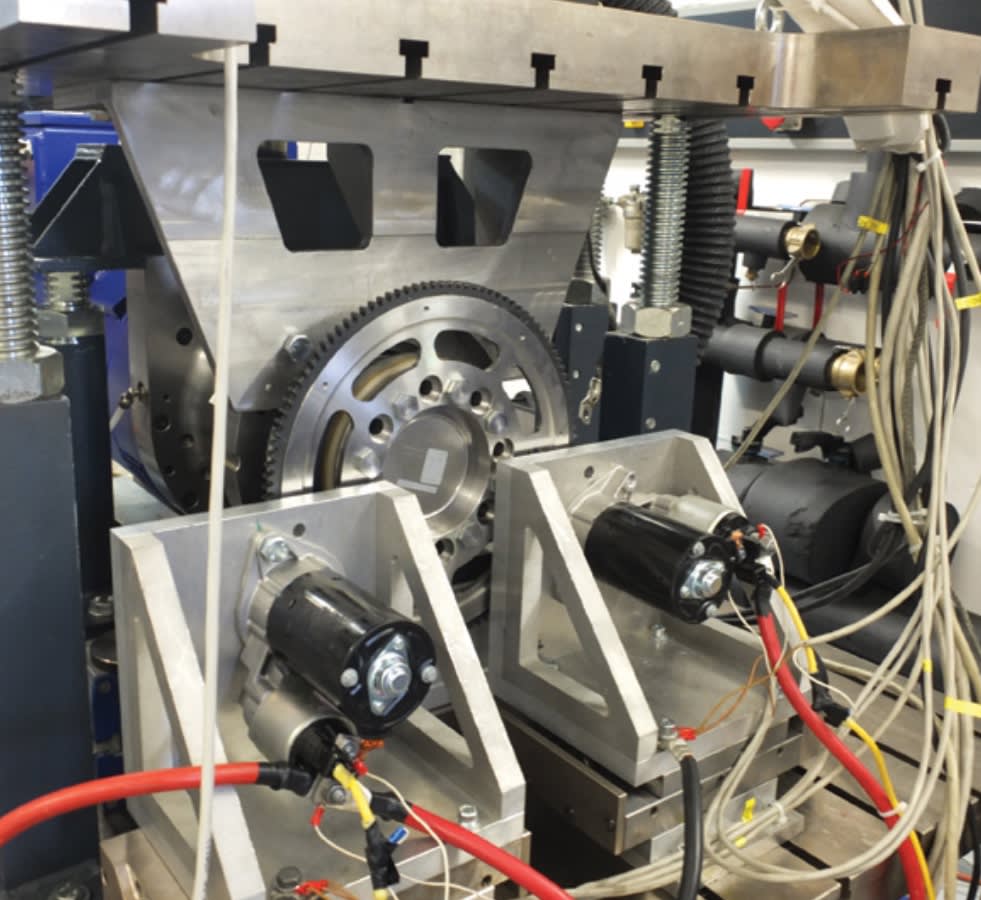
Some key factors driving development of the systems Monroy sees goes beyond fuel economy, as important as that is. “Quality in terms of avoiding recalls,” he said, alluding to a record year in recalls for 2014. “There is also functional safety, as new systems are all drive-by-wire, and onboard diagnostics as well,” he said. “You do not want customers seeing diagnostic lights.”
He summarized the importance of simulation test stands, such as those IAV delivers, fulfilling three functions of equal importance. The first is the obvious, testing control strategies. Just as important is the invention cycle, developing those strategies to meet engineering goals, make the driver happy, and create competitive advantage. The third is to simulate and duplicate faults that are difficult to recreate in real vehicles, avoiding recalls and solving them quickly when they do.
More From SAE Media Group
Off-Highway Engineering
FEV Simplifies Off-Highway Electrification

Off-Highway Engineering
Upswing in Outsourced EV Testing
Automotive Engineering
Tula’s DMD Promises Gains in EV Efficiency
Automotive Engineering
FEV and the Art of EV Testing
Automotive Engineering
Transforming Propulsion with Tula’s Digital-Control Magic
Automotive Engineering
Executive Insights: BorgWarner VP and CTO Hakan Yilmaz
Tech Briefs
EV vs. ICE: How Does Wire Harness Design Differ?

Automotive Engineering
Off-Highway Hybrids Are Entering Prime Time
Autonomous Vehicle Engineering
Autonomy and Electrification: A Perfect Match?
Automotive Engineering
Converting Classic Cars Is Just Step One of This Mission
Automotive Engineering
Tuning the 2024 Corvette E-Ray for Exceptional Drivability
Automotive Engineering
SAE Launches New Standards Document to Rate Power of Electrified Vehicles
Autonomous Vehicle Engineering
Making the Strategic Move into AV Testing
Off-Highway Engineering
Electric Mobile Machines Won’t Abandon Hydraulics
Automotive Engineering
SAE WCX 2022: Driveline Flexibility Is Key for Electrification
Off-Highway Engineering
Case Launches ‘Industry First’ Electric Backhoe Loader
Off-Highway Engineering
Many ICE Paths Lead to Reduced Emissions
Automotive Engineering
E-Axles Speed Electrification
Off-Highway Engineering
AxleTech Develops Electric Independent Suspension Concept for Vehicles Up to 58,000-lb GCWR
Off-Highway Engineering
Engine Developers Increase Efforts to Decrease Fuel Usage
Automotive Engineering
Renault Applies Model-Based Systems Engineering to Dual-Clutch Transmission
Automotive Engineering
A Darker Side of the Chip-Shortage Story
Automotive Engineering
Orbis Says HaloDrive Axial-Flux Motor Available for In-Wheel, Other Uses
Off-Highway Engineering
Solving Problems and Seeking Big Ideas for Commercial Vehicles
Automotive Engineering
Internal Combustion: Once More, with Feeling
Off-Highway Engineering
Off-highway Calibration Challenges — Big and Complex
Power Electronics INSIDER
An Electrifying Collaboration: From the Lab to the Marketplace
Aerospace & Defense Tech Briefs
The Future of Aircraft Electrification
Top Stories
INSIDERManufacturing & Prototyping
 How Airbus is Using w-DED to 3D Print Larger Titanium Airplane Parts
INSIDERManned Systems
 FAA to Replace Aging Network of Ground-Based Radars
NewsTransportation
 CES 2026: Bosch is Ready to Bring AI to Your (Likely ICE-powered) Vehicle
NewsSoftware
 Accelerating Down the Road to Autonomy
EditorialDesign
 DarkSky One Wants to Make the World a Darker Place
INSIDERMaterials
 Can This Self-Healing Composite Make Airplane and Spacecraft Components Last...
Webcasts
Defense
 How Sift's Unified Observability Platform Accelerates Drone Innovation
Automotive
 E/E Architecture Redefined: Building Smarter, Safer, and Scalable...
Power
 Hydrogen Engines Are Heating Up for Heavy Duty
Electronics & Computers
 Advantages of Smart Power Distribution Unit Design for Automotive...
Unmanned Systems
 Quiet, Please: NVH Improvement Opportunities in the Early Design...
