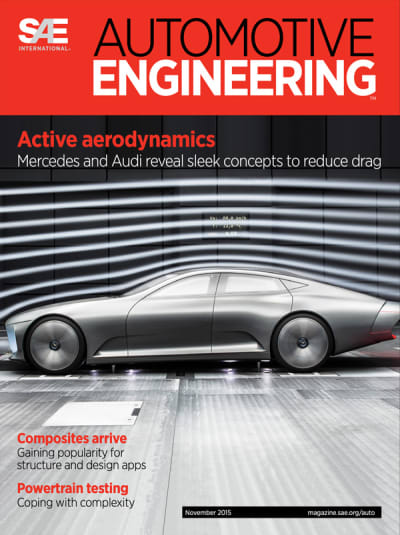
Automotive Engineering - November 2015
Inside this issue
Overview
The November 2015 issue of Automotive Engineering presents a diverse range of topics and innovations in the automotive industry, showcasing advancements in technology, design, and materials. This issue is particularly notable for its focus on aerodynamics, lightweighting, and the integration of new technologies in vehicle design and manufacturing.
Editorial Insights: The editorial section introduces the issue with insights from key editorial staff, including Kevin Jost, the Editorial Director, and other contributors who provide a glimpse into the themes explored in this edition. The editorial emphasizes the importance of innovation in the automotive sector and sets the stage for the features and articles that follow.
Cover Feature: The cover story highlights the Mercedes-Benz Concept IAA, which boasts a remarkable aerodynamic coefficient of drag (Cd) of 0.19. This feature discusses the engineering behind the vehicle's design, showcasing how active aerodynamic elements contribute to its efficiency and performance. The focus on aerodynamics reflects a growing trend in the industry to enhance fuel efficiency and reduce emissions through innovative design.
Major Auto Shows: The issue also discusses the significance of major international auto shows as platforms for automakers to present their visions for the future of mobility. These events serve as a stage for manufacturers to unveil new technologies and concepts, allowing them to gauge public and industry reactions.
Technological Innovations: A key highlight in this issue is the exploration of lightweighting in vehicle design. The article on Jaguar Land Rover's award-winning lightweight architecture design concept for the Range Rover emphasizes the importance of reducing vehicle weight to improve fuel efficiency and performance. This aligns with the industry's broader goals of sustainability and environmental responsibility.
3D Printing in Automotive: The magazine features a segment on Local Motors, which launched a contest for the 3D printing community to design a road-ready vehicle. The winner, Kevin Lo, created the "Reload Redacted - Swim and Sport," showcasing the potential of 3D printing technology in automotive manufacturing. This innovation represents a shift towards more flexible and efficient production methods, allowing for rapid prototyping and customization.
Electric Vehicle Charging Technology: Another significant development covered in this issue is StoreDot's breakthrough in electric vehicle (EV) charging technology. The Israeli startup claims to have developed a battery that can fully charge an electric vehicle in just five minutes, providing enough energy for a 300-mile range. This advancement could revolutionize the EV market by addressing one of the major barriers to widespread adoption: charging time.
Materials and Composites: The issue delves into the increasing use of composite materials in automotive design, both for structural components and aesthetic elements. The article discusses how composites are becoming integral to modern vehicle design, offering benefits such as weight reduction and enhanced performance.
Powertrain Testing: The complexity of powertrain development is another focal point, with an article discussing the challenges posed by the integration of electrical components into traditional combustion engines. The piece highlights how advanced simulation techniques and computer processing are being utilized to develop more efficient and enjoyable powertrains, reflecting the industry's shift towards hybrid and electric technologies.
Interiors for Autonomous Driving: The magazine also features insights from Johnson Controls and Faurecia, who envision the future of vehicle interiors designed for autonomous driving. This forward-thinking approach considers how the interior space of vehicles will evolve as automation becomes more prevalent, emphasizing comfort and functionality.
Global Vehicle Developments: The issue provides updates on various global vehicle developments, including Jaguar's entry into the performance crossover SUV segment, Honda's all-new 2016 Civic, and Opel's new Astra design. These updates reflect the competitive landscape of the automotive market and the continuous push for innovation among manufacturers.
Conclusion: Overall, the November 2015 issue of Automotive Engineering encapsulates the dynamic nature of the automotive industry, highlighting key trends such as aerodynamics, lightweighting, 3D printing, and advancements in electric vehicle technology. The articles and features collectively underscore the industry's commitment to innovation, sustainability, and the pursuit of enhanced performance in vehicle design and manufacturing. As automakers navigate the challenges of modern engineering, this issue serves as a valuable resource for professionals seeking to stay informed about the latest developments and future directions in automotive technology.
Features
-
Articles
Mercedes' Concept Stresses Connectivity, Record-Breaking Aerodynamics
Castrol’s Removable Oil Cell Heralds 90-S Oil Changes, Reduced Friction and CO2
Regulars
-
Global Vehicles
Honda’s All-New Global 2016 Civic Targets Mercedes Refinement
Jaguar Enters Performance Crossover SUV Segment
-
Technology Reports
Can Ads Help in Vehicle-To-Vehicle Rollout?
Porsche Unveils New Downsized, Boosted 3.0-L Boxer Six
Johnson Controls, Faurecia Envision Interiors for Autonomous Driving
-
Product Briefs
Stories
-
News
Delphi Says 48-Volt Mild-Hybrid Systems Could Offer 15% CO2 Reductions
VW Emissions Scandal Will Impact Future Engine Controls, Testing
LyondellBasell Expands Capabilities in India's Automotive Plastics Market
BMW, Honda and Yamaha Form Connected Motorcycle Consortium
Visteon's New CEO Targets Connected-Car Leadership
Elektrobit, Nvidia, and Infineon Team up to Tackle Safety Systems
Harman CTO Discusses Cutting Edge HMI Design
EDAG CEO Discusses the Innovative Concepts Behind the Light Cocoon
Power Struggle Produces ESupercharger
Piston Ring Coating for High-Output GTDI Engines
Concept Car to Production in Six Months Fits 007’s Timeline
Magna Recognized by Mahindra for Modular Frame
GM and LG Corp. Partnering for 2017 Bolt EV May Create New Development Model
Suppliers Struggling to Keep Pace with Faster Product Cycles, Says IHS
Aston Martin CEO Andy Palmer Maps out the Future
Domino's Tasty New Pizza Delivery Vehicle Designed by Crowdsourcing, Developed by Roush
Top Stories
INSIDERManufacturing & Prototyping
 How Airbus is Using w-DED to 3D Print Larger Titanium Airplane Parts
INSIDERManned Systems
 FAA to Replace Aging Network of Ground-Based Radars
NewsTransportation
 CES 2026: Bosch is Ready to Bring AI to Your (Likely ICE-powered) Vehicle
NewsSoftware
 Accelerating Down the Road to Autonomy
EditorialDesign
 DarkSky One Wants to Make the World a Darker Place
INSIDERMaterials
 Can This Self-Healing Composite Make Airplane and Spacecraft Components Last...
Webcasts
Defense
 How Sift's Unified Observability Platform Accelerates Drone Innovation
Automotive
 E/E Architecture Redefined: Building Smarter, Safer, and Scalable...
Power
 Hydrogen Engines Are Heating Up for Heavy Duty
Electronics & Computers
 Advantages of Smart Power Distribution Unit Design for Automotive...
Unmanned Systems
 Quiet, Please: NVH Improvement Opportunities in the Early Design...
Power

Similar Stories
NewsSoftware
 Peugeot Fractal Demonstrates a New Take on Sound Design
NewsElectronics & Computers
 Johnson Controls, Faurecia Envision Interiors for Autonomous Driving