




Balancing GDI Fuel Economy and Emissions
Will OEMs have to adopt gasoline particulate filters (GPFs) in order to comply with stringent new emissions regulations? Top engineers discuss current developments.

Increasing concerns about airborne soot, or particulate matter (PM), are translating into vehicle emissions regulations. One of the more stringent of these, the Euro 6c, is scheduled to phase-in starting September 2017. For engine and powertrain developers, the clock is ticking. And they’re preparing for the possibility that gasoline direct-injected (GDI) engines may have to use exhaust particulate filters in order to comply with the new standards.
A straightforward method to control soot is to use gasoline particulate filters (GPFs.) Like DPFs used in diesel engines, a GPF is placed in the exhaust stream and filters out soot with a wall-flow substrate. While likely effective, there are downsides including extra cost, vehicle complexity, and back-pressure effects on the engine. These changes in world regulations accompanied by changes in drive cycle tests complicate a decision to either use or avoid GPFs.
GDI, PM, and drive cycles

Gasoline engines form particulates in two ways, explained Rick Davis, General Motors Technical Fellow, Combustion and Airflow. One is when the fuel and air mixture is not uniform, or homogenous. This creates rich pockets of oxygen-limited zones of diffusion flame embedded in the normal, premixed flame, creating soot. Another is when liquid fuel droplets or liquid wall-films form, also creating rich diffusion flames that form particulates.
Why is soot more prevalent in GDI engines versus the traditional port fuel injected (PFI) engine? “The time scale for fuel vaporization and mixing is reduced from that in a PFI engine and getting good homogeneity is more difficult,” Davis told Automotive Engineering.
He explained that injecting fuel directly in the combustion cylinder naturally leads to more liquid droplets and liquid fuel forming wall films on pistons or walls. In contrast, since PFI injects gasoline behind the intake valve there is ample time to form a fully gaseous, homogenous mixture with the right air-to-fuel ratio.
How GDI engines are used matters as well. OEMs want to use GDI, usually boosted with a turbocharger, to downsize engines with fewer cylinders. “Downsized boosted engines operate at a higher load, which allows them to run more efficiently, that is how we get better fuel economy,” noted Mark Christie, VP for Engines for Ricardo. “But higher loads can lead to higher soot mass and particulate number. It is one of the tradeoffs with downsizing and boosting.”
For this reason, smaller-displacement engines in heavy vehicles will likely need GPFs to meet the emissions standard, Christie said.
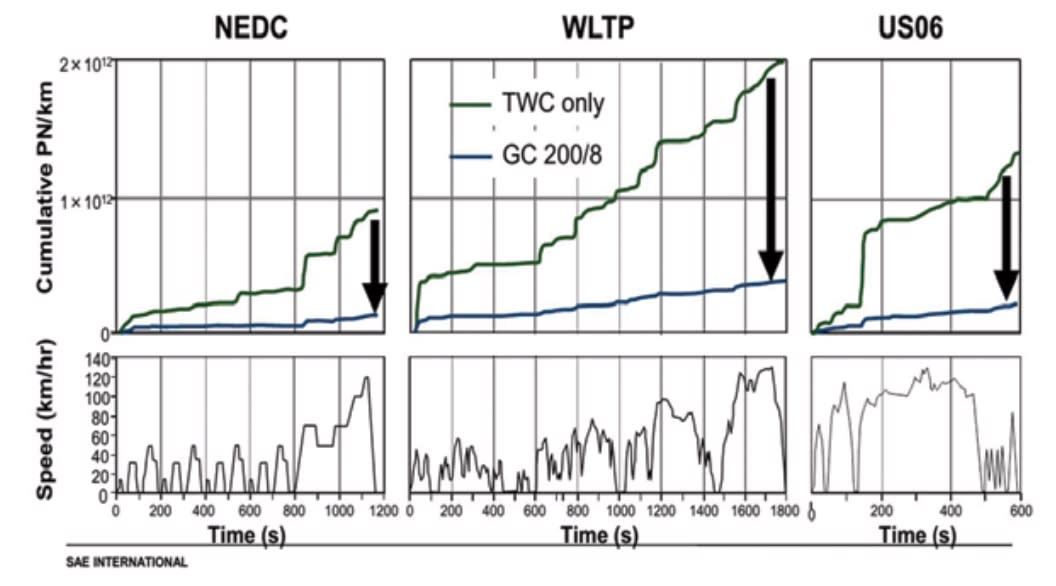
High loads require higher fuel flow rates and longer injection durations, explained GM’s Davis. This makes it more challenging to fully vaporize the fuel and minimize rich areas in the cylinder or prevent any liquid fuel impingement on the combustion chamber surfaces. This is why drive cycles matter because load factors vary among them.
Using a New European Drive Cycle (NEDC) to test is different than, say, using the U.S. Supplemental FTP US06 cycle. “If the drive cycle has a high load factor, the engine is operating at higher speeds and loads more often, increasing soot,” observed Christie.
Countermeasures and choices
A number of features engine makers use for better fuel economy and power also reduce soot. These include integrated exhaust manifolds or low-pressure cooled EGR that reduce turbine inlet temperatures through cooling exhaust gas or suppressing knock, which reduce soot through avoiding enrichment, according to Christie. But the most important factor for countering soot is engineering better combustion systems, he asserted. A critical enabler are improved solenoid fuel injectors with five or six laser-drilled holes that accurately inject small amounts of fuel multiple times in a cycle.
In an interview with Automotive Engineering, Paul Whitaker, Director, Product Technologies for AVL Powertrain Engineering, said options for reducing soot boils down to three potential solutions. The first is using a combination of PFI and GDI.
“With port injection, wall films typically stay behind the intake valve resulting in lower particulates,” Whitaker noted. “With both GDI and PFI systems, the engine could operate throughout most of the drive cycle critical region — including the cold start and warm-up phase — with PFI and low particulates, then switch to GDI at high load to take advantage of the charge cooling and scavenging benefits,” he explained.

The second option is to use a GPF — but whether particulate filters will be required on gasoline engines is currently under debate. Whitaker said AVL R&D has shown that GPFs can be effective at reducing particulates, but optimization for engine-out particulate reduction is still required to avoid increased back pressure. The initial cost is a significant concern, he noted, as are warranty risks, complexity, and the OBD diagnostic burden required by yet another device in the system.
The third, preferred option is a clean-burning GDI engine with well-engineered combustion, enabled by precise mixture formation, injection, and calibration. Reducing “penetration length” — how far fuel flows from the tip of the nozzle into the cylinder — is paramount, Whitaker said. Less penetration, especially during cold start, means the fuel stream does not touch cold metal.

“Multiple, shorter injections, say three instead of one, has been shown to shorten penetration length and reduce soot formation,” he offered. Fuel rail pressure also needs to be carefully optimized since higher pressures produce smaller droplets but increase penetration length. AVL research data shows particulate number levels reduced to 30% of the Euro 6c standard through combustion system and controls/calibration improvements alone. Some of the baseline Euro 5 engines in the study exceeded the Euro 6c limit by 600%.
Even with these results, it is not a forgone conclusion that GPFs can be ignored.
“These results were with new engines and clean injectors,” Whitaker said. “Current injectors accumulate carbon deposits on their tips which can become a source of particulates due to absorption of fuel. There is also oil from engine wear that produces soot.” Longevity is also an issue. OEMs need to ensure that they meet 150,000 mile emissions limits.
Most importantly, there are uncertainties around the impending Real Driving Emission (RDE) evaluation, which tests a vehicle on the road without a set driving schedule using portable test equipment. RDE could become a significant factor in the Euro 6c phase-in since its potential wide variation in dynamic load is a key uncertainty.
Solutions for the future
Dr. Willard Cutler, Commercial Technology Director, Environmental Technologies, for Corning, told Automotive Engineering he believes that the possibility of a Beijing 6 regulation adds to the discussion. This potential regulation for China could match the stringent particle number requirement of Euro 6c with a potential phase-in in September 2017.
For OEMs wanting to sell cars in China, meeting any regulatory requirement is mandatory. Cutler agrees that the RDE cycle could be tougher for OEMs to meet than any of the current dynamometer test cycles, adding more uncertainty.
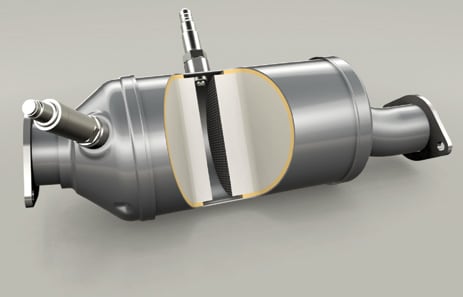
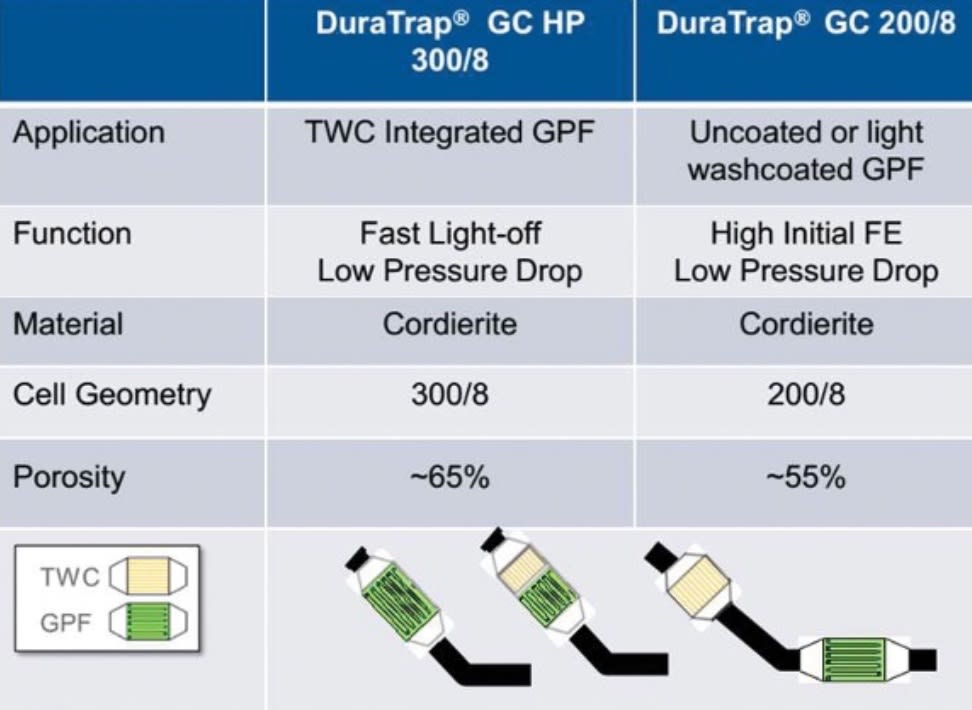
Without discussing price in particular, he expects GPF systems to be cheaper than DPF systems. There are a variety of packaging options, including integrating a GPF with a three-way-catalyst or as a separate device to make on-board diagnostics easier.
“A GPF offers a degree of freedom to the engine designer to account for lifetime and drive cycle uncertainties,” Cutler explained. He added that Corning has a significant GPF program underway with both pilot and full-scale manufacturing. China may see the first limited introduction of the technology, followed by Europe and eventually North America, he predicted.
Faurecia announced that it has a GPF in production, as an option on “a premium vehicle” without specifying the OEM. This catalyst uses a Cordierite substrate with geometric packaging “similar to a DPF,” Emmanuel Jean, an Emissions Master Expert with the company’s Emissions Control Technologies group, told Automotive Engineering. While not commenting on price, Jean noted that the unit is smaller and less expensive than a comparable DPF.
“DPF uses more expensive materials, such as silicon carbide that are constructed in a more complicated fashion,” he said. The GPF can be packaged as a separate unit from the three-way catalyst (TWC), acting as both particulate filter and a second TWC, he added.
There are some noted differences in the way that a GPF operates from DPF. Since gasoline exhaust is hotter than diesel, the GPF regenerates without a light-off event.
“While the temperature of gasoline exhaust is hot enough to regenerate the GPF, the exhaust is lacking in oxygen. Every so often you need to flush fresh air into the exhaust, which automatically regenerates the GPF,” Jean said. By comparison, a DPF requires a specific regeneration event with extra fuel slipped into the exhaust.
More From SAE Media Group
Automotive Engineering
Cooled EGR Shows Benefits for Gasoline Engines
Automotive Engineering
How Higher-Quality Gasoline Keeps Modern Engines Clean and Efficient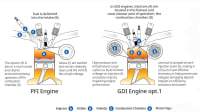
Off-Highway Engineering
Off-highway Calibration Challenges — Big and Complex
Off-Highway Engineering
The Complicated Future of Off-Highway Engines
Off-Highway Engineering
Navistar Updates A26 Engine, Improves FE by 4%
Automotive Engineering
Future ICEs: What Comes After 2025?
Off-Highway Engineering
Mahle, Liebherr Develop Active Pre-Chamber for Hydrogen ICE
Automotive Engineering
Attacking GDI Engine Particulate Emissions
Off-Highway Engineering
Cummins Unveils New B7.2 Diesel Engine
Off-Highway Engineering
Westport Awarded LNG Development Program
Automotive Engineering
Audi's New V6 Diesel to Feature Electric Turbocharging, New NOx Technology
Automotive Engineering
Achates Aims at 2025 Light-truck Power
Automotive Engineering
'Reman' Engine Market Steady, but Complexity Challenges Production Efficiency
Off-Highway Engineering
Rotary SI/CI Combustion Engines: A Thing of the Future?
Off-Highway Engineering
Scania Adapts On-Highway Diesel for New Off-Highway Engine Platform
Automotive Engineering
Mahle’s Pre-Chamber MJI Technology Is Sparking Ignition Advances
Automotive Engineering
Engine Researchers: 50% Gasoline-Engine Efficiency in Sight
Automotive Engineering
Spark of Genius
Tech Briefs
Electrohydraulically Actuated Valve Train
Off-Highway Engineering
Development Trends for Heavy Engines
Automotive Engineering
2015 Engines Ride a Technology Tidal Wave
Off-Highway Engineering
Cummins’ X15 Is a Model of Design Efficiency
Automotive Engineering
Extending the ICE Age: Hyundai Optimizing Engines and Fuels
Off-Highway Engineering
MTU Training Facility Helps Keep Complex Engines up and Running
Off-Highway Engineering
Downsizing a HD Diesel Engine for Off-Highway Applications
Off-Highway Engineering
Cummins New X15 Engine Meets Upcoming Regs While Boosting Efficiency
Tech Briefs INSIDER
Replacing Camshafts with Valves Paves Way for Cheaper, Greener Engines
Automotive Engineering
Leading the Attack on Engine Pumping Losses
Off-Highway Engineering
Delphi and Westport Team on Next-Gen Injectors for Natural Gas Engines
Automotive Engineering
Mazda Plots Wankel-powered Range Extenders, HCCI Mild Hybrids
Top Stories
INSIDERManufacturing & Prototyping
 How Airbus is Using w-DED to 3D Print Larger Titanium Airplane Parts
INSIDERManned Systems
 FAA to Replace Aging Network of Ground-Based Radars
NewsTransportation
 CES 2026: Bosch is Ready to Bring AI to Your (Likely ICE-powered) Vehicle
NewsSoftware
 Accelerating Down the Road to Autonomy
EditorialDesign
 DarkSky One Wants to Make the World a Darker Place
INSIDERMaterials
 Can This Self-Healing Composite Make Airplane and Spacecraft Components Last...
Webcasts
Defense
 How Sift's Unified Observability Platform Accelerates Drone Innovation
Automotive
 E/E Architecture Redefined: Building Smarter, Safer, and Scalable...
Power
 Hydrogen Engines Are Heating Up for Heavy Duty
Electronics & Computers
 Advantages of Smart Power Distribution Unit Design for Automotive...
Unmanned Systems
 Quiet, Please: NVH Improvement Opportunities in the Early Design...
