




Future ICEs: What Comes After 2025?
With 2017-2020 products in the pipeline, what are the over-the-horizon solutions for greater light-vehicle engine efficiency?
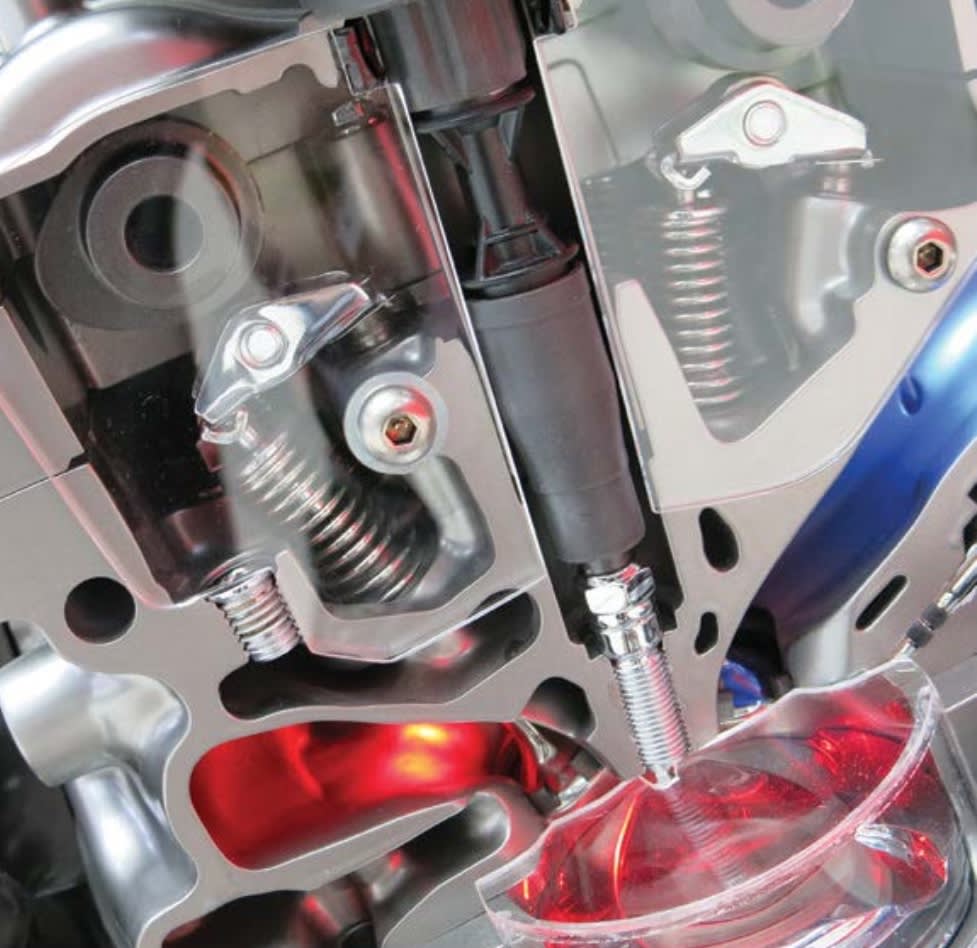
Vehicle engineers and planners have been breathing a bit easier lately, generally confident that the industry will meet the upcoming U.S. CAFE and Euro 6 vehicle CO2 regulations without excessive disruption and cost to the end customer. But those working in powertrain recognize the period beyond 2025 is uncharted territory.
For the U.S., there’s the so-called “mid-term review” coming in early 2018, in which the EPA and NHTSA government agencies will reevaluate the basis for the stringent 54.5-mpg (23.1 km/L; 4.3 L/100 km) standard. Will they stay the course or make corrections? An informal poll of engineers and scientists conducted at the 2015 SAE World Congress by Automotive Engineering showed the majority expect rulemakers will not back down from the current regs.

Discussions during Congress week, and at the Vienna Motor Symposium that followed, revealed a new generation of sophisticated combustion strategies currently under development. Many of these, including GCI (gasoline compression ignition), RCCI (dual-fuel reactivity controlled compression ignition), CAI (controlled auto ignition), and others employ moderate-to-high stratified operation. Such strategies require major leaps in in-cylinder control, valve control, plus new fuels and energy sources. All will be needed, along with techniques such as waste-heat recovery, to continue the combustion engine’s dominant role.
Standing in the way of higher compression ratios and cylinder pressures are the old nemesis “knock” and its evil cousin “super knock” — the latter an increasingly common challenge for boosted engines. Controls, and sensor fidelity and response, will be ever more vital in this battle, causing the electronics portion of total powertrain cost to increase by 15% by 2025, according to the Powertrain Strategies for the 21st Century study published last year by the University of Michigan’s Transportation Research Institute (UMTRI).
“ICEs have made tremendous efficiency improvements over the past several decades,” noted Tom Grissom, Director of Business Development at BorgWarner Turbo Systems. “Current benchmark performance in thermal efficiency are above the 30% range for gasoline engines and 40% range for diesel. Estimated near-term improvements are in the 5% range — but further downsizing and downspeeding alone will not result in significantly higher efficiencies,” he said.
Added Bob Bienenfeld, American Honda’s Assistant Vice President of Environment and Energy Strategy: “There may be more exotic ICE technologies, but much depends upon the pace of the standards after 2025,” he said. “If they are aggressive, it is looking like aggressive HEV implementation will be required, if not plug-in hybrids, battery electrics, and fuel-cell vehicles.”
Those technologies may be more cost/benefit effective, he said, “especially if the question is whether or not we develop a new generation of engine technologies, like HCCI (homogeneous-charge compression ignition), or simply go for the next step in terms of transformation. But much will depend on standards, infrastructure, consumer acceptance, the reduction in costs, and, of course, the overall support of GHG regulations.”
Bienenfeld noted that Honda is confident PHEVs can deliver as much value as BEVs in such an environment, thus keeping the ICE relevant. But to do this, the industry’s challenge “will be translating the many fundamental advances into production-viable hardware,” observed Dr. Robert Wagner, Director of Fuels, Engines, and Emissions Research at the Oak Ridge National Laboratory (ORNL).
Pushing into lean-burn territory

The latest production engine programs use evolutionary combustion systems that are a preview of early 2020’s engines that will combine lean-burn and stoichiometric operation. “I think the high 40% range is feasible for light-duty engine efficiency, without waste heat recovery,” stated Dr. Wagner. He noted that some multi-cylinder test engines have pushed beyond 55% on the ORNL dyno.
“It will all come down to navigating the combustion space — how best to ‘thread the needle’ between soot and NOx formation,” he concluded.
Toyota’s new 8NR-FTS direct-injection turbo engine that recently went on sale in Japan has a claimed peak efficiency of 36%. The 1.2-L unit is both torque-rich (136 lb·ft/185 N·m, generated from 1500 to 4000 rpm) and its claimed fuel efficiency of 19.4 km/L (46 mpg U.S.; 5.15 L/100 km) exceeds the Japanese government’s 2015 fuel economy standards by more than 10%.
Also from Japan, Mazda’s Skyactiv program is progressing through G1, G2, and G3 development stages toward a marriage of Otto and Diesel cycle characteristics.
“Our target with the G3 is 18:1 compression ratio at lambda 2.5 — and up to a 40% improvement in thermal efficiency by setting the ideal pressure and temperature for HCCI combustion,” explained Hiroyki Yamashita, Research Manager of Mazda’s ICE Technical Center, to the SAE High-Efficiency Engine event audience. He said the G3 program focuses on heat transfer from the combustion chamber and employs a special sprayed-on thermal insulation coating on the piston crown and chamber walls.
And Mazda sets the pace in reducing internal friction across its ICEs, noted Marc Sens, IAV Automotive’s Head of Department Thermodynamics/Boost Systems. “We’ve tested their [G1] Skyactiv engines and their claim of 30% friction reduction over the previous generation is real — very impressive,” he said.

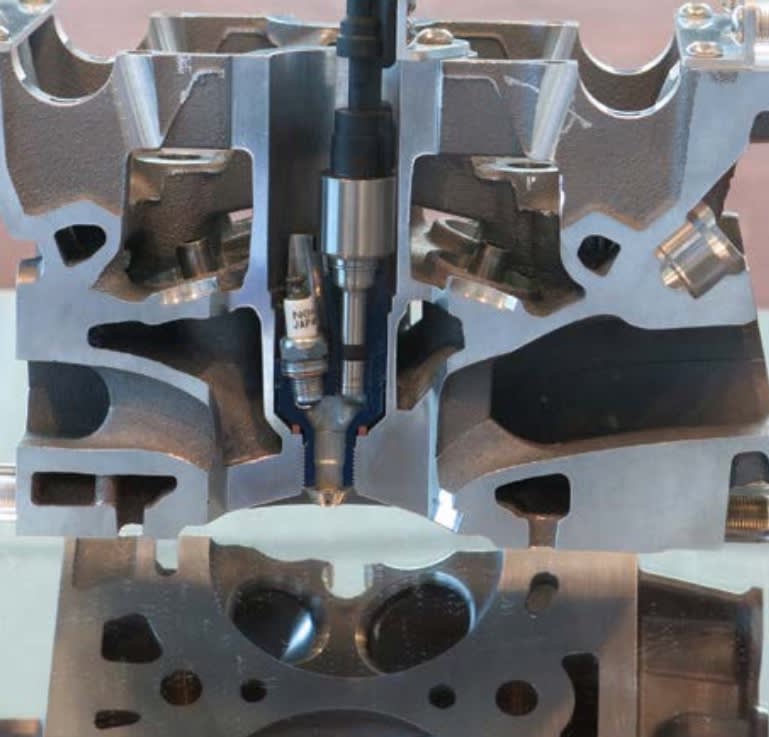
VW Group has committed to its own version of the Miller thermodynamic cycle for its new 2.0-L, 140-kW (188-hp) turbocharged, direct fuel injection (TFSI) production engine that will debut in the 2016 Audi A4. This unit is another step toward gasoline spark-ignition technology with the fuel consumption [less than 5.0 L/100 km on the NEDC test cycle) and torque capability of the diesel, Dr. Stefan Knirsch, Head of Engine Development, told this year’s Vienna audience.
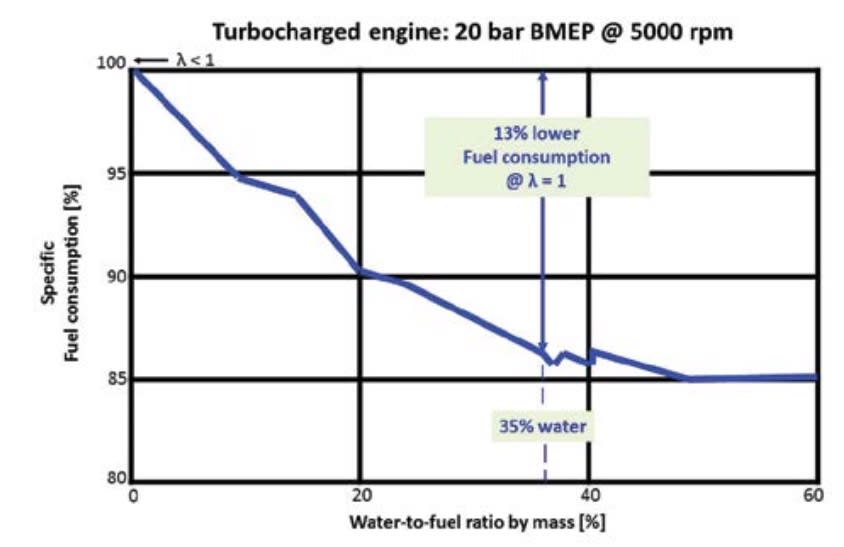
And in pilot development is water injection (WI), a method of improving anti-knock behavior using the charge-cooling effects of water vapor. WI was first proven in World War II air-cooled radial aircraft engines including the mighty Pratt & Whitney 18-cylinder R2800 and the 14-cylinder BMW 801. At Vienna, Dr. Rolf Bulander, a Robert Bosch Board of Management member, announced his company is developing water injection with a customer.

Dr. Bulander noted benefits that have been shown on experimental test engines, including reduction of fuel consumption at high loads and low rpm (up to 4% improvement on the NEDC cycle); reduction or avoidance of fuel enrichment and lower exhaust-gas temperatures at high loads and high rpm; improved “knock” resistance with increased compression ratio; and improved performance.
The cooler charge enabled by water injection (part of a fuel-air systems approach) results in lower CO2 emissions in real driving conditions and the upcoming WLTC test cycle. Injected through the intake port, the WI system includes a water pump, a water rail, and injectors designed to handle the specific challenges of operating with water.
Give me higher octane!
Well over 50% of fuel energy currently is lost through the exhaust and cooling systems, in roughly equal amounts. Waste heat recovery systems will be key to the ICE’s survival, experts noted, and are likely to enter the engine-hardware mainstream once costs are mitigated. Significant energy exists downstream of the turbocharger to power expansion turbines to provide energy storage and/or electrical assist to the powertrain.
“Energy storage, battery, and/or ultracapacitor can capture and utilize otherwise lost heat energy,” noted BorgWarner’s Grissom. “And independently driven eBoosters (electrically powered assist compressors) can overcome turbo lag, improving higher load efficiency where most fuel is burned.” The cost of such systems currently is “significant,” he admitted.
Turbocharging itself is expected to reach 50% penetration by 2025 for all North American-produced engines, according to UMTRI. At that time, 3- and 4-cylinder engines will comprise over 66% of the passenger car market, while fours and sixes will power over 75% of new light trucks.
High on engineers’ list of enablers for next-generation combustion systems is an end to regional/seasonal fuel variations, and higher gasoline octane. “We need to raise the octane floor!” asserted Chris Cowland, Director of NAFTA Advanced Powertrain Engineering at Fiat Chrysler Automobiles, during an SAE Congress panel. Known within the industry as a highly vocal proponent of co-optimizing fuel and engine systems, Cowland stated the U.S. needs “a single, high-grade, high-quality fuel like Europe’s done.”

Moving to a 95-100 RON baseline would yield a 5% fuel-economy gain and would help engineers optimize future designs. Cowland also noted the fuel economy-vs.-CO2 trade-off related to the carbon level in various fuels diminishing the value of some engine technologies.
“Diesel is attractive in U.S. CAFE, but less so with the CO2 equation,” he said.
Connectivity meets the piston engine

“We can reduce petroleum imports to zero by 2035 by increasing the efficiency of new engines and powertrains by 40%,” said Chris Atkinson, Sc.D, Program Director at the U.S. DOE Advanced Research Projects Agency — Energy (ARPA-E) and an expert in engine controls and calibration. He is confident that the vehicle connectivity revolution will play an increasing role in improving fuel efficiency and emissions reduction.
“We can do a lot with the 1000 times more real-time computation capability that we will have in the vehicle,” Atkinson observed. Real-time, over-the-air adjustments of engine calibration are just the beginning. And autonomous vehicles don’t have to be EVs.
“But once we take the driver out of the loop, no more 707-hp [Chrysler Hemi] Hellcat V8s will be required — and I have nothing against 707 horsepower,” Atkinson teased the SAE audience.
More From SAE Media Group
Off-Highway Engineering
Mahle, Liebherr Develop Active Pre-Chamber for Hydrogen ICE
Automotive Engineering
Cooled EGR Shows Benefits for Gasoline Engines
Off-Highway Engineering
Westport Awarded LNG Development Program
Automotive Engineering
Spark of Genius
Automotive Engineering
Engine Researchers: 50% Gasoline-Engine Efficiency in Sight
Off-Highway Engineering
Scania Adapts On-Highway Diesel for New Off-Highway Engine Platform
Automotive Engineering
Reconsidering CNG as an Alt-Fuel Solution
Off-Highway Engineering
Development Trends for Heavy Engines
Automotive Engineering
Mazda Plots Wankel-powered Range Extenders, HCCI Mild Hybrids
Off-Highway Engineering
The Complicated Future of Off-Highway Engines
Automotive Engineering
Balancing GDI Fuel Economy and Emissions
Off-Highway Engineering
Could This Infinitely Variable Compression Mechanism Be the Next Piston Engine Game-Changer?
Automotive Engineering
'Reman' Engine Market Steady, but Complexity Challenges Production Efficiency
Automotive Engineering
Extending the ICE Age: Hyundai Optimizing Engines and Fuels
Automotive Engineering
Mahle’s Pre-Chamber MJI Technology Is Sparking Ignition Advances
Automotive Engineering
How Higher-Quality Gasoline Keeps Modern Engines Clean and Efficient
Off-Highway Engineering
Cummins Unveils New B7.2 Diesel Engine
Automotive Engineering
Delphi and Hyundai GDCI Program Aims to Top Diesel Efficiency
Off-Highway Engineering
Cummins New X15 Engine Meets Upcoming Regs While Boosting Efficiency
Off-Highway Engineering
Developing an Alternative Engine Concept
Automotive Engineering
Audi's New V6 Diesel to Feature Electric Turbocharging, New NOx Technology
Automotive Engineering
2015 Engines Ride a Technology Tidal Wave
Automotive Engineering
Achates Aims at 2025 Light-truck Power
Off-Highway Engineering
Iveco Pursues Natural Gas in Stralis NP Models
Off-Highway Engineering
AGCO Goes Clean and Green with CORE75 Engine
Automotive Engineering
2022 Nissan Rogue Gets a VC Turbo Triple
Automotive Engineering
Leading the Attack on Engine Pumping Losses
Automotive Engineering
Targeting 40% BTE with Advanced VCR
Automotive Engineering
Maruti Suzuki Refines Swift Engine for 10% FE Gain
Automotive Engineering
Bentley Develops W12 Cylinder Deactivation
Top Stories
INSIDERManufacturing & Prototyping
 How Airbus is Using w-DED to 3D Print Larger Titanium Airplane Parts
INSIDERManned Systems
 FAA to Replace Aging Network of Ground-Based Radars
NewsTransportation
 CES 2026: Bosch is Ready to Bring AI to Your (Likely ICE-powered) Vehicle
NewsSoftware
 Accelerating Down the Road to Autonomy
EditorialDesign
 DarkSky One Wants to Make the World a Darker Place
INSIDERMaterials
 Can This Self-Healing Composite Make Airplane and Spacecraft Components Last...
Webcasts
Defense
 How Sift's Unified Observability Platform Accelerates Drone Innovation
Automotive
 E/E Architecture Redefined: Building Smarter, Safer, and Scalable...
Power
 Hydrogen Engines Are Heating Up for Heavy Duty
Electronics & Computers
 Advantages of Smart Power Distribution Unit Design for Automotive...
Unmanned Systems
 Quiet, Please: NVH Improvement Opportunities in the Early Design...
