




How Higher-Quality Gasoline Keeps Modern Engines Clean and Efficient
Gasoline direct injection (GDI) engines are the most common technology on American roadways in 2025, and soon, an industrywide gasoline quality standard will better reflect their unique operational needs. Here’s why that’s important.
It’s no secret that fuel economy has been one of the greatest driving forces of automotive evolution over the past several decades. As corporate average fuel economy (CAFE) standards have grown increasingly lofty, OEMs eke out new efficiencies from every area of the vehicle.
One of those areas, of course, is the engine, and many OEMs have deployed gasoline direct injection (GDI) technology, which is becoming the most common engine technology on American roadways. But while GDI engines proliferate, varying fuel additization throughout North America has not necessarily kept pace with their unique needs and can, in fact, hinder those engines from meeting and sustaining their full fuel economy potential.
A coming upgrade to the Top Tier fuels program – a voluntary standard in which the majority of leading fuel marketers participate – seeks to change that. This article will explore the unique needs of GDI engines with respect to the fuels ’ability to contribute to greater fuel injector cleanliness, how that cleanliness impacts real-world fuel economy and emissions, and why the coming update is a positive step for the industry and consumers.
Gasoline direct injection vs. port fuel injection
To understand the impact that higher-performing fuels can have on today’s most common engine technology, it’s useful to understand how GDI engines differ from those of the past.
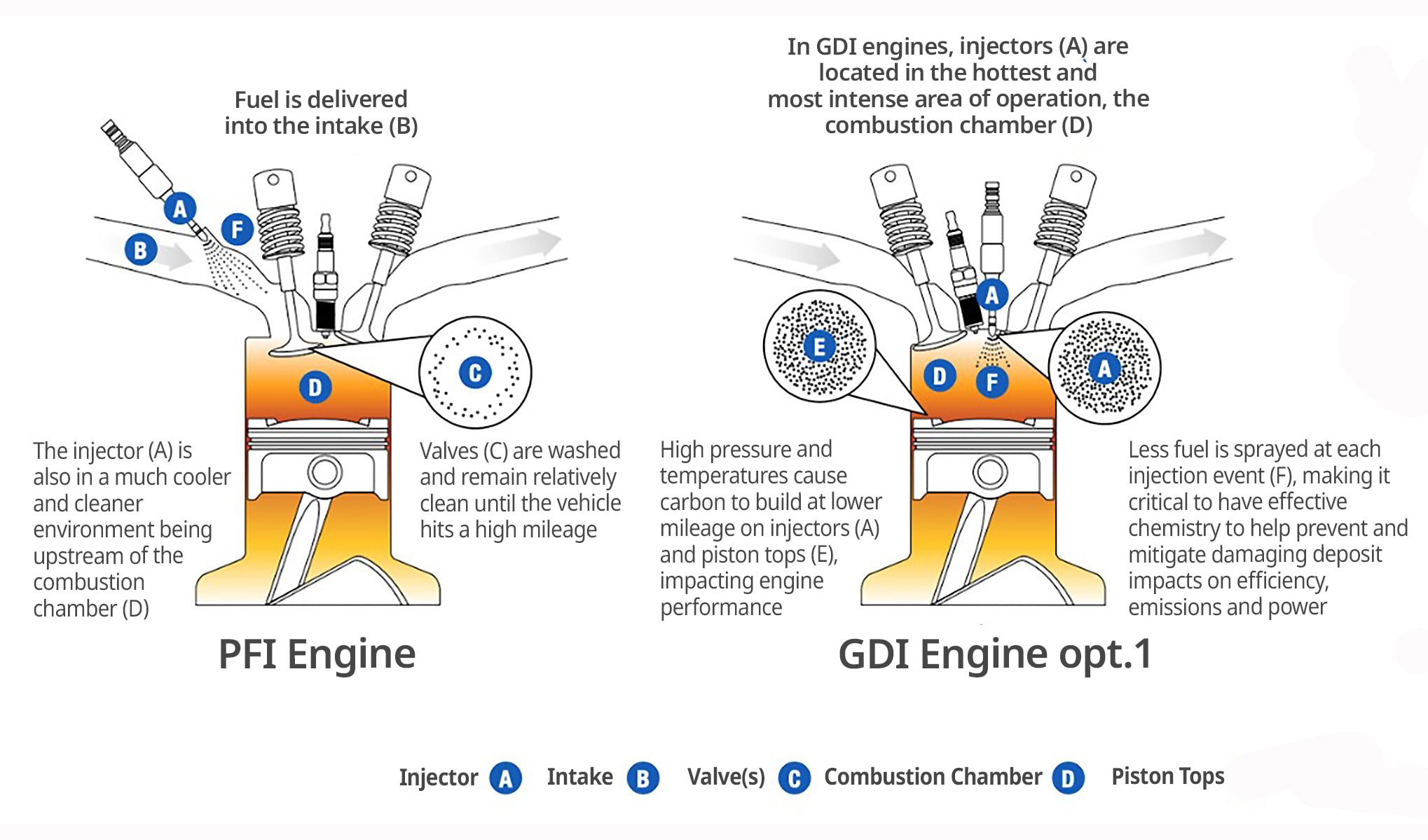
The primary difference between GDI and port fuel injection (PFI) engines is the location of the fuel injector. Within PFI architectures, the fuel injector is located outside of the combustion chamber; fuel is injected into the intake, which is then delivered over the intake valves into the combustion chamber as required by the current duty cycle. Here, because of how the fuel enters the intake, it naturally flushes over these valves, creating a type of natural cleaning cycle simply because the process prevents the majority of buildup from forming.
In comparison, GDI architectures place the fuel injector directly in the combustion chamber, where it can be more precisely controlled by the vehicle’s engine control unit (ECU) and is thus more efficient than a traditional PFI setup. There are major advantages to this architecture, including improved fuel economy, increased power & torque, and reduced emissions – and it’s why OEMs have made the shift.
Engines designed to inject fuel directly into the combustion chamber come with some unintended side effects. The combustion chamber is the hottest and most intense area of operation, where elevated pressure and temperatures can cause carbon to build up prematurely on the injector and piston tops at lower overall vehicle mileage (comparatively, this kind of buildup typically never gets this bad even when a PFI vehicle hits high mileage). Because precise amounts of fuel are sprayed during each injection event, premature carbon deposits can interrupt that precision, and have damaging impacts on the engine’s efficiency, power, and emissions.
These impacts aren’t noticeable in real time. However, within just 20,000 miles – not long into the course of a typical passenger car’s anticipated service life – GDI engines can lose significant fuel efficiency as deposits continue to build up.
The importance of high-quality fuels
The good news is that high-quality gasoline formulated with advanced additive chemistry can help prevent and even clean up deposit buildup on fuel injectors in GDI engines. And while such fuels can be purchased today, their widespread availability has not matched the pace at which GDI engines have become the dominant engine technology in the American car parc. But that may change within the next two years.
Today, the only mandatory standards that must be met by gasoline sold in the United States are those established by the 1995 Clean Air Act (CAA). The CAA set minimum gasoline requirements to reduce air pollution by phasing out leaded gasoline, regulating fuel additives, and establishing standards for reformulated gasoline (RFG) and ultra-low sulfur gasoline (ULSG) to control smog-forming pollutants and tailpipe emissions from vehicles.
But because the CAA was passed 30 years ago, it does not account for the operational conditions of GDI engines. Elsewhere, the Top Tier Gas program was established in 2005 to help elevate gasoline quality throughout the marketplace. While this program is not mandatory, roughly 80% of major fuel marketers participate. For program participants, every pump at every station must dispense fuel that meets program standards, making it easy for everyday drivers to find higher-quality fuel.
However, Top Tier standards were established 20 years ago and, again, do not fully account for the performance requirements of the latest GDI engine architectures. To that end, Top Tier introduced an upgrade to the standard, called Top Tier+, that will take effect in February of 2027. Fuel marketers have until then to make the necessary additive changes to their fuel formulations to continue participating in the program.
How additive science contributes to optimal fuel efficiency
New Top Tier+ standards are based on fuel performance in a series of new tests specific to the GDI market. They will evaluate the fuel’s ability to contribute to greater injector cleanliness as well as other critical performance criteria, including particulate matter generation and pre-ignition performance. Importantly, Top Tier+ will require cleanup performance with regard to fuel injector deposits rather than keep-clean performance. This means Top Tier+ fuels must be able to help eliminate deposits from already-dirty fuel injectors. Broadly, this should benefit the entire modern car parc – GDI engines have been in the field since 2010 without a dedicated fueling solution, and new formulations should be able to help restore some fuel economy and emissions benefits to these vehicles.
Fuels can achieve elevated levels of performance in these areas via the incorporation of new additive chemistries. For example, at a basic level, advanced deposit control additives work by attaching themselves to carbon deposit molecules that have dirtied the fuel injector. The additive pulls those molecules into the fuel stream, where they combust along with the fuel and are then mitigated by the vehicle’s catalytic converter. Over time, a GDI engine serviced with high-quality fuel will regain efficiency that had been hindered by excessive injector buildup, restoring the engine’s operation closer to its original design intent.
By Brett Blackburn, global product manager of Consumer and Professional Fuel Additives at Lubrizol, who wrote this article for SAE Media.
More From SAE Media Group
Off-Highway Engineering
Westport Awarded LNG Development Program
Automotive Engineering
Engine Researchers: 50% Gasoline-Engine Efficiency in Sight
Automotive Engineering
Stanadyne Pumps up the Volume
Off-Highway Engineering
Cummins, Tula Test ‘Dynamic’ Cylinder Deactivation for Diesels
Off-Highway Engineering
Caterpillar Unveils New C13D Off-Highway Engine Platform
Automotive Engineering
Reconsidering CNG as an Alt-Fuel Solution
Automotive Engineering
Eaton Goes Internal with Its Next-Generation EGR Solution
Automotive Engineering
Mahle’s Pre-Chamber MJI Technology Is Sparking Ignition Advances
Off-Highway Engineering
Kohler Doubles down on ICE Development
Off-Highway Engineering
Scania Adapts On-Highway Diesel for New Off-Highway Engine Platform
Automotive Engineering
Brothers Win Eaton's Top Innovation Awards for Advanced Technologies
Automotive Engineering
Extending the ICE Age: Hyundai Optimizing Engines and Fuels
Automotive Engineering
Mercedes-AMG Extracts World-Record Power from New Four-Cylinder Engine
Off-Highway Engineering
Detroit DD15 Gen 5 Showcases Durability of New Diesel Tech
Automotive Engineering
2020 Ford Super Duty Debuts All-New 7.3-Liter Pushrod V8, 10-Speed Automatic
Automotive Engineering
KSPG Automotive Is on the Fast Track Globally
Off-Highway Engineering
Garrett Two-Stage Turbos Ramp up Off-Highway
Off-Highway Engineering
Navistar’s ‘Ground Up’ Approach to All-New Diesel Engine
Off-Highway Engineering
New Volvo D13 VGT Utilizes 24V Architecture
Off-Highway Engineering
Rexroth Releases New Flow-Sharing Valve for Mini Excavators

Off-Highway Engineering
AGCO Goes Clean and Green with CORE75 Engine
Automotive Engineering
Why JLR Is Giving Its Newest Range Rover Straight-6 Power
Automotive Engineering
Mahle Reveals ‘Fits All’ Modular and Scalable Integrated Hybrid Powertrain
Automotive Engineering
Making over the World’s Leading Hybrid
Off-Highway Engineering
Cummins New X15 Engine Meets Upcoming Regs While Boosting Efficiency
Automotive Engineering
Orbis Says HaloDrive Axial-Flux Motor Available for In-Wheel, Other Uses
Off-Highway Engineering
JCB Prepared to Meet EU Stage V Emissions
Off-Highway Engineering
JCB Debuts Clean-Sheet Hydrogen Combustion Engine
Automotive Engineering
SAE Updates Gasoline Fuel-Injection Standards, Additions Expected
Top Stories
INSIDERManufacturing & Prototyping
 How Airbus is Using w-DED to 3D Print Larger Titanium Airplane Parts
INSIDERManned Systems
 FAA to Replace Aging Network of Ground-Based Radars
NewsTransportation
 CES 2026: Bosch is Ready to Bring AI to Your (Likely ICE-powered) Vehicle
NewsSoftware
 Accelerating Down the Road to Autonomy
EditorialDesign
 DarkSky One Wants to Make the World a Darker Place
INSIDERMaterials
 Can This Self-Healing Composite Make Airplane and Spacecraft Components Last...
Webcasts
Defense
 How Sift's Unified Observability Platform Accelerates Drone Innovation
Automotive
 E/E Architecture Redefined: Building Smarter, Safer, and Scalable...
Power
 Hydrogen Engines Are Heating Up for Heavy Duty
Electronics & Computers
 Advantages of Smart Power Distribution Unit Design for Automotive...
Unmanned Systems
 Quiet, Please: NVH Improvement Opportunities in the Early Design...
