




Garrett Two-Stage Turbos Ramp up Off-Highway
Garrett Motion is providing its advanced turbocharging tech for a launch of harvesters, combines and other agricultural equipment by a global manufacturer.
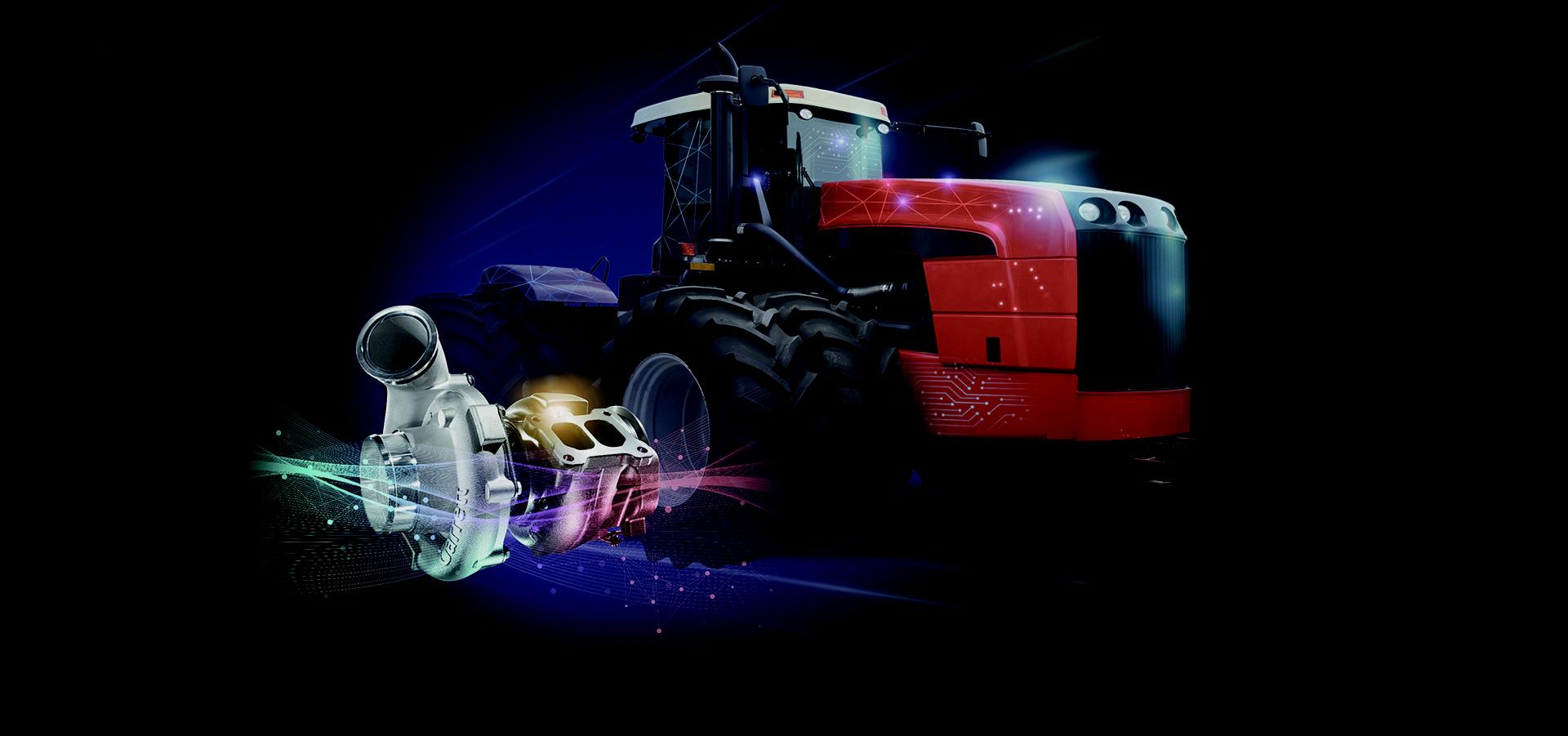
Garrett Motion is providing its advanced turbocharging technologies for a recent launch of harvesters, combines, excavators and other agricultural equipment by a global manufacturer. Garrett did not name the customer but said they have worked with the OEM in the past.
A key takeaway of the agreement, according to a company spokesperson, is that “two-stage turbos — once considered exotic — are ramping up in volumes.” OEM benefits include reduced part counts, since the same turbo can work on a variety of applications, along with increased life. Paired with a 13.6-L engine, the turbo was a key enabler of a 20% increase in efficiency, the spokesperson said.
Garrett’s “custom” single- and two-stage turbos allow both a broader application range and reduced portfolio complexity thanks to engineers’ focus on the efficiency and aerodynamics of the turbocharger, explained Pierre-Jean (PJ) Cancalon-Luna, senior marketing manager, Commercial Vehicle Turbochargers, Garrett Motion.
“The engine is defined with the displacement, but it then goes in the crawler, a tractor, a wheel loader and a harvester,” said Cancalon-Luna. “All of these machines have a different mission profile and a different requirement from the engine, which means that there will also be different requirements for the turbocharger machinery.”
Engineers worked on improving the range and capability of the compressor stage to be able to cover the variety of requirements, Cancalon-Luna explained to SAE Truck & Off-Highway Engineering. “Through a lot of simulation, computational fluid dynamics and bench testing, we’ve really been able to design a new generation of compressor stage, which is much wider and efficient than previously.”
Garrett also worked on the turbine driving the compressor to provide the necessary air and pressure to the engine. A new low-friction bearing further improves mechanical efficiency of the turbo. “You could really have one machine replacing two machines that you had before because they are more efficient and have a wider operating range,” Cancalon-Luna said. “When one turbo is not enough, we go to a two-compressor regiment. The two-stage is really for the ultimate performance.”
Garrett’s turbochargers address three critical pain points for this global customer, said Aileen McDowall, Garrett VP and general manager of Commercial Vehicles. “First, we helped to increase total vehicle fuel efficiency by 20% in an important use case where our new boosting architecture gave the vehicle enough autonomy to eliminate unnecessary refueling journeys. Second, we enabled the customer to achieve greater productivity by creating a two-stage setup for multiple off-highway applications. And finally, [providing] a versatile solution capable of delivering high performance in diverse duty cycles ranging between 8,000 and 12,000 hours in duration, while reducing maintenance costs and increasing vehicle uptime.”
Aerodynamic package
Garrett developed what it says is an advanced aerodynamic package for the compressor stage of the turbocharger. Cancalon-Luna said they achieved this by optimizing every single stage of their process to gain the highest efficiency possible.
On the compressor stage, engineers added a newly designed compressor wheel, he explained. The package also features a new way of designing the compressor housing. “Driving the air toward the compressor wheel to be compressed and then through the diffuser where the energy kinetic is converted in pressure and finally the compressed air is collected in the volute and guided to the compressor outlet. So, optimizing every single part of the air passage is really what’s new here compared to what we were doing previously,” Cancalon-Luna said.
Garrett’s new turbo design allowed the manufacturer to replace 15 part numbers from its previous turbo supplier with only three from Garrett. The new design not only helped reduce portfolio complexity by eliminating a dozen part numbers, but it also led to a smaller packaging requirement, leading to a slimmer hood line.
“What the two-stage solution is really there for is to enable the ultimate power put on an engine. When you want to go above and beyond to have the premium version, the two-stage solution is the most adequate because you’re basically pushing the boundary of a traditional wastegate system,” Cancalon-Luna said. “But again, it really depends on what the application’s mission profile you want to reach and what the OEM wants to do with its engine.”
More From SAE Media Group
Off-Highway Engineering
Cummins Spools up New Turbo Tech
Off-Highway Engineering
Westport Awarded LNG Development Program
Off-Highway Engineering
Liebherr Reveals ‘Hybrid’ CFRP Cylinders and Parallel-Pump Concept
Off-Highway Engineering
Engine Developers Increase Efforts to Decrease Fuel Usage
Off-Highway Engineering
HD Hyundai Rolls out a Slew of New Machines
Automotive Engineering
Stanadyne Pumps up the Volume
Automotive Engineering
Brothers Win Eaton's Top Innovation Awards for Advanced Technologies
Off-Highway Engineering
Rexroth Releases New Flow-Sharing Valve for Mini Excavators
Off-Highway Engineering
Compact Motors
Off-Highway Engineering
Could This Infinitely Variable Compression Mechanism Be the Next Piston Engine Game-Changer?
Off-Highway Engineering
Open-Circuit Piston Pumps
Automotive Engineering
Extending a Wankel Future on Hydrogen Fuel
Automotive Engineering
UAV Turbines to Tackle 200-Hp Class UAV Engines for U.S. Army
Off-Highway Engineering
Axial Piston Pumps
Off-Highway Engineering
Volvo CE, Norrhydro Team to ‘Revolutionize’ Digital Hydraulics
Off-Highway Engineering
Cummins, Tula Test ‘Dynamic’ Cylinder Deactivation for Diesels
Automotive Engineering
Mercedes-AMG Extracts World-Record Power from New Four-Cylinder Engine
Automotive Engineering
KSPG Automotive Is on the Fast Track Globally
Aerospace & Defense Tech Briefs
SAE International Extends Call for Abstracts, Seeks Submissions for AeroTech Conference
Automotive Engineering
Engine Researchers: 50% Gasoline-Engine Efficiency in Sight
Off-Highway Engineering
Caterpillar Unveils New C13D Off-Highway Engine Platform
Automotive Engineering
Mercedes-AMG Ready with Electrically-Assisted Turbocharger
Off-Highway Engineering
FPT Tech Day Reveals Cursor X Concept, Other 4.0 Innovations
Off-Highway Engineering
Danfoss Targets Excavators with New Digital-Hydraulics System
Off-Highway Engineering
Scania Adapts On-Highway Diesel for New Off-Highway Engine Platform
Off-Highway Engineering
New Power Steering Concept Uses Variable Displacement Pump
Automotive Engineering
How Higher-Quality Gasoline Keeps Modern Engines Clean and Efficient
Off-Highway Engineering
Hybrids Are Having a Moment
Off-Highway Engineering
Caterpillar Reveals Seven New Next-Gen Excavators, Increases Push for Remote Control
Top Stories
NewsRF & Microwave Electronics
 Microvision Aquires Luminar, Plans Relationship Restoration, Multi-industry Push
INSIDERAerospace
 A Next Generation Helmet System for Navy Pilots
INSIDERDesign
 New Raytheon and Lockheed Martin Agreements Expand Missile Defense Production
INSIDERMaterials
 How Airbus is Using w-DED to 3D Print Larger Titanium Airplane Parts
NewsPower
 Ford Announces 48-Volt Architecture for Future Electric Truck
ArticlesAR/AI

Webcasts
Electronics & Computers
 Cooling a New Generation of Aerospace and Defense Embedded...
Automotive
 Battery Abuse Testing: Pushing to Failure
Power
 A FREE Two-Day Event Dedicated to Connected Mobility
Unmanned Systems
 Quiet, Please: NVH Improvement Opportunities in the Early Design Cycle
Automotive
 Advantages of Smart Power Distribution Unit Design for Automotive &...
Energy
 Sesame Solar's Nanogrid Tech Promises Major Gains in Drone Endurance