




Spark of Genius
Mazda’s Skyactiv-X—the nexus of gasoline and diesel tech—remains on track for 2019 production. We test-drive recent prototypes to check development status.
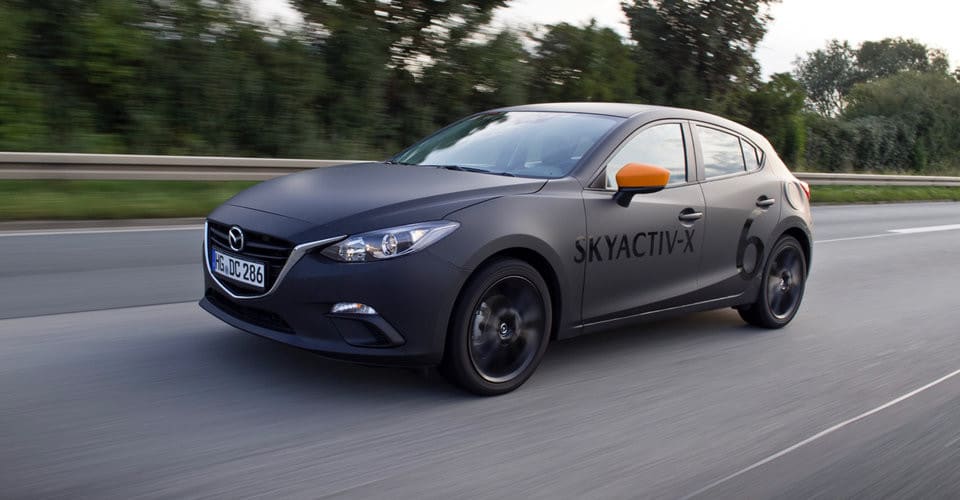
In 2016, after six frustrating years of R&D invested in an ultra-lean-burn, high-compression gasoline engine, Mazda’s managing executive officer, Mitsuo Hitomi, 63, had this brainstorm: Adding spark ignition might help stabilize the new Skyactiv-X engine’s fickle compression-ignition combustion process. Like at least four other OEMs, Mazda considers the marriage of gasoline and diesel attributes to be the next and possibly last opportunity to reap significant efficiency gains from internal combustion.
What’s most commonly known as Homogeneous Charge Compression Ignition (HCCI) is the IC engine’s holy grail. Unlike conventional IC engines, where a flame front initiated by a spark spreads throughout the gasoline-air mixture, ignition in an HCCI engine is instantaneous — like all of a city’s street lights illuminating at once.

While other makers have slowed further development of the ICE to devote greater resources to electrification, Mazda is hesitant to cease development of propulsion technology that has served it well. From the Skyactiv efficiency initiative launched in 2007, Mazda engineers set two ambitious goals: a 50% reduction in CO2 (from the 2010 baseline) by 2030 with combustion engines shouldering most of the load. And, by combining more efficient engines with electrification, a 90% CO2 reduction by 2050.
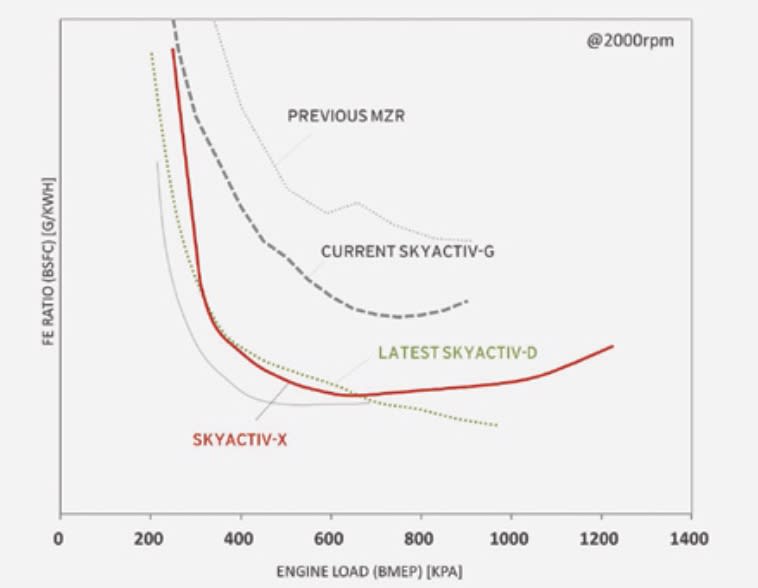
For the small but feisty Hiroshima-based automaker, revolutionizing 19th-century inventions by Nikolaus Otto and Rudolf Diesel would be a monumental feat. Accentuating that goal, the X in the Skyactiv-X name coined last year stands for the intersection of gasoline and diesel attributes. The program remains on track for 2019 production and Mazda has kept Automotive Engineering apprised of development progress at two dedicated events since summer 2017, including mule-vehicle test drives (see sidebar). Hitomi-san’s development team has also published SAE Tech Papers on their work (https://www.sae.org/publications/technical-papers).
Like every other 21st-century attempt to ignite a homogeneous mixture of gasoline and air without a spark, Mazda’s approach creates a lean, cool blend during the intake stroke. A higher-than-normal (currently 16.0:1) compression ratio raises the charge’s temperature and pressure to the point of auto ignition as the piston nears the top of its stroke.
Then the trouble begins.
If the air-fuel mixture lights prematurely, energy in the form of pressure against a rising piston and heat transferred to surrounding engine components is wasted. When ignition is tardy, with the piston well past top-dead center, a significant portion of the expansion (power) stroke is squandered, also greatly diminishing efficiency.

Hitomi-san realized that a well-timed spark could be perfect for triggering compression ignition. What he and his engineering team have developed (they call it SpCCI—Spark-Controlled Compression Ignition) during the past two years in hopes of a production start sometime in 2019 is three engines in one. In high-load and -rpm circumstances, Skyactiv-X operates like a conventional high-output spark-ignition gasoline engine with a stoichiometric (14.7:1) air-fuel ratio. The second mode also is stoichiometric, but with compression- ignition triggered at the right instant by a pressure rise in the combustion chamber resulting from the spark ignition of a locally rich air-fuel mix. Mode three also uses a spark to trigger compression ignition, but now with ultra-lean (λ up to 2.5) mixtures.
Although the Skyactiv-X’s basic architecture continues Mazda’s 2.0-L engine fundamentals, key features have been added. The direct fuel-injection system currently operates “between gasoline and diesel levels” according to Mazda engineers; AE has previously reported a 500 bar (7250 psi) operating pressure (see October 2017 issue). One squirt is delivered during the intake stroke and a second injection occurs just before the sparkplug fires. The engine is significantly under-square (bore and stroke dimensions remain proprietary) to diminish combustion-chamber volume.
Electric actuators provide variable intake and exhaust valve timing. The intake system is enhanced with the addition of an Eaton-supplied Roots-type super-charger with a clutched belt drive to allow switching between normal and pressurized aspiration. An engine coolant heat exchanger diminishes the temperature of recirculated exhaust gas (EGR). A belt-driven motor-generator wired to a 24-V battery powers this engine’s stop-start feature and its ECM. A three-way catalytic converter and a particulate filter treat the emissions leaving the combustion chamber.
Swirl motion within the Skyactiv-X cylinder assists fuel vaporization and creates a consistent air-fuel mixture. The piston crown has a volcano-shaped bowl to tumble the rich mixture created near the spark plug.
While these features have been seen before, Mazda’s Skyactiv-X breaks ground with the addition of a pressure sensor in each cylinder and the use of a powerful, high-speed processor to control each and every combustion event. Details of that equipment’s speed and cost have yet to be revealed. Exact mpg and CO2 details also are pending.
What is known is that current prototype engines deliver 178 hp (133 kW) and 170 lb·ft (230 N·m) with 6000 rpm within easy reach on 87-octane regular gasoline. To support the three combustion modes, Mazda uses valve overlap at the end of the exhaust stroke to scavenge the cylinder of hot gasses. When necessary, closing the intake valves well after BDC on the compression stroke inhibits full-load detonation (Miller cycle). Heavy doses of EGR reduce throttling losses and the supercharger aids full-throttle performance.
Mazda engineers also are exploiting a ‘gram strategy approach’ to curb the new engine’s mechanical losses. Claims thus far are 31% lower water-circulating loss; a 74% reduction in oil-pumping loss; 25% less reciprocating loss; a 54% more-efficient valvetrain (using roller-finger followers and hydraulic lash control), and 27% lower accessory drive belt losses.
Achieving the program’s near-term goals of more power with a 30% gain in efficiency indicates that genius is indeed present under the hood.
More From SAE Media Group
Off-Highway Engineering
Mahle, Liebherr Develop Active Pre-Chamber for Hydrogen ICE
Off-Highway Engineering
Could This Infinitely Variable Compression Mechanism Be the Next Piston Engine Game-Changer?
Automotive Engineering
Future ICEs: What Comes After 2025?
Tech Briefs
Electrohydraulically Actuated Valve Train
Automotive Engineering
Cooled EGR Shows Benefits for Gasoline Engines
Automotive Engineering
Mahle’s Pre-Chamber MJI Technology Is Sparking Ignition Advances
Off-Highway Engineering
Developing an Alternative Engine Concept
Automotive Engineering
Eaton Goes Internal with Its Next-Generation EGR Solution
Automotive Engineering
Maruti Suzuki Refines Swift Engine for 10% FE Gain
Off-Highway Engineering
Cummins New X15 Engine Meets Upcoming Regs While Boosting Efficiency
Automotive Engineering
Targeting 40% BTE with Advanced VCR
Off-Highway Engineering
The Complicated Future of Off-Highway Engines
Off-Highway Engineering
IAV Brings Variable Valvetrains to Heavy Duty
Aerospace & Defense Tech Briefs
X Marks the Spot
Automotive Engineering
Audi's New V6 Diesel to Feature Electric Turbocharging, New NOx Technology
Off-Highway Engineering
Navistar Updates A26 Engine, Improves FE by 4%
Automotive Engineering
Extending the ICE Age: Hyundai Optimizing Engines and Fuels

Automotive Engineering
Nautilus Claims Radical Advance in HCCI Engine Development
Automotive Engineering
V-CR, Water Injection, New EGR Methods Top SAE Engines Symposium
Off-Highway Engineering
Eaton Demonstrates Waste Heat Recovery, Variable Valve Actuation for HD Diesels
Automotive Engineering
Balancing GDI Fuel Economy and Emissions
Tech Briefs INSIDER
Replacing Camshafts with Valves Paves Way for Cheaper, Greener Engines
Automotive Engineering
Engine Researchers: 50% Gasoline-Engine Efficiency in Sight
Automotive Engineering
German Spark-Ignited Compression-Ignition Research Paralleling Mazda’s SPCCI
Automotive Engineering
ICE Breaker!
Off-Highway Engineering
Development Trends for Heavy Engines
Off-Highway Engineering
Flex-Fuel Snowmobile Challenge Results in Improved Efficiency and Lower Emissions
Automotive Engineering
Achates Aims at 2025 Light-truck Power
Automotive Engineering
Turbos Tackle New Propulsion Applications
Top Stories
INSIDERManufacturing & Prototyping
 How Airbus is Using w-DED to 3D Print Larger Titanium Airplane Parts
INSIDERManned Systems
 FAA to Replace Aging Network of Ground-Based Radars
NewsTransportation
 CES 2026: Bosch is Ready to Bring AI to Your (Likely ICE-powered) Vehicle
NewsSoftware
 Accelerating Down the Road to Autonomy
EditorialDesign
 DarkSky One Wants to Make the World a Darker Place
INSIDERMaterials
 Can This Self-Healing Composite Make Airplane and Spacecraft Components Last...
Webcasts
Defense
 How Sift's Unified Observability Platform Accelerates Drone Innovation
Automotive
 E/E Architecture Redefined: Building Smarter, Safer, and Scalable...
Power
 Hydrogen Engines Are Heating Up for Heavy Duty
Electronics & Computers
 Advantages of Smart Power Distribution Unit Design for Automotive...
Unmanned Systems
 Quiet, Please: NVH Improvement Opportunities in the Early Design...
