




Targeting 40% BTE with Advanced VCR
French engine technologists MCE-5 push their variable-compression-ratio program with new tech.
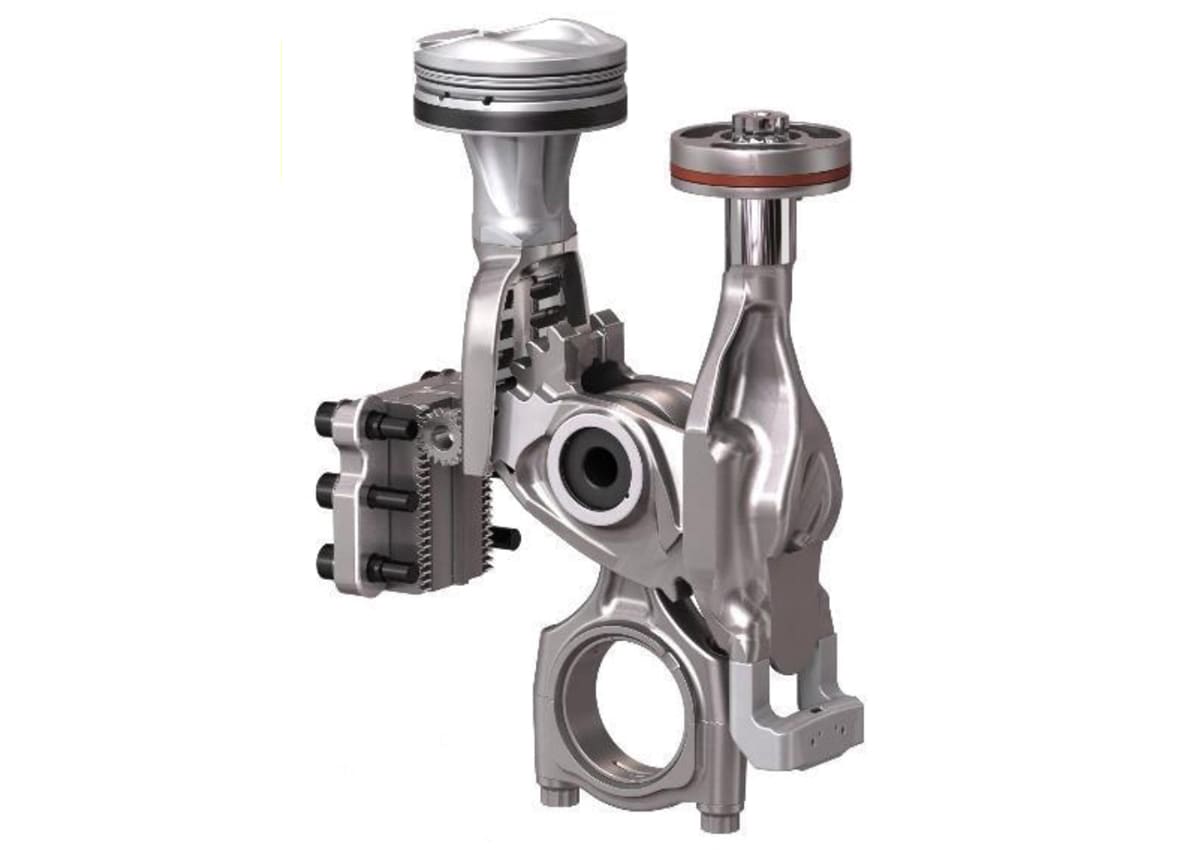
Nissan’s announcement at the 2016 Paris Motor Show that it will bring a variable-compression-ratio engine to production in 2018 (see AE November, 2016, p. 6) energized those in the advanced-ICE development community who also have VCR technologies in the works. Varying compression ratio according to load, speed and other parameters is a significant ‘lever’ that has yet to be pulled, in series-production volumes, to further optimize 4-stroke efficiency.
“The automakers have picked the low-hanging ‘fruit’ and are now climbing higher in the technology ‘tree’ to pick what will enable them to achieve the 2025 CO2 regulations,” explained Henri Trintignac, Chief Executive Officer at MCE-5 Development. The Lyon, France-based engine-tech company has been focused on its unique VCRi system for 17 years and has documented its progress via many SAE technical papers and presentations over the past decade. Its first development contract, signed in 2015, is with China’s Dongfeng Motor.

“The customer is interested in an engine family covering from 70 kW up to 200 kW. We do that with only three displacement variants and one bore, one stroke. Two-, three- and four-cylinder engines,” he said.
MCE-5’s system uses a dedicated cylinder block, cranktrain and actuators to provide continuous compression ratio control, ranging between 8:1 and [geometric ratio] 18:1 to each cylinder. Trintignac, a former Valeo powertrain systems executive, said the turbocharged VCRi can switch from minimum to maximum compression ratios in less than 100 ms.
“We can vary the compression ratio infinitely and we can go from 15:1 to 18:1 in just one combustion cycle,” he told Automotive Engineering. Running at part load, the effect is to minimize BSFC and maximize the “sweet spot” area on the fuel consumption map.
The company now is demonstrating the thermodynamic synergies of combining VCR with infinitely variable valve actuation. The aim is to enable enhanced Miller/Atkinson-cycle operation and thus improve part-load efficiency by reducing heat and pumping losses and optimize the compression-expansion ratio. With this combination of technologies, the inlet valves are open only during half of the compression stroke, so the effective compression ratio is in the range of 10:1.
“We can move three points of compression ratio in less than two cycles,” Trintignac reported. “And yes, we spend a lot of time on controls development!” He said 3D combustion simulations [conducted with IFP-C3D, a parallel solver] correlate closely with data from single-cylinder bench work. The tests show an indicated efficiency increase of 12-13% between 10:1 and 18-20:1 compression ratios at low loads, with BMEP less than 8 bar, he said.
The MCE-5 development team is targeting 50% brake thermal efficiency (BTE) by 2030, using a step-phase process. “For the first application by 2020, we are aiming for 40% BTE, 260 g/kW,” he said. “Next, we can increase the BTE to 44-45% by 2025” then beyond through methodical technology steps.
Refinement of the VCR mechanism and controls continues while combustion engineers play with geometric compression ratios as high as 23:1. Work proceeds on high rates of external cooled EGR (up to 60%) — heavy charge dilution described by Trintignac as HCCI (homogeneous-charge compression-ignition) — aided by a super-high-energy ignition necessary for stable and rapid combustion. Engine-heat recovery strategies also are under review.
The new ignition system is dubbed SSP, or Stratified Spark Plug. Trintignac would say only that it was developed internally and it’s not a plasma-based system. He claimed SSP can deliver 1 joule of ignition energy, compared with the 50 millijoules of a conventional ignition system.
Trintignac invites OEM engineers to Lyon to drive MCE-5’s demo vehicle and find out more. “To the industry it’s all about cost-to-benefit ratio — how many euros or dollars they have to spend to save each gram of CO2,” he noted. “Hybrid 48-volt systems save almost 15 grams on the WLTP cycle and we’re in the same range, 10-15 grams.
“But the 48-volt hybrid costs 60 to 70 euros per gram saved. Our VCR costs 30 euros per gram.”
More From SAE Media Group
Automotive Engineering
Cooled EGR Shows Benefits for Gasoline Engines
Automotive Engineering
2022 Nissan Rogue Gets a VC Turbo Triple
Automotive Engineering
Engine Researchers: 50% Gasoline-Engine Efficiency in Sight
Automotive Engineering
New Axial-Piston Engine Aimed at Range Extenders, Military Applications
Off-Highway Engineering
Mahle, Liebherr Develop Active Pre-Chamber for Hydrogen ICE

Off-Highway Engineering
IAV Brings Variable Valvetrains to Heavy Duty
Off-Highway Engineering
Cummins New X15 Engine Meets Upcoming Regs While Boosting Efficiency
Automotive Engineering
Engine Technology a Decade Later
Off-Highway Engineering
SwRI: CHEDE Consortium Closing in on 55% HD Diesel-Engine Efficiency
Automotive Engineering
Spark of Genius
Off-Highway Engineering
Cummins’ New Mid-Displacement Turbos Quieter and More Efficient
Off-Highway Engineering
Navistar Updates A26 Engine, Improves FE by 4%
Automotive Engineering
SwRI’s D-EGR Demo Car Wows SAE Engines Symposium with 42% BTE
Automotive Engineering
Audi's New V6 Diesel to Feature Electric Turbocharging, New NOx Technology
Automotive Engineering
German Spark-Ignited Compression-Ignition Research Paralleling Mazda’s SPCCI
Off-Highway Engineering
Could This Infinitely Variable Compression Mechanism Be the Next Piston Engine Game-Changer?
Automotive Engineering
Future ICEs: What Comes After 2025?
Off-Highway Engineering
Tier 4 Diesels
Automotive Engineering
Maruti Suzuki Refines Swift Engine for 10% FE Gain
Automotive Engineering
Audi Evolves the Miller Cycle in Its New 2.0-L Spark-Ignition Engine
Automotive Engineering
Extending the ICE Age: Hyundai Optimizing Engines and Fuels
Automotive Engineering
Mahle’s Pre-Chamber MJI Technology Is Sparking Ignition Advances
Automotive Engineering
Pushing the ICE Forward, Gradually
Tech Briefs
Electrohydraulically Actuated Valve Train
Off-Highway Engineering
Isuzu Simplifies Fuel Changeovers
Automotive Engineering
New Four-Chamber Rotary Engine Could Supplant Wankel and Piston Engines for UAV Applications
Off-Highway Engineering
Developing an Alternative Engine Concept
Automotive Engineering
UAV Turbines to Tackle 200-Hp Class UAV Engines for U.S. Army
Aerospace & Defense Tech Briefs
X Marks the Spot
Top Stories
INSIDERManufacturing & Prototyping
 How Airbus is Using w-DED to 3D Print Larger Titanium Airplane Parts
INSIDERManned Systems
 FAA to Replace Aging Network of Ground-Based Radars
NewsTransportation
 CES 2026: Bosch is Ready to Bring AI to Your (Likely ICE-powered) Vehicle
NewsSoftware
 Accelerating Down the Road to Autonomy
EditorialDesign
 DarkSky One Wants to Make the World a Darker Place
INSIDERMaterials
 Can This Self-Healing Composite Make Airplane and Spacecraft Components Last...
Webcasts
Defense
 How Sift's Unified Observability Platform Accelerates Drone Innovation
Automotive
 E/E Architecture Redefined: Building Smarter, Safer, and Scalable...
Power
 Hydrogen Engines Are Heating Up for Heavy Duty
Electronics & Computers
 Advantages of Smart Power Distribution Unit Design for Automotive...
Unmanned Systems
 Quiet, Please: NVH Improvement Opportunities in the Early Design...
