




Audi Evolves the Miller Cycle in Its New 2.0-L Spark-Ignition Engine
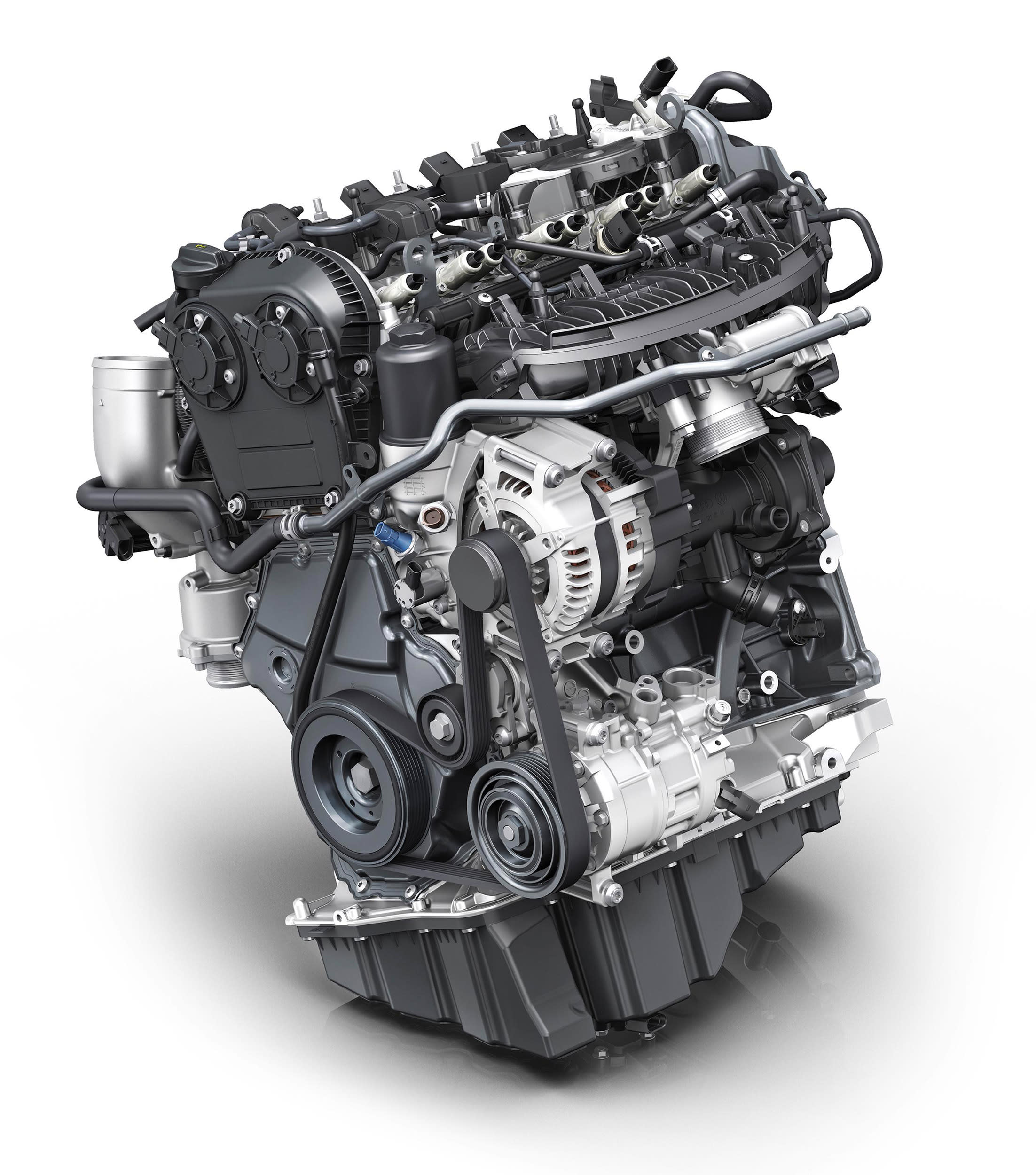
Audi’s next generation A4 due later this year will be the first model to receive a new 2.0-L engine that takes gasoline spark-ignition technology a step further towards the fuel consumption and torque capability of the diesel.

It does so via technology that is mostly on the inlet side of the cylinder. That is due to Audi’s introduction of a design that company engineers describe as being “comparable to the Miller cycle.” Engines using the Miller thermodynamic cycle have been used by other engine and vehicle manufacturers, notably Mazda. They employ late inlet-valve closing, before the piston reaches BDC, which facilitates the use of a higher compression ratio.
Audi revealed the 140-kW (188-hp) turbocharged, direct fuel injection (TFSI) engine at the 2015 Vienna Motor Symposium, and it illustrates the company’s “rightsizing” rather than downsizing philosophy for its new powertrains.
Prof. Dr. Ulrich Hackenberg, Audi’s Board Member for Technical Development, is adamant that end-user expectations of premium products must continue to enjoy satisfying powertrains.
“Rightsizing involves the optimal interplay of vehicle class, displacement output, torque, and efficiency characteristics under everyday conditions,” he explained.
His remarks were backed in Vienna by those of Dr. Stefan Knirsch, Head of Engine Development, who added: “The new engine enjoys the consumption benefits [less than 5.0L/100 km on the NEDC test cycle] of a downsized engine in partial load operation, while at high speeds it has the advantages of a large displacement engine.”

The new TFSI engine weighs about 140 kg (308 lb), the engineers claim.
Knirsch and his team further developed the Miller cycle, originally patented by American engineer Ralph Miller in 1957, “in crucial ways.” Focusing on the inlet side of the engine, intake timing has been greatly reduced by adopting a 140° crank angle compared to typical 190-200º timing.
And while Miller-cycle engines traditionally employ a Roots or screw-type positive-displacement supercharger, Audi is using a turbo. The engine gets a higher boost pressure on the inlet side to provide what Audi describes as “optimal cylinder charges” despite shorter intake timing. The engineers did not specify the new engine's compression ratio.
To help achieve Audi’s performance targets, in part-load range there is an additional injection upstream from the intake valve. This yields an efficient mixture formation that is already complemented by the direct injection in the combustion chamber as well as in the intake manifold, according to the engineers.
Also on the inlet side, the Audi Valvelift System ensures a short intake time at part-load and a longer at higher loads.
Full details of the engine have yet to be released, but features include subtle coolant flow control to reduce engine warm-up time. This is also complemented by the exhaust manifold being integrated in the cylinder head. Audi adds that consistent reduction of friction, as well as the use of low friction engine oil (OW-20), also contributes to enhanced engine efficiency.
Maximum torque of the engine is claimed to be 320 N·m (236 lb·ft), available from 1450 rpm to 4400 rpm. The lower end of that speed range is diesel-like, while the upper end helps to ensure the level of driving satisfaction required.
Following its introduction in the new A4, the engine will power other Audi models in various states of tune.
More From SAE Media Group
Automotive Engineering
German Spark-Ignited Compression-Ignition Research Paralleling Mazda’s SPCCI
Off-Highway Engineering
Navistar Updates A26 Engine, Improves FE by 4%
Off-Highway Engineering
Mahle, Liebherr Develop Active Pre-Chamber for Hydrogen ICE
Off-Highway Engineering
Could This Infinitely Variable Compression Mechanism Be the Next Piston Engine Game-Changer?
Automotive Engineering
V-Charging Aims to Add Muscle to Downsized Engines
Automotive Engineering
Achates Powers toward Production
Aerospace & Defense Tech Briefs
X Marks the Spot
Automotive Engineering
Injecting a Sense of Urgency to Clean up Diesels
Automotive Engineering
More sting for the STINGRAY
Automotive Engineering
New Axial-Piston Engine Aimed at Range Extenders, Military Applications
Automotive Engineering
Chevrolet Delivers a Bombshell with First-Ever 4-Cylinder for Fullsize Pickups
Automotive Engineering
New Peugeot 3-Cylinder Gasoline Engine Family Optimizes Combustion
Automotive Engineering
SwRI’s D-EGR Demo Car Wows SAE Engines Symposium with 42% BTE
Automotive Engineering
Pushing the ICE Forward, Gradually
Automotive Engineering
Optimizing Hybrids for Cost and Efficiency
Automotive Engineering
New Four-Chamber Rotary Engine Could Supplant Wankel and Piston Engines for UAV Applications
Automotive Engineering
Turbocharger Speed Sensors Aim for Light-Duty Applications
Off-Highway Engineering
IAV Brings Variable Valvetrains to Heavy Duty
Off-Highway Engineering
Kohler Extends Its Hand in Off-Highway Diesels
Automotive Engineering
RCCI Engine Begins In-Vehicle Demonstration Testing
Automotive Engineering
Engine Researchers: 50% Gasoline-Engine Efficiency in Sight
Automotive Engineering
Extending a Wankel Future on Hydrogen Fuel
Off-Highway Engineering
Cummins’ New Mid-Displacement Turbos Quieter and More Efficient
Automotive Engineering
Power Struggle Produces ESupercharger
Automotive Engineering
First Look: GM’s New Modular Ecotec Engines
Automotive Engineering
Ferrari Massages 458 to Create 488 GTB
Automotive Engineering
Tata Launches Family of Petrol Engines
Automotive Engineering
Delphi and Hyundai GDCI Program Aims to Top Diesel Efficiency
Automotive Engineering
Mercedes-AMG Extracts World-Record Power from New Four-Cylinder Engine
Off-Highway Engineering
Volvo Penta Debuts Two New Off-Highway Engines
Top Stories
INSIDERManufacturing & Prototyping
 How Airbus is Using w-DED to 3D Print Larger Titanium Airplane Parts
INSIDERManned Systems
 FAA to Replace Aging Network of Ground-Based Radars
NewsTransportation
 CES 2026: Bosch is Ready to Bring AI to Your (Likely ICE-powered) Vehicle
NewsSoftware
 Accelerating Down the Road to Autonomy
EditorialDesign
 DarkSky One Wants to Make the World a Darker Place
INSIDERMaterials
 Can This Self-Healing Composite Make Airplane and Spacecraft Components Last...
Webcasts
Defense
 How Sift's Unified Observability Platform Accelerates Drone Innovation
Automotive
 E/E Architecture Redefined: Building Smarter, Safer, and Scalable...
Power
 Hydrogen Engines Are Heating Up for Heavy Duty
Electronics & Computers
 Advantages of Smart Power Distribution Unit Design for Automotive...
Unmanned Systems
 Quiet, Please: NVH Improvement Opportunities in the Early Design...
