




Achates Aims at 2025 Light-truck Power
After more than a decade of steady development, Achates Power’s opposed-piston two-stroke diesel is impressing powertrain experts with its test results and pace of technical progress.

It’s autumn 2024, and you’re at the local auto mall shopping for a new pickup truck — one that delivers the 32-mpg fuel economy required of full-size trucks for the upcoming model year. As the salesperson lifts a hood to show off the engine underneath, she proudly declares “2.25 liters” and you see what appears to be a supercharged SOHC inline four nestled neatly within the engine bay.
Nice packaging, you comment. But closer inspection reveals this isn’t a traditional ICE.
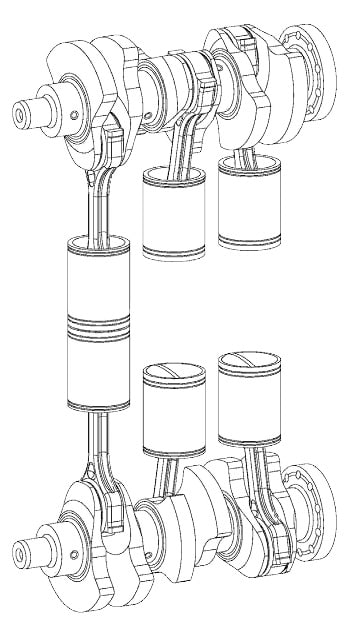
There are no spark plug wires — must be a diesel. Glancing down reveals a row of three fuel injectors and an exhaust manifold — so, it’s a triple! But wait. There’s another trio of injectors and a manifold on the other side of the...block. Hmmm, there’s no visible cylinder head. This couldn’t be an I3 with such an unusual layout.
Indeed, it is a three-cylinder engine, but vastly different than today’s. The engine in question is the OP2S — opposed-piston two-stroke — an advanced compression-ignition unit that has its roots in 1930s aero, marine, and military vehicle propulsion, where its inherent reliability, fuel efficiency, and smooth operating characteristics were proven. And for the past decade, Achates Power, a San Diego-based engine and combustion-technology company, has been re-inventing the OP2S, transforming it into a viable candidate to power future light trucks and other applications.
With its two piston sets facing each other in the same cylinder — the three-cylinder engine actually uses six pistons — and driven by two crank trains on opposite sides of the crankcase, Achates’ OP2S design offers a stroke-to-bore ratio double that of conventional single-piston-per-cylinder designs without limiting the engine speed range. This brings a significant reduction in surface area-to-volume ratio of the combustion space and, with no need for a cylinder head, a resulting increase in thermal efficiency due to a reduction in heat loss over the combustion cycle.
Uniflow cylinder scavenging helps reduce pumping work, and the proprietary Achates combustion system (piston crown geometries, boosting, EGR management) brings other advantages including lower NOx characteristics, also a result of the two-stroke operating cycle’s lower brake mean-effective pressure (BMEP) requirements.

“Compared with four-stroke diesels in the same performance category, we’re showing efficiency advantages of 30%, with reduced cold-start emissions, and a 50% advantage over SI engines,” observed Fabien Redon, Achates’ Vice President of Technology Development.
For the Achates Power technical paper presented at the SAE 2014 World Congress, go here . For recent Achates Power technical papers and presentations, go here .

Multi-fuel capable, the Achates proprietary piston-crown topographies and combustion system create thorough air-fuel mixing and high turbulence. As a result, the OP2S “platform” offers synergies with, and is capable of supporting, advanced combustion regimes such as RCCI (reactivity-controlled compression ignition), PPC (partially-premixed combustion), and GCI (gasoline compression ignition) that aim for low engine-out NOx and particulate levels, according to Redon who, prior to joining Achates, oversaw development of General Motors’ groundbreaking 4.5-L Duramax V8 diesel that was axed during GM’s 2008 financial crisis just before it reached production.
As this issue of Automotive Engineering went to press, Achates had established 21 U.S. and 11 foreign patents, and more than 50 pending, covering approximately 1500 technology items, Redon said. In late 2013 the company signed its first publicly announced joint development and licensing deal. The agreement is with Fairbanks Morse, which aims to use OP2S engines in a variety of applications including emergency stationary power and marine propulsion.
Ironically, Fairbanks Morse was a major supplier of OP2S diesels to the U.S. Navy for many years, its engines powering fleet submarines.
Encouraging FE, emissions results
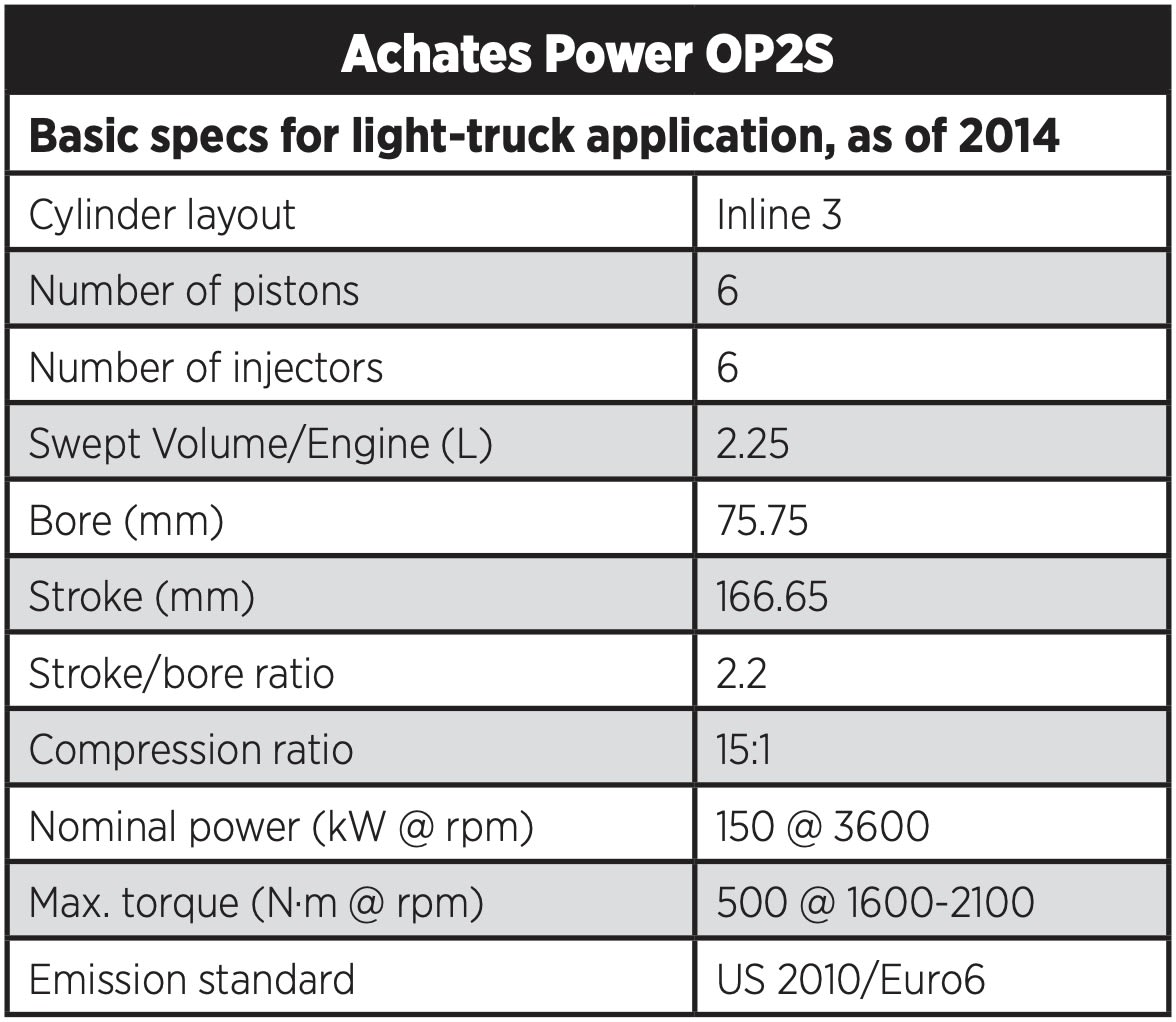
Redon has been busy this year, traveling to SAE and other powertrain technical conferences to present results of a detailed benchmark study comparing Achates’ 2.25-L OP2S for light-duty vehicles (75.75 x 166.65 mm bore and stroke; 2.2:1 stroke-to-bore ratio) to an advanced 2.8-L four-cylinder four-stroke diesel that is part of a U.S. DOE-funded project to demonstrate the potential of meeting U.S. EPA Tier 2 Bin 2 emissions levels.
By 2025, the standards will require OEMs to have a fleet average emissions level of 0.030 g/mi NMOG+NOx (non-methane organic gas plus nitrogen oxide) for all light-duty vehicles below 8500 lb (3855 kg) gross vehicle weight.
“We think our engine will fit particularly well with the duty cycle and performance requirements of light-duty trucks,” he said.
In its comparison to the DOE-funded engine (based on a Cummins Atlas), the Achates Power team successfully demonstrated a 30% fuel-economy (FE) improvement without hybridization or major vehicle upgrades; potential to meet fully phased-in Tier 3 standards; rapid catalyst light-off; excellent NVH characteristics; and the ability to integrate the engine seamlessly into a broad range of passenger cars and light trucks.
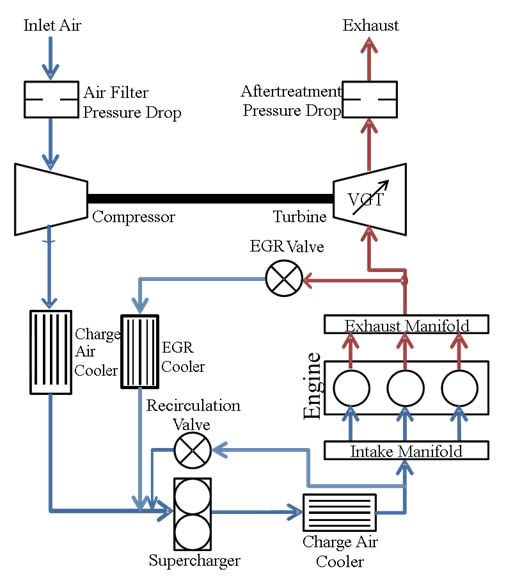
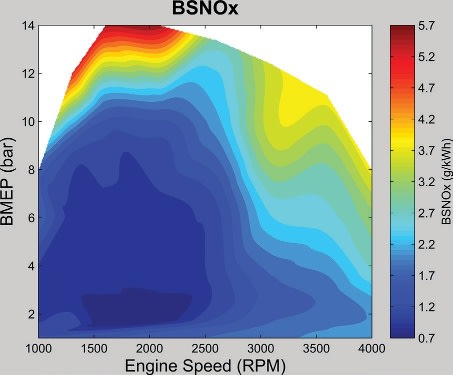
In a detailed presentation to Automotive Engineering at the Achates technical center, engineers showed a flat BSFC (brake-specific fuel consumption) map, averaged over the LA-4 (city) and highway drive cycles. The flat map revealed the OP2S engine’s high fuel efficiency across the speed/load ranges. Redon observed that the engine’s optimum fuel efficiency and low engine-out NOx levels correlate ideally with the low speed/load duty cycle that is typical of light-vehicle operation.
In the benchmarking, the Achates OP2S also demonstrated significant reductions in NOx, hydrocarbon, and particulates. The cycle average was based on a 10-mode weighted calculation, similar to that used to predict the cycle fuel economy and emissions of the DOE-funded engine.
Particulate was measured with an AVL415S smoke meter; Redon noted that while it was not total PM, a close correlation was established and is presented in SAE technical paper 2014-01-1187.
On the LA-4 cycle, the Achates Power OP2S diesel produced NOx levels of 0.47 g/mi, versus the benchmark engine’s 0.82 g/mi. On the highway cycle, the difference between the two engines’ NOx emissions increased — 0.34 g/mi for the Achates Power unit, and 0.94 g/mi for the DOE-funded engine.
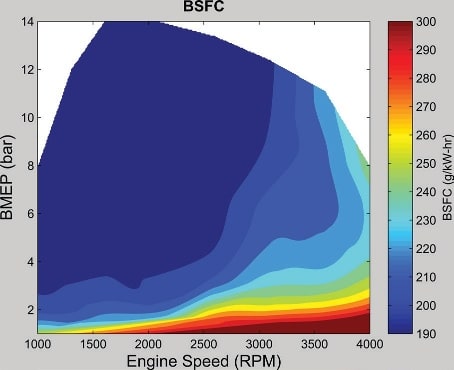
A proprietary thermal-management strategy enables the OP2S to reach higher exhaust temperatures during catalyst light-off than are possible with conventional four-stroke diesels, Redon said. That’s critical for the FTP-75 test in which, for a conventional diesel, more than half of tailpipe emissions are produced in the first 200 s of operation after a cold start.
Redon and the Achates Power team are particularly proud of their engine’s exemplary NVH characteristics. For the benchmarking, the team decided not to compare the OP2S against the DOE 2.8-L inline-four diesel, since it was equipped with balance shafts. Emboldened by the opposed-piston design’s self-cancelling forces — good for smooth running — and their CAE and simulation data, they instead compared the OP2S to a state-of-the-art four-stroke gasoline V6: Honda’s buttery-smooth and quiet 3.5-L 60° V6.
Redon noted that the OP2S vibration moments, while not perfectly balanced, proved to be several orders-of-magnitude less than the Honda’s.
Attracting and impressing experts
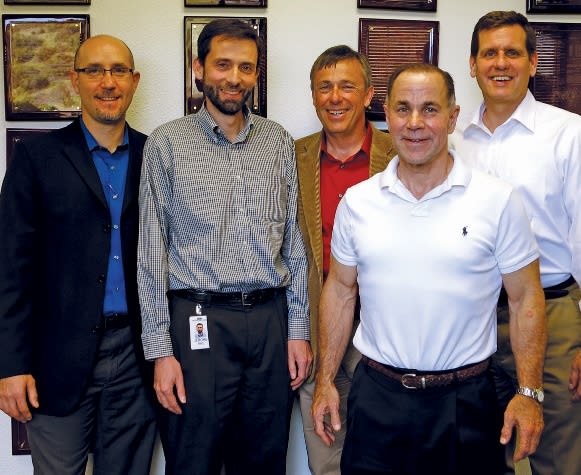
Achates Power’s rapid pace of development and increasingly convincing technical results of its OP2S program have helped the company attract a stellar advisory board. Members include combustion-engineering legend Dr. David Foster; former Detroit Diesel Executive Vice President of Engineering Dave Merrion; and low-emissions engine pioneer Wally Wade, all of whom are SAE Fellows. As is 2014 SAE President, Dan Hancock.
“When Dan was invited by [Achates CEO] Dave Johnson to join our industry board, he came out to visit our facility — and we sensed that he was prepared to kind of blow us off politely,” said company Chief Technology Officer John Koszewnik. “I think he carried the notion that two-stroke diesels were a dead end.”
Recalled Hancock: “When Dave invited me to come aboard, I agreed to make one visit to Achates. Having worked at Detroit Diesel during the decline of the two-stroke diesel for on-highway markets, I knew all of its pitfalls. But I was intrigued by horizontally-opposed pistons and the theory that you save all that heat loss into the cylinder head, because there is no head.
“Plus there’s the potential for eliminating one of our major sources of energy loss in the fundamental combustion process, which is the best place to get efficiency. It’s in the 60% that we don’t get today,” he said.
Hancock also was mightily impressed by the technical depth and professional reputations of those already on the advisory boards. “Achates Power Founder Jim Lemke is a brilliant individual, and Dave Foster in my opinion is one step away from God in the combustion-science universe. And guys like Merrion and Wade — they wouldn’t be on the Achates board if there were issues with the technology. So it was worth one trip to meet the team and see the fundamentals behind their new engine.”
Part way through his visit, Hancock’s preliminary caveats had mostly vanished. “It quickly became apparent that the engineering team is really, really good,” he said, noting “high pedigree” industry veterans Koszewnik, Gerhard Regner (Vice President of Emissions and Performance), and Mechanical Systems Chief Dnyanesh Sapkal, whose long powertrain careers have included tenure at FEV, AVL, Ford, and Mahindra.
Achates “clearly has terrific analytical underpinnings to prove their engine, and have done everything the right way through sound modeling and simulation,” Hancock observed. “The test results they’ve been able to demonstrate have been very encouraging.”
The base design also has bill-of-material benefits — the OP2S having two crankshafts but no valvetrain — and the architecture isn’t disruptive in terms of manufacturing processes.
Hancock and other powertrain experts acknowledge the OP2S engine still has some development hurdles to cross in order to silence the most ardent skeptics.
“There are the traditional two-stroke challenges of crankcase sealing and keeping lubricant oil out of the combustion chamber,” said Dr. Tim Johnson, Director of Emerging Technologies and Regulations at Corning. “But I’ve seen them make a lot of progress in the last couple years” in terms of component and systems design, and advances in machining, manufacturing, sealing technologies, and lubricant management.
“They’re dealing methodically with the thermal and oil-use issues related to two-stroke engines,” Dr. Johnson told Automotive Engineering during the 2014 SAE High-Efficiency ICE Symposium. “Among the various emergent engine innovators, Achates’ progress impresses me greatly.”
More From SAE Media Group
Off-Highway Engineering
Cummins Unveils New B7.2 Diesel Engine
Automotive Engineering
Cooled EGR Shows Benefits for Gasoline Engines
Off-Highway Engineering
Development Trends for Heavy Engines
Automotive Engineering
Future ICEs: What Comes After 2025?
Automotive Engineering
'Reman' Engine Market Steady, but Complexity Challenges Production Efficiency
Off-Highway Engineering
Mahle, Liebherr Develop Active Pre-Chamber for Hydrogen ICE
Off-Highway Engineering
The Complicated Future of Off-Highway Engines
Off-Highway Engineering
Off-highway Calibration Challenges — Big and Complex
Automotive Engineering
Balancing GDI Fuel Economy and Emissions
Automotive Engineering
2015 Engines Ride a Technology Tidal Wave
Automotive Engineering
Audi's New V6 Diesel to Feature Electric Turbocharging, New NOx Technology
Automotive Engineering
2022 Nissan Rogue Gets a VC Turbo Triple
Automotive Engineering
Bentley Develops W12 Cylinder Deactivation
Automotive Engineering
New Engines 2016
Off-Highway Engineering
Navistar Updates A26 Engine, Improves FE by 4%
Automotive Engineering
Achates Powers toward Production
Automotive Engineering
Spark of Genius
Automotive Engineering
JLR's All-New 2015 Modular Engines Feature Roller-Bearing Cams, Balance Shaft
Automotive Engineering
Mazda Plots Wankel-powered Range Extenders, HCCI Mild Hybrids
Off-Highway Engineering
Could This Infinitely Variable Compression Mechanism Be the Next Piston Engine Game-Changer?
Off-Highway Engineering
Iveco Pursues Natural Gas in Stralis NP Models
Off-Highway Engineering
Many ICE Paths Lead to Reduced Emissions
Off-Highway Engineering
Rotary SI/CI Combustion Engines: A Thing of the Future?
Automotive Engineering
Extending the ICE Age: Hyundai Optimizing Engines and Fuels
Automotive Engineering
Advancing the OP Engine on Three Fronts
Off-Highway Engineering
Miserly Power Systems
Automotive Engineering
Porsche Unveils New Downsized, Boosted 3.0-L Boxer Six
Automotive Engineering
Leading the Attack on Engine Pumping Losses
Off-Highway Engineering
Life-cycle Planning — Design and Calibration for Ultimate Efficiency
Off-Highway Engineering
FEV Simplifies Off-Highway Electrification
Top Stories
INSIDERManufacturing & Prototyping
 How Airbus is Using w-DED to 3D Print Larger Titanium Airplane Parts
INSIDERManned Systems
 FAA to Replace Aging Network of Ground-Based Radars
NewsTransportation
 CES 2026: Bosch is Ready to Bring AI to Your (Likely ICE-powered) Vehicle
NewsSoftware
 Accelerating Down the Road to Autonomy
EditorialDesign
 DarkSky One Wants to Make the World a Darker Place
INSIDERMaterials
 Can This Self-Healing Composite Make Airplane and Spacecraft Components Last...
Webcasts
Defense
 How Sift's Unified Observability Platform Accelerates Drone Innovation
Automotive
 E/E Architecture Redefined: Building Smarter, Safer, and Scalable...
Power
 Hydrogen Engines Are Heating Up for Heavy Duty
Electronics & Computers
 Advantages of Smart Power Distribution Unit Design for Automotive...
Unmanned Systems
 Quiet, Please: NVH Improvement Opportunities in the Early Design...
