




2015 Engines Ride a Technology Tidal Wave
Powertrain engineers are diving deeper to find new ways to make light-duty power units more efficient without compromising performance.

As MY2015 approaches, the debut of Atkinson-cycle engines for non-hybrids, diesel-like compression ratios on gasoline engines with sophisticated cooled EGR, low-friction roller-bearing camshafts, and electrically enhanced boosting systems shows the industry is diving deeper into its technology toolboxes to tackle stiff new regulatory challenges. Meanwhile, there’s still room for a hairy 707-hp (527-kW) overhead-valve V8 to power Chrysler muscle cars.
In Europe, the trend in light-vehicle engines is turning away from the diesel panacea that has driven the market since the 1990s. Euro 6 emission standards are finally approaching the North American benchmark, making compression-ignition engines and their elaborate aftertreatment increasingly costly. DI spark-ignition engines are running dizzy-high compression ratios well above 12:1, downsized turbo engines are earning rave reviews, and the gasoline-vs-diesel efficiency gap is diminishing — the latest analyses pegging it at about 10% for A- and B-class cars. And compared with parallel-type full hybrid systems, the latest gas engines and transmissions are a value.
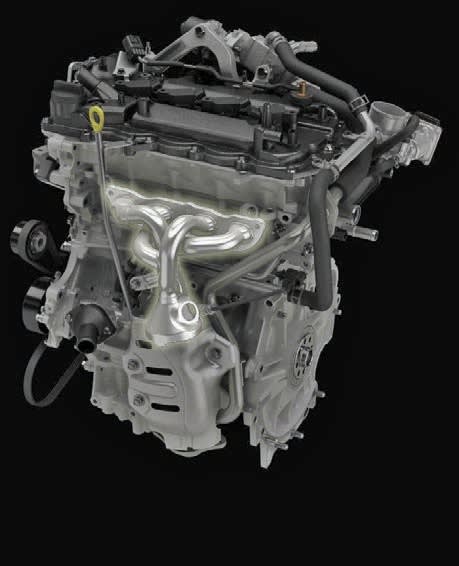
Amid this gasoline-ICE rebirth, Automotive Engineering highlights some of the most significant new light-vehicle engine and related technologies entering the market for MY2015.
Mr. Atkinson meet Herr Otto
For those who missed it, SAE Technical Paper 2014-01-1192 published by Toyota last April contained a minor manifesto: The world’s largest automaker aims to increase the brake thermal efficiency (BTE) of its gasoline engines to beyond 40% — contemporary engines typically have 30-35% BTE. Most noteworthy among the technologies being employed to achieve these targets is Toyota’s first use of the Atkinson combustion cycle in non-hybrid vehicles.
In MY2015, the Atkinson-cycle onslaught includes a 1.3-L four; two 2.0-L fours (both naturally-aspirated and turbocharged), and a 5.0-L V8 that powers the new Lexus RC-F performance coupe. Others are in the pipeline through 2017. Some of the engines, notably the turbo 2.0-L and the V8, run Atkinson cycle at low loads, for greater fuel efficiency, and shift to Otto-cycle operation at high load and high rpm. The company is aiming for light-vehicle fuel-economy improvements of up to 15%, according to Toyota powertrain engineers.

Toyota’s Atkinson-cycle engines, made famous in the Prius, use late intake-valve closing during the compression stroke to achieve an increased expansion ratio. Typically they feature geometric compression ratios of 13:1 or higher for excellent thermal efficiency. But the downside of their high compression is a reduction in torque, which in hybrids is supplemented by the electric motor, noted Tetsu Yamada, one of the SAE paper’s authors. The torque deficit for non-hybrids is being addressed in various ways, including liquid-cooled exhaust gas recirculation (EGR) and new infinitely variable valvetrain systems.
Toyota engineers have created an acronym for the new engine technology — ESTEC (Economy with Superior Thermal Efficient Combustion). The 1.3-L ESTEC four (coded 1NR-FKE) that powers the Yaris/Vitz features the company’s latest VVT-iE — the iE denotes “intelligent electric” control — which provides faster and more precise intake-cam phasing. This is vital for optimum Atkinson-cycle operation without cold-start issues caused by oil temperature and pressure variations.

High-tumble inlet ports speed combustion, reduce “knock,” and are part of an integrated system that combines the intake manifold, EGR cooler, and EGR valve. Toyota engineers noted that during low load operation the cooled EGR, while it reduced pumping losses, caused unacceptable torque fluctuation. Their solution was to switch to internal EGR through advancing the exhaust-cam timing. As load increases, the exhaust-cam timing is retarded and an EGR valve step is advanced.
To help recover torque lost to the higher (13.5:1) CR, there’s a purpose-designed 4-into-2-into-1 exhaust manifold that helps scavenge residual exhaust gas from the cylinders. The 4-2-1 manifold also is used on the 2.0-L Atkinson engines. Combined with revised injection timing and more efficient coolant jackets (with spacers around the cylinders to help moderate temperature), the manifold helps recoup nearly 7 lb·ft (9 N·m). The new engine’s 77.5-lb·ft (105-N·m) peak torque is actually 1 lb·ft more than that of the 11.5:1 non-Atkinson engine, according to Toyota.
The development team also focused on reducing internal friction, using solid-film moly-impregnated piston skirts and timing chain tensioner, plastic-coated bearings, a revised oil sump, and a stop-start system. Their overall effort resulted in the ESTEC 1.3-L producing 98 hp (73 kW), which is a 4-hp (3-kW) gain versus the Otto-cycle 1NR-FE previously used in Toyota A- and B-segment cars. It delivers up to 38% BTE — similar to the Prius application and among the best mass-produced ICEs, the company claims. Additionally, the 1NR-FKE offers 11% greater fuel economy in the low-load JC08 drive mode.
Turbocharged 2.0-L Atkinson debuts
Toyota’s pair of 2.0-L Atkinson-cycle engines already have applications in the European Camry (naturally aspirated) and the Lexus NX200t and NX200t F Sport compact crossover (turbo). Their VVT-iW continuously variable valvetrain enables the engines to start out in the Otto cycle and run there during high loads/speed operation for stronger performance, then switch to Atkinson at low loads (i.e., highway cruising) for improved fuel efficiency and lower emissions, delivering high torque across the operating range. The ‘W’ denotes wide bandwidth operation on the intake side, their cam phasers employing a mechanism to lock the phaser in mid-position to retard valve timing when required.
Both 2.0-L units use Toyota’s D-4S fuel injection system featuring separate injectors for both high-pressure direct and lower-pressure port injection, according to engine speed. They also use tumble-flow cylinder heads with liquid-cooled EGR and 4-2-1 integral-cast exhaust manifolds, with an integral cooling jacket. An electronically controlled EGR valve enables precise and equal gas recirculation to each cylinder. Compression ratios are 10:1 on the 8AR-FTS turbo engine and 12.8:1 on the naturally aspirated version.
The new turbo engine in the NX200t is the first in a Toyota product since the early 2000s Supra and Lexus GS300. Capable of generating 235 hp (175 kW) from 4800 to 5600 rpm, and 258 lb·ft (350 N·m) from 1650 to 4000 rpm, the 2.0-L is designed for strong throttle tip-in rather than ultimate performance while delivering low emissions and fuel consumption. The single, twin-scroll turbocharger was developed in-house and uses a dedicated air-to-liquid intercooler. An active, variable waste-gate control valve helps minimize pumping losses by reducing exhaust backpressure at low engine loads. Max boost at WOT is 17 psi (1.2 bar).
Our recent test-drive in a U.S.-spec NX200t showed the dual-cycle turbo engine performs superbly at low-to-medium engine speed. Broad torque across the rev range allows the vehicle to flatten hills without much downshifting fuss. The engine switches seamlessly from Otto to Atkinson, though torque drops off above about 3800 rpm.
By comparison, the naturally aspirated and Euro 5-compliant 2.0-L Atkinson cycle four delivers 147 lb·ft (199 N·m) at 4600 rpm, enabling the 2015 European Camry to achieve 7.2 L/100 km (32.7 mpg U.S.) fuel consumption, 13% less than that of the previous Otto-cycle engine, Toyota claims.
An Otto-Atkinson performance-car V8
It may be hard to imagine an Atkinson-cycle engine powering any non-hybrid performance coupe that aims to compete with the mighty BMW M4, but Toyota powertrain planners had other ideas. Their new 5.0-L V8, based on the 2UR-GSE, spins the rear wheels of the new-for-2015 Lexus RC-F, an M4 fighter with a mildly green heart. Sharing only its cylinder block with the 2UR unit that powered the outgoing IS-F sedan — cylinder heads and reciprocating parts are different — the new DOHC V8 generates a claimed 467 hp (348 kW) at 6600 rpm, and 389 lb·ft (527 N·m) at 5200 rpm.
New electric phasers on the four camshafts enable the V8 to switch imperceptibly from Otto-cycle operation at low loads/revs to the more efficient Atkinson cycle during low-load cruising. During Atkinson-cycle operation, with the titanium inlet valves remaining open during part of the compression stroke, the V8 is effectively a 4.2-L, utilizing its 12.3:1 compression ratio to optimize the air-fuel charge.
As with the 2.0-L 8AR-FTS turbo four, the V8 uses dual-stage (DI and secondary port) D4S injection. Redline is 7300 rpm. For the RC-F, Lexus quotes a 0-60 mph (0-97 km/h) acceleration time of 4.4 s; claimed top speed is a governed 170 mph (274 km/h). EPA fuel-economy estimates are 16/25/19 mpg city/highway/combined. Not bad for a “Prius” ICE!
Roller cams in JLR’s new modular range
With a common 500-cm3 cylinder volume, and flexible cylinder-block architecture for transverse FWD and longitudinal RWD vehicle applications, Jaguar Land Rover’s (JLR) all-new Ingenium range of turbocharged, modular gasoline and diesel engines will power a variety of passenger car and SUV models currently planned through 2019. First vehicle application for the initial 2.0-L four-cylinder units are the 2015 Jaguar XE, the brand’s aluminum-intensive 3-Series fighter.

According to Ron Lee, JLR Director of Powertrain Engineering, the modular design allows planners to vary engine displacement and cylinder count, and is amenable to hybridization. Target CO2 emissions levels for the AJ200D diesel version are below 100 g/km. Official output figures at launch for the gas engine is 177 hp (132 kW) at 4000 rpm, and 317 lb·ft (430 N·m) at 1750-2500 rpm. Its diesel cousin is rated at 161 hp (120 kW) at 4000 rpm, and 280 lb·ft (380 N·m) also at 1750-2500 rpm.
Particular engineering focus was put on reducing internal friction, and JLR follows Volvo’s latest “Drive-E” engine family by using rolling-element bearings to support its engines’ twin overhead camshafts. “Roller cams,” as racers call them, reduce mechanical bearing friction and eliminate the need to supply pressure oil to the camshaft’s plain bearing support — the oil mist in the cylinder head is sufficient to lubricate the rolling bearings.
Roller-camshaft systems tested by Mahle (which is developing them for OEMs) in DOHC engines have shown a reduction in frictional loss of over 40% as measured in the low-rpm range. Mahle engineers say this is a benefit during cold starts, when oil viscosity is high. Roller cams also require up to 40% less oil in the valvetrain and cylinder head, so the oil pump can be downsized to consume less power.
While some powertrain engineers are wary of potentially higher noise levels with rolling-element bearings in the top end, Mahle’s acoustic analysis of a roller bearing camshaft using structure-borne and airborne-sound measurements taken on an acoustic test bench, with a driven cylinder head, show a slightly higher overall noise level but with a shift to lower frequencies. Engineers say DI injector noise is likely to be higher, as perceived within the vehicle cabin, than camshaft-bearing noise.

Both single- and twin-turbo boosting solutions from Mitsubishi and BorgWarner are in the Ingenium plan, giving engineers the ability to tailor the engines to specific vehicle applications. Lee said the 2.0-L four that powers the new XE weighs up to 176 lb (80 kg) less than a typical incumbent of equivalent output. Particular emphasis has been placed on achieving exceptionally low internal friction, which is described as being 17% less than a current 2.2-L diesel.
Ford’s robust new 2.7-L V6
We’ve tested the 2015 Ford F-150, and our favorite engine offered in that lightweight truck is Ford’s 2.7-L twin-turbocharged “EcoBoost” gasoline V6. This is a dandy power unit that is destined for other Ford and Lincoln products. Code-named Nano during development, the all-new direct-injected V6, with a “square” 83-mm bore and stroke, is SAE certified at 325 hp (242 kW) and 375 lb·ft (508 N·m). Peak torque arrives at 2500 rpm, about 1000 rpm short of redline.
In terms of output vs. vehicle curb weight on the aluminum-intensive truck, the 2.7-L compares with Ford’s 3.5-L EcoBoost V6 that is purchased by half of F-150 customers, according to the company’s 2014 sales.

Perhaps the V6’s most interesting technology is its linerless compacted-graphite-iron (CGI) cylinder block, first used by Ford in its 6.7-L PowerStroke diesel V8. The CGI block offers approximately 75% greater tensile strength, 45% greater stiffness, and roughly double the fatigue strength of alternative block materials, noted Ed Waszczenko, Ford’s V-Engine Design Lead. It also has superb dimensional stability, durability, and NVH damping characteristics. CGI’s strength properties allow for thinner-section cylinder block walls and narrower main bearing saddles.
The CGI block is actually one of two main structural elements of the new V6’s bottom end. The other main element is a die-cast aluminum ladder frame that surrounds the lower portion of the CGI element and bolts to thick flanges on each side of the cylinder block. Heavily ribbed on its exterior for added rigidity, the ladder frame also supports the precision-fractured main bearing caps (which influenced the design of the 2.7-L’s block, offset I-beam connecting rods, reinforced-plastic oil pan, and pistons). The bearing caps, also in CGI, are laser-etched at an angle, Waszczenko explained, creating a wedge effect that when the sections are merely set together, the engine actually would be able to run without the cap bolts. The Federal-Mogul multi-layered main bearing inserts carry a proprietary low-friction coating.
The twin-turbo setup uses low-pressure BorgWarner turbo machines, operating on 29-psi (200-kPa) peak boost pressure. On the induction side, twin-independent continuously variable valve timing (TI-CVT) features cam phasers operating with over 30° of authority. The TI-CVT system helps eliminate the need for an EGR valve. Compression ratio is 10:1.
e-boosting for Vw-Audi’s 2015 V6 diesel
Electrically enhanced turbochargers are under investigation across the industry, and Volkswagen-Audi may be the first OEM to offer the efficiency-and-power-boosting devices in production — likely in MY2015.
Popularly dubbed “e-booster,” the machines integrate an electric motor within the turbocharger architecture. They are used in Formula 1 in more sophisticated form, for eliminating typical turbo “lag” while also offering a modicum of energy recovery that can be applied back to the driveline. Earlier this year, VW’s R&D chief Dr. Ulrich Hackenburg announced that a high-performance version of the 2015 Q7, to be badged SQ7, will offer an electric turbo system on its new-generation 3.0-L V6 TDI diesel.
Audi engineers have been testing “e-boosters” for years, and Automotive Engineering has driven a prototype equipped with the technology. The major turbocharger manufacturers, including BorgWarner, Hitachi, Valeo, and Honeywell, have prototypes under customer evaluation, sources tell Automotive Engineering.

OEM powertrain engineers see e-boosting as a potential alternative to two-stage turbocharging systems, and an opportunity to gain a small bit of package space underhood — depending on engine configuration and vehicle. But along with the benefits of e-boosting are various challenges, primarily electric-power consumption and cost. Systems currently in development require 48-V power.
Engineers familiar with the technology reckon a properly calibrated electric turbocharger can reduce fuel consumption by between 7 and 15%, the greatest opportunity being when combined with regenerative braking, they said. Boost is available instantaneously, and the increased mass-airflow the devices produce at low loads can help reduce PM emissions.
In an interview with Automotive Engineering at the 2014 Geneva Motor Show, Dr. Heinz-Jakob Neusser, VW Group’s top powertrain engineer, voiced his enthusiasm for e-boosters: “I think they’re a good solution for increasing the specific output of smaller engines, so they can be used in larger vehicles without suffering a performance loss,” he said.
More From SAE Media Group
Off-Highway Engineering
Cummins Unveils New B7.2 Diesel Engine
Off-Highway Engineering
Cummins Spools up New Turbo Tech
Automotive Engineering
Lexus Equips NX Entry-Level SUV with New Turbo Gasoline Engine
Automotive Engineering
Cooled EGR Shows Benefits for Gasoline Engines
Automotive Engineering
New Engines 2016
Automotive Engineering
Future ICEs: What Comes After 2025?
Automotive Engineering
Audi's New V6 Diesel to Feature Electric Turbocharging, New NOx Technology
Automotive Engineering
'Reman' Engine Market Steady, but Complexity Challenges Production Efficiency
Off-Highway Engineering
Off-highway Calibration Challenges — Big and Complex
Off-Highway Engineering
Development Trends for Heavy Engines
Automotive Engineering
Mazda Plots Wankel-powered Range Extenders, HCCI Mild Hybrids
Automotive Engineering
Porsche Unveils New Downsized, Boosted 3.0-L Boxer Six
Automotive Engineering
Achates Aims at 2025 Light-truck Power
Automotive Engineering
Balancing GDI Fuel Economy and Emissions
Automotive Engineering
JLR's All-New 2015 Modular Engines Feature Roller-Bearing Cams, Balance Shaft
Automotive Engineering
2022 Nissan Rogue Gets a VC Turbo Triple

Off-Highway Engineering
Navistar Updates A26 Engine, Improves FE by 4%
Off-Highway Engineering
Mahle, Liebherr Develop Active Pre-Chamber for Hydrogen ICE
Tech Briefs
Products of Tomorrow
Automotive Engineering
Chevrolet Delivers a Bombshell with First-Ever 4-Cylinder for Fullsize Pickups
Off-Highway Engineering
Cummins New X15 Engine Meets Upcoming Regs While Boosting Efficiency
Automotive Engineering
Testing Audi’s New E-Booster Reveals Turbocharging's Future
Automotive Engineering
Bentley Develops W12 Cylinder Deactivation
Off-Highway Engineering
Komatsu Logs a New Timber Machine


Off-Highway Engineering
FEV Simplifies Off-Highway Electrification
Tech Briefs
Lithium Metal Battery Allows Cold Charging

Top Stories
INSIDERManufacturing & Prototyping
 How Airbus is Using w-DED to 3D Print Larger Titanium Airplane Parts
INSIDERManned Systems
 FAA to Replace Aging Network of Ground-Based Radars
NewsTransportation
 CES 2026: Bosch is Ready to Bring AI to Your (Likely ICE-powered) Vehicle
NewsSoftware
 Accelerating Down the Road to Autonomy
EditorialDesign
 DarkSky One Wants to Make the World a Darker Place
INSIDERMaterials
 Can This Self-Healing Composite Make Airplane and Spacecraft Components Last...
Webcasts
Defense
 How Sift's Unified Observability Platform Accelerates Drone Innovation
Automotive
 E/E Architecture Redefined: Building Smarter, Safer, and Scalable...
Power
 Hydrogen Engines Are Heating Up for Heavy Duty
Electronics & Computers
 Advantages of Smart Power Distribution Unit Design for Automotive...
Unmanned Systems
 Quiet, Please: NVH Improvement Opportunities in the Early Design...
