




Iveco Pursues Natural Gas in Stralis NP Models
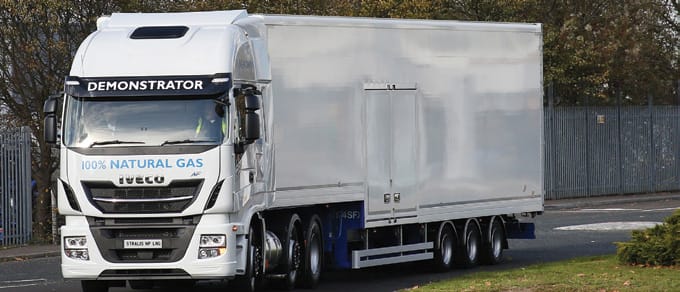
With the transport and logistics business looking for an alternative to diesel, European truck manufacturer Iveco believes the future is gas-powered. Electric drive is certainly being explored for lighter commercial vehicles and for trucks operating in an urban environment, but for long-haul efficiency, compressed natural gas (CNG) and liquified natural gas (LNG) provide a low emissions solution, without compromising range or load-carrying ability.
Of course, there is nothing new about operating on gas. Iveco and its CNH Industrial sister company FPT Industrial have been working with gas engines for more than 20 years, selling over 32,000 gas-powered vehicles.
The real breakthrough for the two companies came in 2016, with the launch of the Cursor 9 gas engine, which was the first to offer a high power density, boast- ing 400 hp (298 kW) and 1,700 N·m (1,254 lb·ft), that could compete with its diesel counterparts. This was followed by the 12.9-L Cursor 13, which in 2017 was fitted into Iveco’s Stralis 4x2 tractor unit.
The Cursor 13 gas engine meets Euro VI emissions standards, delivering 460 hp (343 kW) with a solid 2,000 N·m (1,475 lb·ft) across a wide 500-rpm band. The major benefit, however, is that the engine produces 60 percent less NOx than a Euro VI diesel and 99 percent less particulate matter (PM).
Iveco claims that the gas engine creates 10 percent less CO2 when the gas is provided from fossil fuels. Using biomethane, the gas truck produces 95 percent less CO2 on a well-to-wheel basis. The engine is also considerably less noisy than a diesel, producing just 71 dB, making it the quietest engine of that size on the market.
Iveco currently offers CNG engines in its 3.5- to 7.2-tonne Daily vans, in its EuroCargo trucks at 11 to 16 tonnes, and in the Stralis 4x2 and now 6x2 tractors. In 2019, the company will also offer the NP engine in its X-Way range of construction rigid trucks.
Stralis natural gas setup
There are several ways to use CNG and LNG in a truck engine. Some manufacturers have gone for a stoichiometric combustion system with exhaust gas recirculation (EGR), while others use a mix of diesel, with AdBlue, plus the gas.
Iveco’s solution is a spark ignition engine using a relatively low 12:1 compression ratio and a stoichiometric ratio logic, basically a 1:1 air-fuel mix. FPT Industrial has produced a proprietary knock control system, with software that makes it possible to increase performance, while offering the widest possible fuel compatibility. A compact, one-box, three-way catalyst requires no AdBlue, no maintenance, no particulate filter and no forced regeneration.
The engine uses multi-point, highflow fuel injectors and operates with no gas returning to the tank. This ensures that there is no heat build-up in the tanks, leading to a loss of gas.
In the Stralis tractor, Iveco has matched the engine to ZF’s latest 12-speed Hi-Tronix automated transmission. This electronic clutch transmission offers a 10 percent reduction in shift time compared to the previous generation yet boasts transmission oil change intervals that have been extended to 375,000 miles.
The engine and transmission work together as part of Iveco’s Hi-Cruise integrated drive system. This incorporates GPS-based predictive cruise control and gear-shifting to enhance the Eco-Roll function, letting the truck roll downhill in neutral when cruising. The transmission and GPS system are networked, to provide an anticipatory driving strategy that matches the topography with the shift sequence where possible.
Iveco’s Stralis Natural Power (NP) 460 has proven an increasingly popular choice since its launch last year as a 4x2 tractor, with more than 1,100 orders across Europe and almost 200 in the UK. However, while 4x2 tractors make up 90 percent of the articulated truck fleet in Europe, the 6x2 layout equates to 91 percent of UK heavy haulage tractors.
Iveco can offer a range of tank layouts to suit varying operations. For the 4x2 tractor this includes LNG tanks capable of providing a 995-mile (1,600-km) range. To prove this fact, the company recently drove an LNG truck and a diesel Stralis from its UK base in Essex to Madrid, Spain, on a single tank of LNG, a distance of more than 1,050 miles (1,690 km).
In standard layouts, a 4x2 tractor running on CNG offers a range of up to 350 miles (563 km), while the new 6x2 tractor with double LNG tanks offers a range of 460 miles (740 km).
Gas-powered trucks are also less expensive to run, though cost savings will depend on taxation within individual countries.
Natural gas-powered trucks are gaining headway in the North American market, too, where they are offered by the likes of Daimler brand Freightliner. A report from Frost & Sullivan in 2017 suggested that by 2025, around 10 percent of medium- and heavy-duty trucks will be powered by natural gas. China, Europe and North America will account for 80 percent of those sales.
More From SAE Media Group
Off-Highway Engineering
Westport Awarded LNG Development Program
Off-Highway Engineering
Hexagon Bullish on CNG for Long-Haul Trucks
Off-Highway Engineering
The Complicated Future of Off-Highway Engines
Off-Highway Engineering
FPT Tech Day Reveals Cursor X Concept, Other 4.0 Innovations
Off-Highway Engineering
Propane Powers Ahead for Medium Duty Sector
Automotive Engineering
Reconsidering CNG as an Alt-Fuel Solution
Off-Highway Engineering
Electric Actuators Can Benefit Heavy-Duty Diesels
Off-Highway Engineering
Hybrids Are Having a Moment

Off-Highway Engineering
Mahle, Liebherr Develop Active Pre-Chamber for Hydrogen ICE
Off-Highway Engineering
Hybrid Powertrains in the Product Mix
Off-Highway Engineering
Diesel Isn’t Dead
Off-Highway Engineering
Bosch Stresses Need for E/E Architecture Upgrade
Off-Highway Engineering
Delphi Injects Life into Diesel
Automotive Engineering
Keeping Combustion in the Conversation

Automotive Engineering
Orbis Says HaloDrive Axial-Flux Motor Available for In-Wheel, Other Uses
Off-Highway Engineering
Bosch Sees Two Paths Forward for On-Road Hydrogen Trucks
Off-Highway Engineering
Developing Next-Gen Diesels to Last Decades
Tech Briefs
Making Diesel Engines Nearly Emission-Free
Automotive Engineering
Future ICEs: What Comes After 2025?
Automotive Engineering
Audi's New V6 Diesel to Feature Electric Turbocharging, New NOx Technology
Off-Highway Engineering
Off-highway Calibration Challenges — Big and Complex
Off-Highway Engineering
Combustion Engines Carry on in Construction
Off-Highway Engineering
Case CE Upgrades 621F and 721F Wheel Loaders to Meet Tier 4 Final
Off-Highway Engineering
Hitting the Gas on Hydrogen Tech for Commercial Trucks
Off-Highway Engineering
Many ICE Paths Lead to Reduced Emissions
Off-Highway Engineering
Developing an Alternative Engine Concept
Off-Highway Engineering
Digital Tech a Las Vegas Headliner
Off-Highway Engineering
Refining Heavy-Duty Diesel Fuel Systems
Top Stories
INSIDERManufacturing & Prototyping
 How Airbus is Using w-DED to 3D Print Larger Titanium Airplane Parts
INSIDERManned Systems
 FAA to Replace Aging Network of Ground-Based Radars
NewsTransportation
 CES 2026: Bosch is Ready to Bring AI to Your (Likely ICE-powered) Vehicle
NewsSoftware
 Accelerating Down the Road to Autonomy
EditorialDesign
 DarkSky One Wants to Make the World a Darker Place
INSIDERMaterials
 Can This Self-Healing Composite Make Airplane and Spacecraft Components Last...
Webcasts
Defense
 How Sift's Unified Observability Platform Accelerates Drone Innovation
Automotive
 E/E Architecture Redefined: Building Smarter, Safer, and Scalable...
Power
 Hydrogen Engines Are Heating Up for Heavy Duty
Electronics & Computers
 Advantages of Smart Power Distribution Unit Design for Automotive...
Unmanned Systems
 Quiet, Please: NVH Improvement Opportunities in the Early Design...
