




Cummins’ X15 Is a Model of Design Efficiency
How Cummins used modeling and other advanced design software to create its most efficient engines yet.
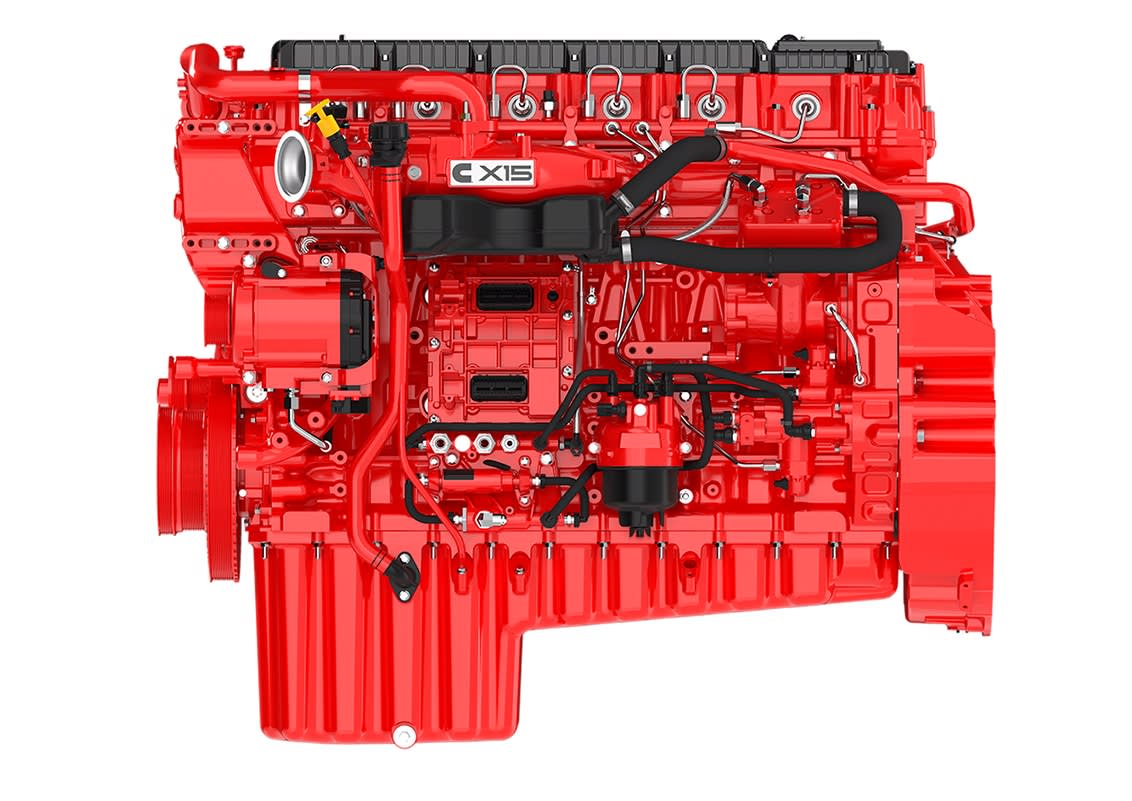
As AI and other deep-learning tools begin to help shape the transportation industry, they also bring improvements to existing technology. Modeling and simulation software has rapidly become a crucial tool for improving the design process of new diesel engines.
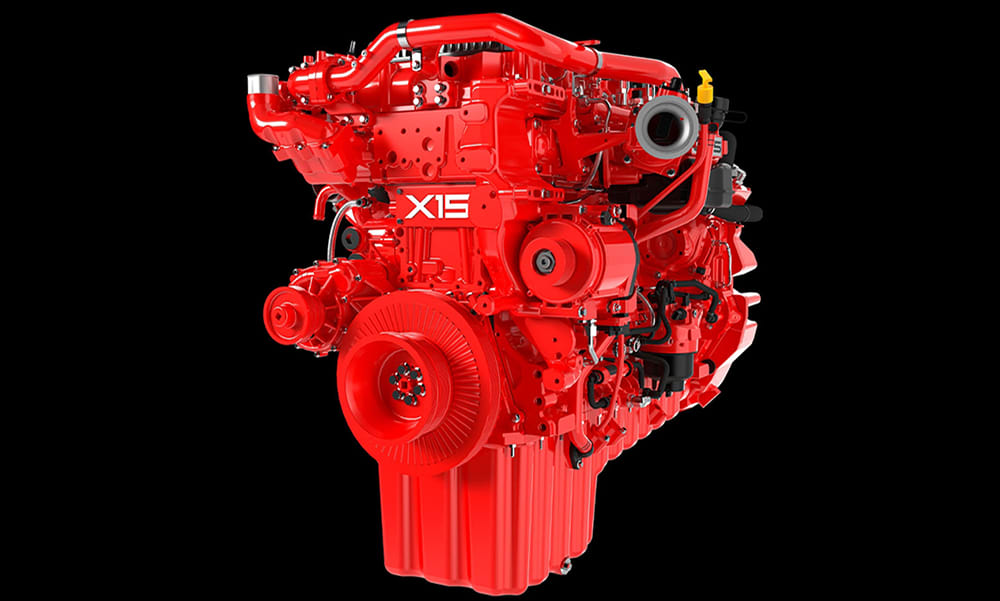
More than two decades after the first X15 engines rolled off the assembly line, Cummins has applied today’s modeling tools to help create the HELM version of the X15. The HELM architecture (which stands for Higher Efficiency, Lower emissions and Multiple fuels) is the company’s basis for a global platform capable of meeting all manners of emissions regulations while still serving customers across a wide variety of use cases.
SAE Media got its first look at the HELM X15 engine last summer during a visit to Cummins headquarters in Columbus, Indiana (www.sae.org/news/2024/09/cummins-x15-engine). The HELM version underwent extensive software-based testing during its development, including structural analysis, fluid dynamics simulation and other digital validation to become one of the most efficient engines Cummins has ever produced.
Block party
“If you look all the way back to 1998 when we initially developed the X15 and imagine the technology level in terms of computing power, it was very much hand calculations and, in some cases, still drawing boards,” said Tom Marsh, program leader at Cummins. “When we were developing that product, we really didn’t have the capability we have now in terms of computational analysis tools. Nearly two decades later, we have the capability to do most of the design work digitally.”
Marsh explained that while the basic design of the X15 has largely been carried over from its original sketches in the late 90s, there have been numerous improvements thanks to present-day simulation and analysis tools.
“We’ve carried over a lot of the fundamental design and architecture of the existing X15 that we have in production today. If you look at the HELM engine versus the more recent versions of X15, it looks exactly the same,” Marsh said. “But there’s been numerous modifications and evolutions to this product to create the new platform. What we’ve really done is take all of that existing technology and develop it with the help of modern software.”
Marsh detailed how structural analysis tools influenced the design of the HELM version of the X15 engine. “The block is one area where we’ve really leveraged these tools and capabilities that we have now. If you compare the HELM engine to the outgoing X15, it’s about three inches shorter than the existing engine. If you put the two side by side, you’ll see that. What you may not see is all the work we have done on the structural analysis and how we make the block stiff but light.”
Marsh explained the internal design changes Cummins has made to create the HELM version of the X15 in further detail. “If you look at the design, we have all kinds of patented technology,” he said. “Those straight and round bars in the exterior block webbing and the rings around them are all there because of what we found when we did our structural analysis. There’s all sorts of details that are very much hidden in the internal design, but you’ll see them if you look closely.
“We’ve also used that structural analysis to develop the internal walls and structure of the block,” he continued. “We’ve also integrated the gear housing into the block, which makes the whole system structurally stiffer from the old engine. What that’s allowed us to do is reduce the block weight by over 50 pounds.”
While 50 lb (23 kg) may seem like a drop in the bucket considering the full system weight of the HELM X15 is roughly 1.5 tons, Marsh explained that the weight losses Cummins realized in the engine block were necessary gains due to the increase in accessories that these engines must now be equipped with.
“We have to increase the weight on our engines thanks to items like more robust aftertreatment systems in order to meet emissions standards,” he explained. “Thankfully, we’ve taken all that weight back out of the engine so that the new system is essentially a net-zero weight gain compared to the old model.”
Cooler heads
Cummins also used modeling and simulation tools extensively when redesigning the HELM X15’s cooling system. According to Cummins, the system was far better optimized for use with an exhaust gas recirculation (EGR) system as well as improving internal cooling through flow and structural design changes.
“From a structural design perspective, we completely redesigned the internal cooling paths in the HELM engine,” Marsh said. “One of the big downsides of the design of the original X15 was that it was designed without EGR. Then later due to changes in emissions regs, we had to add the EGR system. So there were compromises made in the cooling system to add the EGR because the block wasn’t designed with that as the intent. So we carried more pressure drop in the cooling system than we would ideally have otherwise. The HELM engine has been designed to have EGR right from the beginning.”
According to Marsh, the cylinder liner design of the HELM X15 has also been changed for not only better sealing, but also better overall coolant flow. “One of our goals was to improve the overall coolant flow velocity with the design changes,” he said. “When you have areas of stagnant flow, you tend to get cavitation. Whenever you have that internal cavitation in the coolant flow, you’re not taking full advantage of that flow to remove heat.”
The internal coolant flow is now more focused around the top portion of the cylinder. “By doing so, we can really take a lot of the combustion heat out of the process,” Marsh said. “We’ve also moved to a press-fit block to liner interface that adds more support to the liner and should improve our bore distortion, which then equates to less oil consumption and of course better sealing of the combustion chamber.”
Marsh further explained the importance of the new cylinder liner design and its overall gain in cooling efficiency. “Where we improved the overall design the most is we minimized the pressure drops and maximized the efficiency of pumping coolant around the engine,” he said. “Any energy you’re using to move fluid around the engine is just lost energy from burning fuel. But we must cool those components to make them work within their mechanical capability. So to make the engine as efficient as possible, we have to minimize these losses in the overall design.”
Under pressure
In addition to the structural design analysis, Cummins also conducted extensive studies in fluid dynamics to optimize the overall efficiency of the HELM X15 engine.
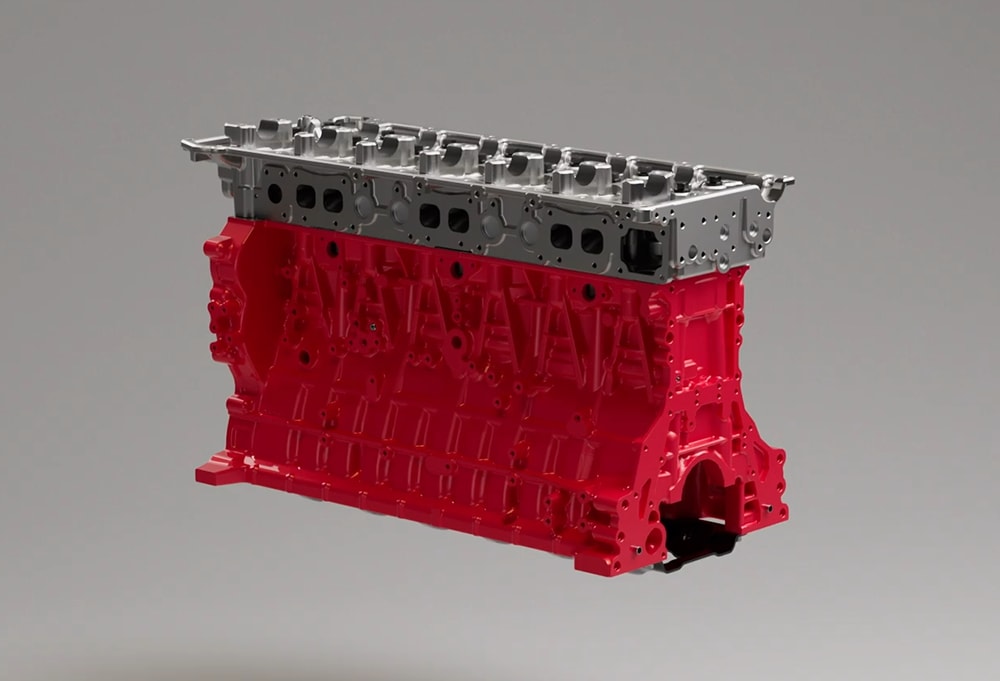
“There’s a lot of great examples of how we use these tools to create better engines,” Marsh said. “One of the best is how we use computational fluid dynamics. When we developed the outgoing version of the X15, we were able to design a cylinder head that maintained about 65 kilopascals of pressure drop. Thanks to these new software tools, we’re much more capable at designing for heat loss and actual fluid in the interface. We were able to really optimize and significantly reduce overall pressure loss.”
Marsh continued, “When we’re looking for traits like cavitation, testing for robustness and other characteristics, the software analysis can do all of that now. So when you look at a totally optimized system, we actually dropped the pressure loss in the head to a third of what it was on the non-HELM engine.”
“One of the key things we’re able to do now that we have these more capable tools, rather than designing into something that has excess cold flow or excess pressure loss, is we’re really able to find out how and, more importantly, why we need to make certain design changes,” Marsh explained. “Now with these tools, we’re able to make design changes faster and more intelligently to get the desired results.”
Efficiency through design
Considering the X15 family was already well regarded as an efficient heavy-duty powertrain, Cummins has done yeoman’s work to realize the claimed 4% fuel economy gain from the base engine design alone of the HELM version.
The software tools now at engineers’ disposal have enabled Cummins and other OEMs to truly optimize their designs not only more effectively, but also more efficiently. Equally important is that these tools have enabled this level of analysis without needing to construct and test numerous prototypes.
While digital tools will likely never fully replace physical testing of new engine technologies, they are extremely helpful in optimizing structural designs and allowing users to better understand how to build the most efficient engines in the shortest amount of time.
More From SAE Media Group
Off-Highway Engineering
Cummins New X15 Engine Meets Upcoming Regs While Boosting Efficiency
Off-Highway Engineering
Westport Awarded LNG Development Program
Automotive Engineering
Mahle’s Pre-Chamber MJI Technology Is Sparking Ignition Advances
Automotive Engineering
Advancing the OP Engine on Three Fronts
Off-Highway Engineering
Caterpillar Unveils New C13D Off-Highway Engine Platform
Automotive Engineering
Extending the ICE Age: Hyundai Optimizing Engines and Fuels
Off-Highway Engineering
Garrett Two-Stage Turbos Ramp up Off-Highway
Off-Highway Engineering
Developing an Alternative Engine Concept
Off-Highway Engineering
Scania Adapts On-Highway Diesel for New Off-Highway Engine Platform
Automotive Engineering
Tula’s DMD Promises Gains in EV Efficiency
Automotive Engineering
How Higher-Quality Gasoline Keeps Modern Engines Clean and Efficient
Automotive Engineering
Extending a Wankel Future on Hydrogen Fuel
Off-Highway Engineering
SwRI Rolls out Hydrogen Demonstration Truck
Off-Highway Engineering
Isuzu Simplifies Fuel Changeovers
Off-Highway Engineering
Cummins, Tula Test ‘Dynamic’ Cylinder Deactivation for Diesels
Off-Highway Engineering
FPT Tech Day Reveals Cursor X Concept, Other 4.0 Innovations
Automotive Engineering
Engine Technology a Decade Later
Off-Highway Engineering
Improving Heavy-duty Engine Component Efficiencies
Automotive Engineering
Engine Researchers: 50% Gasoline-Engine Efficiency in Sight
Off-Highway Engineering
Bigger Processors, Smaller Engines
Off-Highway Engineering
Cummins Spools up New Turbo Tech
Off-Highway Engineering
Cummins Unveils EPA-Compliant 2021 Heavy-Duty Diesels
Off-Highway Engineering
Komatsu Logs a New Timber Machine
Off-Highway Engineering
Combustion Engines Carry on in Construction
Off-Highway Engineering
Challenges and Opportunities of Electrifying Off-Highway Machines
Automotive Engineering
Stanadyne Pumps up the Volume
Off-Highway Engineering
Cummins Cylinder Deactivation Saves on Fuel and Emissions
Off-Highway Engineering
Detroit DD15 Gen 5 Showcases Durability of New Diesel Tech
Off-Highway Engineering
Compact Motors
Off-Highway Engineering
Electric Actuators Can Benefit Heavy-Duty Diesels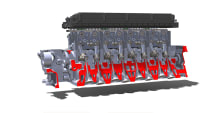
Top Stories
NewsSensors/Data Acquisition
 Microvision Aquires Luminar, Plans Relationship Restoration, Multi-industry Push
INSIDERRF & Microwave Electronics
 A Next Generation Helmet System for Navy Pilots
INSIDERWeapons Systems
 New Raytheon and Lockheed Martin Agreements Expand Missile Defense Production
NewsAutomotive
 Ford Announces 48-Volt Architecture for Future Electric Truck
INSIDERAerospace
 Active Strake System Cuts Cruise Drag, Boosts Flight Efficiency
ArticlesTransportation

Webcasts
Aerospace
 Cooling a New Generation of Aerospace and Defense Embedded...
Energy
 Battery Abuse Testing: Pushing to Failure
Power
 A FREE Two-Day Event Dedicated to Connected Mobility
Automotive
 Quiet, Please: NVH Improvement Opportunities in the Early Design Cycle
Electronics & Computers
 Advantages of Smart Power Distribution Unit Design for Automotive &...
Unmanned Systems
 Sesame Solar's Nanogrid Tech Promises Major Gains in Drone Endurance