




Will ‘Recalls’ Become ‘Upgrades’?
Jaguar Land Rover R&D Director Wolfgang Epple discusses maximum rpm, revolutionary technology, product updating by end users, and model cycle times cut to satisfy end-user impatience.

"The nice thing about the digital world is that, when you enter it, you don't know where you will end up," said Jaguar Land Rover (JLR) Research and Development Director, Dr. Wolfgang Epple. “Take Google and Apple and look back around 20 years; I doubt if anyone would have foreseen the prominent roles they would play.”
Today, JLR has to be ready to cope with whatever might happen in both short- and long-term digital development, and meet the expectations of a buying public imbued with the constantly shifting fads, fashions, and opportunities it brings.
Connectivity and processing power are the two enablers that are absolutely vital for automotive companies to accommodate future developments in both the more obvious areas and other less considered aspects of efficiency: “For example, in the past two years there have been vehicle recalls all over the world. But in the digital world they don’t talk about recalls; they talk about upgrades.”
It is a different word that is used for “improvement,” stated Epple. While mechanical changes will continue to require a vehicle to be taken to an approved dealer, with the burgeoning proliferation of digital applications the need for many recalls may dwindle as connectivity becomes an enabler on a much broader front.
“It will be the software that really provides differentiation between models as hardware technology gets much closer model-to-model, and that differentiation can be distributed by the network,” said Epple.
Cloud communication

In this context “the cloud” is very important, he said: “It is for upgrading certain features and apps that can be distributed; it is a depository — a central storage area for the car.” He also sees a car’s CAN bus linking to the driver’s mobile phone. But it is potentially a lot of information: “Every OEM has to consider how far it wants the gate to be opened!”
JLR is involved in research with MITAgeLab, Denso, and Touchstone Evaluations to define and deliver methods to measure driver distraction. This will support work that will help to deliver safer vehicle HMI (human-machine interface) solutions, which could ultimately include anything from “gaze tracking” to biometrics that interact with the vehicle.
However, will such developments add capital or running costs to a vehicle? There is, says Epple, “no such thing as a free lunch.” People have got used to a remarkably comprehensive Internet, but some business models or upgrades will require payment by a vehicle user, and processor and storage memory will add cost.
It remains very difficult to estimate what this development would mean financially, he explained: “Yes, we are adding features to a car, but we are constantly reducing costs across the vehicle as a whole. For example, we have developed, or are developing, various architectures with a high volume per car capability. And component costs will come down as a higher level of systems integration is achieved — such as using three instead of five control modules as their power is increased.”
All this helps towards reduced model cycle times, he said: “So many people are now getting used to the digital world, and because of that they have different time scales.” A new mobile phone design may be created in 6 to 9 months, but a car still takes 3 to 5 years, he added: “Customer expectation in one area raises it in others, including the car industry, and model cycles are getting shorter.”
Hardware still takes time and great expense to test, but more and more validated components are now carried over to subsequent models without the need for constant re-invention. Software elements of that hardware can of course be upgraded and have a different time scale for modification. However, it would be the aesthetics of the car that would be changed rather than its underbody, explained Epple.

It all adds up to meeting shorter cycle times to counter end-user impatience for change.
Toward full autonomy
One very significant aspect of digital development concerns autonomous driving systems. For JLR this arguably began almost 20 years ago with a radar-based active cruise control system for the XK. Since then, autonomous active driver support systems have greatly multiplied to a point where some OEMs feel introduction of autonomous driving is now essentially a matter of meeting legal requirements.
Epple does not agree: “It is not just the legal aspects. A few areas remain to be validated. These include sensing systems that must be capable of coping with all eventualities. For example, if when driving along a tree-lined road in a storm, a branch falls in the path of the vehicle, to my knowledge no system caters for such an obstruction. The world is pretty complex and the human brain extremely powerful, which is why there are many tests still needed by the motor industry. And testing gives you answers to questions you have not thought of — and you are surprised at the outcome!
“My personal forecast is that autonomous driving will happen within 10 years, but its approach is on a glide path, not a discrete step.”
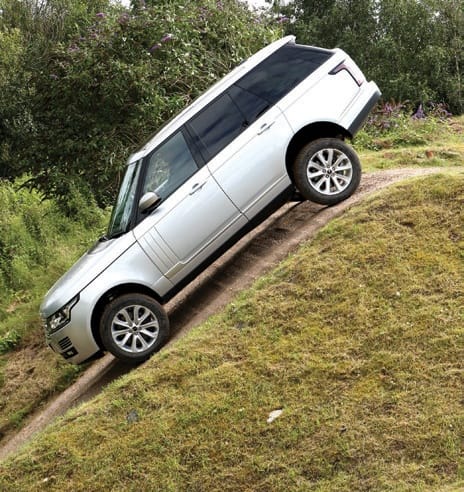
Experience for this application is being broadened via Land Rover’s research into remote-control off-road driving (with the driver outside the cabin when necessary) and predictive terrain scanning.
Assault on batteries
In another technology sector, JLR’s commitment to hybrids grows, and Epple is confident of battery advances as science makes assaults on the technology: “Every two to three weeks, someone on the globe finds new material which — in the laboratory at least — increases storage capability.”
A lithium-air solution looks promising (at least in the laboratory), doubling the efficiency of lithium-ion (from 300-400 W/kg to around 800 W/kg), although in high-volume production “some loss” would be expected. Epple regards lithium-air as currently the best next battery step: “But remember, we keep seeing new things on the horizon.”
JLR is looking across the entire range of hybrid solutions, including plug-in, plus pure electric solutions. It is building technology demonstrators based on the Range Rover Evoque platform, and playing the lead role in a U.K. Government-backed multi-partner project that includes Zytek and Tata Steel.
Small gas turbines as a range extender solution remain on JLR’s “may-do” list, but Epple cites reduction of emissions and of high exhaust temperature — 360°C (680°F) is a problem in pedestrian areas — as areas for further development.
As for fuel cells, Epple remains cautious, particularly as battery development continues to evolve with promising new solutions: “There are great ideas for batteries flowing around, but for as long as I remember fuel cells have always been 10 years away,” he said.
Like all OEMs, JLR has a raft of priorities that continue to challenge, with the whole spectrum of environmental issues at the top of the list.
Technology transparency
Solutions invariably touch on the matter of engine efficiency. Epple wants to achieve greater friction reduction, greater capture and use of waste energy, and greater weight reduction, with more technology transparency between manufacturers.
“We have great experience in the use of aluminum and have opened our Solihull manufacturing plant to competitors to let them see what we have done,” he said. “We want to help accelerate development further in the industry so all can benefit. It is not collaboration; it is sharing, particularly with regard to joining technology. We believe other industries could also contribute to achieving similar stiffness and crashworthiness while using less material.”
So, while the industry focuses increasingly on digitalization, the enhancement of traditional skills and processes will continue to be a vital support for future success.
More From SAE Media Group
Off-Highway Engineering
Addressing Electromagnetic Compatibility in the Context of Aircraft Electrification
Automotive Engineering
Planning for a Digital World
Aerospace & Defense Tech Briefs
Air Mobility Innovations Take Center Stage at Aerospace Systems and Technology Conference

Aerospace & Defense Tech Briefs
Industry Invited to Participate in AeroTech Aerospace and Defense Technical Program
Aerospace & Defense Tech Briefs
SAE International Extends Call for Abstracts, Seeks Submissions for AeroTech Conference
Off-Highway Engineering
CES 2025: Oshkosh Puts AI, Autonomy and Electrification to Work
Autonomous Vehicle Engineering
'Level 2+': Making Automated Driving Profitable, Mainstream
Automotive Engineering
Designing and Assessing Vehicle Safety Functions with a Use Case Approach
Automotive Engineering
Automated Vehicle Safety Series Addresses Design, Testing, Verification, and Validation
Autonomous Vehicle Engineering
Making the Strategic Move into AV Testing
Aerospace & Defense Tech Briefs
Quality Management Experts Provide Guidance on AS9100 Standard, Equipment Calibration
Aerospace & Defense Tech Briefs
GE Aviation, Teradata Partner on Data Analytics, Edge Connectivity for Airlines
Aerospace & Defense Tech Briefs
SAE International Issues, Revises Technical Reports for Aerospace Engineering
Aerospace & Defense Tech Briefs
Bell Nexus Full-Scale Air Taxi Design Debuts, Taps Novel VTOL, Hybrid Propulsion, Energy Storage, and Avionics Technologies
Automotive Engineering
Airbus’ Connected Cabin Concept Is Materializing with First Round of Partnerships
Aerospace & Defense Tech Briefs
AIA Predicts Flying Air Taxis, Supersonic Air Travel, and Space Industry for 2050
Aerospace & Defense Tech Briefs
AVIO Software Developers Leverage AdaCore GNAT pro Assurance for ESA Vega C Launch Vehicle
Aerospace & Defense Tech Briefs
Unleashing AI in Aviation Will Accelerate Move to Zero-Pilot Cargo and Passenger Aircraft
Off-Highway Engineering
WCX 2019: IAMTS Association Will Establish Standardization and Testing for Connected Vehicles
Aerospace & Defense Tech Briefs
SAE International Launches Aerospace Technology Symposium at Japan Aerospace 2018
Aerospace & Defense Tech Briefs
Barker Approaches Aircraft as System of Systems in Latest SAE International Book
Aerospace & Defense Tech Briefs
US Army Tests Avionics in Effort to Upgrade Black Hawk Helicopters from Analog to Digital Glass Cockpit
Automotive Engineering
Systems-engineering a New 4x4 Benchmark
Aerospace & Defense Tech Briefs
Rolls-Royce to Work with Airframe Manufacturers, Seek Partners for EVTOL Project
Aerospace & Defense Tech Briefs
Maintaining the Data-Rich Pratt & Whitney GTF Engine
Aerospace & Defense Tech Briefs
Boeing, SparkCognition Partner on Safe Integration of Autonomous Air Vehicles in Airspace
Aerospace & Defense Tech Briefs
Boeing and NASA Unveil Lightweight, Ultra-Thin, More Aerodynamic Transonic Truss-Braced Wing Concept
Automotive Engineering
Nvidia Partners with AdaCore to Secure Self-Driving Firmware
Top Stories
NewsRF & Microwave Electronics
 Microvision Aquires Luminar, Plans Relationship Restoration, Multi-industry Push
INSIDERAerospace
 A Next Generation Helmet System for Navy Pilots
INSIDERDesign
 New Raytheon and Lockheed Martin Agreements Expand Missile Defense Production
INSIDERMaterials
 How Airbus is Using w-DED to 3D Print Larger Titanium Airplane Parts
NewsPower
 Ford Announces 48-Volt Architecture for Future Electric Truck
ArticlesAR/AI

Webcasts
Electronics & Computers
 Cooling a New Generation of Aerospace and Defense Embedded...
Automotive
 Battery Abuse Testing: Pushing to Failure
Power
 A FREE Two-Day Event Dedicated to Connected Mobility
Unmanned Systems
 Quiet, Please: NVH Improvement Opportunities in the Early Design Cycle
Automotive
 Advantages of Smart Power Distribution Unit Design for Automotive &...
Energy
 Sesame Solar's Nanogrid Tech Promises Major Gains in Drone Endurance