




Expediting Engine Design
Simulation tools drive development of the most complex, fuel-efficient and powerful engines ever seen in off-highway applications.
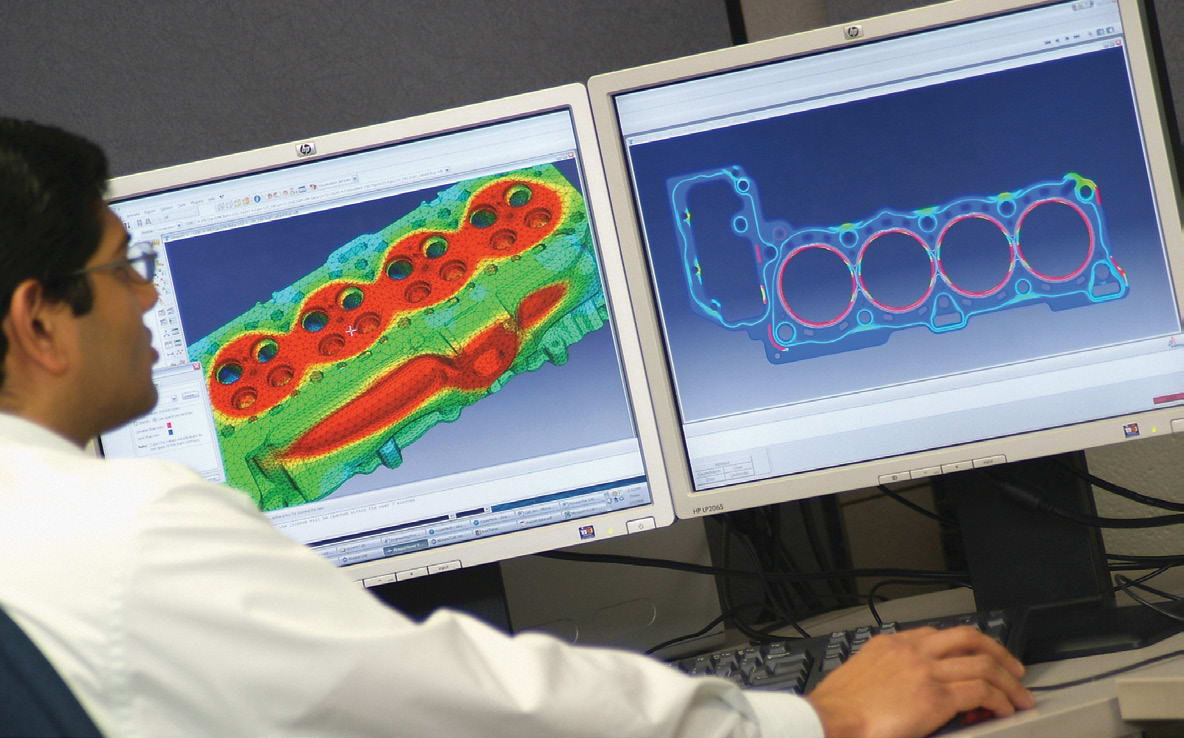
Creating or updating a new engine today is more complicated than ever. Most heavy-duty and off-highway engine makers are expanding their product lines, responding to an increasingly diverse global marketplace. A good example is Perkins.
“[Our] priority is in expanding our engine range, not only with new models for U.S. EPA Tier 4 Final, but also by offering OEMs a full range of global platforms,” said Oliver Lythgoe, Perkins product marketing manager. “Whether they are based in the Americas, Europe or Asia, OEMs are increasingly wanting to participate in global markets, and that means having platforms that can be cost-effectively adapted to the different global emissions standards without excessive R&D expenditure.”

The front end of the development process has changed considerably, Lythgoe explained to Off-Highway Engineering. Apart from the considerable advancements in CAE, he noted that they are also able to consider, through CAD collaboration with customers, how engines will be installed in machine designs in the early phases of engine design. Other experts have noted the importance of this system integration.
“System integration has been going through a transformation in recent years with the introduction of electrified powertrains, including hybrid solutions,” said Michael Franke, director, light-duty and diesel commercial engines for FEV North America.
Franke believes development processes are not fixed. They continuously change with the introduction of new technologies and new engineering tools. New technologies used to meet Tier 4 final regulations include electronic fuel injection, electronic boost control, exhaust gas recirculation (EGR) and exhaust aftertreatment. Add to this their associated control functions and new development methods are required, he said. This implies mandatory implementation of systematic systems-engineering approaches, and especially model-based design methodologies.
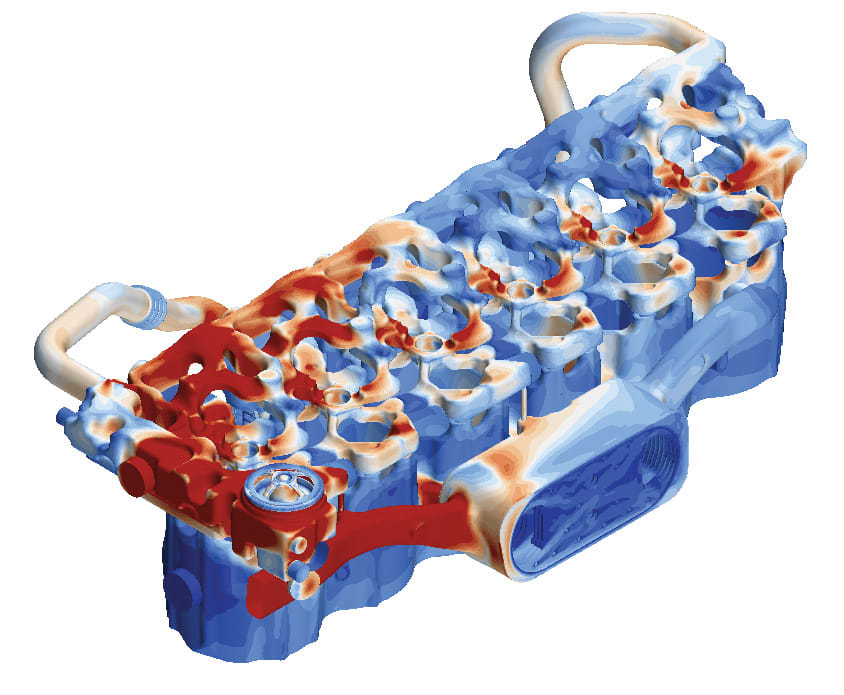
Another theme expressed by most experts interviewed for this story is the adoption of simulation-led design — using simulation tools to create the design rather than validate an already existing one.
“CAE tools are well suited to be used to lead the design process, providing accurate and efficient design direction,” explained Brian Campbell, chief engineer, design engineering, FEV North America. Why? “[Because the] capabilities of CAE tools and hardware platforms continue to evolve, allowing for faster solutions to more complicated CAE problems,” he said.
This speed is enabling simulation-led design techniques such as structural optimization, the process of choosing a “best” design that meets specified constraints using CAE. “With today’s focuses on increasing engine power and reducing weight, design optimization tools can provide significant insight toward meeting these often-conflicting objectives,” he said.
CAE-designed components and details
While simulation design and enhanced systems engineering are useful for those looking at engines and powertrains, CAE is proving its worth in designing components as well. One example is Dana, a supplier of cylinder head gaskets, exhaust gaskets, secondary gaskets, and turbo gaskets as well as various heat shields and other smaller — but vital—components. The push for better fuel economy and cleaner emissions is translating into higher peak operating pressures as well as weight reduction, Rohit Ramkumar, manager of CAE for the Power Technologies Group, Dana, explained to OHE.
Ramkumar agrees that product development processes across the board are moving toward simulation-led design, even for the components that Dana provides.
“You also hear about the ‘virtual’ or ‘digital twin’ as well,” he said, where companies evolve the specifics of a design from the concept stage into manufacturing and beyond. “There is definitely more push for suppliers like us to come up with design options up front. Simulation is not a ‘feel good factor’ anymore, but a reality of the product development process and ensuring the engine will meet the requirements of stringent operating conditions.”
As Ramkumar described it, adoption of simulation-led design is clearly enabled by improvements in both algorithms and the advancing power of inexpensive computing. Co-simulations combine multiple disciplines, such as finite element structural code with a computational fluid dynamic (CFD) code. This captures temperature induced stress, for example.
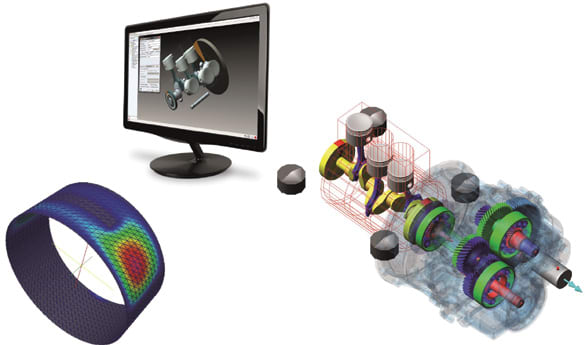
“These have helped us in general improve our processes including better correlation with test,” he said. He also cites optimization tools as more powerful than ever, providing useful insight when developing designs using CAE tools.
CAE tools advance
Gamma Technologies, maker of the well-known GT POWER modeling tool for engines and its GT SUITE for powertrain and vehicle-level simulations, has seen the growing complexity in engines over time.
“In anticipation of these trends, GT-SUITE has been created specifically as an integrated vehicle system tool capable of responding to these demands,” explained Dr. Thomas Morel, president and founder of the company. “Integration of the whole vehicle system enables evaluations of subsystem alternatives, even individual component alternatives and their effect on fuel economy, emissions and NVH.”
The tool also combines modeling methods, using so-called 0D and 1D system models integrated with 3D models. The company notes that this makes GT-SUITE a particularly useful tool for model-based systems engineering, or MBSE, which enables the progressive development of an engine or powertrain from an initial concept to the final product. It does this by first using 0D and 1D system modeling tools then switching to high-fidelity 3D models that examine system performance, efficiency, dynamics, structural stresses and temperatures and other parameters.
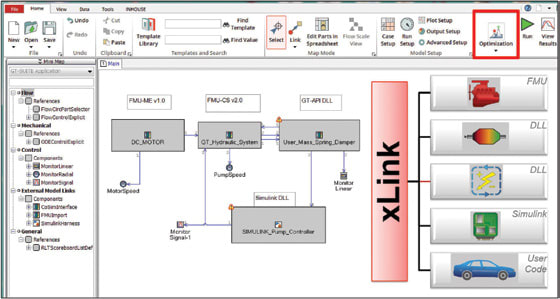
Morel emphasized that GT-SUITE models the whole vehicle. “From fuel combustion to the wheels, including the effects of fluids, hydraulics, all mechanical systems, thermal analysis, chemistry, tribology, friction, hardware-in-the-loop and controls,” he said.
Another key point that Morel emphasized — and was echoed by many other tool suppliers — is the growing need to interface and incorporate simulation tools from other suppliers. For example, the company offers an engine combustion tool from Convergent Science and a CAD-to-model tool as well as a virtual analysis tool for complete vehicles, including GT-SUITE and the predictive 3D chassis models, from Adams, the dynamics tool from MSC Software.
Toward that end, the company recently released its own unique technology for co-simulation employing xLink. To simulate a system, it accepts any tool that matches the Functional Mockup Interface (FMI) standard, Simulink, or executables compiled as a Dynamic-Link Library (DLL). It can also implement a user-defined code through the xLink interface. (For further information on Functional Mockup Interface, see “CAE’s next leap forward”.)
“Access to the right computing power will not be a limiting factor.” That is the view of Vivian Page, engineering systems team leader, Cat Industrial Engines. “The challenge will be in how we manage and process the vast amounts of data and information that are generated by these simulation tools to understand the complex multi-physics environment within a diesel engine.”
Closing the loop with the real world
Siemens PLM Software is responding to comments like Page’s, looking at a grander view of engineering. “There is a movement across all industries, including off-highway, that is looking to incorporate a new set of technologies,” explained Ravi Shankar, director of marketing, simulation and test solutions, Siemens PLM Software. These include use of advanced lightweight materials, additive manufacturing, mass customization and wide deployment of inexpensive sensors.
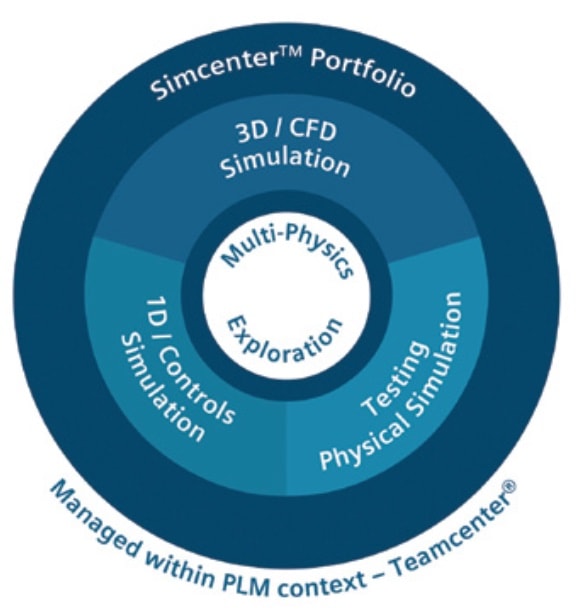
Through acquisitions and investment, Siemens PLM is looking to help companies incorporate these new technologies in a new way. It has created a comprehensive portfolio of simulation and data management tools in its newly announced Simcenter portfolio, combining advanced simulation and the potential to access real-world data through the Industrial Internet of Things (IIoT).
“Data can be fed back to engineering teams to provide more useful predictive results and react with more updates to the customers,” explained Shankar. “We think of that as opening a new front with [Big Data] analytics combined with physics-based simulations that we are now calling Predictive Engineering Analytics.”
This means constraints for optimization runs can be further honed from actual data on, say, bulldozers or agricultural equipment. Actual operator preferences can be accounted for, and actual operating cycles can be used for setting engine parameters for best fuel economy in engines. This sort of talk leads naturally to discussions of “digital twin,” a simulated version of a real engine used to monitor and predict its behavior — at its heart the Predictive Engineering Analytics that Shankar describes. This is especially relevant to off-highway engine development, with the focus on operating economics and the equipment’s high duty cycles.
“With our acquisition of LMS and now CD-adapco, we have a comprehensive portfolio of simulation, test and data management solutions — as well as established consultancies — we think we are unique in our ability to combine that with IIoT,” said Shankar.
However, the future of CAE in engine development is not limited to Big Data and analytics. Much new development is going into microscale simulation, especially in combustion, as well as cosimulation and Multiphysics. “For example, modeling the engine and its coolant flow requires multiple disciplines, and as engines get more efficient, modeling these types of physics will get ever more important,” he said.
That said, physical testing remains important. “One thing that has not changed is that we still have a strong commitment to field validation for all our products,” stressed Perkins’ Lythgoe. “Expectations of OEMs and machine users are high, so we spend thousands of hours testing our engines, including in extreme temperatures and conditions.”
The virtual can only go so far.
More From SAE Media Group
Off-Highway Engineering
Heavy-Duty Engine Design
Off-Highway Engineering
CAE Tools Advance for Engine Design
Off-Highway Engineering
Advances for Off-highway Engine Design
Autonomous Vehicle Engineering
Speeding Thermal Analysis for Autonomous EVs

Off-Highway Engineering
Siemens Improves Optimization for Engine Development
Off-Highway Engineering
Engine Developers Increase Efforts to Decrease Fuel Usage
Off-Highway Engineering
Life-cycle Planning — Design and Calibration for Ultimate Efficiency

Off-Highway Engineering
Engineering with Simulation and Data
Off-Highway Engineering
Machine Learning Drives Design Space Exploration
Automotive Engineering
Renault Applies Model-Based Systems Engineering to Dual-Clutch Transmission
Off-Highway Engineering
Advanced Simulation Techniques Drive Powertrain Design

Off-Highway Engineering
Cummins Unveils New B7.2 Diesel Engine
Aerospace & Defense Tech Briefs
A Supercomputer for Aerospace and Defense Systems Modeling and Simulation
Off-Highway Engineering
Advances in Virtual Powertrain Development

Tech Briefs
Disrupting the Automobile Design Process
Off-Highway Engineering
ZM Trucks Starts Production in Fontana, California
Off-Highway Engineering
Off-highway Calibration Challenges — Big and Complex
Tech Briefs
Embracing Agile Product Development
Automotive Engineering
Powertrain Testing: Coping with Complexity

Off-Highway Engineering
Cummins’ X15 Is a Model of Design Efficiency



Automotive Engineering
Harnessing the Power of Sim
Tech Briefs
Vehicle Design with System-Level Modeling
Top Stories
INSIDERManufacturing & Prototyping
 How Airbus is Using w-DED to 3D Print Larger Titanium Airplane Parts
INSIDERManned Systems
 FAA to Replace Aging Network of Ground-Based Radars
NewsTransportation
 CES 2026: Bosch is Ready to Bring AI to Your (Likely ICE-powered) Vehicle
NewsSoftware
 Accelerating Down the Road to Autonomy
EditorialDesign
 DarkSky One Wants to Make the World a Darker Place
INSIDERMaterials
 Can This Self-Healing Composite Make Airplane and Spacecraft Components Last...
Webcasts
Defense
 How Sift's Unified Observability Platform Accelerates Drone Innovation
Automotive
 E/E Architecture Redefined: Building Smarter, Safer, and Scalable...
Power
 Hydrogen Engines Are Heating Up for Heavy Duty
Electronics & Computers
 Advantages of Smart Power Distribution Unit Design for Automotive...
Unmanned Systems
 Quiet, Please: NVH Improvement Opportunities in the Early Design...
