




Siemens Improves Optimization for Engine Development

Siemens AG and its software division Siemens PLM Software have greatly increased its technology offerings to the engine development community. Adding to its portfolio of NX CAD, Teamcenter, and simulation tools, Siemens in recent years acquired combustion simulation capabilities through Simcenter STAR-CCM+, 1D system simulation with Simcenter Amesim, and multidomain optimization with HEEDS. All of these acquired products are now part of Siemens’ Simcenter portfolio of simulation and testing solutions.
Offering an expanded set of tools is useful to company and customer alike. The real challenge, however, is integrating a group of functions into something that is better than the sum of their capabilities. The key is Siemens integrating 1D system simulations with 3D combustion and CFD via its HEEDS optimization tool. The promise is faster, higher fidelity simulations in support of engine development.
Combined models and iteration

Combining 1D with 3D simulations, especially in engine development, is nothing new. “The problem is that the conventional way of doing that is very time consuming,” said Jaeman Lim, Project Manager Engineering and Consulting Services Americas, speaking to Truck & Off-Highway Engineering.
This conventional way, well known to simulation practitioners and their managers, is to create both a 1D system model of an entire engine and a detailed 3D model of the combustion in the cylinder. “The initial 3D boundary conditions are provided by the 1D simulation. The 3D model provides the high-fidelity and accurate results the 1D model cannot predict,” he said. Once an in-cylinder calculation is completed, that new data is used to update the 1D system model.
Parameters needed for this include, for example, a 1D Wiebe function that models heat-release rate. The 1D model speedily uses the Wiebe function while simulating the whole engine. Engineers can predict coolant, lubrication and NVH accurately enough for practical engineering design. The iteration process continues by the 1D model, again, updating the boundary conditions for the 3D model for another round of simulations. Multiple iterations will — hopefully — converge to an ideal engine.
However, in that constant data transfer and iterations lies the problem. It is manual and slow. “You can spend more time in [a manually intensive] simulation than you might in actual experimentation,” Lim explained.
Also, while the system model in Simcenter Amesim or the 3D CFD model in Simcenter STAR-CCM+ is each optimized, they are not optimized as an integrated system.
Integrated optimization equals speed
Enter HEEDS and its ability to combine multiple domains and scales in its optimization routines. “By loosely coupling Simcenter STAR-CCM+ with Simcenter Amesim, we can let HEEDS transfer the data of initial and boundary conditions and parameters for combustion,” said Lim.
Calibrated parameters, such as those needed for an updated Wiebe function, are delivered automatically from the STAR-CCM+ calculation. The 3D computational mesh is refined or recreated automatically as well, improving efficiency. It is what Lim calls a “loosely coupled system.”
Lim showed an example of where the HEEDS interface used simple icons to show the connections between Simcenter Amesim, Simcenter STAR-CCM+, a purpose-built analysis program to provide Wiebe parameters, and back to an improved Simcenter Amesim model. In this example, HEEDS found the most effective burn duration profile for efficient combustion. In support of that goal, HEEDS could also optimize in the 3D domain the shape of the inlet port and piston bowl depth to increase the charge tumble to get that efficient burn rate.
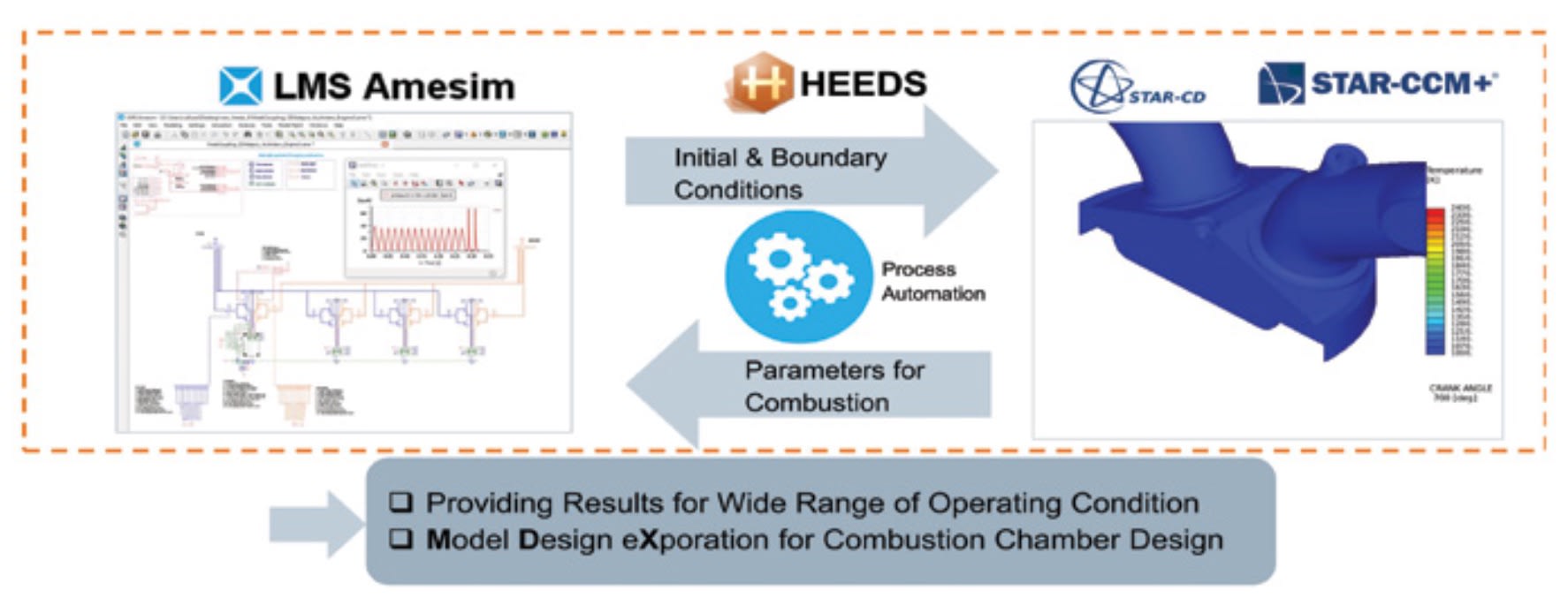
This new system effectively optimizes a combined 1D and 3D model.
“We can set the parameters we wish to optimize, such as indicated mean effective pressure, or IMEP,” said Lim. Further applications of the technique, according to Lim, include optimizing designs for direct injection, turbocharging or minimizing knock and emissions.
While HEEDS could be used for any kind of 1D simulations and 3D combustion and CFD systems, supplied by any software company, the advantage of this system lies in the ability of Siemens to understand the “plumbing” of each of its own components. HEEDS can also parse a model run into multiple computational cores based on the hardware availability.
Improved tools
Siemens PLM is now releasing improvements to the STAR- CCM+ family of products three times a year. A couple of such improvements are of particular interest to engine developers: improved set-up of “charge motion” simulation released in June 2018 and an improved, faster chemistry solver released in October 2018.
The charge motion feature allows users to perform more advanced in-cylinder studies, according to the company. This simulates the injection of liquid fuel and the ensuing mixing process. Charge motion is less expensive to run than a full combustion simulation and provides insight into the design of the combustion system. Setting up a charge motion simulation in STAR-CCM+ is designed to be easy and quick.
The other feature is a reportedly faster generation of complex chemistry and combustion table. The company touts enhanced complex chemistry and flamelet combustion table generation solvers. The company claims this means faster high-fidelity combustion simulations.
More From SAE Media Group


Off-Highway Engineering
Heavy-Duty Engine Design

Autonomous Vehicle Engineering
Speeding Thermal Analysis for Autonomous EVs
Sensor Technology
Digital Twins for Industry
Off-Highway Engineering
CAE Tools Advance for Engine Design


Aerospace INSIDER
Accelerating Climate-Compatible Aircraft Design with AI
Off-Highway Engineering
Expediting Engine Design
Off-Highway Engineering
TE Connectivity Enhances Digital Platform with CT Data Analysis
Automotive Engineering
BMW, Classiq Find Better Architectures Through Quantum Computing
Tech Briefs
Disrupting the Automobile Design Process
Off-Highway Engineering
Advanced Simulation Techniques Drive Powertrain Design
Aerospace & Defense Tech Briefs
Software for Additive Design, Manufacturing Evolves Quickly

Aerospace & Defense Tech Briefs
Digitally Transforming the Future of Defense: Collaborative Combat Aircraft
Tech Briefs
Embracing Agile Product Development
Off-Highway Engineering
Advances in Virtual Powertrain Development

Motion Design
New Products
Motion Design
CAD Model Offers Robots Precise Pick-and-Place Solutions
Off-Highway Engineering
Achieving Grid Convergence in Large Internal-Combustion Engine Simulations



Aerospace & Defense Tech Briefs
Analyzing Aircraft Antenna Placement and Performance with Unified Modeling and Simulation
Top Stories
INSIDERManufacturing & Prototyping
 How Airbus is Using w-DED to 3D Print Larger Titanium Airplane Parts
NewsAutomotive
 Microvision Aquires Luminar, Plans Relationship Restoration, Multi-industry Push
INSIDERAerospace
 A Next Generation Helmet System for Navy Pilots
INSIDERDesign
 New Raytheon and Lockheed Martin Agreements Expand Missile Defense Production
ArticlesAR/AI
 CES 2026: Bosch is Ready to Bring AI to Your (Likely ICE-powered) Vehicle
Road ReadyDesign

Webcasts
Semiconductors & ICs
 Advantages of Smart Power Distribution Unit Design for Automotive...
Unmanned Systems
 Quiet, Please: NVH Improvement Opportunities in the Early Design...
Electronics & Computers
 Cooling a New Generation of Aerospace and Defense Embedded...
Power
 Battery Abuse Testing: Pushing to Failure
AR/AI
 A FREE Two-Day Event Dedicated to Connected Mobility
