




Analyzing Aircraft Antenna Placement and Performance with Unified Modeling and Simulation
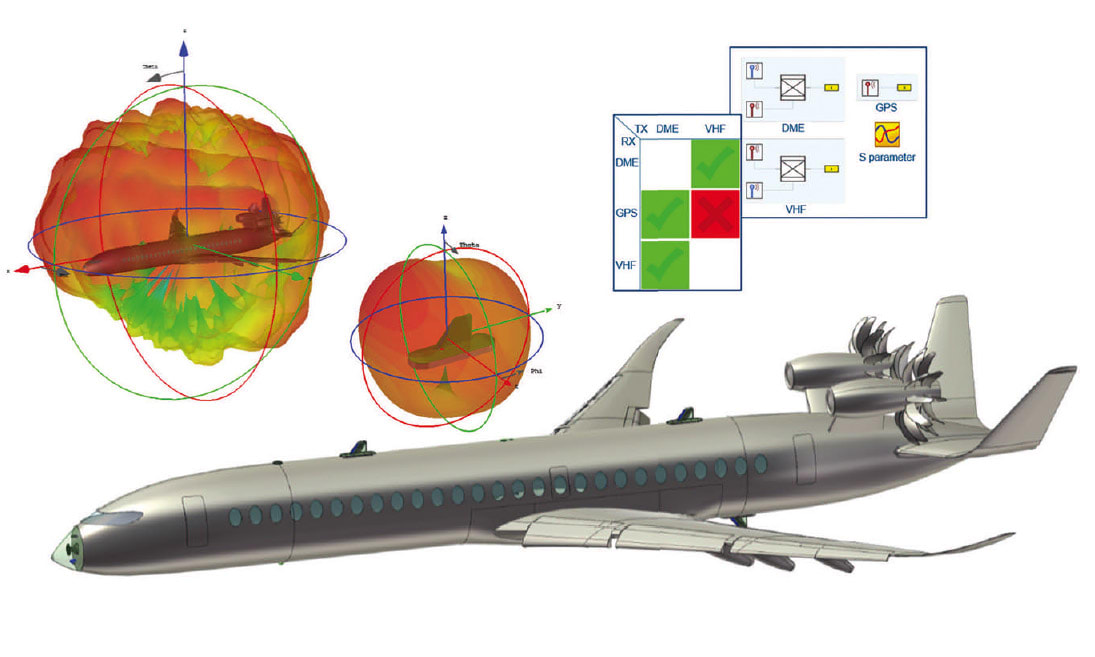
Reliable antenna performance is crucial for aircraft communication, navigation, and radar detection systems. However, an aircraft’s structure can detune the antenna input impedance and obstruct radiation, creating a range of potential problems from a low-quality experience for passengers who increasingly expect connectivity while in the air, to violating legal requirements around strict compliance standards. Determining appropriate antenna placement during the design phase can reduce risk of costly problems arising during physical testing stages.
Engineers traditionally use a variety of CAD and electromagnetic simulation tools to design and analyze antennas. The use of multiple software tools, combined with globally distributed aircraft development teams, can result in challenges related to sharing models, transferring data, and maintaining the associativity of design and simulation results. To address these challenges, aircraft OEMs and suppliers are implementing unified modeling and simulation technology and processes, which enables them to combine their CAD model with multiphysics simulation within a secure, data-managed and collaborative computing environment. By using a common user interface with unified collaboration, data management, and design and simulation tools, development teams can create a virtual twin of the complete system, including the aircraft structure, electronics and antennas.
Accurate simulation of installed antenna performance requires solving detail-rich problems of high contrast scales, and wide RF bandwidth. Aircraft antennas typically operate from several hundred Megahertz up to 10s of GHz; the maximum electrical scale of an aircraft can then be 100s or even 1,000s of wavelengths in total size, whereas electrically critical features like seams and windows will be only a fraction of a wavelength. Therefore, flexible and hybridized simulation methods are highly desirable.
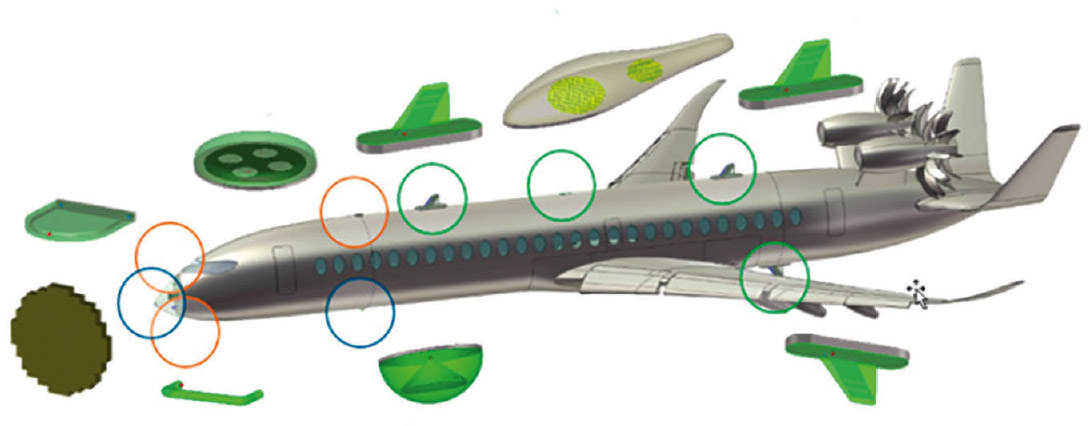
To facilitate collaborative design and placement of the antennas, development teams need access to the aircraft design model, including the structural elements, electronic system elements, as well as the antenna and radio specification. The development team then selects the type of antenna design and antenna feed network best suited to meet requirements.
Unified modeling simulation technology and methods simplify the process of defeaturing the parameterized CAD model and assigning material properties, needed for simulation. Once an antenna design is created and placed within the aircraft design, the team can use multiscale electromagnetic simulation capabilities to analyze a range of performance factors across wide frequency ranges, such as signal propagation pattern, filter designs, high-power breakdown, and others. This rapid simulation of the antenna performance within the aircraft model, enables early identification of possible co-site interference problems and provides the opportunity to modify the antenna design and placement before committing to costly physical prototypes.
Some benefits of a truly unified design and simulation environment for aircraft design and antenna placement can include:
Aircraft modeling: De-featuring 3D CAD models for simulation can be time-consuming and create a bottleneck. With the unified modeling and simulation, development teams can generate a simplified 3D model for simulation while maintaining associativity with the detailed CAD model, without compromising accuracy.
Antenna synthesis: Engineers can select antenna models from a library of different types available across their organization or supply chain, tagged according to their performance specifications, and apply design exploration techniques to quickly find an antenna to meet their requirements.
Antenna placement: Using the combined aircraft and antenna models, electromagnetics simulation capabilities are used to analyze installed antenna performance and coupling. Design teams can quickly update and analyze a variety of antennas to select the best design for the performance criteria.
Co-site-interference: Electromagnetic simulation also enables design teams to analyze potential interferences of aircraft systems connected to antennas, using tools like the Antenna Placement app in the 3DXPERIENCE platform. Filter synthesis and simulation tools allow the design of filter solutions to mitigate interference.
Multiphysics / Multiscale simulation: Since exterior antenna placement can affect airflow around the aircraft, unified modeling and simulation enable design teams to perform both electromagnetic and aerodynamic simulations on a shared model. This allows rapid trade-offs between aerodynamic and electromagnetic performance to find a solution to meet all the functional requirements.
Validated Antenna Performance - Virtually
Ultimately, the virtual twin of the aircraft and antennas, created on a common computing platform, provides a consistent reference model for all teams, from requirements to validated design, regardless of their location. By leveraging unified modeling and simulation to perform virtual tests in a realistic operating environment, aircraft manufacturers are able to evaluate the installed performance of more antenna options faster and at lower cost than physical testing alone. Additionally, visualization of electromagnetic fields and currents enables engineers to see and correct potential problems during the design process, reducing the risk of costly late-stage failure.
This article was written by Ian Wood, SIMULIA Aerospace & Defense, Sr. Industry Process Expert, Dassault Systemes (Vélizy-Villacoublay, France). For more information, visit here .
More From SAE Media Group
Sensor Technology
What Will 5G Do for the IoT/IIoT?
Off-Highway Engineering
Addressing Electromagnetic Compatibility in the Context of Aircraft Electrification


Aerospace & Defense Tech Briefs
New Products
Aerospace & Defense Tech Briefs
Advanced RF Simulation Reduces Cost and Schedule Risk

Automotive Engineering
Savant and EMIT Simulation Software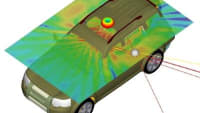
Tech Briefs
New Phase Shifter to Reduce Antenna Signal Loss
Aerospace & Defense Tech Briefs
Tackling Ruggedization Challenges for RF Communications in Software Defined Radios
Tech Briefs
New on the Market: October 2018
Sensing Technology
NIST Tackles Wireless Industrial Systems
Aerospace & Defense Tech Briefs
Persistent Systems Auto-Tracking Antenna Adds Aircraft to Network, Enhances Data Sharing
Aerospace & Defense Tech Briefs
Three Challenges to 5G’s Military Success
Aerospace INSIDER
Northrop's New Multifunction Active Electronically Scanned Array
Aerospace & Defense Tech Briefs
Qualification of Multi-Channel Direction Finding Radar Receivers in The Lab
Aerospace & Defense Tech Briefs
Making Fully Digital Beamforming for Radar and Electronic Warfare Applications a Reality
Aerospace & Defense Tech Briefs
Multi-Agent RF Propagation Simulator

Aerospace & Defense Tech Briefs
Engineers Enable a Drone to Determine Its Position in the Dark and Indoors
Motion Design INSIDER
Engineers Enable a Drone To Determine Its Position in the Dark and Indoors
Aerospace & Defense Tech Briefs
How RF-over-Fiber is Providing the Backbone of Next Generation Mil/Aero Networks
Tech Briefs
Deployable Fresnel Rings
Aerospace & Defense Tech Briefs
Developing New Anti-Drone Radar Technology

Aerospace & Defense Tech Briefs
The World’s Largest Real Time EW Test Range

Aerospace & Defense Tech Briefs
New Products

Aerospace & Defense Tech Briefs
Communicating from Space: The Front End of Multiscale Modeling
Top Stories
NewsSensors/Data Acquisition
 Microvision Aquires Luminar, Plans Relationship Restoration, Multi-industry Push
INSIDERRF & Microwave Electronics
 A Next Generation Helmet System for Navy Pilots
INSIDERWeapons Systems
 New Raytheon and Lockheed Martin Agreements Expand Missile Defense Production
NewsAutomotive
 Ford Announces 48-Volt Architecture for Future Electric Truck
INSIDERAerospace
 Active Strake System Cuts Cruise Drag, Boosts Flight Efficiency
ArticlesTransportation

Webcasts
Aerospace
 Cooling a New Generation of Aerospace and Defense Embedded...
Energy
 Battery Abuse Testing: Pushing to Failure
Power
 A FREE Two-Day Event Dedicated to Connected Mobility
Automotive
 Quiet, Please: NVH Improvement Opportunities in the Early Design Cycle
Electronics & Computers
 Advantages of Smart Power Distribution Unit Design for Automotive &...
Unmanned Systems
 Sesame Solar's Nanogrid Tech Promises Major Gains in Drone Endurance