




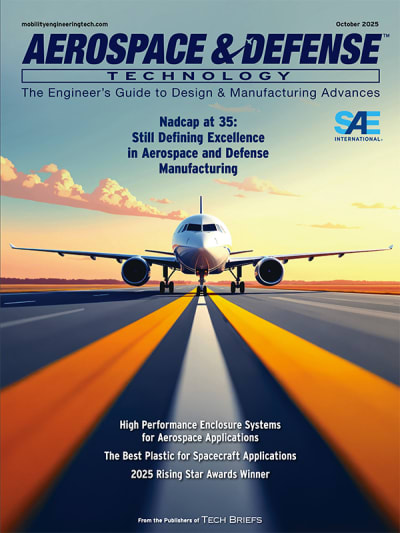
Aerospace & Defense Technology - October 2025
Inside this issue
Overview
The October 2025 issue of Aerospace & Defense Technology focuses on the latest advancements and challenges in the aerospace and defense sectors, particularly emphasizing thermal management, connectivity standards, and the integration of emerging technologies.
Thermal Management
A significant theme throughout the issue is the critical importance of thermal management in military and aerospace applications. As systems become more complex and power-hungry, effective thermal management is essential to ensure reliability and performance. The Department of Defense (DoD) has recognized the strategic importance of advanced thermal interface materials, particularly in light of competition from foreign technologies like carbon nanotubes. However, the current procurement practices often rely on outdated solutions that can fail under operational stress, leading to premature equipment failures in mission-critical scenarios. The issue highlights the need for innovative thermal management solutions that can withstand harsh environments, especially for portable systems used by warfighters in the field.
OpenVPX and VITA Standards
The magazine delves into the evolution of the OpenVPX standard, which is crucial for modular, ruggedized hardware in military applications. The VITA 91 standard is introduced as a means to increase connector density and support higher data rates, allowing for 56G speeds through the channel. This is a stepping stone towards achieving even higher bandwidths with the upcoming VITA 100 standard, which promises to double the baud rate and density of OpenVPX connectors, potentially achieving eight times the performance of traditional connectors. The VITA 100 standard will also enhance power capacity, supporting over 1000W with a 48VDC version, although it may require liquid cooling solutions.
Integration of AI and Cybersecurity
The issue also discusses the integration of artificial intelligence (AI) and enhanced cybersecurity measures into military systems. As the demand for real-time data processing and multi-domain interoperability increases, rugged embedded systems must evolve to meet these challenges. The merging of AI computing with advanced sensor interfaces is highlighted as a key trend, enabling more efficient data handling and decision-making in critical situations.
Challenges in Satellite Communications
Another focus area is satellite communications, where the magazine addresses the need for reliable and efficient systems that can operate under extreme conditions. The issue emphasizes that predictable thermal interface performance is foundational for the success of satellite systems, which are essential for connecting sensors and transmitting data across various domains. The article points out that the defense community must prioritize thermal management as a primary design constraint rather than a secondary concern.
Real-World Applications and Scenarios
The magazine provides real-world scenarios to illustrate the importance of these advancements. For instance, it describes a warfighter carrying a "mini data center" in a backpack, which includes sensors and communication equipment. Each component generates heat, and without effective thermal management, the reliability of the intelligence gathered can be compromised. This scenario underscores the necessity for systems that can maintain performance without the luxury of climate control or redundant cooling systems.
Emerging Technologies and Future Directions
The issue concludes with a look at emerging technologies that are set to transform the aerospace and defense landscape. The integration of co-packaged optical I/O and high-density RF transitions is expected to become more common in new designs, necessitating careful consideration of board space, connector alignment, and electromagnetic interference (EMI) shielding. As the industry moves towards higher performance standards, the collaboration between various stakeholders, including manufacturers and defense agencies, will be crucial in driving innovation and ensuring the reliability of next-generation systems.
In summary, the October 2025 issue of Aerospace & Defense Technology provides a comprehensive overview of the current state and future directions of the aerospace and defense industries. It highlights the critical role of thermal management, the evolution of connectivity standards like OpenVPX and VITA, and the integration of AI and cybersecurity in military applications. The magazine serves as a valuable resource for professionals in the field, offering insights into the challenges and opportunities that lie ahead in this rapidly evolving sector.
Features
-
Application Briefs
46 Armored Multi-Purpose Vehicle Rapid Capability Kit Upgrades
46 TRML-4D Radar for Ukrainian Air Defense
47 The World’s Largest Real Time EW Test Range
47 Vulcan Rocket Completes First National Security Launch for Space Force
-
Articles
10 Nadcap at 35 Still Defining Excellence in Aviation, Defense and Space Manufacturing
22 High-Performance Enclosure Systems for Aerospace and Defense Applications: Preparing for What’s Next
26 Selecting the Best Plastic for Spacecraft Applications
31 2025 RISING STAR AWARDS Aerospace and Defense Winner – Keshika Warnakula
34 Managing Thermal Reliability at the Edge: The Critical Challenge DoD Isn’t Talking About
38 Analyzing Aircraft Antenna Placement and Performance with Unified Modeling and Simulation
Tech Briefs
-
Aerospace
40 U.S. Army Tests Innovative Autonomous Tactical Vehicle Prototype
42 Researchers Discover New Materials That Could Enhance Fighter Jet Efficiency
44 Could Metasurfaces Be The Next Quantum Information Processors?
Products
-
48 New Products
Top Stories
NewsRF & Microwave Electronics
 Microvision Aquires Luminar, Plans Relationship Restoration, Multi-industry Push
INSIDERAerospace
 A Next Generation Helmet System for Navy Pilots
INSIDERDesign
 New Raytheon and Lockheed Martin Agreements Expand Missile Defense Production
INSIDERMaterials
 How Airbus is Using w-DED to 3D Print Larger Titanium Airplane Parts
NewsPower
 Ford Announces 48-Volt Architecture for Future Electric Truck
ArticlesAR/AI

Webcasts
Electronics & Computers
 Cooling a New Generation of Aerospace and Defense Embedded...
Automotive
 Battery Abuse Testing: Pushing to Failure
Power
 A FREE Two-Day Event Dedicated to Connected Mobility
Unmanned Systems
 Quiet, Please: NVH Improvement Opportunities in the Early Design Cycle
Automotive
 Advantages of Smart Power Distribution Unit Design for Automotive &...
Energy
 Sesame Solar's Nanogrid Tech Promises Major Gains in Drone Endurance