




High-Performance Enclosure Systems for Aerospace and Defense Applications: Preparing for What’s Next

As mission-critical systems demand more processing power, real-time data movement, and multi-domain interoperability, rugged embedded systems are being transformed. Today’s military and aerospace applications increasingly demand the merging of AI computing, enhanced sensor interfaces, and cybersecurity — all under harsh environmental conditions.
At the heart of this evolution is the 3U OpenVPX form factor, a modular, compact, and ruggedized hardware standard and increasingly the SOSA aligned subset of the architecture. However, next-generation systems need to go further: supporting higher bandwidth, better thermal efficiency, improved security, while maintaining multi-vendor interoperability and long-term sustainability. We’ll discuss some of today’s enclosure solutions as well as emerging technologies.
Approaching Performance Boundaries
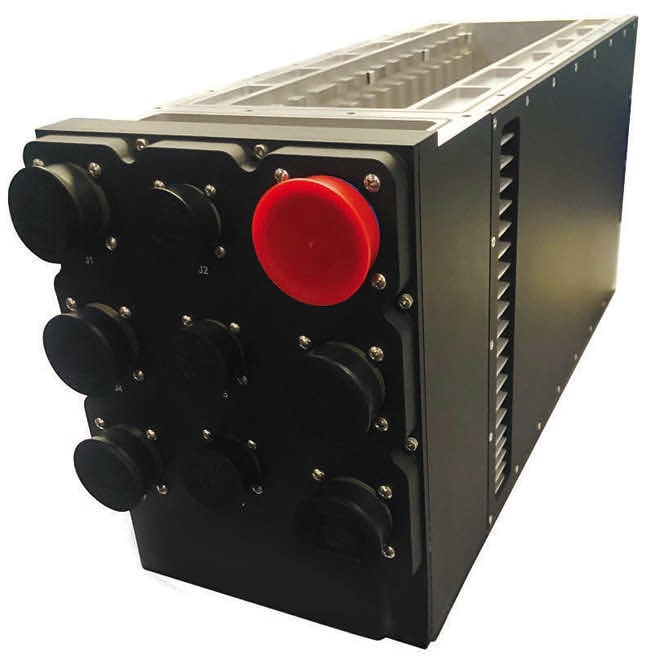
Cooling an embedded computing system becomes more challenging every year. With today’s AI-centric processors, the thermal loads are ramping up faster than ever. While some of these 3U Open-VPX modules such as Xeon D or some UltraScale+ based are in the 50W-75W range, other GPU and high-end FPGAs can hit the 175W range. Cooling 600W in an Air Transport Rack (ATR) with airflow over the fins is certainly possible in medium-sized enclosures. In fact, Figure 1 shows a 10+2 slot 5/8 ATR for 3U Open-VPX/SOSA cooling over 800W. But there are physics limitations to the cooling, especially meeting environmental thresholds which may be up to 70 °C or higher. Additionally, there is often the desire to reach high altitudes where there is less air available for thermal management of the system.
There are tricks of the trade to enhance or balance out the cooling in the system including special alloys, heat-pipes (which tend to be more effective at spreading the thermal load versus dissipating much heat), etc. But, to make a significant difference, we need to incorporate other methods. Liquid cooling is an obvious choice, but it is often a last resort with the complication, expense, and other hurdles involved. So let’s put that aside for now.
So, given a certain amount of airflow available, instead of focusing on the materials, etc., perhaps we can utilize the existing air more efficiently. In most ATRs with supplemental airflow, the VITA 48.2 module conducts the heat to the enclosure surfaces (primarily on one side) and that heat radiates to fins which elongate the surface area, allowing more air/surface. But what if we can have that air go directly through the module itself, without compromising the electronics in a harsh environment?
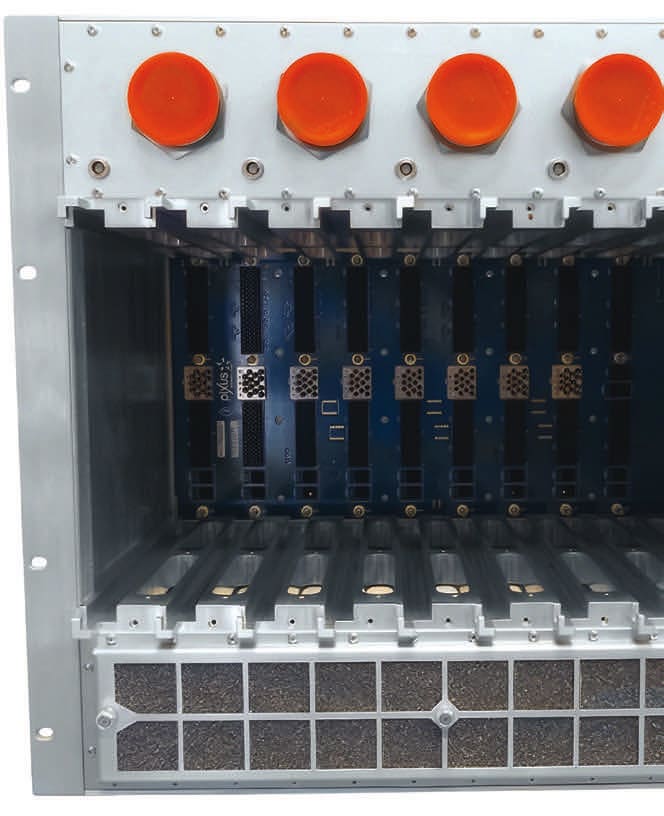
An emerging approach for cooling is Air Flow Through (AFT) the module via the VITA 48.8/48.5/48.9 standards. Actually, this concept has been around for a while. Figure 2 shows a Pixus chassis developed in 2019 that leverages VITA 48.8 for special-sized OpenVPX boards. With the airflow through the individual cards, the cooling performance could reach a 50 percent improvement or more (estimated from like modules with similar processors in both VITA 48.2 and 48.8 formats). However, there is a cost associated with this approach in that the module slot pitch often needs to increase. VITA 48.8 for example includes 1.0", 1.2", 1.5" size modules. While 1.0" is the slot pitch of a typical 3U or 6U OpenVPX board, currently the more common modules are 1.2" or 1.5"
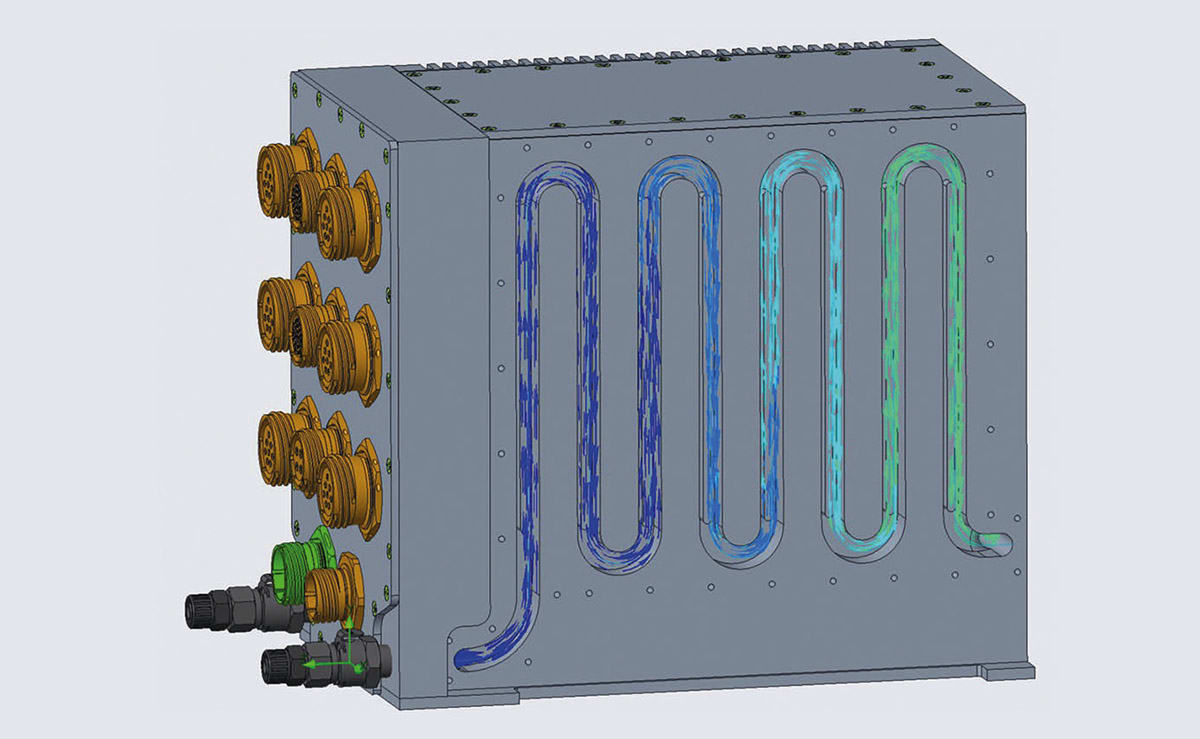
As mentioned, liquid cooling is an option with liquid through the sidewalls as shown in Figure 3 or via VITA 48.4 where the liquid flows through the module itself. While AFT is expected to significantly boost thermal performance, the push for higher speeds and performance continue to drive up heat loads. As we’ve seen, there are mechanical/thermal challenges, but there is a whole other side of being able to handle the speeds across the backplane.
The Road to 400GBASE-KR4 and Beyond
Military and aerospace systems are now deploying AI algorithms to process video, radar, or acoustic data in real time. This requires significant processing horsepower — CPUs, GPUs, FPGAs, and AI ASICs — packed into these small 3U cards. The next generation of processors will require more real estate, however. There is a reluctance to go all the way up to the 6U module size for all types of avionics, ground vehicle, and other applications where there just is not the space to double the size. So, how do we go faster than the traditional limit of 100GbE speeds in the OpenVPX connector (with 4x lanes of ~ 25G signals)?
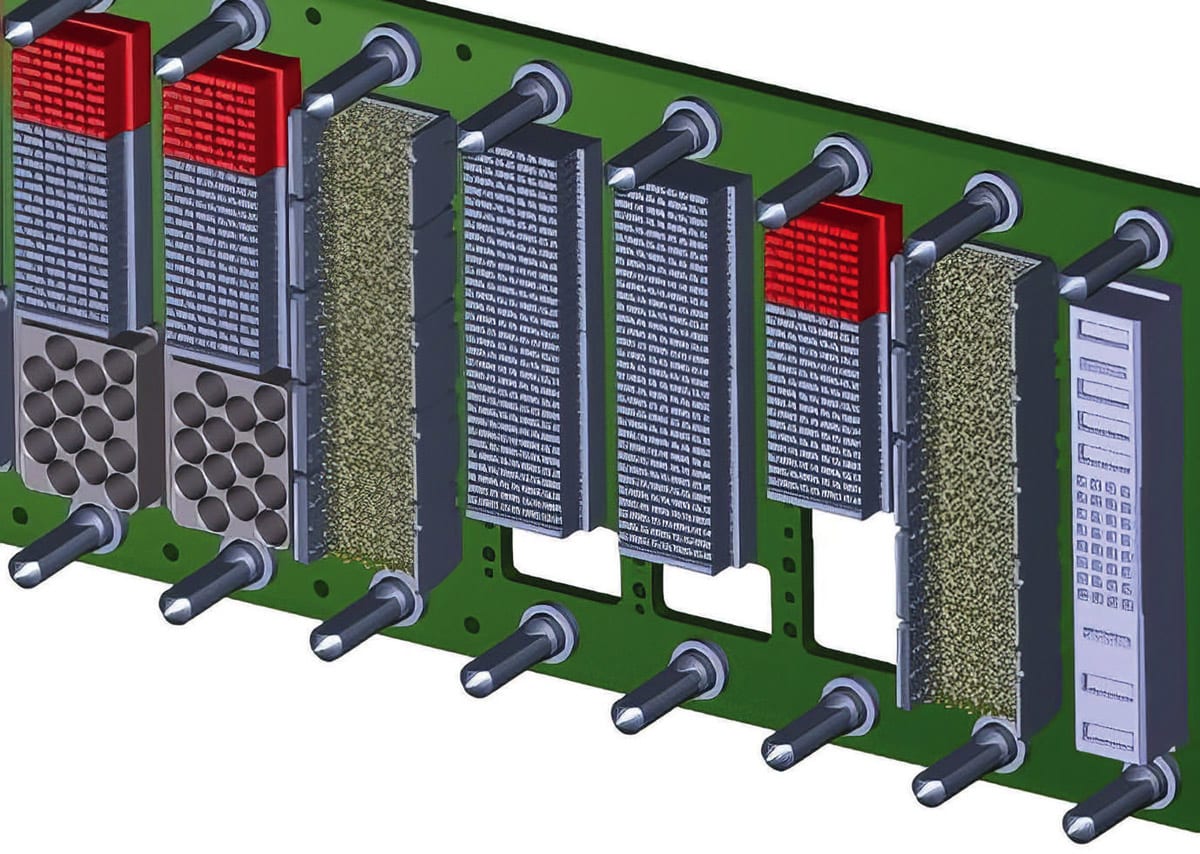
One path is to increase the density of the connector, without “breaking” the interoperability of the system. This can be achieved via the VITA 91 standard, which is a double density version which allows 56G through the channel. Figure 4 shows a 3U OpenVPX/SOSA aligned backplane design incorporating the VITA 91 connectors for higher density in the switch slots. This solution is a nice stepping-stone to higher speeds, but there is still the goal of much higher bandwidth. The next step is to not only double the density, but increase the baud rate which can be achieved in a new connector solution.
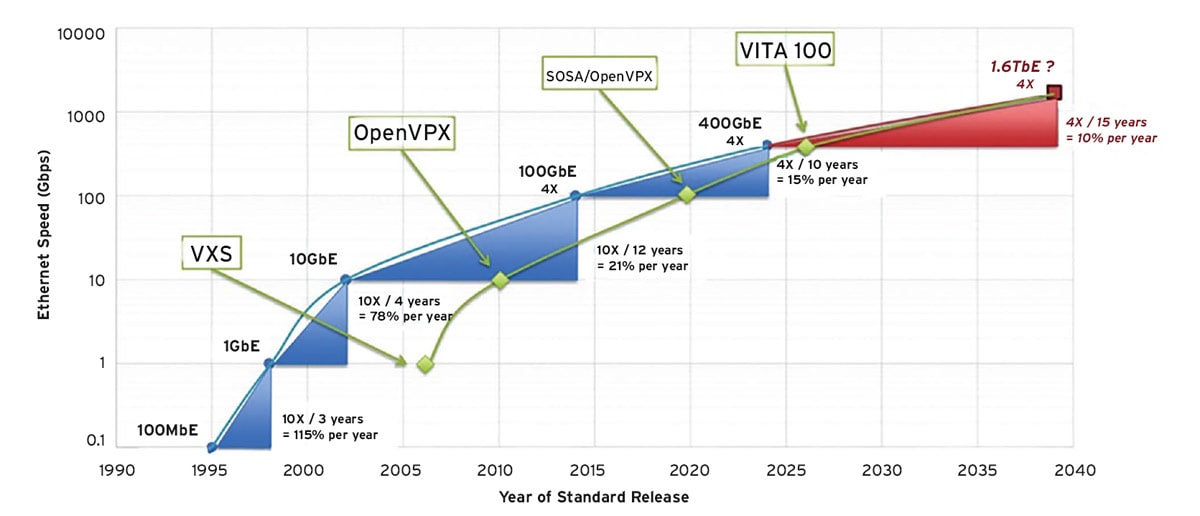
Leveraging the double density and improved signal performance/density learned in VITA 91, VITA 100 is the next evolution in VITA performance. See Figure 5 for a chart showing the performance horizon for various VITA-based technologies. The emerging VITA standard promises 2x the baud rate, 2x the density of OpenVPX (like VITA 91), and enables 2 bits/baud rather than just 1 bit/baud. So, it’s also more efficient in encoding.
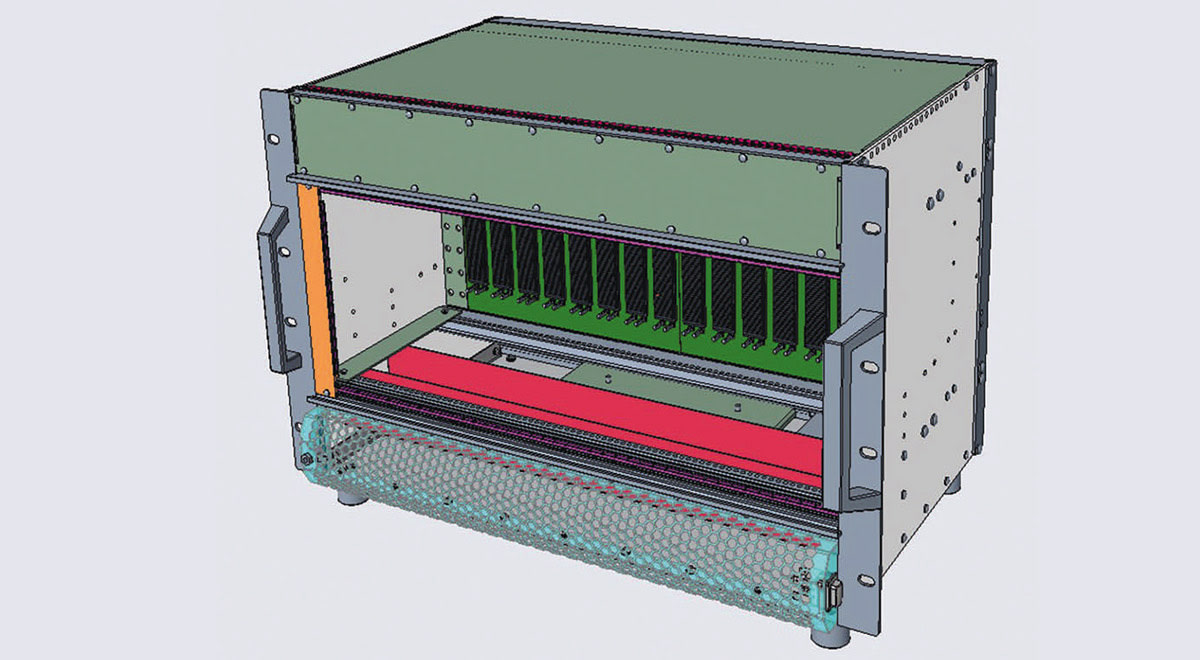
The result is 8x the performance of the typical OpenVPX connector. Many of the emerging leading-edge chipsets require more board real-estate than a 3U OpenVPX board can support. Therefore, a 4U module size has been introduced, with approximately 60 percent more surface area. This will require a whole new generation of enclosure systems to support the 4U form factor. But for testing/development, utilizing a modular enclosure approach, we don’t need to start from scratch. Figure 6 shows a Pix-Cool chassis that supports 4U modules in various slot pitch sizes. So, once the VITA 100 is fully developed, this type of solution can quickly be utilized with the new backplane designed to the emerging standard.
The new architecture is intended to support modular payloads, high-speed optical/RF I/O, and high-performance compute accelerators. It is likely to include integrated chiplets, co-packaged optics, and AI-oriented bus protocols. To support potentially power-hungry components, VITA 100 will also more than double the power capacity. If a 48VDC version is incorporated, it could theoretically support over 1000W. But those modules would likely necessitate liquid cooling.
While VITA 100 will not be backwards compatible, it will leverage many features of OpenVPX, including many of the same routing profiles or elements therein. VITA 66 and VITA 67 for RF and optical through the backplane are already enhancing OpenVPX systems. Expect new designs to increasingly incorporate co-packaged optical I/O or high-density RF transitions. Designers must budget board space, connector alignment tolerances, and EMI shielding accordingly.
Security and Trust
The tri-service community has increasingly required that MIL computing systems must be cyber-hardened. There are various elements that can be incorporated in an OpenVPX/SOSA aligned computing system. This includes trusted computing modules, root-of-trust boot mechanisms, secure keylock/ access, and hardware-based data isolation are a growing part of system architectures. This includes red/black separation for preventing classified data from mixing with unclassified content. As OpenVPX/SOSA evolve, perhaps elements of red/black separate thinking will be employed. For example, external access requirements such as commands through the chassis manager perhaps can be kept separate from data traffic.
Evolving Standards
While we’ve seen that new MOSA architectures are evolving through VITA and SOSA to meet tomorrow’s advanced computing needs, 3U and 6U OpenVPX will remain critical to the backbone of critical platforms in defense, aerospace, and industrial applications for decades to come. Not all system applications require the performance of VITA 100, plus there are cost, lead-time, integration, risk mitigation, training, and many other factors that affect what architecture is chosen. In fact, there are still a few recent designs that still use 50-year-old VMEbus technology and it does what they need.
However, the road ahead demands more performance. VITA 91 provides the bridge — enabling higher data rates and denser interconnects without disrupting existing infrastructure. VITA 100 lays the groundwork for an entirely new generation of ruggedized computing platforms, purpose-built for the AI-enabled, multi-domain, data-intensive future of military and aerospace missions.
System architects and designers must think proactively — adopting flexible, standards-aligned, and future-compatible design methodologies now to ensure long-term success. Those who do will be well-positioned to deliver rugged, high-performance, and upgradeable platforms that can meet tomorrow’s mission demands — no matter how complex or connected the battlefield becomes.
This article was written by Justin Moll, Vice President of Sales & Marketing, Pixus Technologies (Waterloo, Canada). For more information, visit here .
More From SAE Media Group
Aerospace & Defense Tech Briefs
New Products
Aerospace & Defense Tech Briefs
Advancing Embedded Systems with VITA 93: A New Era in Modular I/O for Aerospace and Defense
Aerospace & Defense Tech Briefs
MicroTCA Computing for Mil/Aero Applications
Aerospace & Defense Tech Briefs
Ruggedizing Commercial-Grade Computers into MIL-Hardened Systems
Aerospace & Defense Tech Briefs
New Products
Aerospace & Defense Tech Briefs
Small Form Factor Strategies for Military Embedded Systems
Aerospace & Defense Tech Briefs
New Products
Aerospace & Defense Tech Briefs
VPX: The Rugged Bus Architecture for Embedded Military Applications
Aerospace & Defense Tech Briefs
Defining an Open System Architecture Standard for Defense Systems
Off-Highway Engineering
Military System Designers Aren’t Resting on COTS Deployment
Aerospace & Defense Tech Briefs
Military, Suppliers Focus on Long-Term Technical Advances, Compatibility
Aerospace & Defense Tech Briefs
Open-Standard Multicomputers Address Next-Generation Multi-Function Radar Applications
Aerospace & Defense Tech Briefs
Mini Embedded Systems
Aerospace & Defense Tech Briefs
COTS Embedded Systems and Link Budgets
Aerospace INSIDER
New Power Module Developed for Next Gen Military Airborne Electronics
Aerospace Manufacturing and Machining INSIDER
Army Launches CMOSS Prototyping Competition for Computer Chassis and Cards
Aerospace & Defense Tech Briefs
Security IP Module
Aerospace & Defense Tech Briefs
How SpaceVPX is Influencing the Design of Next Generation Spacecraft Avionics
Aerospace & Defense Tech Briefs
MOSA Enclosure Design for Military Systems
RF & Microwave Technology
Prototyping Advanced Military Radar Systems
Aerospace & Defense Tech Briefs
Maximizing Thermal Cooling Efficiencies in High-Performance Processors
Aerospace & Defense Tech Briefs
New Products
Aerospace & Defense Tech Briefs
Open Generic Avionics Architectures and Distributed Processing Using Ethernet and VPX
Aerospace & Defense Tech Briefs
Multiple Node Networking Using PCIe Interconnects
Aerospace Manufacturing and Machining INSIDER
Field-Deployable Computing Platform
Aerospace & Defense Tech Briefs
Analog Transformation Complements Open System Designs to Optimize Modern Defense Systems
Aerospace & Defense Tech Briefs
Inside Story: The Role of the SFFs in Rugged HPEC Computing
Aerospace & Defense Tech Briefs
Signal AHPEC Platform
Aerospace & Defense Tech Briefs
Small Form Factor Embedded Systems
Aerospace & Defense Tech Briefs
New Products
Top Stories
NewsRF & Microwave Electronics
 Microvision Aquires Luminar, Plans Relationship Restoration, Multi-industry Push
INSIDERAerospace
 A Next Generation Helmet System for Navy Pilots
INSIDERDesign
 New Raytheon and Lockheed Martin Agreements Expand Missile Defense Production
INSIDERMaterials
 How Airbus is Using w-DED to 3D Print Larger Titanium Airplane Parts
NewsPower
 Ford Announces 48-Volt Architecture for Future Electric Truck
ArticlesAR/AI

Webcasts
Electronics & Computers
 Cooling a New Generation of Aerospace and Defense Embedded...
Automotive
 Battery Abuse Testing: Pushing to Failure
Power
 A FREE Two-Day Event Dedicated to Connected Mobility
Unmanned Systems
 Quiet, Please: NVH Improvement Opportunities in the Early Design Cycle
Automotive
 Advantages of Smart Power Distribution Unit Design for Automotive &...
Energy
 Sesame Solar's Nanogrid Tech Promises Major Gains in Drone Endurance