




How RF-over-Fiber is Providing the Backbone of Next Generation Mil/Aero Networks

RF and fiber have long co-existed within modern military and aerospace systems, with each medium dedicated to separate, mission-critical roles. Increasingly, however, system designers are turning to RF-over-fiber (RFoF) architectures to bridge the gap between over-the-air RF interfaces and the long, interference-resistant transport advantages of fiber.
When it comes to over-the-air communications uses like tactical radio or satellite communications terminals, radio frequency (RF) is still the dominant signal format. RF is also commonly used at the front end of radar and electronic warfare, supporting search, tracking, fire control radar, missile seekers, jammers and electronic support measures.
Fiber, meanwhile, forms the core of networks that connect terrestrial data centers, command centers and intel facilities, and is also used to carry digital traffic aboard mobile platforms like aircraft and ships. Fiber offers several advantages that make it well-suited for military and aerospace use, such as low signal loss, light weight, high bandwidth and electromagnetic interference (EMI) immunity, which makes data transmitted over fiber much more difficult to intercept.
While both mediums are incredibly useful in isolation, they each have their own sets of limitations. RF can be susceptible to interference from other electrical sources, particularly in crowded electronic environments. Also, over long distances, RF signals gradually weaken or attenuate, requiring the installation of occasional repeaters to boost the signals, which adds cost, complexity and additional potential points of system failure. As an optical medium, fiber can carry data quickly over long distances with very little loss, but it can’t communicate directly with antennas, radios and most legacy or tactical systems, which work with electrical RF signals.

These limitations have driven the development of RF-over-fiber, a hybrid approach that combines RF’s compatibility at the edge with fiber’s reach and resilience along the transport path.
RFoF uses RF to communicate with antennas and radios, but switches the signal to fiber for the majority of the transmission path to take advantage of fiber’s wider bandwidth and EMI immunity. As an RF signal enters the chain from a radio, modem, radar or another source, it feeds into an RFoF transmitter module, where it is converted to light. The signal is then carried over fiber to the receive end, where an RFoF receiver module with a photodiode converts the optical signal back to an RF signal that can be amplified, filtered or sent to an antenna or receiver.
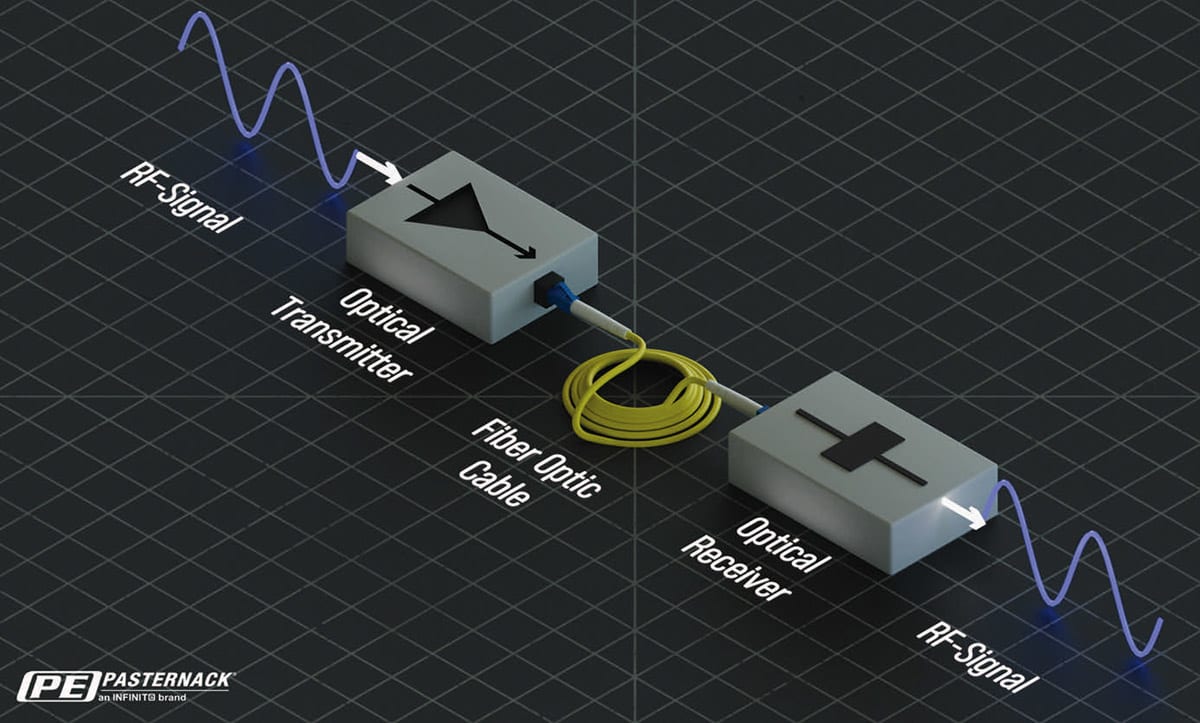
RFoF has become firmly established within the mil/aero industry, though its use continues to grow in areas where long, interference-resistant RF transport is crucial. It is commonly deployed in three areas:
Satellite ground stations and gateways, where it transports RF signals across various satellite frequency bands to outdoor antennas and indoor shelters or bunkers.
Large outdoor environments like test ranges, flight-test corridors and telemetry sites.
Internal communications systems on military bases, command facilities and naval vessels.
Maintaining Signal Integrity in Challenging Conditions
With technology playing an ever-more-central role in modern conflicts, particularly those now taking place in Ukraine and the Middle East, militaries are increasingly adopting RFoF for its tactical advantages. The prevalence of jamming, electronic attacks and interception attempts leaves long RF cable runs highly vulnerable to compromise.

Even without deliberate interference, traditional RF coaxial cables are still vulnerable to electromagnetic noise. Military and aerospace platforms are loaded with electronic equipment, such as radar transmitters, radios, jammers, engines and power converters, which generate strong electromagnetic interference, radio-frequency interference (RFI) and voltage ground loops. RF can pick up noise and crosstalk from these sources, degrading data for satellite communications, electronic warfare and telemetry.
RFoF counters this by confining RF to the antenna ends while transporting signals over fiber for the rest of the distance, boosting resilience, security and EMI immunity inside ships, aircraft, tanks and bases. Signals arrive cleaner, with lower noise and preserved integrity.
Mil-aero equipment is often operated in extreme conditions, where intense vibrations, severe temperatures and quickly changing altitudes are common. RFoF assemblies and fiber optic connectors are ruggedly designed for mil-aero applications, enabling them to maintain signal integrity through situations in which coaxial cables are more prone to degradation or failure.
The Move to Higher Frequencies
Modern radar and electronic warfare (EW) systems’ shift to higher frequencies and wider bandwidths is also affecting demand for RFoF. In the past, radar and EW systems primarily used the low-frequency L-, S- and C-bands, and the even lower HF, VHF and UHF ranges. While those bands are still common, there has been movement in recent years toward the higher-spectrum X-, Ku- and Ka-bands, which offer numerous benefits.
Despite a shorter wavelength and signals that weaken more severely over long distances, the X-band (~8–12 GHz), Ku-band (~12–18 GHz) and Ka-band (~26–40 GHz) deliver much better resolution and can support very wide bandwidths using smaller antennas. This makes them a good fit for modern high-resolution radar, advanced electronic warfare and high-capacity satellite communications systems.
RFoF leverages fiber’s low-loss transport to carry high-frequency signals — up to GHz ranges and beyond — over long distances without degradation. It is equally effective carrying signals from legacy L-, S- and C-bands.
Mission-Ready and Future-Proof with RFoF
As technology evolves, military systems will need to adapt to new radar bands or communications standards, ideally without the cost, downtime and complexity of physically replacing coaxial cables to accommodate new connectors, lengths and upgraded performance specs. Hybrid RFoF architectures address this need by using a common fiber infrastructure to carry both analog RF and digital services, extending the useful life of existing cabling.
Along with radio signals for communications, radar and electronic warfare, RFoF systems can carry Ethernet data, timing, GPS signals and other digital traffic over the same set of fibers and panels. This reduces size and weight and makes deployment easier. Because fiber lines can be reassigned to carry radio signals, data traffic, timing or control without tearing out and replacing rigid coax runs, operators can quickly reconfigure systems as missions, bands and waveforms change.
This approach goes hand-in-hand with broader trends in network modernization, as well as the “fiberization” of bases and platforms. As defense organizations continue installing fiber to support IP networking and secure cloud connectivity, it’s a natural next step to carry RF over that same optical infrastructure instead of building separate, RF-only networks.
Similar to telecom’s strategy of putting small radio units near antennas while keeping the majority of processing in a central room, centralized and remote radio setups fit naturally with RFoF, with fiber carrying radio signals between those remote units and the main processing equipment. At the same time, the spread of unmanned and distributed systems such as drones, ground robots, loitering munitions and wide sensor grids is increasing the need to move radio signals from many small, scattered nodes back to processing hubs over long distances with low weight and high reliability, which is a natural sweet spot for RFoF.
Taken together, modern high frequency, high bandwidth and highly contested operations, combined with the accelerating integration of fiber into bases, ships and platforms, are driving broader adoption of hybrid RF-over-fiber architectures. By combining RF’s compatibility with antennas and radios with fiber’s reach, security and capacity, RFoF is keeping mission-critical networks ready for whatever comes next.
This article was written by Diana Nottingham, Fiber Optics Product Line Manager, Infinite Electronics (Irvine, CA). For more information, visit here .
More From SAE Media Group

Tech Briefs
New Phase Shifter to Reduce Antenna Signal Loss
Tech Briefs
Wireless, Wearable Transmitter
Aerospace & Defense Tech Briefs
Tackling Ruggedization Challenges for RF Communications in Software Defined Radios
Tech Briefs
Enabling High-Capacity Space Communication

Aerospace & Defense Tech Briefs
Making Fully Digital Beamforming for Radar and Electronic Warfare Applications a Reality
Tech Briefs
Radio Signals Image Hidden and Speeding Objects
Aerospace & Defense Tech Briefs
Engineers Enable a Drone to Determine Its Position in the Dark and Indoors
Aerospace & Defense Tech Briefs
What Today’s Advances in Radar Technology Mean for Testing and Training
Aerospace & Defense Tech Briefs
Development of a 94 GHz Radar System for Dedicated Bird Detection at Airports and Airfields
Aerospace & Defense Tech Briefs
Space Lasers: Aiming Towards Next Leap in Global Communications
Aerospace & Defense Tech Briefs
Designing Multi-Channel Microwave Radio Systems Using Optical Interconnects
Tech Briefs
Cascaded Offset Optical Modulator

Aerospace & Defense Tech Briefs
Key Measurements to Maintain Performance of Critical Electronic Systems on Military Aircraft and Warships
Aerospace & Defense Tech Briefs
Stepped-Frequency Distributed Radar for Through-the-Wall Sensing
Aerospace & Defense Tech Briefs
New Products
Automotive Engineering
Homing in on STEM Innovation
Aerospace & Defense Tech Briefs
The Next Generation of Mission-Critical Communications Infrastructure is Here
Aerospace & Defense Tech Briefs
RF Technology Helps Connect Avionics Systems

Aerospace & Defense Tech Briefs
Beyond the Beam: The Impact of Coaxial Cables on Phased Array Technology
Photonics & Imaging Technology
Photonic Microwave Generation Using On-Chip Optical Frequency Combs
Aerospace & Defense Tech Briefs
RF Photonics for Avionics Signal Processing
Tech Briefs
Atom-Based Radio Communications
Aerospace & Defense Tech Briefs
Improving Transmit/Receive Module Test Accuracy and Throughput
Motion Design INSIDER
Engineers Enable a Drone To Determine Its Position in the Dark and Indoors
Aerospace & Defense Tech Briefs
What is Drone Jamming and How Can it Be Countered?
Top Stories
INSIDERDesign
 How Airbus is Using w-DED to 3D Print Larger Titanium Airplane Parts
NewsAutomotive
 Microvision Aquires Luminar, Plans Relationship Restoration, Multi-industry Push
INSIDERRF & Microwave Electronics
 A Next Generation Helmet System for Navy Pilots
ArticlesDesign
 CES 2026: Bosch is Ready to Bring AI to Your (Likely ICE-powered) Vehicle
Road ReadyAutomotive
 2026 Nissan Sentra Review: Putting the Pieces Together
NewsUnmanned Systems

Webcasts
Power
 Hydrogen Engines Are Heating Up for Heavy Duty
Electronics & Computers
 Advantages of Smart Power Distribution Unit Design for Automotive...
Transportation
 Quiet, Please: NVH Improvement Opportunities in the Early Design...
Energy
 Battery Abuse Testing: Pushing to Failure
Connectivity
 A FREE Two-Day Event Dedicated to Connected Mobility
Aerospace
 SiPhog Technology: Enabling GPS‑Independent Flight for Uncrewed Aerial...