




RF Photonics for Avionics Signal Processing
The maturity of RF photonic components has reached the point where fiber optic links are being system-tested to replace traditional copper coax links on avionic platforms. Many demonstrations of RF photonic links have been made with traditional and non-traditional modulation formats to improve the RF performance of the link. While the advantages of RF photonic links in regard to size and weight are important, the large instantaneous bandwidth of the fiber optic links is a key driver for the use of this technology in the airframe.
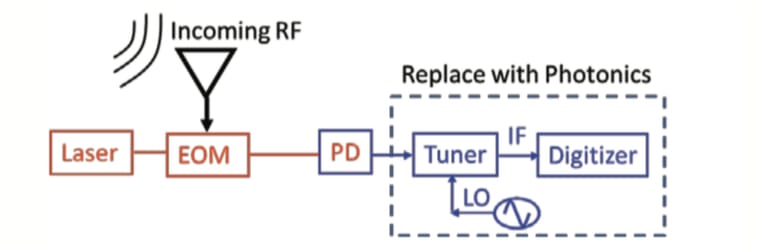
Starting with a traditional RF photonic link shown in the figure, the RF signal is received at the antenna and then modulated onto an optical carrier provided by the laser. The RF modulated light is then passed down a fiber optic link to a photodetector, which then recovers the RF electrical signal. The RF signal would then be passed through a tuner to frequency down convert it to an intermediate frequency (IF) chosen by the local oscillator (LO). The IF signal is then digitized at an analog-to-digital converter (ADC) and processed. Since the RF signal is already in the optical domain, the photodetector and electronic tuner can be replaced with an optical tuner that can down convert the signal to an electrical IF.
An optical tuner can reduce mixing spurs in RF frequency down conversion. Such a system is important as it can provide better spur free performance than current electronic tuners and over a larger bandwidth. In addition, work continues on photonic ADCs that can digitize 10 GHz of instantaneous bandwidth with a resolution greater than 8 effective number of bits. A combination of these technologies can provide an RF-to-bits architecture without an optical-to-electronic conversion in the middle.
In support of the frequency down converter and ADC technologies, work continues on the optical clock that is used either for the LO or the sampler in these architectures, respectively. Optoelectronic oscillators continue to be investigated for improved performance; however, the limited frequency tunability is still a drawback to these types of low-phase-noise clock sources. New methods have been shown to make tunable RF sources using the injection locking of two lasers. These sources continue to be further explored in order to determine their noise performance over their tunable range.
Other signal processing applications include signal discrimination in cluttered RF environments. Once the RF signals have been modulated onto the optical carrier, a portion of the light can be split off for spectrum analysis. Demonstrations have already been made with a rare-earth doped crystal in a spectrum analyzer with an RF instantaneous bandwidth of 10 GHz with the potential for even higher bandwidths. Another demonstration has been made with a multimode optoelectronic oscillator for selective amplification of RF signals with an input sensitivity less than 15 dB above the thermal noise limit. These systems are sensitive to frequency agile signals and can be used to cue a narrowband receiver to analyze the signal.
Work continues on using RF photonic solutions for signal processing at the receive end of the fiber optic link on an avionics platform. Multiple applications exist that can benefit from the large instantaneous bandwidth of photonic systems. However, to compete with electronic solutions, integrating photonic solutions into small form factors will continue to be emphasized.
To learn more, visit visit www.dtic.mil/dtic/tr/fulltext/u2/a588088.pdf .
More From SAE Media Group
Tech Briefs
Sensitive Optical Receivers for Space
Photonics & Imaging Technology
Unique Amplifier Could Change Optical Communication

Tech Briefs
Enabling High-Capacity Space Communication

Photonics & Imaging Technology
Photonic Microwave Generation Using On-Chip Optical Frequency Combs
Aerospace & Defense Tech Briefs
Identifying and Isolating Signals Using Radio Frequency Photonics
Aerospace & Defense Tech Briefs
Validation of Ubiquitous 2D Radar
Aerospace & Defense Tech Briefs
Photonic Recirculating Delay Line for Analog-to-Digital Conversion
Photonics & Imaging Technology
Photonics-Based Wireless Link Breaks Speed Records for Data Transmission
Aerospace & Defense Tech Briefs
Photonic Analog-to-Digital Converters
Aerospace & Defense Tech Briefs
The Next Generation of Mission-Critical Communications Infrastructure is Here
Aerospace & Defense Tech Briefs
Analysis of Analog Photonic Links Employing Multiple-Channel (Arrayed) Receivers
Aerospace & Defense Tech Briefs
90° Hybrid Coupled Power Amplifier – Pros and Cons
Tech Briefs
Cascaded Offset Optical Modulator

Photonics & Imaging Technology
Testing 800G Direct Modulated Optical Signaling
Aerospace & Defense Tech Briefs
Space Lasers: Aiming Towards Next Leap in Global Communications
Aerospace & Defense Tech Briefs
Effect of Laser Noise on an Analog RF/Photonic Link
Photonics & Imaging Technology
Researchers Develop a Wide-Bandwidth, Low-Polarization Semiconductor Optical Amplifier
Aerospace & Defense Tech Briefs
Microwave Photonic Notch Filter
Photonics & Imaging Technology
Transferring Data with Many Colors of Light Simultaneously
Aerospace & Defense Tech Briefs
New Pulse Analysis Techniques for Radar and EW
Tech Briefs
Fast-Tunable Laser System

Aerospace & Defense Tech Briefs
Fiber Interferometry for Testing Military Avionics
Tech Briefs
More Uses for Brillouin Amplification

Tech Briefs
Free-Space Fiber Optic Laser Rod
Top Stories
NewsSensors/Data Acquisition
 Microvision Aquires Luminar, Plans Relationship Restoration, Multi-industry Push
INSIDERRF & Microwave Electronics
 A Next Generation Helmet System for Navy Pilots
INSIDERWeapons Systems
 New Raytheon and Lockheed Martin Agreements Expand Missile Defense Production
NewsAutomotive
 Ford Announces 48-Volt Architecture for Future Electric Truck
INSIDERAerospace
 Active Strake System Cuts Cruise Drag, Boosts Flight Efficiency
ArticlesTransportation

Webcasts
Aerospace
 Cooling a New Generation of Aerospace and Defense Embedded...
Energy
 Battery Abuse Testing: Pushing to Failure
Power
 A FREE Two-Day Event Dedicated to Connected Mobility
Automotive
 Quiet, Please: NVH Improvement Opportunities in the Early Design Cycle
Electronics & Computers
 Advantages of Smart Power Distribution Unit Design for Automotive &...
Unmanned Systems
 Sesame Solar's Nanogrid Tech Promises Major Gains in Drone Endurance