




Analysis of Analog Photonic Links Employing Multiple-Channel (Arrayed) Receivers
This technique develops high-fidelity arrayed receivers for fiber-based or free-space applications.
Analog optical links are finding increased application in commercial and military systems ranging from radio-over-fiber applications, antenna remoting, and optical signal processing. As the performance of an analog link improves with received photocurrent, optical amplifiers — predominantly erbium-doped fiber amplifiers (EDFAs) — have been readily incorporated into a variety of systems. It is known that the addition of an optical amplifier (EDFA) raises the electrical noise floor in both digital and analog applications due to the presence of amplified spontaneous emission (optical) noise. To mitigate this additional noise in systems employing EDFAs prior to modulation, dual-output optical modulators and balanced detection are frequently employed. This technique has been utilized alone to achieve the first multi-gigahertz bandwidth analog optical link with a noise figure
While pre-modulation amplification and balanced detection may be utilized to approach shot noise-limited performance in an analog link, other techniques may be applied to increase the link gain (increase the received photocurrent), while also decreasing the effect of noise from the EDFA; in particular, arrayed receivers — those employing multiple optical paths post-modulation and multiple photodiodes.
In these architectures, the desired output RF photocurrent is recovered from each photodiode individually; the individual photocurrents are then coherently combined in the electrical domain. Conceptually, the operation of these receivers is analogous to a phased-array antenna operating in receive mode, where the outputs of multiple antenna elements are combined in-phase to increase the signal-to-noise ratio of the received signal as compared to that from a single element. These phased receivers (with no intentional filtering) could find widespread application in analog systems utilizing freespace optical links.
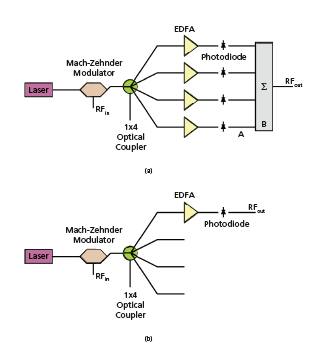
To verify the analysis, two 4-channel optoelectronic receivers were constructed. The general receiver architecture is shown in (a) in the figure. The output of a single distributed feedback laser (DFB) is modulated with a single-output low-Vn Mach-Zehnder intensity modulator (MZM). The modulator output is subsequently split evenly using a 1×4 optical coupler. Each output of the coupler is amplified using a commercial ~30 mW EDFA and the input RF modulation of each channel is recovered via direct detection with a photodiode (~12 GHz or ~3 GHz). The photodiode outputs are then combined either with a 1×4 RF power combiner (10 MHz - 2 GHz), or via hard wiring with a custom-built combining circuit. Prior analysis compared the performance of the arrayed receiver to that of a single reference link. The reference link architecture utilized in this work is shown in (b) in the figure.
This work was done by Jason D. McKinney, Vincent J. Urick, Frank Bucholtz, and Carl Villarruel of the Naval Research Laboratory; and Christopher Sunderman of Global Strategies Group. For more information, download the Technical Support Package (free white paper) at www.defensetechbriefs.com/tsp under the Photonics category. NRL-0034
This Brief includes a Technical Support Package (TSP).
Analysis of Analog Photonic Links Employing Multiple-Channel (Arrayed) Receivers
(reference NRL-0034) is currently available for download from the TSP library.
Don't have an account?
More From SAE Media Group
Aerospace & Defense Tech Briefs
Photonic Recirculating Delay Line for Analog-to-Digital Conversion
Photonics & Imaging Technology
Photonics-Based Wireless Link Breaks Speed Records for Data Transmission
Aerospace & Defense Tech Briefs
Photonic Analog-to-Digital Converters
Aerospace & Defense Tech Briefs
Effect of Laser Noise on an Analog RF/Photonic Link
Aerospace & Defense Tech Briefs
Heterodyne RF/Optical Links Utilizing Integrated Photonics
Tech Briefs
Sensitive Optical Receivers for Space
Aerospace & Defense Tech Briefs
Stimulated Brillouin Scattering (SBS) Suppression and Long Delivery Fibers at the Multikilowatt Level with Chirped Seed Lasers
Photonics & Imaging Technology
Ultra-Broadband Photonic Chip Boosts Optical Signals
Tech Briefs
Fast-Tunable Laser System

Photonics Tech Briefs
Stabilization of Phase of a Sinusoidal Signal Transmitted Over Optical Fiber
Photonics Tech Briefs
Stabilizing Microwave Frequency of a Photonic Oscillator
Photonics Tech Briefs
OEOs With Carrier Suppression for Reduction of Phase Noise
Tech Briefs
Coherent Optical Transistor
Aerospace & Defense Tech Briefs
Everyday Life, Improved by Light: GRYPHON’s Photonic Discoveries
Photonics & Imaging Technology
Chip-Scale Device ‘Fine-Tunes’ Wireless Communications
Photonics Tech Briefs
Opto-Electronic Oscillator Using Suppressed Phase Modulation
Photonics Tech Briefs
Tunable, Highly Stable Lasers for Coherent Lidar
Photonics & Imaging Technology
Optical Signal Amplifying Technique
Photonics Tech Briefs
A High-Repetition-Rate Optical Communications Source
Aerospace & Defense Tech Briefs
Photon-Counting Chirped Amplitude Modulation Ladar

Photonics Tech Briefs
Stabilized Fiber-Optic Distribution of Reference Frequency
Aerospace & Defense Tech Briefs
Apparatus Generates CE-Phase-Stable Two-Cycle Optical Pulses
Photonics & Imaging Technology INSIDER
Advanced Quantum-Enhanced Receiver Boosts Fiber Optics Communications
Tech Briefs
Radio Signals Image Hidden and Speeding Objects
Photonics & Imaging Technology
Photonic Integrated Circuit Testing: Accelerating R&D From Lab to Fab
Photonics Tech Briefs
Automatic Alignment of Displacement-Measuring Interferometer
Photonics Tech Briefs
Fiber-Optic Phase-Locked Loop Sensitive to Local Strain Only
Overview
The document titled "Analysis of Analog Photonic Links Employing Multiple-Channel (Arrayed) Receivers" is a memorandum report authored by Jason D. McKinney, Vincent J. Urick, Frank Bucholtz, Carl Villarruel, and Christopher Sunderman from the Naval Research Laboratory. It was published on November 7, 2008, and is approved for public release.
The report addresses the growing application of analog photonic links in military systems, particularly emphasizing their use in optical fiber transmission and the emerging interest in free-space applications. In free-space systems, the received optical power is often significantly lower than in fiber-based systems, which necessitates the development of new receiver and amplification architectures to enhance receiver sensitivity.
A key focus of the report is the use of arrayed receivers, which consist of multiple receive channels. This approach is analogous to phased array systems used in radar technology. Each channel is equipped with an optical amplifier to boost the received optical signal, thereby improving overall system performance. The report highlights that while single-channel and balanced receivers have been extensively studied, arrayed receiver architectures have not received as much attention, making this analysis particularly relevant.
The authors provide a comprehensive noise analysis of multiple-channel receivers that utilize optical amplifiers. They also present experimental verification of the increased sensitivity achievable with these architectures. The report discusses the performance of intensity-modulated direct-detection (IMDD) analog optical links, detailing the output photocurrent and RF gain in electronically combined multiple-channel receivers. Additionally, it examines the RF noise performance for IMDD links that employ multiple-channel receivers and post-modulation optical amplification.
The findings suggest that arrayed receivers can significantly enhance the sensitivity of analog photonic links, making them more effective for applications where received optical power is low. The report concludes with a call for further research into these architectures to fully realize their potential in both military and civilian applications.
Overall, this document serves as a valuable resource for understanding the advancements in analog photonic link technology, particularly in the context of multiple-channel receiver systems, and their implications for future optical communication systems.
Top Stories
NewsRF & Microwave Electronics
 Microvision Aquires Luminar, Plans Relationship Restoration, Multi-industry Push
INSIDERAerospace
 A Next Generation Helmet System for Navy Pilots
INSIDERDesign
 New Raytheon and Lockheed Martin Agreements Expand Missile Defense Production
INSIDERMaterials
 How Airbus is Using w-DED to 3D Print Larger Titanium Airplane Parts
NewsPower
 Ford Announces 48-Volt Architecture for Future Electric Truck
ArticlesAR/AI

Webcasts
Electronics & Computers
 Cooling a New Generation of Aerospace and Defense Embedded...
Automotive
 Battery Abuse Testing: Pushing to Failure
Power
 A FREE Two-Day Event Dedicated to Connected Mobility
Unmanned Systems
 Quiet, Please: NVH Improvement Opportunities in the Early Design Cycle
Automotive
 Advantages of Smart Power Distribution Unit Design for Automotive &...
Energy
 Sesame Solar's Nanogrid Tech Promises Major Gains in Drone Endurance