




Apparatus Generates CE-Phase-Stable Two-Cycle Optical Pulses
Applications notably include HHG of short EUV and soft-x-ray pulses.
A n apparatus that includes two optical parametric chirped pulse amplification stages has been built as a means of generating few-cycle, common-envelope (CE)-phase-stable, high-energy optical pulses. [CE phase is the phase of an optical carrier-signal waveform relative to the pulse envelope waveform. CE phase is an important property of fewcycle pulses, and CE-phase stability is essential in typical applications involving few-cycle pulses.] The apparatus can generate two-cycle (14-fs-duration) pulses at a nominal middle wavelength of 2 μm, and two-cycle (5-fs-duration) pulses at a nominal middle wavelength of 800 nm at a repetition rate of 1 kHz, without need for pulse compression by an external apparatus. The apparatus is intended for use in high-harmonic generation (HHG) of extreme ultraviolet (EUV) and soft x-rays in the near term, extending to production of attosecond EUV and soft-x-ray pulses in the longer term. Moreover, this apparatus is expected to enable exploration of generation of fewand single-cycle laser pulses over the wavelength range from 700 to 2.6 μm.
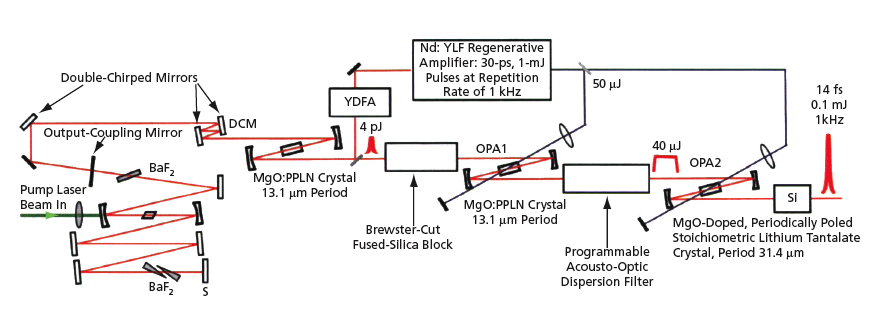
To ensure efficient transfer of energy from pump pulses to seeded signal pulses, it is necessary to match the duration of the signal pulses with that of the pump pulses. For 30 ps pump pulses and 14 fs signal pulses, this corresponds to a stretching factor of ≈2×10³. The needed match is accomplished by means of an ultracompact stretcher compressor unit that includes a first stretching stage, preceding the first OPA stage, comprising a Brewster-cut, 150-mm block made of a commercially available high-optical-quality, optically isotropic fused-silica (quartzglass) product. After sufficient amplification of signal pulses in the first OPA stage, there is a second stretching stage (which also serves as a pulse-shaping and higher-order-dispersion-compensation stage) comprising a programmable acousto-optic dispersion filter based on a 45-mm TeO2 crystal. Following amplification in the second OPA stage, pulses are compressed in a 30-mm silicon block.
In addition to matching the durations of the pump and seeded signal pulses, it is necessary to synchronize the pulses because any temporal mismatch adversely reduces the efficiency of optical parametric amplification and distorts the signal pulses. The Ti-doped sapphire laser is synchronized with the Nd:YLF regenerative amplifier by injection seeding of this amplifier: A portion of the broadband DFG output from the MgO:PPLN crystal in the wavelength range of 1,050 ±10 nm is coupled into an yttrium-doped fiber amplifier (YDFA), the output of which seeds the Nd:YLF regenerative amplifier for generating 30-ps pulses having a nominal middle wavelength of 1,047 nm.
This work was done by Franz X. Kärtner of the Massachusetts Institute of Technology for the Air Force Research Laboratory.
This Brief includes a Technical Support Package (TSP).
Apparatus Generates CE-Phase-Stable Two-Cycle Optical Pulses
(reference AFRL-0022) is currently available for download from the TSP library.
Don't have an account?
More From SAE Media Group
Aerospace & Defense Tech Briefs
Stimulated Brillouin Scattering (SBS) Suppression and Long Delivery Fibers at the Multikilowatt Level with Chirped Seed Lasers
Tech Briefs
Free-Space Fiber Optic Laser Rod
Photonics Tech Briefs
A High-Repetition-Rate Optical Communications Source
Photonics & Imaging Technology
Creating High-Precision Glass for NIR Lasers
Photonics Tech Briefs
Fiber Laser Amplifiers with Broad Applications
Aerospace & Defense Tech Briefs
Photonic Recirculating Delay Line for Analog-to-Digital Conversion
Aerospace & Defense Tech Briefs
Compact Megawatt Infrared Free-Electron Laser Amplifier
Tech Briefs
Sensitive Optical Receivers for Space
Photonics & Imaging Technology
Unique Amplifier Could Change Optical Communication
Photonics & Imaging Technology
Optical Signal Amplifying Technique
Photonics Tech Briefs
Fiber-Coupled Microsphere Laser at Wavelength of 1.55 µm
Photonics Tech Briefs
Stabilizing Microwave Frequency of a Photonic Oscillator
Aerospace & Defense Tech Briefs
Analysis of Analog Photonic Links Employing Multiple-Channel (Arrayed) Receivers
Photonics Tech Briefs
Control Program and Optical Improvements of Fresnel Microspectrometer
Photonics & Imaging Technology
A Laser That Could Reshape the Landscape of Integrated Photonics
Aerospace & Defense Tech Briefs
High-Power Broadband Multispectral Source on a Hybrid Silicon Chip
Photonics & Imaging Technology
A First-Of-Its-Kind Integrated Optical Isolator
Photonics & Imaging Technology
Photonics-Based Wireless Link Breaks Speed Records for Data Transmission
Photonics & Imaging Technology
Photonic Integrated Circuit Testing: Accelerating R&D From Lab to Fab
Aerospace & Defense Tech Briefs
Development of Photoacoustic Sensing Platforms

Aerospace & Defense Tech Briefs
On the Pulsed Laser Ablation of Metals and Semiconductors
Photonics Tech Briefs
Silicon Modulator Brings Optical Computing A Step Closer
Photonics & Imaging Technology
Making Measurements with a Fine-Toothed Comb
Photonics & Imaging Technology
A Sharper Look at the Interior of Semiconductors
Photonics & Imaging Technology
A Primer on Solid-State Lasers
Aerospace & Defense Tech Briefs
Photonic Analog-to-Digital Converters
Tech Briefs
New Family of Glass for Lens Applications
Photonics Tech Briefs
Pulsed Laser System to Simulate Effects of Cosmic Rays in Semiconductor Devices
Overview
The document is a final report for the DURIP (Defense University Research Instrumentation Program) project titled "Few-Cycle Optical Parametric Chirped Pulse Amplification," authored by Franz X. Kaertner from the Massachusetts Institute of Technology. The report covers the period from April 15, 2005, to October 14, 2006, and outlines significant advancements in ultrafast laser physics and frequency metrology.
The primary focus of the research is on achieving unprecedented control over the electric field of few-cycle laser pulses generated by modelocked lasers. These pulses are crucial for high-energy, phase-controlled few-cycle laser applications, which are essential for reliable extreme ultraviolet (EUV) and soft X-ray production through high-harmonic generation (HHG). The report emphasizes that the technology developed during this project has led to the generation of attosecond pulses, marking a new frontier in time and frequency measurements.
The document discusses the potential of 4D spatio-temporal characterization of laser pulses, which allows for a complete understanding of the pulse's properties at each point in the beam profile. This capability is particularly important for measuring the full spatio-temporal characteristics of pulses shorter than 1 picosecond, which is a significant advancement in the field. The report also highlights the motivation for using longer wavelength driver pulses in HHG, as the photon energy produced increases with the wavelength and intensity of the driver pulse.
In addition to the technical advancements, the report includes references to various studies and publications that support the findings and methodologies employed in the research. It cites works related to attosecond control of electronic processes, phase-coherent optical pulse synthesis, and active synchronization of mode-locked lasers, showcasing the collaborative nature of the research and its grounding in existing literature.
Overall, the report serves as a comprehensive overview of the project's objectives, methodologies, and outcomes, illustrating the significant contributions made to the field of ultrafast optics and the potential applications of the developed technologies in various scientific and industrial domains. The findings not only advance the understanding of laser pulse dynamics but also pave the way for future innovations in high-energy laser applications.
Top Stories
INSIDERDefense
 New Raytheon and Lockheed Martin Agreements Expand Missile Defense Production
NewsAutomotive
 Ford Announces 48-Volt Architecture for Future Electric Truck
INSIDERManufacturing & Prototyping
 Active Strake System Cuts Cruise Drag, Boosts Flight Efficiency
ArticlesTransportation
 Accelerating Down the Road to Autonomy
INSIDERMaterials
 How Airbus is Using w-DED to 3D Print Larger Titanium Airplane Parts
Road ReadyTransportation

Webcasts
Electronics & Computers
 Cooling a New Generation of Aerospace and Defense Embedded...
Power
 Battery Abuse Testing: Pushing to Failure
Connectivity
 A FREE Two-Day Event Dedicated to Connected Mobility
Automotive
 Quiet, Please: NVH Improvement Opportunities in the Early Design Cycle
Transportation
 Advantages of Smart Power Distribution Unit Design for Automotive &...
Aerospace
 Sesame Solar's Nanogrid Tech Promises Major Gains in Drone Endurance