




Compact Megawatt Infrared Free-Electron Laser Amplifier
The optical path within the amplifier would be <5 m long.
A proposed high-gain free-electron laser (FEL) amplifier, conceived primarily for use in a maritime environment, would be capable of average output power of the order of a megawatt at one or more of several infrared wavelengths (1.045, 1.625, or 2.141 μm) for which propagation through air is minimally adversely affected by water vapor and aerosols. The conceptual design of this FEL amplifier provides for a combination of conventional and unconventional characteristics that, taken together, would be advantageous in the intended power and wavelength regime.
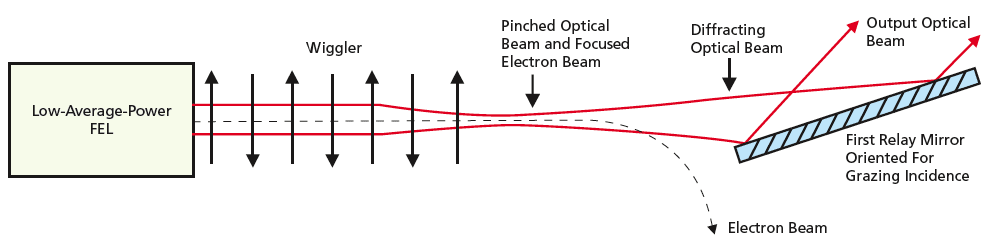
The proposed FEL amplifier (see figure) would feature refractive optical guiding in the wiggler, with pinching of the electron and optical beams at the output end of the wiggler. The electron beam would be driven by a radio-frequency linear accelerator (not shown in the figure).
The gain length, efficiency, electron-pulse slippage, and distance between the wiggler and the first relay mirror have been calculated for the conceptual design. Of particular concern in the design is the overall length of the amplifier optical system; that is, the length of the wiggler and the distance from the wiggler to the first relay mirror. The wiggler would be about 1.5 m long. The distance from the wiggler to the first relay mirror would be chosen so that the threshold intensity for damage to the mirror would not be exceeded, as described next.
The focusing of the electron beam and the desired consequent pinching of the optical beam at the output end of the wiggler could be effected by application of an externally generated magnetic field or by utilizing the betatron oscillation of the electron-beam envelope. Pinching of the optical beam would reduce its Rayleigh length, thereby making it possible to put the first relay mirror closer to the wiggler without exceeding the damage threshold. The mirror would be oriented for grazing incidence to reduce the intensity at incidence and thereby increase the damage threshold. The combination of pinching the optical beam and grazing incidence would enable placement of the first relay mirror at or perhaps closer than a distance of 3μm from the output end of the wiggler.
The FEL efficiency could be increased by tapering the wiggler. Alternatively, if using a uniform wiggler, enhanced efficiency could be obtained through frequency detuning of the input oscillator signal. Electron-pulse slippage, which could be large enough to limit the FEL interaction length in a low-gain design, has been shown to be small enough not to be of concern in the present high-gain design conceptual design. In one example design calculation, it was found that for an electron-beam current of 1 kA at an electron kinetic energy of 81 MeV, a wiggler magnetic flux density of 5 kG (0.5 T), frequency detuning of -1.5 percent, and linear-accelerator duty factor of 1.5×10⁻³, the FEL power-gain length would be 14 cm, the intrinsic efficiency would be about 1.2 percent, the peak optical output power would be 1 GW, and the average optical output would be 1.5 MW.
This work was done by Phillip Sprangle and Joseph Peñano of the Naval Research Laboratory, and Bahman Hafizi of Icarus Research, Inc.
NRL-0025
This Brief includes a Technical Support Package (TSP).
Compact Megawatt Infrared Free-Electron Laser Amplifier
(reference NRL-0025) is currently available for download from the TSP library.
Don't have an account?
More From SAE Media Group
Aerospace & Defense Tech Briefs
Frequency Agile Plasmonic Antennas and Sensors
Photonics & Imaging Technology
Ultrafast Beam-Steering Breakthrough at Sandia Labs
Photonics & Imaging Technology
A Laser That Could Reshape the Landscape of Integrated Photonics
Aerospace & Defense Tech Briefs
On the Pulsed Laser Ablation of Metals and Semiconductors
Photonics & Imaging Technology
Creating High-Precision Glass for NIR Lasers
Photonics & Imaging Technology
Optical Signal Amplifying Technique
Photonics & Imaging Technology
Using Magnets to Toggle Nanolasers Leads to Better Photonics
Photonics & Imaging Technology
A First-Of-Its-Kind Integrated Optical Isolator
Tech Briefs
Multiplexed Optical Antennas
Photonics & Imaging Technology
Blue Laser Power Beaming for Planetary Exploration
Tech Briefs
Free-Space Fiber Optic Laser Rod
Aerospace & Defense Tech Briefs
Stimulated Brillouin Scattering (SBS) Suppression and Long Delivery Fibers at the Multikilowatt Level with Chirped Seed Lasers
Aerospace & Defense Tech Briefs
Development of Photoacoustic Sensing Platforms
Photonics Tech Briefs
Pulsed Laser System to Simulate Effects of Cosmic Rays in Semiconductor Devices
Tech Briefs
High-Power, Portable Terahertz Laser
Aerospace & Defense Tech Briefs
High-Power Broadband Multispectral Source on a Hybrid Silicon Chip

Photonics & Imaging Technology
Researchers Create World’s Smallest LED And Holographic Microscope
Tech Briefs
Chip Measures Quantities with Quantum Precision
Aerospace & Defense Tech Briefs
Determining Optical Material Parameters With Motion in Structured Illumination
Photonics & Imaging Technology
A Sharper Look at the Interior of Semiconductors
Photonics Tech Briefs
Control Program and Optical Improvements of Fresnel Microspectrometer
Photonics & Imaging Technology
Making Measurements with a Fine-Toothed Comb
Photonics & Imaging Technology INSIDER
Can a Breakthrough in Photonic Time Crystals Change How We Use and Control Light?
Tech Briefs
Optical Signal Amplifying Technique


Tech Briefs
Sensitive Optical Receivers for Space
Photonics & Imaging Technology
Pratt & Whitney, Virginia Tech Pioneer Laser-Optical Approach for Turbofan Engine Thrust Measurement
Aerospace & Defense Tech Briefs
Analysis of Broadband Metamaterial Shielding for Counter-Directed Energy Weapons
Overview
The document is a final technical report titled "Design of a Compact, Optically Guided, Pinched, Megawatt-Class Free-Electron Laser," prepared by researchers from the Naval Research Laboratory and Icarus Research, Inc. The report outlines a conceptual design for a free-electron laser (FEL) that operates within atmospheric transmission windows, aiming to achieve megawatt-class output.
The report begins with an introduction to the significance of high-energy lasers and their applications, particularly in maritime environments. It emphasizes the need for efficient laser propagation and the advantages of operating at specific wavelengths for both performance and safety reasons.
The core of the report details the design of the optically guided FEL amplifier. Key parameters such as operating wavelength, gain length, efficiency, and optical guiding are discussed. The design incorporates an RF linac (radio frequency linear accelerator) to drive the laser, and the report analyzes critical factors like electron pulse slippage, which affects the performance of the laser. The authors present calculations for the gain length and efficiency, providing insights into the optimal configuration for achieving high output power.
The report also addresses the optical beam quality, beam spreading, and the distance between the wiggler (a component that generates the laser light) and the first relay mirror, which are crucial for maintaining the integrity of the laser beam over long distances. The authors discuss frequency detuning and its potential to enhance efficiency, highlighting the importance of precise control in laser design.
In addition to the technical specifications, the report includes a discussion of recent experimental results from a high-gain FEL amplifier demonstrated at Brookhaven National Laboratory, which aligns closely with the theoretical predictions made in the report. This validation of the design principles reinforces the feasibility of the proposed megawatt-class FEL.
The document concludes with a summary of the findings and their implications for future research and development in high-energy laser technology. The report is intended for the High-Energy Laser Joint Technology Office and covers the period from May 2004 to May 2006. It is approved for public release, indicating its relevance to ongoing advancements in laser technology and its potential applications in various fields.
Top Stories
NewsRF & Microwave Electronics
 Microvision Aquires Luminar, Plans Relationship Restoration, Multi-industry Push
INSIDERAerospace
 A Next Generation Helmet System for Navy Pilots
INSIDERDesign
 New Raytheon and Lockheed Martin Agreements Expand Missile Defense Production
INSIDERMaterials
 How Airbus is Using w-DED to 3D Print Larger Titanium Airplane Parts
NewsPower
 Ford Announces 48-Volt Architecture for Future Electric Truck
ArticlesAR/AI

Webcasts
Electronics & Computers
 Cooling a New Generation of Aerospace and Defense Embedded...
Automotive
 Battery Abuse Testing: Pushing to Failure
Power
 A FREE Two-Day Event Dedicated to Connected Mobility
Unmanned Systems
 Quiet, Please: NVH Improvement Opportunities in the Early Design Cycle
Automotive
 Advantages of Smart Power Distribution Unit Design for Automotive &...
Energy
 Sesame Solar's Nanogrid Tech Promises Major Gains in Drone Endurance