




Speeding Thermal Analysis for Autonomous EVs
Solving thermal challenges is vital to AEV development. Siemens PLM’s new Simcenter integrated simulation package offers a high-fidelity, easy-to-use solution.
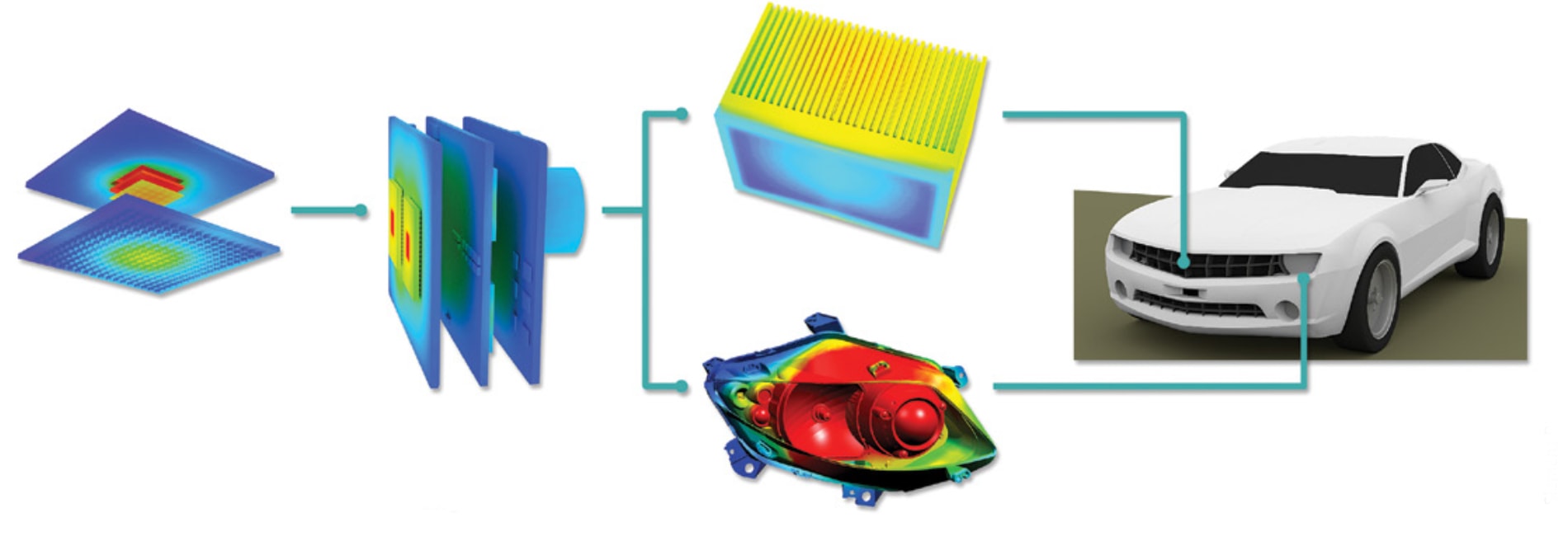
Siemens PLM recently introduced a new Simcenter software solution for thermal simulation used in autonomous electric vehicle (AEV) development. The product is designed to help engineers quickly solve heat-related challenges related to the vehicles’ high-power electronics.
Speed and ease-of-use were important considerations in development of this tool. While traditional CAE simulations are useful, automakers are finding that restricting simulations to a few experts leads to a slow and costly engineering process. The answer is software that a design-and-release engineer devoted to specific AEV components can exercise. In general, this has come to be known as the “democratization of CAE,” and Siemens PLM hopes to accelerate this trend with the new offering.
Integrated physics
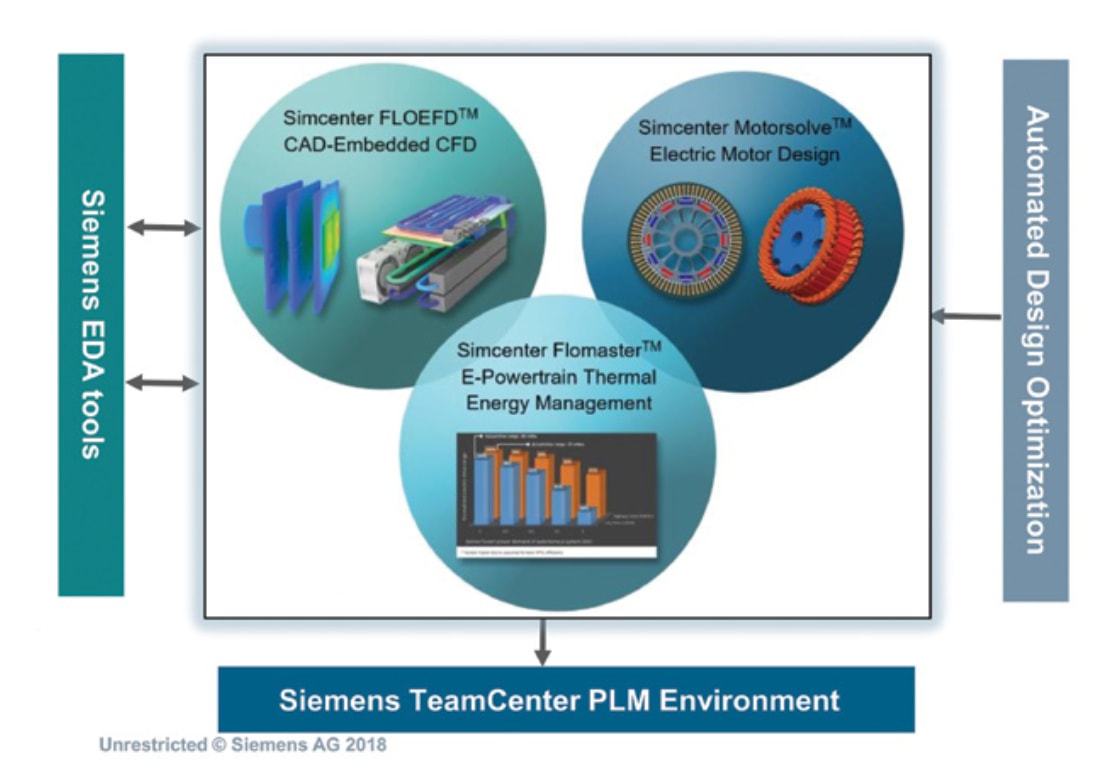
AEVs, with their power-hungry sensor fusion boxes, have significant thermal-management demands. While properly addressing these power and thermal loads is important even in combustion-engine automated vehicles, it is paramount in battery electrics. Keeping the battery pack not too cold, and the sensors and electronics not too hot, makes all the difference when every fraction of a kilowatt hour counts. The electronics alone, if not optimized, can reduce an AEV’s range by as much as 35%, according to Siemens.
The new integrated CAE solution package combines three of Simcenter’s CAE simulations: FLOEFD for 3-D thermal analysis; MotorSolve for electric motor design, and Flomaster, a 1-D CAE for electric powertrain thermal energy management. All three are now linked—for component thermal and electric powertrain performance, connectivity between simulation of electric motor performance and system simulation for electrical and thermal management.
FloEFD CFD is full-featured 3-D fluid flow and heat transfer analysis. It includes engineering models such as porous media, PCB and LED model. It is built into major MCAD systems such as Creo, CATIA V5, Siemens NX, Solid Edge, according to Siemens. It also includes an electronics cooling module for detailed thermal modeling of electronic models. Battery electrochemical-thermal simulation capabilities are available.
MotorSolve is Siemens’ design and analysis software for brushless DC, induction, switched reluctance and brushed DC machines. It is based on finite element analysis with automatic mesh refinement, post-processing and domain knowledge to compute design parameters that are of interest to a motor designer.
The third element, Flomaster, is a 1-D solver for thermo-fluid system or other simulations that can be captured in 1-D. For higher accuracy, individual components can be solved in 3-D using FLOEFD, and then summarized and connected in the 1-D Flomaster model. “The 1-D and 3-D CFD solutions are dynamically linked simulations,” said Puneet Sinha, MAD Automotive Manager at Siemens PLM.
In the hands of engineers
Just as important as the physics is the intended user: mainstream automotive engineers. Enhancing ease of use, according to Sinha, are simulation automation, a built-in database, and model representation from data.
“There is a seamless connection among electrical, electronics, and mechanical domains,” he said. There will also be some access to design optimization and generative design capabilities in this initial roll-out. He anticipates these features to be strengthened in future releases.
The combined package is especially useful for generating thermal “digital twin” simulations of the powertrain, processors, and sensors, according to Sinha. These and other key enabling technologies are anticipated to be used in next-generation AEV designs.
This latest tool can be viewed as a further development in the “democratization of CAE” trend among CAE providers in the last few years. This movement views accessibility of CAE to non-specialists as the next, vital step in making CAE useful to industry. This also means that the user of Siemens’ FLOEFD software, in particular, will not need to know about some of the trickier aspects of CFD, such as mesh creation, selection of a laminar or turbulence flow model, or what type of turbulence model to apply.
More From SAE Media Group


Aerospace & Defense Tech Briefs
Software for Additive Design, Manufacturing Evolves Quickly
Off-Highway Engineering
Siemens Improves Optimization for Engine Development

Off-Highway Engineering
Expediting Engine Design
Motion Design
New Products
Tech Briefs
Disrupting the Automobile Design Process

Battery & Electrification Technology
How Battery Simulation Is Taking High-Performance EV Development to New Heights
Off-Highway Engineering
Engineering with Simulation and Data

Battery Technology
Using Multiphysics to Predict and Prevent EV Battery Fire

Tech Briefs
Embracing Agile Product Development
Tech Briefs
New on the Market
Automotive Engineering
Unifying Design and Multiphysics Simulation for Electric Drive Development
Off-Highway Engineering
Addressing Electromagnetic Compatibility in the Context of Aircraft Electrification
Automotive Engineering
Multiphysics Helps Transform Modeling, Simulation
Automotive Engineering
BMW, Classiq Find Better Architectures Through Quantum Computing
Automotive Engineering
Simulation Rules: Scrubbing Heat, Sound and Dirt from Autonomous EVs

Off-Highway Engineering
Advanced Simulation Techniques Drive Powertrain Design

Automotive Engineering
A Lesson in Multiphysics
Off-Highway Engineering
CAE Tools Advance for Engine Design
Aerospace & Defense Tech Briefs
Analyzing Aircraft Antenna Placement and Performance with Unified Modeling and Simulation
Aerospace & Defense Tech Briefs
Mentor Graphics Updates CFD Tool for Improved Productivity
Automotive Engineering
Rewriting the Engineer’s Playbook: What OEMs Must Do to Spin the AI Flywheel
Top Stories
INSIDERManufacturing & Prototyping
 How Airbus is Using w-DED to 3D Print Larger Titanium Airplane Parts
INSIDERManned Systems
 FAA to Replace Aging Network of Ground-Based Radars
NewsTransportation
 CES 2026: Bosch is Ready to Bring AI to Your (Likely ICE-powered) Vehicle
NewsSoftware
 Accelerating Down the Road to Autonomy
EditorialDesign
 DarkSky One Wants to Make the World a Darker Place
INSIDERMaterials
 Can This Self-Healing Composite Make Airplane and Spacecraft Components Last...
Webcasts
Defense
 How Sift's Unified Observability Platform Accelerates Drone Innovation
Automotive
 E/E Architecture Redefined: Building Smarter, Safer, and Scalable...
Power
 Hydrogen Engines Are Heating Up for Heavy Duty
Electronics & Computers
 Advantages of Smart Power Distribution Unit Design for Automotive...
Unmanned Systems
 Quiet, Please: NVH Improvement Opportunities in the Early Design...
