




A Lesson in Multiphysics
OEM engineers reveal how new software from Comsol improved their modeling and analysis of EV battery performance and audio-system sound quality.

Modeling and simulation are becoming a more critical factor in automotive design, particularly in subjective areas like passenger-cabin sound quality and complex newer technologies like battery management. Design tool suppliers are increasing the power of those tools while also making them easier to use.
Tools that handle multiple physics categories are becoming more important as engineers need to understand how complex interactions change when various parameters are adjusted. At the recent Comsol Users Conference, technologists from General Motors and Nissan detailed their efforts to understand nuances in audio systems and electrified-vehicle battery packs.
Patrick Dennis, Principal Engineer at Nissan, told attendees how the company migrated to virtual sound rooms because physical tests for analyzing audio speaker quality and configuration proved problematic. After the analysis of the sound room tests showed problems at certain frequencies, Nissan engineers ran simulations that predicted those issues, giving the team the confidence to change the roles of physical and virtual tests.
“We went into a sound room and made a binaural recording that seemed to be perfect,” Dennis said. “When we brought it back and put it in a car, it didn’t sound that good. We created a reference room using Comsol tools that gave us recordings that sound better than what we did in the expensive room. That’s our primary tool now.”

At the conference, Comsol unveiled Multiphysics Version 5.4, which the company claims offers improved performance and ease of use. The latest version provides a number of modules that make it easier and faster for users to understand how changes to one parameter ripple out to many other elements of the overall system.
“Version 5.4 is several times faster for rendering large 3D models; depending on the geometries, it can be an order-of-magnitude faster,” claimed Bjorn Sjodin, Comsol’s VP of product management. “There’s also a new comparison tool that lets you change the settings in a model and compare the new one with the model saved on file. We also added a more sophisticated module for batteries.”
That’s a helpful move for automakers and Tier 1s that are striving to meet regulatory mandates for fuel economy and emissions. Battery charging/discharging and overall lifetimes involve myriad factors that span several types of physics. The updated tools and modules can give developers deeper insight into areas that haven’t previously been examined.
“We need to supplement the information suppliers give us, so we end up with huge data sets,” reported Taylor Garrick of General Motors Global Propulsion Systems. “I deal with 40 to 50 parameters I need to model; the suppliers usually only give us 20 to 30. We need to understand all these parameters to answer questions about the size, performance, and output of battery packs, and to see when we need to cool every cell or when we should selectively cool cells.”
Multiphysics tools are becoming more important as engineers attempt to eke out more performance, since minor changes in one area can cause often-unexpected changes elsewhere.
“In battery packs, you’ve got a lot of factors to examine,” noted Sjodin. “You need to know how the ions inside the battery are reacting to heat, and you need to know how temperature changes are impacting the cooling liquids. Both factors have a big impact on performance and [battery] lifetime.”
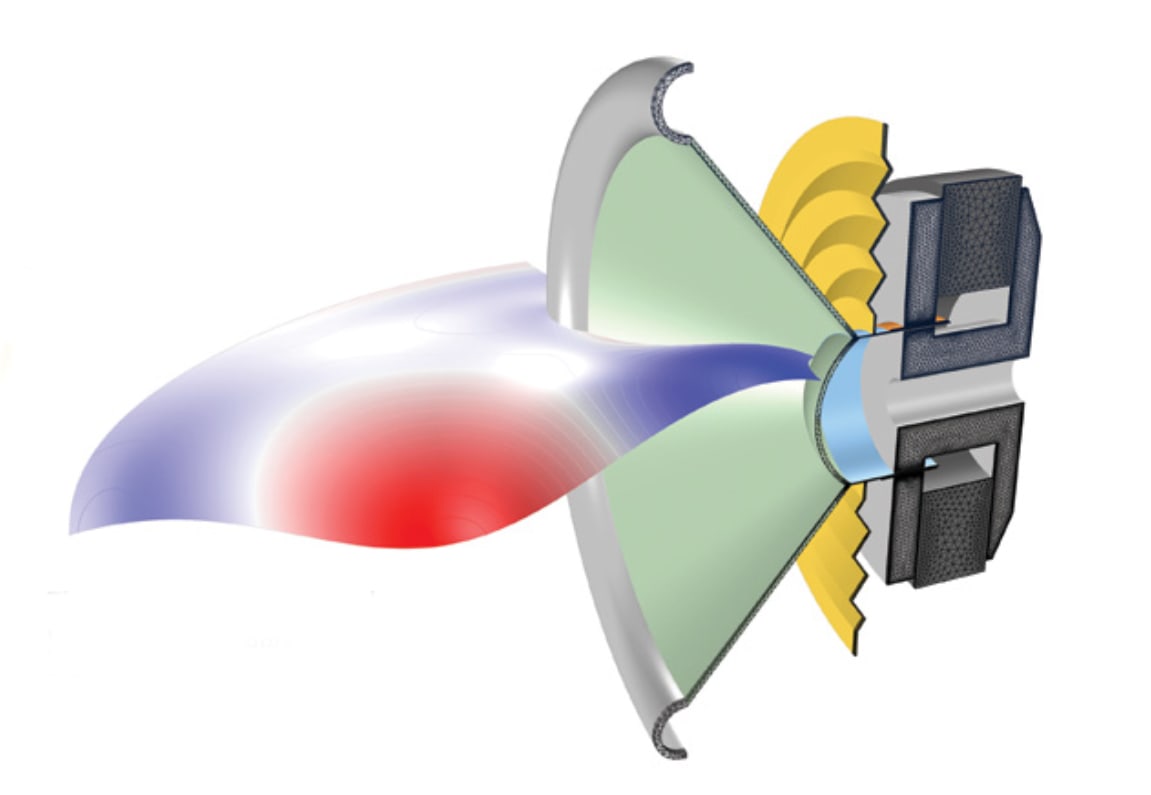
The addition of dedicated modules is part of a corporate focus on making the multiphysics software easier to use. The battery module includes 1D, 2D and 3D options, so users can work with different fidelity levels depending on the task at hand.
“When we want to put the battery pack together with inverters and other components, a 1D model gives us the quickest results,” Garrick said. “If we’re trying to work out some aspects of battery pack design, 3D models give us the best results. 3D has the highest fidelity.”
Comsol also unveiled a compiler program that makes it easier to share apps. It even lets users who don’t have the company’s software view models and simulations. Version 5.4 attempts to balance the need to provide more ways to analyze the subtleties of each design with the need to offer tools that don’t take a long time to learn. Modules dedicated to specific fields are among the company’s ease-of-use techniques.
That approach also helps specialists in these fields delve into the subtle factors that determine end performance.
“We have more modules for specific applications,” noted Valerio Marra, the company’s marketing director. “They make it easier to do the work in those fields, since many advanced factors are tailored to the application.”
More From SAE Media Group
Battery Technology
Using Multiphysics to Predict and Prevent EV Battery Fire
Battery & Electrification Technology
How Battery Simulation Is Taking High-Performance EV Development to New Heights
Automotive Engineering
SAE WCX 2022: EV Cybersecurity Threats
Battery & Electrification Technology
New Products

Battery Technology
An Immersive Solution for Thermally Safer EV Batteries
Tech Briefs
New on the Market
Automotive Engineering
Proving out DC Fast Charging — in the Extreme
Battery & Electrification Technology
Leveraging AI for EV Performance Improvement
Power Electronics INSIDER
World’s Strongest Battery Paves Way for Light, Energy-Efficient Vehicles
Battery & Electrification Technology
Overcoming Challenges and Boosting Productivity for EV Battery and E-Axle Testing
Battery & Electrification Technology
The Impact of Fast Charging on the EV Charging Chain
Battery & Electrification Technology
How Intelligent Battery Management Drives EV Buyer Confidence
Off-Highway Engineering
Monarch Unveils AI-Powered Autonomous Platform
Off-Highway Engineering
Webasto Delivers Battery System for Zeus EV Chassis
Off-Highway Engineering
ABS Ramps up Commercial-Vehicle Battery-Pack Assembly
Battery Technology
Advancing Battery Technology: THE 2021 BATTERY SHOW Preview
Battery & Electrification Technology
Volvo Trucks’ Battery Chemistry of Choice: NCA
Battery & Electrification Technology
The Rechargeable Renaissance

Tech Briefs
New on the Market: August 2022
Automotive Engineering
Inside GM’s Expanded Electric-Vehicle Battery Lab


Automotive Engineering
All (Robot) Hands on Deck
Battery & Electrification Technology
How Test Equipment Is Evolving to Keep Up with EV Batteries
Automotive Engineering
Cox Automotive's One-Stop Shop for Repairing, Recycling EV Batteries
Tech Briefs
Product of the Month
Top Stories
INSIDERManufacturing & Prototyping
 How Airbus is Using w-DED to 3D Print Larger Titanium Airplane Parts
INSIDERManned Systems
 FAA to Replace Aging Network of Ground-Based Radars
NewsTransportation
 CES 2026: Bosch is Ready to Bring AI to Your (Likely ICE-powered) Vehicle
NewsSoftware
 Accelerating Down the Road to Autonomy
EditorialDesign
 DarkSky One Wants to Make the World a Darker Place
INSIDERMaterials
 Can This Self-Healing Composite Make Airplane and Spacecraft Components Last...
Webcasts
Defense
 How Sift's Unified Observability Platform Accelerates Drone Innovation
Automotive
 E/E Architecture Redefined: Building Smarter, Safer, and Scalable...
Power
 Hydrogen Engines Are Heating Up for Heavy Duty
Electronics & Computers
 Advantages of Smart Power Distribution Unit Design for Automotive...
Unmanned Systems
 Quiet, Please: NVH Improvement Opportunities in the Early Design...
