




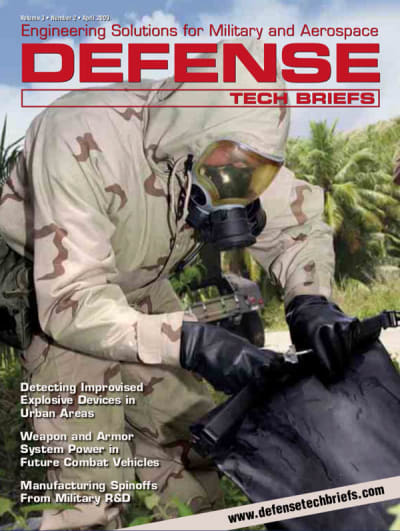
Defense Tech Briefs - April 2009
Inside this issue
Overview
The April 2009 issue of Defense Tech Briefs presents a comprehensive overview of advancements in defense technology, focusing on critical areas such as urban warfare, combat vehicle systems, and the impact of military research and development on manufacturing. This issue is particularly relevant given the ongoing challenges faced by military forces in urban environments and the need for innovative solutions to enhance operational effectiveness.
Key Articles and Themes
-
Detecting Improvised Explosive Devices (IEDs) in Urban Areas: One of the central themes of this issue is the detection of IEDs, which pose a significant threat in urban warfare scenarios. The article discusses various technologies and methodologies being developed to improve the detection and neutralization of these devices. It highlights the importance of integrating advanced sensors, robotics, and data analysis techniques to enhance situational awareness and response times. The focus is on creating systems that can operate effectively in complex urban landscapes, where traditional detection methods may fall short.
-
Weapon and Armor System Power in Future Combat Vehicles: Another critical topic covered is the power requirements for weapon and armor systems in future combat vehicles. As military operations evolve, there is a growing need for vehicles that can support advanced weaponry and protective measures without compromising mobility or efficiency. The article explores innovations in power generation and management, including hybrid systems and energy-efficient technologies. It emphasizes the importance of developing vehicles that can sustain prolonged operations while providing the necessary firepower and protection for troops in the field.
-
Manufacturing Spinoffs from Military R&D: The issue also delves into the broader impact of military research and development on civilian manufacturing. It discusses how technologies initially developed for defense applications often find their way into commercial markets, leading to advancements in various industries. The article provides examples of successful spinoffs, illustrating how military investments in R&D can drive innovation and economic growth. This section underscores the dual-use nature of many technologies, highlighting the benefits of collaboration between military and civilian sectors.
Additional Features
Editorial Insights: The editorial team, led by Joseph T. Pramberger and Linda L. Bell, provides context for the articles, emphasizing the importance of staying ahead in defense technology to address emerging threats. The editorial notes the ongoing challenges faced by military forces and the need for continuous innovation.
-
Technical Contributions: Contributions from technical writers and editors, including Bruce A. Bennett and Ted Selinsky, ensure that the content is not only informative but also accessible to a broad audience. Their expertise helps bridge the gap between complex technical concepts and practical applications.
-
User-Friendly Navigation: The magazine is designed with a user-friendly interface, allowing readers to easily navigate through articles, access the table of contents, and zoom in on specific sections. This enhances the reading experience, making it easier for professionals and enthusiasts alike to engage with the material.
Conclusion
The April 2009 issue of Defense Tech Briefs serves as a vital resource for understanding the current landscape of defense technology. By focusing on critical areas such as IED detection, power systems for combat vehicles, and the impact of military R&D on manufacturing, the magazine provides valuable insights into the innovations shaping the future of defense. As military operations continue to evolve, the need for advanced technologies and collaborative efforts between sectors becomes increasingly important. This issue not only highlights the challenges faced by defense forces but also showcases the potential for technological advancements to enhance operational effectiveness and safety in complex environments.
Overall, this edition of Defense Tech Briefs is a must-read for anyone interested in the intersection of technology and defense, offering a glimpse into the future of military operations and the innovations that will drive them.
Features
-
Tech Transfer Reports
Ceramic Manufacturing Technique Opens New Markets
New Micromachining Method Upgrades Microfluidic Chip Technology
Tech Briefs
-
Electronics & Computers
Evaluation of Four Methods of Reconfiguring an FPGA
Asynchronous Architectures for Large-Integer Processors
Using High-Performance Computing Clusters to Support Fine-Grained Parallel Applications
Implementing On-Board Cloud Detection on a Reconfigurable Computer
-
Information Sciences
-
Mechanics & Machinery
-
Physical Sciences
Miniature Rotorcraft Flight Control Stabilization System
Studies of Dynamic Fracture in Brittle Materials
Products
Top Stories
INSIDERDefense
 New Raytheon and Lockheed Martin Agreements Expand Missile Defense Production
NewsAutomotive
 Ford Announces 48-Volt Architecture for Future Electric Truck
INSIDERManufacturing & Prototyping
 Active Strake System Cuts Cruise Drag, Boosts Flight Efficiency
ArticlesTransportation
 Accelerating Down the Road to Autonomy
INSIDERMaterials
 How Airbus is Using w-DED to 3D Print Larger Titanium Airplane Parts
Road ReadyTransportation

Webcasts
Electronics & Computers
 Cooling a New Generation of Aerospace and Defense Embedded...
Power
 Battery Abuse Testing: Pushing to Failure
Connectivity
 A FREE Two-Day Event Dedicated to Connected Mobility
Automotive
 Quiet, Please: NVH Improvement Opportunities in the Early Design Cycle
Transportation
 Advantages of Smart Power Distribution Unit Design for Automotive &...
Aerospace
 Sesame Solar's Nanogrid Tech Promises Major Gains in Drone Endurance