




Simulation of Airflow Through a Test Chamber
An apparent anomaly was resolved and a correction was devised.
A computational-simulation study of the flow of air through a thermo-anemometer chamber was performed to resolve what originally seemed to be an anomaly in the measurement data obtained by use of the chamber. The thermo-anemometer chamber is a test chamber used to measure the rate of generation of heat by a device placed within it. In the original application that produced the apparent anomaly that prompted this study, the chamber was used to measure the power dissipation (as manifested by heating) in an operating power-supply inductor. The apparent anomaly was that the heating of the inductor as calculated from the measurements made by use of the chamber seemed unrealistically high.

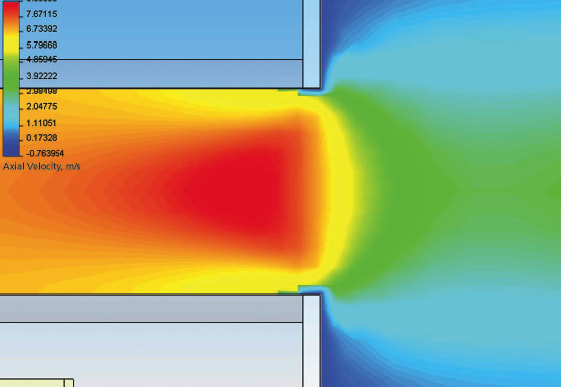
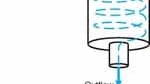
The simulation results revealed the source of the apparent anomaly to be a combination of Bernoulli-like and laminar-flow effects at the outlet. For example, in Figure 2, which depicts results for the case in which the inlet and outlet diameters are both 3" (7.62 cm), the axial velocity at the edge of the outlet is reduced and the axial velocity in the center of the outlet exceeds the inlet velocity; the effect on the axial velocity averaged across the outlet area is equivalent to that of reducing the outlet diameter. This effect causes the thermoanemometer, located in the center of the outlet, to read a speed greater than the cross-sectional average, so that the use of this speed in estimating the heat-dissipation rate gives rise to an unrealistically high value. The simulation results make it possible to calculate an effective reduced diameter of the outlet port to correct the apparent anomaly.
This work was done by Gregory K. Ovrebo of the Army Research Laboratory.
ARL-0029
This Brief includes a Technical Support Package (TSP).
Simulation of Airflow Through a Test Chamber
(reference ARL-0029) is currently available for download from the TSP library.
Don't have an account?
More From SAE Media Group


Aerospace & Defense Tech Briefs
Measuring Skin Friction in Complex Flows That Include Shocks
Tech Briefs
Device Eliminates Vortices and Vibration
Motion Design INSIDER
Nimble Dimples: Agile Underwater Vehicles Inspired by Golf Balls
Software Tech Briefs
Electrical Calibration Source for Next-Generation Oscilloscope
Tech Briefs
System for Testing Thermal Insulation of Pipes
Motion Design INSIDER
Dragonfly Wings Used to Study Motion

Tech Briefs
Thermogravimetric Analysis With Laser Heating
Motion Design INSIDER
Friction That Cools

Battery & Electrification Technology
Examining EV Battery Thermal Management
Aerospace & Defense Tech Briefs
A New Look at Ignition: Refining Our Understanding of Combustion Dynamics in Gun Chambers


Aerospace & Defense Tech Briefs
Considerations of Aeroacoustics in Turbojet-Engine Testing
Overview
The document titled "Simulation of Air Flow Through a Test Chamber" by Gregory K. Ovrebo, published in December 2007, presents a comprehensive study on the airflow dynamics within a test chamber designed to measure heat dissipation from inductors, which are critical components in high-power electronics. Conducted by the U.S. Army Research Laboratory (ARL), the research aims to enhance the understanding of thermal management in high-density power conversion systems, particularly for military applications.
The report begins with an introduction that outlines the significance of high-power inductors and the necessity for effective cooling mechanisms to ensure their optimal performance. The study employs computer simulations, specifically using Cosmos FloWorks, to model the airflow patterns and velocities within the test chamber. This simulation approach allows for a qualitative analysis of the air movement, which is crucial for accurately measuring the heat dissipated by the inductors during operation.
In the methodology section, the document details the preparation of the model and the parameters set for the simulation. The airflow simulation results are presented, showcasing the air velocity at the chamber's outlet port and providing insights into how the airflow interacts with the inductors. These findings are essential for developing correction factors that improve the accuracy of power dissipation measurements in high-power electric components.
The results section highlights key findings from the simulations, emphasizing the importance of airflow in maintaining the thermal stability of inductors. The report concludes by summarizing the implications of the research for future developments in high-power electronics and thermal management strategies. It underscores the potential for these simulations to inform design choices and optimize the performance of inductors in various applications.
Overall, the document serves as a valuable resource for researchers and engineers in the field of high-power electronics, offering insights into airflow dynamics and their impact on thermal management. The findings contribute to the ongoing efforts to enhance the reliability and efficiency of power conversion systems, particularly in military contexts where performance and durability are paramount. The report is approved for public release, ensuring that the knowledge gained can be disseminated and utilized by a broader audience.
Top Stories
INSIDERDefense
 New Raytheon and Lockheed Martin Agreements Expand Missile Defense Production
NewsAutomotive
 Ford Announces 48-Volt Architecture for Future Electric Truck
INSIDERManufacturing & Prototyping
 Active Strake System Cuts Cruise Drag, Boosts Flight Efficiency
ArticlesTransportation
 Accelerating Down the Road to Autonomy
INSIDERMaterials
 How Airbus is Using w-DED to 3D Print Larger Titanium Airplane Parts
Road ReadyTransportation

Webcasts
Electronics & Computers
 Cooling a New Generation of Aerospace and Defense Embedded...
Power
 Battery Abuse Testing: Pushing to Failure
Connectivity
 A FREE Two-Day Event Dedicated to Connected Mobility
Automotive
 Quiet, Please: NVH Improvement Opportunities in the Early Design Cycle
Transportation
 Advantages of Smart Power Distribution Unit Design for Automotive &...
Aerospace
 Sesame Solar's Nanogrid Tech Promises Major Gains in Drone Endurance