




Considerations of Aeroacoustics in Turbojet-Engine Testing
Recommendations for preventing aeroacoustic damage to test cells have been made.
A study of the aeroacoustics of a turbojet-engine test cell has been performed as one step in the development of a computational aeroacoustics capability (CAA) that could provide guidance for the design and operation of such cells. Ground testing of turbojet engines in test cells necessarily involves very high acoustic amplitudes, often severe enough to cause damage to test-cell equipment and to engines under test. Heretofore, the acoustic responses of test cells containing energetic jets have been poorly understood and generally unpredictable. The CAA capability is intended to enable prediction of deleterious acoustic events, making it possible to design test cells and choose operating conditions to prevent damage and thereby avoid the costly interruption of test schedules.
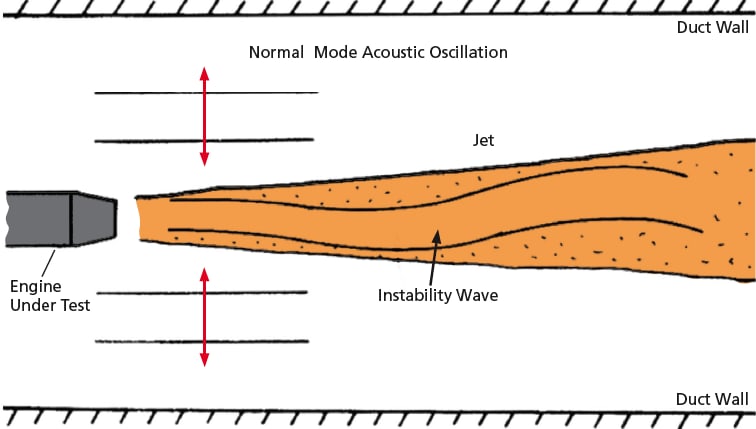
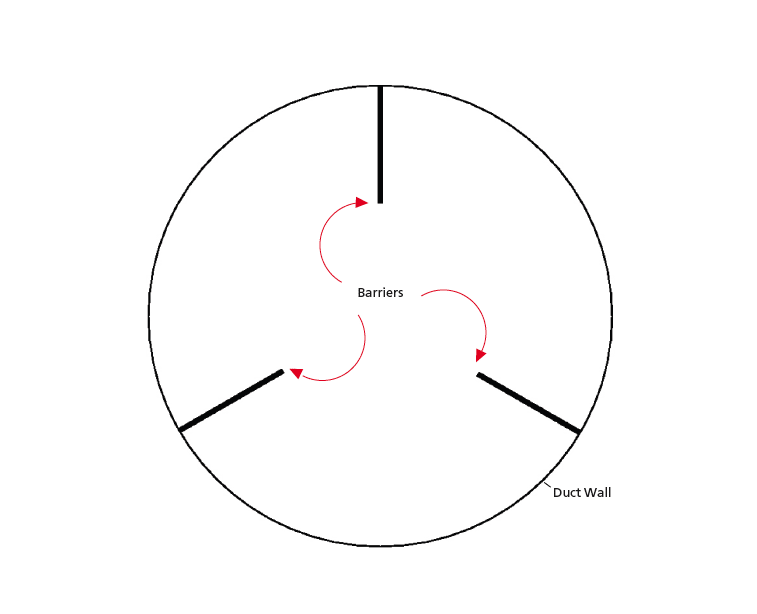
As a potential superior alternative to suppression or interruption, it has been proposed to design and construct cells to disrupt the duct modes that participate in super resonance. In particular, in the case of a hot circular-cross-section jet, the most amplified instability waves are those characterized by azimuthal wave number ±1. These are helical or flapping-mode jet waves that interact with acoustic waves in the corresponding helical and flapping duct normal modes. In principle, it should be possible to prevent super resonance by blocking the helical and flapping duct modes. This could be done by, for example, inserting barriers into the duct as shown in Figure 2.
Another product of the study is a set of recommendations concerning the development of a CAA capability for a turbojet-engine-testing laboratory. Summarizing the recommendations, the CAA capability should be developed and maintained by an in-house engineer, perhaps augmented with an engineering assistant who preferably has some expertise in CAA and/or computational fluid dynamics (CFD). The engineer and/or the assistant (perhaps augmented with consulting engineers having CAA and/or CFD expertise) should develop a battery of special-purpose CAA computer codes, each optimized for a specific class of CAA problems.
This work was done by Christopher Tam of Florida State University for the Air Force Research Laboratory. AFRL-0057
This Brief includes a Technical Support Package (TSP).
Considerations of Aeroacoustics in Turbojet-Engine Testing
(reference AFRL-0057) is currently available for download from the TSP library.
Don't have an account?
More From SAE Media Group
Aerospace & Defense Tech Briefs
SAE International Extends Call for Abstracts, Seeks Submissions for AeroTech Conference
Aerospace & Defense Tech Briefs
Industry Invited to Participate in AeroTech Aerospace and Defense Technical Program
Aerospace & Defense Tech Briefs
SAE International Issues, Revises Technical Reports for Aerospace Engineering
Off-Highway Engineering
Garrett Two-Stage Turbos Ramp up Off-Highway
Off-Highway Engineering
Schaeffler Optimizes Rolling Bearings for Hydraulic and Axle Drives
Off-Highway Engineering
Advances in Virtual Powertrain Development
Automotive Engineering
Handicapping the ‘Race Toward Zero’
Tech Briefs
Rocket Nozzle Side-Load Analysis Software
Off-Highway Engineering
Advanced Simulation Techniques Drive Powertrain Design
Automotive Engineering
WCX 2025: Luminary Cloud Debuts Foundational Datasets for Aerodynamic Sims
Battery Technology
An Immersive Solution for Thermally Safer EV Batteries
Automotive Engineering
NVH Simulation Meets Realism
Automotive Engineering
EVs Drive NVH Material Innovations
Off-Highway Engineering
SKF Employs Digital Tools to Enhance Bearing Design, Performance
Automotive Engineering
Engineering at the New NVH Frontier
Tech Briefs
Products of Tomorrow
Tech Briefs
PGUOM Can Block Noise Without Blocking Air
Autonomous Vehicle Engineering
The Electric, Autonomous Revolution Lifts Off
Automotive Engineering
Subaru Uses ANSYS Tools to Accelerate Hybrid Vehicle Design
Off-Highway Engineering
In Pursuit of a Dedicated Hydrogen ICE for Heavy-Duty Vehicles
Aerospace & Defense Tech Briefs
Measuring Skin Friction in Complex Flows That Include Shocks
Aerospace & Defense Tech Briefs
Performance and Operability of a Dual-Cavity Flame Holder in a Supersonic Combustor
Automotive Engineering
Cadillac to Launch 2023 Lyriq EV Months Earlier Than Planned
Aerospace & Defense Tech Briefs
R/V Athena Model (5365) Response in Waves
Autonomous Vehicle Engineering
Truck Platooning an Evolving Pathway to Full Autonomy
Robotics & Automation INSIDER
Network of Robots Can Successfully Monitor Pipes Using Acoustic Wave Sensors
Tech Briefs
Compact Infrasonic Windscreen
Aerospace & Defense Tech Briefs
Bringing Turbine Power to Small Aircraft
Overview
The document titled "Engine Test Cell Aeroacoustics and Recommendations" is a final report prepared by Dr. Christopher Tam from Florida State University, under the auspices of the Arnold Engineering Development Center (AEDC) and the Air Force Materiel Command (AFMC). The research was conducted to address the challenges associated with aeroacoustics in engine test cells, particularly focusing on noise prediction and resonance suppression.
The report details extensive comparisons between semi-empirical noise prediction formulas and experimental measurements, demonstrating that the predictions align well with actual data across various conditions, including both hot and cold jets and different expansion states. The nozzle design Mach number and fully expanded jet Mach number were tested within a range of 1.0 to slightly over 2.0, yielding satisfactory results for engineering applications.
A significant portion of the report is dedicated to the phenomenon of super resonance, which can cause severe structural damage to test cells if not controlled. The document outlines methods for suppressing super resonance, including the use of large quantities of water to dampen vibrations and the installation of Helmholtz resonators tuned to the resonance frequency, which have proven effective in reducing resonance amplitude.
The report emphasizes the importance of further testing to enhance the confidence in the semi-empirical theory used for noise predictions, as the current data set is limited. It suggests that additional research could provide more robust validation of the theoretical models.
Overall, the document serves as a comprehensive resource for understanding the complexities of aeroacoustics in engine testing environments. It provides practical recommendations for mitigating noise and resonance issues, ensuring that engine development processes can proceed without interruption. The findings are particularly relevant for engineers and researchers involved in aerospace testing and development, offering insights that can lead to improved testing methodologies and enhanced engine performance.
In conclusion, this report not only presents valuable experimental data and theoretical insights but also highlights the critical need for ongoing research in the field of aeroacoustics to support the advancement of aerospace technologies.
Top Stories
NewsRF & Microwave Electronics
 Microvision Aquires Luminar, Plans Relationship Restoration, Multi-industry Push
INSIDERAerospace
 A Next Generation Helmet System for Navy Pilots
INSIDERDesign
 New Raytheon and Lockheed Martin Agreements Expand Missile Defense Production
INSIDERMaterials
 How Airbus is Using w-DED to 3D Print Larger Titanium Airplane Parts
NewsPower
 Ford Announces 48-Volt Architecture for Future Electric Truck
ArticlesAR/AI

Webcasts
Electronics & Computers
 Cooling a New Generation of Aerospace and Defense Embedded...
Automotive
 Battery Abuse Testing: Pushing to Failure
Power
 A FREE Two-Day Event Dedicated to Connected Mobility
Unmanned Systems
 Quiet, Please: NVH Improvement Opportunities in the Early Design Cycle
Automotive
 Advantages of Smart Power Distribution Unit Design for Automotive &...
Energy
 Sesame Solar's Nanogrid Tech Promises Major Gains in Drone Endurance