




Measuring Skin Friction in Complex Flows That Include Shocks
A prior gauge concept is augmented with features to suppress spurious effects.
A methodology for measuring skin friction (also known as wall shear) in complex flows typical of those inside supersonic-combustion ramjet (scramjet) engines has been developed. The flows inside scramjet engines are turbulent and include shocks. Because the dynamic pressures of such flows are high, even small skin-friction coefficients can significantly degrade engine performance. Hence, it is desirable to measure skin friction in order to gain better understanding of engine performance and to enable calibration of skin-friction submodels of computational fluid dynamics models used to design scramjet engines. The presence of shocks and the large heat fluxes associated with flows in scramjet engines add to the challenge of measuring skin friction, and the present methodology provides means to meet the challenge. Major elements of the methodology are a generic design for a gauge and techniques for processing the readings of the gauge such that the wall shear at the gauge location can be determined fairly accurately, even when a shock impinges directly on the gauge.
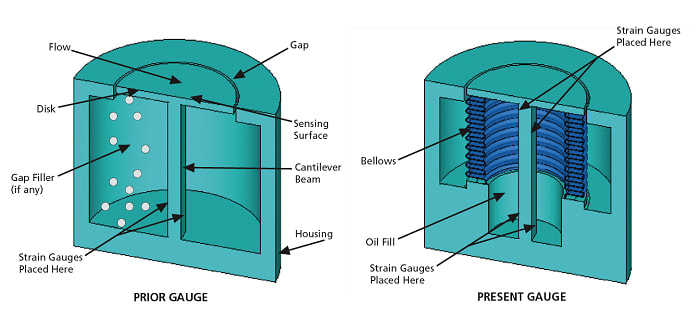
A generic gauge according to the present methodology is derived from a prior cantilever-beam skin-friction gauge (see Figure 1). Either gauge includes a housing designed to be mounted in a recess such that one of its end faces lies flush with the wall surface on which one seeks to measure skin friction. The gauge includes a cantilever beam that supports a disk, the outer face of which constitutes a sensing surface flush with the wall surface. The base of the cantilever is instrumented with strain gauges. The disk is separated from the wall-surface end face of the housing by a small gap, which allows for movement of the disk in response to forces exerted on the disk by the impinging flow. The readings of the strain gauges are taken as measures of flexing of the cantilever associated with movement of the disk, and, hence, of the wall shear exerted on the sensing surface by the flow.
Depending on the specific application, the interior of the housing of the prior skin-friction gauge may contain a filler, which is typically an oil. As long as the flow speed is not too high, the oil is retained in the cavity by capillary action at the gap. The oil helps to suppress spurious components of gauge readings by damping vibrations and reducing intragauge thermal gradients associated with heat flux. Unlike the prior gauge, the present gauge includes a bellows, sealed to the disk and the housing in such a way as to define a cavity behind the disk. During assembly of the gauge, prior to sealing, the cavity is filled with an oil, with care taken to keep the oil free of air bubbles. In the present gauge, because of retention within the bellows, the relatively incompressible oil supports the cantilever beam against axial compression in the presence of uniform wall pressure on the sensing surface, thereby suppressing the spurious component of strain (and the associated spurious components of the strain-gauge readings) attributable to uniform wall pressure.
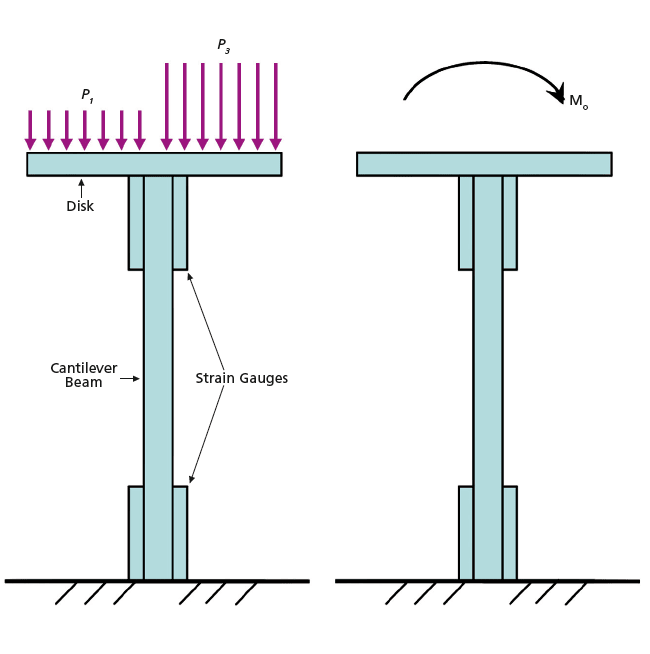
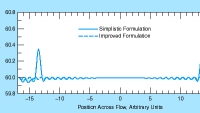
If a shock impinges on the wall at the gauge location, then the pressure can vary with position along the sensing surface (see Figure 2). The variation in pressure with position gives rise to a bending moment (M0) that contributes to the flexing of the cantilever and thus contributes a spurious component to the readings of the strain gauges at the base of the cantilever. In the present gauge, there is an additional set of strain gauges at the point where the cantilever beam is joined to the disk; the readings of these gauges are indicative primarily of M0. The spurious effect of the M0 can be cancelled by processing all the strain-gauge readings by use of simple equations that can readily be solved to obtain the wall shear alone (and, if desired, M0 alone).
Another important spurious effect is that of apparent strains associated with temperature changes. This effect can be compensated by suitable processing of the outputs of additional strain gauges that are positioned to be especially responsive to the spurious effects. Yet another spurious effect is that of bending of the cantilever beam under the combined influences of acceleration and the inertia of the cantilever beam and disk. The readings of an accelerometer mounted next to the skinfriction gauge can be used to correct for this spurious effect by means of simple proportionalities among strain, wall shear, and acceleration.
An important element of the present methodology is an approach to designing skin-friction gauges for specific applications. This approach involves consideration of numerous phenomena within a multidisciplinary computational-simulation framework. The phenomena to be considered include the ones described above, plus such other relevant phenomena as instrumentation errors, settling times, filtering of measurement signals, and dynamic responses to multiple inputs.
This work was done by August J. Rolling of Virginia Polytechnic Institute and State University for the Air Force Research Laboratory.
AFRL-0055
This Brief includes a Technical Support Package (TSP).
Measuring Skin Friction in Complex Flows That Include Shocks
(reference AFRL-0055) is currently available for download from the TSP library.
Don't have an account?
More From SAE Media Group
Aerospace & Defense Tech Briefs
Performance and Operability of a Dual-Cavity Flame Holder in a Supersonic Combustor
Aerospace & Defense Tech Briefs
Diode Laser Sensor for Scramjet Inlets

Aerospace & Defense Tech Briefs
A New Look at Ignition: Refining Our Understanding of Combustion Dynamics in Gun Chambers
Motion Design INSIDER
Friction That Cools
Aerospace & Defense Tech Briefs
Considerations of Aeroacoustics in Turbojet-Engine Testing
Aerospace & Defense Tech Briefs
Portable Data Recorder for Measuring Sand Grain Fracture After Blasts

Aerospace & Defense Tech Briefs
Simulation of Airflow Through a Test Chamber


Tech Briefs
Device Eliminates Vortices and Vibration
Motion Design INSIDER
Nimble Dimples: Agile Underwater Vehicles Inspired by Golf Balls
Tech Briefs
Microscale Regenerative Heat Exchanger
Motion Design INSIDER
Dragonfly Wings Used to Study Motion


Aerospace & Defense Tech Briefs
System for Imaging Turbulent Combustion Flows
Overview
The document titled "Design of Gages for Direct Skin Friction Measurements in Complex Turbulent Flows with Shock Impingement Compensation" by August J. Rolling presents a comprehensive study on the design and optimization of gages used for measuring skin friction in turbulent compressible flows, particularly in the presence of shock waves. The research addresses the challenges associated with accurately measuring skin friction in complex flow environments, which are critical for various aerospace applications.
The study begins with a detailed overview of the optimization techniques employed, specifically a parametric analysis that involves selecting materials and defining design variables such as length and thickness. A total of 625 different gage configurations were virtually constructed and tested to evaluate their performance against specified test facility constraints. The results of this extensive testing process informed the selection of gages that met the desired performance criteria.
Key findings include the identification of trade-offs between vibration frequency and strain, which are crucial for ensuring the reliability and accuracy of the gages under dynamic conditions. The document also discusses the modeling techniques applied in the characterization of gages, emphasizing the importance of computational efficiency in the design process.
In addition to the optimization summary, the document covers various aspects of gage performance, including dynamic response, thermal response, and the effects of different boundary conditions. The research highlights the significance of understanding the gage's reaction to external loads and its thermal distribution, which are essential for accurate skin friction measurements.
The conclusions drawn from this research underscore the contributions made to the field of direct skin friction measurement, particularly in turbulent flows where shock interactions are prevalent. The document provides recommendations for short-term, mid-term, and long-term improvements in gage design and testing methodologies, aiming to enhance measurement accuracy and reliability.
Overall, this dissertation serves as a valuable resource for researchers and engineers in aerospace engineering and related fields, offering insights into the design and optimization of measurement tools that are critical for advancing our understanding of fluid dynamics in complex flow scenarios.
Top Stories
INSIDERDefense
 New Raytheon and Lockheed Martin Agreements Expand Missile Defense Production
NewsAutomotive
 Ford Announces 48-Volt Architecture for Future Electric Truck
INSIDERManufacturing & Prototyping
 Active Strake System Cuts Cruise Drag, Boosts Flight Efficiency
ArticlesTransportation
 Accelerating Down the Road to Autonomy
INSIDERMaterials
 How Airbus is Using w-DED to 3D Print Larger Titanium Airplane Parts
Road ReadyTransportation

Webcasts
Electronics & Computers
 Cooling a New Generation of Aerospace and Defense Embedded...
Power
 Battery Abuse Testing: Pushing to Failure
Connectivity
 A FREE Two-Day Event Dedicated to Connected Mobility
Automotive
 Quiet, Please: NVH Improvement Opportunities in the Early Design Cycle
Transportation
 Advantages of Smart Power Distribution Unit Design for Automotive &...
Aerospace
 Sesame Solar's Nanogrid Tech Promises Major Gains in Drone Endurance