




Performance and Operability of a Dual-Cavity Flame Holder in a Supersonic Combustor
This technology enables stabilization and enhancement of supersonic combustion in scramjets.
Supersonic combustion has been of interest for many years in order to support future Air Force hypersonic missions. The current generation of hydrocarbon-fueled scramjet combustors typically requires a flame-holding device to facilitate flame ignition and stable combustion. The amount of time available for fuel injection, fuel-air mixing, and combustion is very short — on the order of 1 millisecond. This short dwell time, along with the relatively long ignition delay times of hydrocarbon fuels, makes the flow path and flame holder design extremely important. This study investigates the perormance and operability of using a symmetric dual-cavity flame holder flow path to stabilize and enhance supersonic combustion.

The first objective was to investigate the dual-cavity performance and determine the advantages and disadvantages of using a dual-cavity versus a single-cavity flame holder. This objective was accomplished by studying wall pressures, temperatures, pressure ratios, stream thrusts, combustion efficiencies, CFD, and visualization. Peak pressure and combustor exit pressures were studied, and the dual-cavity consistently showed higher ratios for both. The increase in pressure is a result of additional heat being released from the combustion process. This result suggests the dual-cavity flow path provides better combustion and performance than the single cavity.
Stream thrust was the next performance parameter studied. Each case showed a stream thrust significantly higher for the dual-cavity than for the single-cavity. The dual flow path had an average of 34% higher values over all of the cases. The increase of stream thrust with the dual-cavity is further evidence that adding the additional flame holder provides better performance.
The second objective was to investigate the operability of the dual-cavity flow path over a range of equivalence ratios and fuel injection schemes. Each run with the dual-cavity configuration had a shock position farther upstream in the isolator than the single-cavity flow path. The dual-cavity had a smaller range of operability and proved to be more likely to unstart as the equivalence ratio was increased to 1.0 or higher. Including bottom side injection also moved the pre-combustion shock train further upstream and decreased the operability range of the dual-cavity.
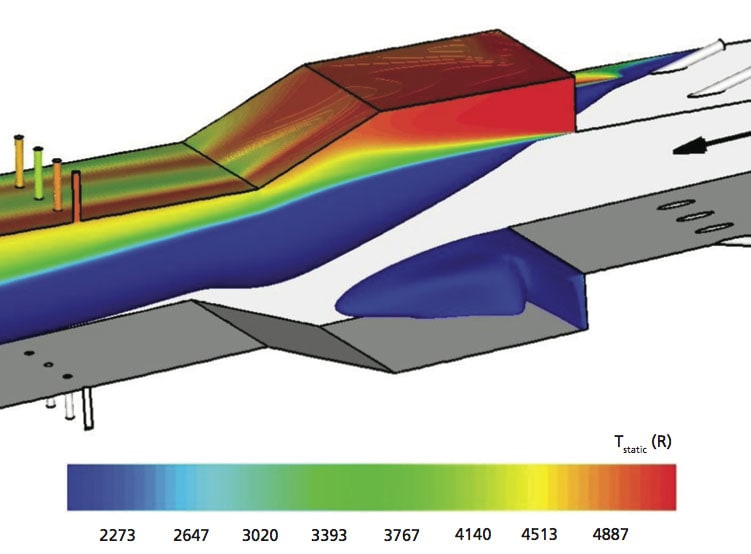
The final objective was to analyze the overall advantages and disadvantages of the two flow path configurations and determine if the dual-cavity flame holder may be a viable option for future scramjet engines. The single-cavity flow path has been more extensively studied in the past and is known to provide sufficient combustion under most conditions. This research verified operability of the single-cavity flow path between equivalence ratios of approximately 0.53 to 0.95. The operability window of the dual-cavity flow path was smaller than that of the single cavity as the equivalence ratio was increased. However, the dual-cavity did provide increased overall performance shown by the stream thrust and pressure ratio results.
The analysis conducted in this study suggests the dual-cavity flame holder flow path provides significant advantages over the baseline and would be a viable option for future scramjet engines. However, the flight conditions and equivalence ratios could provide limitations to its capabilities. Operational equivalence ratios range from approximately 0.3 to 1.2. Fuel-rich conditions are useful during periods of acceleration where maximum thrust is desired. The inability to operate with these high equivalence ratios could increase acceleration time, thereby reducing cruise speed, flight time, and range.
The dual-cavity flame holder showed a significant overall increase in performance through higher temperatures, pressure ratios, and stream thrusts. The operability was slightly reduced due to an increase in pre-combustion shock train position. CFD and flow path visualization were used to verify these results.
This work was done by MacKenzie J. Collatz of the Air Force Institute of Technology. For more information, download the Technical Support Package (free white paper) at www.defensetechbriefs.com/tsp under the Physical Sciences category. AFRL-0141
This Brief includes a Technical Support Package (TSP).
Performance and Operability of a Dual-Cavity Flame Holder in a Supersonic Combustor
(reference AFRL-0141) is currently available for download from the TSP library.
Don't have an account?
More From SAE Media Group

Aerospace & Defense Tech Briefs
A New Look at Ignition: Refining Our Understanding of Combustion Dynamics in Gun Chambers
Aerospace & Defense Tech Briefs
Measuring Skin Friction in Complex Flows That Include Shocks
Aerospace & Defense Tech Briefs
Diode Laser Sensor for Scramjet Inlets

Aerospace & Defense Tech Briefs
System for Imaging Turbulent Combustion Flows
Tech Briefs
Simplified Modeling of Oxidation of Hydrocarbons

Tech Briefs
Fighting Fire with Electrically Assisted Wind


Tech Briefs
Device Eliminates Vortices and Vibration
Aerospace & Defense Tech Briefs
Considerations of Aeroacoustics in Turbojet-Engine Testing
Tech Briefs
Microscale Regenerative Heat Exchanger
Software Tech Briefs
Electrical Calibration Source for Next-Generation Oscilloscope
Motion Design INSIDER
Dragonfly Wings Used to Study Motion
Tech Briefs
Thin Film Sensor for Ultra High-Temp Measurement
Off-Highway Engineering
In Pursuit of a Dedicated Hydrogen ICE for Heavy-Duty Vehicles
Tech Briefs
Cryogenic Oxygen Storage Modules (COSM)
Tech Briefs
Cryogenic Flux Capacitor
Motion Design
Flexible Conductive Skin Gives Robots the Human Touch

Off-Highway Engineering
Cummins’ X15 Is a Model of Design Efficiency
Aerospace & Defense Tech Briefs
Simulation of Airflow Through a Test Chamber

Aerospace & Defense Tech Briefs
Scientists Fuse Simulations and Machine Learning to Accelerate Novel Additively Manufactured Materials
Overview
The document is a Master's thesis authored by First Lieutenant MacKenzie J. Collatz at the Air Force Institute of Technology, focusing on the performance and operability of a dual cavity flame holder in a supersonic combustor. The research was conducted from September 2008 to June 2009 and aims to address the challenges of achieving stable combustion in high-speed flight conditions, which is critical for the advancement of hypersonic technologies.
The thesis begins with an introduction that outlines the motivation behind the research, the problem statement, and the research objectives. It emphasizes the importance of efficient combustion in supersonic environments, where traditional combustion methods may fail due to the extreme conditions. The study specifically investigates the design and functionality of cavity flame holders, which are essential for stabilizing flames in supersonic combustors.
The theoretical framework includes a review of previous research on supersonic ignition, cavity flame holder design, and fuel injection techniques. The document details the experimental setup, including the test facility, instrumentation, and procedures used to gather data. A comprehensive data analysis process is also described, along with an uncertainty analysis to ensure the reliability of the results.
The results section discusses various performance metrics, including equivalence ratios, pressure profiles, peak pressure ratios, and combustion efficiency. The findings indicate that the dual cavity flame holder design significantly enhances the operability of the combustor, leading to improved combustion stability and efficiency under supersonic conditions.
Conclusions drawn from the research highlight the effectiveness of the dual cavity flame holder in achieving stable combustion, which is crucial for the development of future hypersonic vehicles. The thesis also provides recommendations for further research, suggesting areas where additional studies could enhance understanding and performance of combustion systems in high-speed applications.
Overall, this thesis contributes valuable insights into the field of aerospace propulsion, particularly in the context of supersonic and hypersonic flight. It underscores the importance of innovative designs in combustion technology and sets the stage for future advancements in the area. The document is approved for public release, indicating its relevance and potential impact on ongoing research and development within the Air Force and broader aerospace community.
Top Stories
INSIDERManufacturing & Prototyping
 How Airbus is Using w-DED to 3D Print Larger Titanium Airplane Parts
INSIDERManned Systems
 FAA to Replace Aging Network of Ground-Based Radars
NewsTransportation
 CES 2026: Bosch is Ready to Bring AI to Your (Likely ICE-powered) Vehicle
NewsSoftware
 Accelerating Down the Road to Autonomy
EditorialDesign
 DarkSky One Wants to Make the World a Darker Place
INSIDERMaterials
 Can This Self-Healing Composite Make Airplane and Spacecraft Components Last...
Webcasts
Defense
 How Sift's Unified Observability Platform Accelerates Drone Innovation
Automotive
 E/E Architecture Redefined: Building Smarter, Safer, and Scalable...
Power
 Hydrogen Engines Are Heating Up for Heavy Duty
Electronics & Computers
 Advantages of Smart Power Distribution Unit Design for Automotive...
Unmanned Systems
 Quiet, Please: NVH Improvement Opportunities in the Early Design...
