




Axial Field Electric Motor
This axial field electric motor is optimized for high-power-density applications.
An axial field electric motor comprises one or more elements such as a rotor mounted for rotation and multiple axial flux permanent magnets carried by the rotor. The axial flux permanent magnets are oriented such that an associated magnetic flux produced thereby is at least substantially axially oriented. The axial flux permanent magnets are positioned around the rotor with alternating orientations of flux direction so that a flux direction of adjacent magnets is at least substantially axially oriented but opposite in direction. The radial flux permanent magnets are also carried by the rotor and oriented so that an associated magnetic flux produced is at least substantially radially oriented.
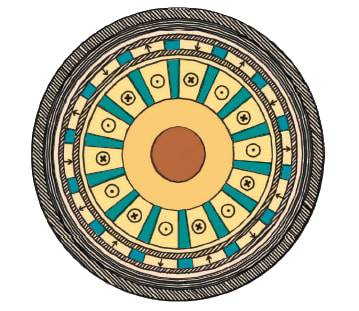
Alternatively, the structure and spacers may be comprised of separate components, laminates, and the like. The motor may be utilized to create an electromagnetic feedback system that magnetically clamps and holds the rotor in its centrally aligned position, thereby reducing axial vibrations. Stator windings may be substantially perpendicular to the axis of the rotation of the hybrid rotor shaft. With the magnetic flux directed radially, either inwardly or outwardly, and with electron current in the direction as indicated either into the page or out of the page, then two forces will be produced in opposite directions on opposite radial ends of the hybrid rotor.
If the hybrid rotor attempts to warp, then the force produced on one side of the rotor will be greater than that produced in the opposite direction, tending to push the hybrid rotor back into a vertical position and thereby reducing axial vibrations produced due to warping or bending of the rotor. The feedback or centralizing effect will be greatest if the wires in the radial stator winding are oriented to be substantially perpendicular to the rotor axis, and positioned so that the stator windings are adjacent axially opposite sides of the radial flux permanent magnets.
If the orientation of stator windings is parallel to the hybrid rotor shaft or the axis thereof, then the stator windings produce a force that increases torque applied to the hybrid rotor. When the stator windings are at angles between parallel and perpendicular with respect to the rotor shaft, some feedback effects will be produced to reduce axial vibrations and some amount of force will be provided to increase torque of the hybrid rotor. Thus, the orientation of the stator windings can be selected as desired with these benefits in mind.
This work was done by Chahee P. Cho of the Naval Undersea Warfare Center.
NUWC-0008
This Brief includes a Technical Support Package (TSP).
Axial Field Electric Motor
(reference NUWC-0008) is currently available for download from the TSP library.
Don't have an account?
More From SAE Media Group
Aerospace & Defense Tech Briefs
Simulations of Brush Contacts of Homopolar Motor/Generators
Motion Design
High-Speed Reluctance Machine Design
Automotive Engineering
Model-Based Analysis of E-Motor Designs
Medical Design Briefs
Selecting Motors for Medical Pumps
Motion Control Tech Briefs
Improved Bearingless Switched-Reluctance Motor
Motion Control Tech Briefs
Brushless DC Rotary Motor Improves Efficiency in Fuel Cell Applications

Automotive Engineering
Axial Flux E-Motor Maker Progresses Toward Mobility, Alters Cooling Design
Tech Briefs
Conical Bearingless Motor/Generators
Sensor Technology
Machine Condition Monitoring Keeps a Factory Running
Automotive Engineering
New Ampere EV Motor Aims for Power, Torque Benchmarks
Motion Control Tech Briefs
High-Temperature Switched-Reluctance Electric Motor
Motion Design
New Products
Motion Control & Automation Technology
Ring Motors - Design Flexibility for Innovative Configurations
Motion Control & Automation Technology
Hybrid Stepper Advancements Improve Medical Pump Performance
Tech Briefs
High Bus Voltage Stepper Motor Systems
Tech Briefs
Axial Halbach Magnetic Bearings

Motion Control & Automation Technology
Reasons for Turning to Slotless DC Motor Technology


Tech Briefs
Chemically Driven Wheels “Morph” Into Gears
Tech Briefs
Radial Halbach Magnetic Bearings
Aerospace & Defense Tech Briefs
Using Electromagnetic Brakes to Keep Thrust Reversers IN PLACE
Medical Design Briefs
A Cross-Section of DC Motors and Their Characteristics
Motion Control Technology
Improved Electromagnetic Brake
Medical Design Briefs
Designing the Right Motor to Enhance Surgical Robot Precision

Overview
The document pertains to a patent application for an innovative Axial Field Electric Motor and Method developed by inventor Chahee P. Cho, under the auspices of the Naval Undersea Warfare Center. The invention aims to enhance the efficiency and performance of electric motors, particularly in applications relevant to naval and underwater technologies.
The Axial Field Electric Motor is characterized by its unique design that allows for a more compact and lightweight structure compared to traditional electric motors. This design is particularly advantageous in underwater applications where space and weight are critical factors. The motor operates on the principle of axial magnetic fields, which contribute to improved torque and power density, making it suitable for various applications, including propulsion systems for submarines and unmanned underwater vehicles.
The document outlines the technical specifications and operational principles of the motor, detailing its components, such as the rotor and stator configurations, and the materials used in its construction. It emphasizes the potential for significant improvements in energy efficiency, which is crucial for extending the operational range of underwater vehicles and reducing the need for frequent recharging or refueling.
Additionally, the patent application discusses the method of manufacturing the motor, highlighting innovative techniques that could streamline production and reduce costs. The document also addresses the potential for modifications and adaptations of the motor design, allowing for customization based on specific operational requirements or constraints.
The invention is positioned as a significant advancement in electric motor technology, with implications for both military and commercial applications. The document encourages interested parties to consider licensing the technology, suggesting that it could lead to enhanced capabilities in various fields, including marine engineering and robotics.
Overall, the Axial Field Electric Motor represents a forward-thinking approach to electric motor design, with the potential to revolutionize how electric motors are utilized in challenging environments. The document serves as a call to action for industry stakeholders to explore the benefits of this innovative technology and consider its applications in future projects.
Top Stories
NewsRF & Microwave Electronics
 Microvision Aquires Luminar, Plans Relationship Restoration, Multi-industry Push
INSIDERAerospace
 A Next Generation Helmet System for Navy Pilots
INSIDERDesign
 New Raytheon and Lockheed Martin Agreements Expand Missile Defense Production
INSIDERMaterials
 How Airbus is Using w-DED to 3D Print Larger Titanium Airplane Parts
NewsPower
 Ford Announces 48-Volt Architecture for Future Electric Truck
ArticlesAR/AI

Webcasts
Electronics & Computers
 Cooling a New Generation of Aerospace and Defense Embedded...
Automotive
 Battery Abuse Testing: Pushing to Failure
Power
 A FREE Two-Day Event Dedicated to Connected Mobility
Unmanned Systems
 Quiet, Please: NVH Improvement Opportunities in the Early Design Cycle
Automotive
 Advantages of Smart Power Distribution Unit Design for Automotive &...
Energy
 Sesame Solar's Nanogrid Tech Promises Major Gains in Drone Endurance