




Simulations of Brush Contacts of Homopolar Motor/Generators
Time-dependent distributions of electromagnetic force and heating were studied.
A computational- simulation study of distributions of electric current and temperature in brushes and slip rings in two model homopolar- motor/generator configurations was performed in support of the development, by the U.S. Navy, of a superconducting homopolar motor/generator (SCHPMG) machine for ship propulsion. Electrical-contact performance (more specifically, brush/slip-ring contact performance) is a limiting factor in the performance of an SCHPMG machine. The present study and similar studies are needed to gain understanding of brush/slip-ring contact performance in order to enable optimal design of brushes for homopolar machines.
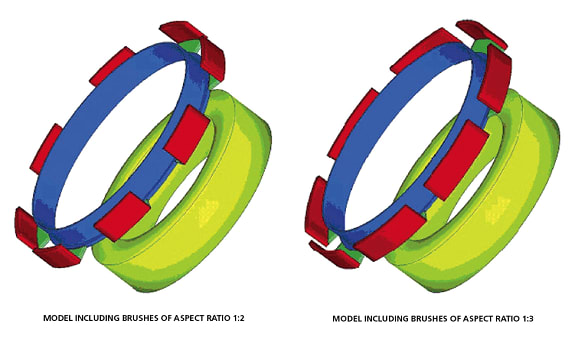
At the interface between a brush and a slip ring, where transfer of electric current occurs, factors that affect wear include the spatial distributions of electric current, magnetic field, temperature, and electromagnetic forces as the brush slides at a given velocity on an imperfect rotor (slip-ring) surface. There is experimental evidence that wear is not only highly asymmetric between anode and cathode brushes but is also nonuniform within the contact area of an individual brush. The asymmetry and nonuniformity of wear limits the life and efficiency of a brush assembly, inasmuch as the full volume of brush fiber material is not fully utilized. Moreover, debris from worn brushes can give rise to internal short circuits and/or other adverse effects on the operation of a machine containing a brush assembly.
Each of the two models in the computational- simulation study was a half-symmetric finite-element model representing eight stator brushes, an electromagnet coil, a slip ring, and buses (see figure). The two models differed in the aspect ratios of the brushes (1:2 versus 1:3). The brush contact area was kept constant at 2 cm2, a transport current of 325 A was considered to be applied to each brush, and the current applied to the electromagnet coil was chosen to produce a magnetic flux density of 0.4 T at the brush locations. Coupled electromagnetic and thermal behaviors (including bulk ohmic heating) were included in the simulations. Local adiabaticity and a specific form of the temperature dependence of electrical conductivity were assumed. Time-dependent spatial distributions of electric current, temperature, and electromagnetic force were calculated. The conclusions drawn from the numerical results include the following:
- Circumferential components of electric current at leading and trailing edges of brushes could interact with the magnetic field to produce forces tending to destabilize the brushes, but these forces could be reduced through appropriate design.
- A brush having a higher aspect ratio is subject to smaller destabilizing forces.
- Power loss per brush due to bulk ohmic heating is about 0.74 W for an aspect ratio of 1:2 vs. 0.72 watts for an aspect ratio of 1:3.
- Assuming a contact pressure of 2 psi (≈14 kPa) and a tip speed of 12 m/s, frictional heating is about 16.5 W per brush.
- The power loss per slip ring due to bulk ohmic heating is about 0.98 W for an aspect ratio of 1:2 vs. 0.9 W for an aspect ratio of 1:3.
This work was done by Kuo-Ta Hsieh of the University of Texas at Austin for the Naval Research Laboratory.
NRL-0018
This Brief includes a Technical Support Package (TSP).
Simulations of Brush Contacts of Homopolar Motor/Generators
(reference NRL-0018) is currently available for download from the TSP library.
Don't have an account?
More From SAE Media Group
Aerospace & Defense Tech Briefs
Axial Field Electric Motor
Aerospace & Defense Tech Briefs
Designing a Sensorless Torque Estimator for Direct Torque Control of an Induction Motor
Sensor Technology
Machine Condition Monitoring Keeps a Factory Running
Aerospace & Defense Tech Briefs
Using Electromagnetic Brakes to Keep Thrust Reversers IN PLACE
Tech Briefs
Rotary Electrical Contact
Motion Control Tech Briefs
High-Temperature Switched-Reluctance Electric Motor
Automotive Engineering
New Ampere EV Motor Aims for Power, Torque Benchmarks

Battery & Electrification Technology
Modeling Considerations for Optimizing EV Motors
Motion Design
High-Speed Reluctance Machine Design
Aerospace & Defense Tech Briefs
Approximating the Material Stresses and System Requirements for Hypersonic Flight
Tech Briefs
Engine Made as a Single Calcium Ion
Motion Design INSIDER
Artificial Muscles Propel a Robotic Leg to Walk and Jump
Aerospace & Defense Tech Briefs
Thermal Management Techniques in Avionics Cooling
Tech Briefs
Chemically Driven Wheels “Morph” Into Gears

Photonics & Imaging Technology
Advanced Materials Help Lasers Beat the Heat
Medical Design Briefs
Product Focus: Mechanical Components 2024
Automotive Engineering
Model-Based Analysis of E-Motor Designs
Automotive Engineering
Axial Flux E-Motor Maker Progresses Toward Mobility, Alters Cooling Design
Sensor Technology
Self-Powered Wireless Sensors in the Industrial Internet of Things
Tech Briefs
Radial Halbach Magnetic Bearings
Aerospace & Defense Tech Briefs
MEMS Offset-Beam Torsional Electrothermal Actuators

Tech Briefs
Process Enables Machines to Thermally “Breathe”
Aerospace & Defense Tech Briefs
Thermal Design and Analysis of a Rocket-Engine TAN Injector

Overview
The document is a Quarterly Progress Report prepared by Dr. Kuo-Ta Hsieh from the Institute for Advanced Technology at The University of Texas at Austin, covering the period from January 1 to March 31, 2006. It details the ongoing research and development efforts related to superconducting homopolar motor/generator (SCHPMG) technology, which is being explored for naval ship propulsion.
The report emphasizes the critical role of electrical contact systems, specifically the performance of brushes and slip rings, in the efficiency and longevity of SCHPMG machines. It highlights that brush wear is a significant challenge, exhibiting asymmetric and non-uniform patterns between brushes of opposite polarity (anode and cathode) and within the contact area of individual brushes. This wear not only limits the operational life of the brush assembly but also generates debris that can negatively impact the machine's operating environment.
To address these issues, the report underscores the importance of accurate electromagnetic (EM) characterization of the brush/rotor and brush/slip ring interfaces. Understanding the wear behavior of brushes is essential for optimizing brush design and improving overall system performance.
The report also outlines the key personnel involved in the project, including Dr. Hsieh, who is an expert in electromechanical codes, and Dr. Sikhanda Satapathy, who focuses on mechanical simulations and brush design improvements. Their combined expertise is crucial for advancing the research objectives.
Figures included in the report illustrate temperature distributions on brushes and slip rings at various time intervals, providing insights into the thermal behavior of these components under operational conditions. The data presented in these figures is vital for understanding the thermal dynamics that contribute to brush wear and overall system efficiency.
Overall, the report serves as a progress update on the SCHPMG project, detailing the challenges faced, the methodologies employed, and the ongoing efforts to enhance the performance and reliability of superconducting motor technology. The findings and developments reported are expected to contribute significantly to the advancement of naval propulsion systems, aligning with the U.S. Navy's goals for innovative and efficient ship propulsion solutions.
Top Stories
NewsSensors/Data Acquisition
 Microvision Aquires Luminar, Plans Relationship Restoration, Multi-industry Push
INSIDERRF & Microwave Electronics
 A Next Generation Helmet System for Navy Pilots
INSIDERWeapons Systems
 New Raytheon and Lockheed Martin Agreements Expand Missile Defense Production
NewsAutomotive
 Ford Announces 48-Volt Architecture for Future Electric Truck
INSIDERAerospace
 Active Strake System Cuts Cruise Drag, Boosts Flight Efficiency
ArticlesTransportation

Webcasts
Aerospace
 Cooling a New Generation of Aerospace and Defense Embedded...
Energy
 Battery Abuse Testing: Pushing to Failure
Power
 A FREE Two-Day Event Dedicated to Connected Mobility
Automotive
 Quiet, Please: NVH Improvement Opportunities in the Early Design Cycle
Electronics & Computers
 Advantages of Smart Power Distribution Unit Design for Automotive &...
Unmanned Systems
 Sesame Solar's Nanogrid Tech Promises Major Gains in Drone Endurance