




MEMS Offset-Beam Torsional Electrothermal Actuators
Progress has been made toward realizing larger-force, larger-displacement MEMS actuators.
Prototypes of microelectromechanical system (MEMS) rotational actuators based on a principle of torsion induced by thermal expansion of electrically heated offset beams have been designed, fabricated, and tested. It is envisioned that after further development, these actuators might be used to satisfy stringent competing requirements for smaller, larger-force, largerdisplacement actuators in increasingly complex MEMS systems. Until now, MEMS thermal actuators have been regarded as inefficient and capable of producing, variously, either large forces and small displacements or small forces and large displacements. The actuators of the present type are intended to overcome some of the deficiencies heretofore attributed to MEMS thermal actuators by producing medium displacements and medium forces.
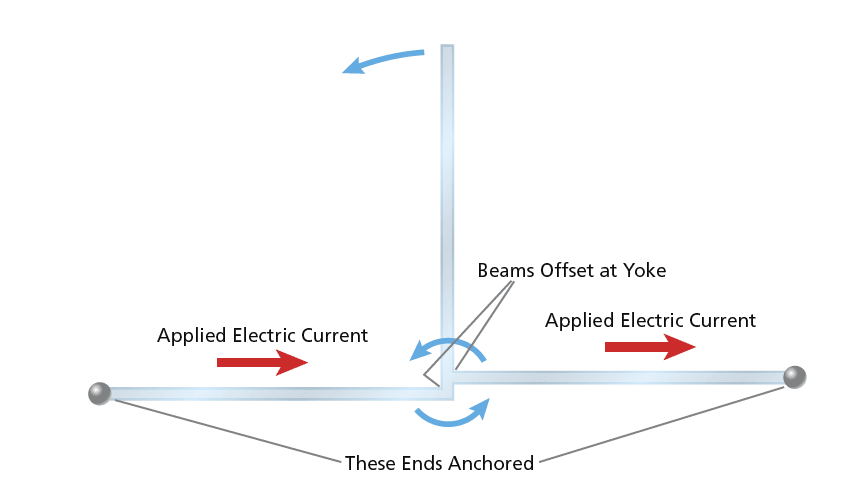
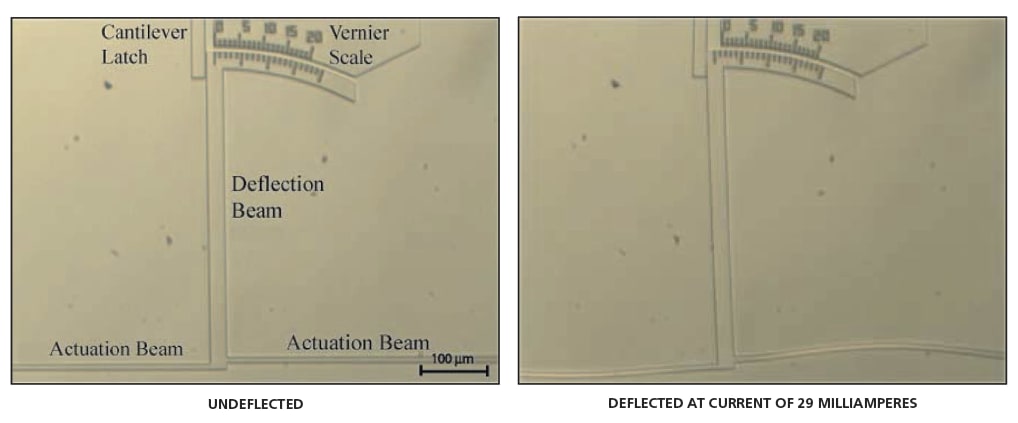
The efficiency of such an actuator and its force and displacement capabilities, and, thus, its suitability for a given application, depend on its electrothermal and thermomechanical characteristics as well as such purely geometrical and mechanical characteristics as its dimensions and its linear and torsional spring stiffnesses. A theory taking these considerations into account has been developed for use in designing such actuators and evaluating results of experiments in which their forces and displacements are measured at different levels of applied electric power.
This work was done by Danny Gee and Luke Currano of the Army Research Laboratory.
This Brief includes a Technical Support Package (TSP).
MEMS Offset-Beam Torsional Electrothermal Actuators
(reference ARL-0030) is currently available for download from the TSP library.
Don't have an account?
More From SAE Media Group
Tech Briefs
Nano-Sized Actuator Lifts Many Times its Weight

Motion Design
Popcorn-Driven Robotic Actuators
Aerospace & Defense Tech Briefs
Biaxial and Shear Testing Apparatus With Force Controls

Motion Control Tech Briefs
Piezoelectrically Actuated Microvalve for Liquid Effluents

Motion Design
Multi-Axis Motion Controller Accelerates Gear Testing
Motion Control Tech Briefs
Miniature Inchworm Actuators Fabricated by Use of LIGA
Photonics & Imaging Technology
Advanced Materials Help Lasers Beat the Heat
Aerospace & Defense Tech Briefs
Encapsulated Ball Bearings for Rotary Micro Machines
Tech Briefs
Measuring Stickiness of Microscale Surfaces
Sensor Technology
Sensing Hazardous Gases Can Save Lives

Motion Design
Inflatable Actuators Use Origami Principles to Deform
Tech Briefs
Self-Sensing Electric Artificial Muscles
Aerospace & Defense Tech Briefs
Simulations of Brush Contacts of Homopolar Motor/Generators

Motion Design
Calculating the Estimated Fatigue Life of a Disc Spring
Tech Briefs
Rotary Electrical Contact


Tech Briefs
Soft Robotic Gripper Based on Twining Plants
Tech Briefs
Cheetah-Inspired Soft Robots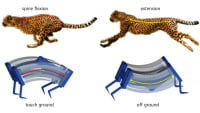
Overview
The document titled "Fabrication and Testing of a Novel MEMS Rotational Thermal Actuator," authored by Danny Gee and Luke Currano, presents research conducted by the U.S. Army Research Laboratory, with a focus on the development and evaluation of a new type of Micro-Electro-Mechanical Systems (MEMS) actuator. The report is dated November 2007 and covers work performed from May to August 2007.
The introduction outlines the significance of MEMS technology in various applications, particularly in the defense sector, where precise control and actuation are critical. The novel actuator discussed in this report is designed to utilize thermal energy for rotational movement, which can be advantageous in applications requiring compact and efficient actuation mechanisms.
The document is structured into several key sections. The "Experiment" section delves into the theoretical background that underpins the actuator's design, explaining the principles of thermal actuation and the expected performance characteristics. This section is followed by a detailed account of the fabrication process, which includes the materials and techniques employed to create the MEMS device. The authors emphasize the importance of precision in the fabrication process to ensure the actuator's functionality and reliability.
In the "Results and Discussion" section, the authors present the findings from the testing of the fabricated actuator. They analyze the performance metrics, including response time, rotational range, and energy efficiency. The results indicate that the novel actuator demonstrates promising capabilities, with potential applications in various fields, including robotics and micro-manipulation.
The report concludes by summarizing the key findings and suggesting directions for future research. The authors highlight the potential for further optimization of the actuator design and fabrication techniques to enhance performance. They also discuss the implications of their findings for advancing MEMS technology and its applications.
Overall, the document provides a comprehensive overview of the research conducted on the MEMS rotational thermal actuator, detailing the theoretical foundations, fabrication methods, and experimental results. It serves as a valuable resource for researchers and engineers interested in MEMS technology and its applications in modern engineering challenges. The report is approved for public release, allowing for broader dissemination of its findings.
Top Stories
NewsSensors/Data Acquisition
 Microvision Aquires Luminar, Plans Relationship Restoration, Multi-industry Push
INSIDERRF & Microwave Electronics
 A Next Generation Helmet System for Navy Pilots
INSIDERWeapons Systems
 New Raytheon and Lockheed Martin Agreements Expand Missile Defense Production
NewsAutomotive
 Ford Announces 48-Volt Architecture for Future Electric Truck
INSIDERAerospace
 Active Strake System Cuts Cruise Drag, Boosts Flight Efficiency
ArticlesTransportation

Webcasts
Aerospace
 Cooling a New Generation of Aerospace and Defense Embedded...
Energy
 Battery Abuse Testing: Pushing to Failure
Power
 A FREE Two-Day Event Dedicated to Connected Mobility
Automotive
 Quiet, Please: NVH Improvement Opportunities in the Early Design Cycle
Electronics & Computers
 Advantages of Smart Power Distribution Unit Design for Automotive &...
Unmanned Systems
 Sesame Solar's Nanogrid Tech Promises Major Gains in Drone Endurance