




Encapsulated Ball Bearings for Rotary Micro Machines
This bearing design can be used in MEMS elements for micro-motors and micro-turbomachinery.
Microelectromechanical systems (MEMS)-fabricated silicon rotary elements for micro-motors, micro-generators, and micro-turbomachinery have received growing attention with applications in power conversion and actuation. Within these technologies, the bearing mechanism is the primary determinant of device performance and reliability. Active bearings, such as magnetic or electrostatic, have the advantage of being controlled during the operation, but at the cost of the accompanying circuitry. Passive bearings span a large range of velocities that include center-pin bushings with low revolution rates possible, and hydrostatic or hydrodynamic bearings with high revolution rates possible.
The design and fabrication of the rotary ball bearing is based on commercially available 440C stainless steel balls with a diameter, dball, of 285 μm and a lot diameter variation of 0.254 μm. The design features balls housed at the periphery of the rotor to enable a two-layer fabrication sequence for encapsulation via bonding. At the same time, this scheme of encapsulation allows features to be patterned on either side of the rotor while having minimal influence from the bearings.
A square groove race was designed to encase the micro ball bearings. Alter n a tive designs may improve the performance and fatigue characteristics of the bearings. Housing the balls using a square groove race fabricated by a dry anisotropic etch process, such as deep reactive ion etching (DRIE), allows control of the contact points and better repeatability when compared to other race designs and fabrication methods.
The bearing mechanism is fabricated in three major steps: (1) silicon races are fabricated on the wafer level, (2) balls are placed into the race and an identical race is bonded on top to encapsulate them, and (3) silicon DRIE is used to release the rotor.
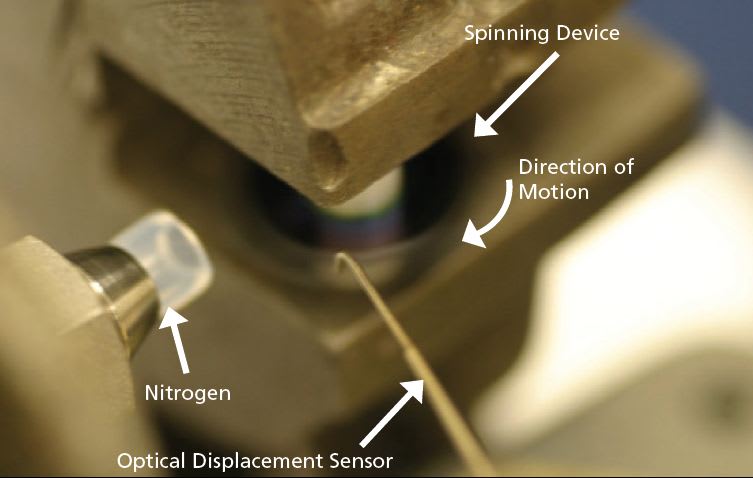
Demonstration of the encapsulated ball bearing was accomplished using a setup in which standoffs are placed on both the top and bottom of the rotor, and the stack is held in place using a mechanical vice. A nitrogen line is placed within 2 mm of the die corner using a second mechanical vice. The flow from the nitrogen line causes the outer portion of the die to spin about the clamped center. A Philtec D6 Fiberoptic displacement sensor is used to measure the angular velocity of the spinning square die.
Initial movement of the square die about the center required a line pressure greater than 5 psi for most of the devices tested. Lower pressures were not able to produce enough force on the edge of this square die to counteract static friction, which is much higher than the dynamic friction once it is rotating. In some cases, bearings have to be manually started to overcome this initial friction. Once they are spinning, line pressures as low as 1 psi have been used to maintain operation.
The testing method induces a high load onto the bearing device. This, as well as the square groove race design and the brittle silicon material, lead to high wear. Scanning electron micros copy (SEM) images were used to investigate the wear of the silicon race and of the stainless steel balls. The device, which operated for 39 minutes before jamming, was separated on a hot plate at 400 °C.
Ball jamming that occurred for both bearing devices is an inherent problem when full-complement-type bearings are used. The race dimensions increase as wear ensues, giving the balls more play and a greater chance to seize. Im ple - mentation of a low-wear material on top of the silicon race, along with tighter fabrication tolerances, can reduce the probability of jamming, but not eliminate it completely. Instead, a retainer ring (or cage) could be used to isolate the balls from one another. In addition, to eliminating ball jamming, the use of a retainer ring can greatly reduce the friction since a much smaller number of balls can be used. A retainer ring maintains a separation distance between the balls allowing for a minimum number of balls to be used. Reduction in the friction by decreasing the number of balls will similarly lead to much higher speeds as well as better reliability.
This work was done by C. Mike Waits and Reza Ghodssi of the Institute for Systems Research, and Bruce Geil of the Army Research Laboratory. ARL-0133
This Brief includes a Technical Support Package (TSP).
Encapsulated Ball Bearings for Rotary Micro Machines
(reference ARL-0133) is currently available for download from the TSP library.
Don't have an account?
More From SAE Media Group
Aerospace & Defense Tech Briefs
Pulse Plasma Nitriding for Aerospace Applications
Medical Design Briefs
Quiet Gears Improve Patient Comfort and Imaging Quality in Medical Equipment
Motion Design
Linear Bearings: What You Need to Know
Tech Briefs
Contaminant-Free Steel
Tech Briefs
Nickel Titanium Alloy Ball Bearings
Motion Design
Multi-Axis Motion Controller Accelerates Gear Testing
Motion Control Tech Briefs
Crowned Races for Crossed Roller Bearings
Tech Briefs
Quick Disconnect for High-Pressure Mate/De-Mate
Motion Design
Plastic Bearings Redefine the Wheelchair
Motion Design
Custom Gimbal for JHU-APL Shows Promise for Others
Motion Design INSIDER
Superlubricity Coating for Nearly Friction-Free Surfaces
Aerospace & Defense Tech Briefs
Plain Bearings for Aerospace Applications

Motion Design
New Products
Aerospace & Defense Tech Briefs
MEMS Offset-Beam Torsional Electrothermal Actuators
Aerospace & Defense Tech Briefs
Biaxial and Shear Testing Apparatus With Force Controls
Medical Design Briefs
Winter 2022 Resource Guide
Tech Briefs
Products of Tomorrow
Tech Briefs
Shape Memory Alloy Art (SMA-Art) Shapes
Automotive Engineering
Axial Flux E-Motor Maker Progresses Toward Mobility, Alters Cooling Design

Aerospace & Defense Tech Briefs
Limiting Creep in Aerospace Materials


Aerospace & Defense Tech Briefs
Hydraulic Testing of Polymer Matrix Composite 102mm Tube Section
Tech Briefs
Miniature Latching Valve
Aerospace Manufacturing and Machining
Aerospace Work Platforms — More than Meets the Eye
Motion Design INSIDER
NYU Tandon Researchers Explore a More Frictionless Future
Motion Design
Self-Lubrication Improves Standard Braking Systems
Aerospace & Defense Tech Briefs
MEMS Resettable Circuit Breaker and Switch for DC-DC Voltage Converters
Overview
The document presents research on the development of encapsulated rotary ball bearings designed for rotary micro machines, utilizing silicon microfabrication techniques and stainless steel balls. The authors, C. Mike Waits, Bruce Geil, and Reza Ghodssi, detail the innovative method of capturing stainless steel balls within a silicon race to support a silicon rotor both axially and radially. This design aims to enhance the performance and reliability of micro electromechanical systems (MEMS).
The encapsulated ball bearing mechanism is notable for its ability to achieve high rotational speeds, with initial demonstrations showing speeds of up to 6.8 krpm without lubrication and up to 15.6 krpm with lubrication. The research emphasizes the significance of understanding the tribological behavior of the bearings, including start-up behavior and wear characteristics of the stainless steel balls and silicon race.
The design features a square groove race that houses the micro ball bearings, allowing for a two-layer fabrication sequence via bonding. This encapsulation method enables the patterning of features on both sides of the rotor while minimizing the influence of the bearings on the overall design. The document includes detailed dimensions of the ball bearing mechanism, such as the diameter of the balls (285 μm) and the pitch radius of the race (4 mm), which are critical for ensuring proper fit and function.
The fabrication process involves several steps, including the use of deep reactive ion etching (DRIE) to create the race and alignment pits for precise placement of the balls. The authors discuss the challenges associated with the bonding process, such as the potential formation of metal particles in the bearing race due to reflow of the metal adhesion layer.
Overall, this research represents a significant advancement in the field of MEMS, providing insights into the design, fabrication, and performance of encapsulated ball bearings. The findings have implications for various applications, including micro-motors and other rotary devices, highlighting the potential for improved efficiency and reliability in micro-scale machinery. The study contributes to the ongoing exploration of tribology in MEMS, paving the way for future innovations in this area.
Top Stories
NewsSensors/Data Acquisition
 Microvision Aquires Luminar, Plans Relationship Restoration, Multi-industry Push
INSIDERRF & Microwave Electronics
 A Next Generation Helmet System for Navy Pilots
INSIDERWeapons Systems
 New Raytheon and Lockheed Martin Agreements Expand Missile Defense Production
NewsAutomotive
 Ford Announces 48-Volt Architecture for Future Electric Truck
INSIDERAerospace
 Active Strake System Cuts Cruise Drag, Boosts Flight Efficiency
ArticlesTransportation

Webcasts
Aerospace
 Cooling a New Generation of Aerospace and Defense Embedded...
Energy
 Battery Abuse Testing: Pushing to Failure
Power
 A FREE Two-Day Event Dedicated to Connected Mobility
Automotive
 Quiet, Please: NVH Improvement Opportunities in the Early Design Cycle
Electronics & Computers
 Advantages of Smart Power Distribution Unit Design for Automotive &...
Unmanned Systems
 Sesame Solar's Nanogrid Tech Promises Major Gains in Drone Endurance