




Asynchronous Architectures for Large-Integer Processors
Cryptographic computer systems are needed for secure communications in military, homeland security, medical, and financial applications.
New architectures have been developed for cryptographic hardware that offer high throughput, algorithm flexibility, radiation hardness, and low power. The asynchronous (clockless) architecture combines a dedicated large-integer processor (LIP), a field programmable gate array (FPGA), and a simple processor. The asynchronous LIP can perform public-key encryption using large keys at a fraction of the runtime energy consumption of synchronous (clocked) systems. The system is made of quasi-independent components that can be commercialized as stand-alone or in different configurations.
The LIP architecture consists of a large array of computing elements communicating by message passing. The architecture mixes granularities in order to match the needs of different cryptographic protocols and the different phases within each protocol. FPGAs are helpful in implementing private-key systems and can be used to configure partially evaluated arithmetic functions for public-key protocols.
The LIP’s public-key cryptographic operations were performed in the Large Integer Datapath (LID), which is optimized for maximum throughput and support of different key sizes. Since each operation requires a very large number of bit operations, a number of arithmetic algorithms must be applied to reduce the number of bit-ops to close to what is achieved by the best-known algorithms.
The LIP architecture enables trading speed for energy over a wide range. Speed is limited only by power and heat-dissipation concerns. Operated at full speed, a “simple” LIP based on a 512-bit array multiplier, could perform 300,000 RSA (public-key) decryptions per second using about 300 watts of power. The low-energy operation of the LIP is practical only with an asynchronous implementation. Unless the LIP is used continuously, clock gating would be necessary for energy efficiency.
This work was done by Alain J. Martin of Situs Logic for the Air Force Research Laboratory. AFRL-0117
This Brief includes a Technical Support Package (TSP).
Asynchronous Architectures for Large-Integer Processors
(reference AFRL-0117) is currently available for download from the TSP library.
Don't have an account?
More From SAE Media Group
Aerospace & Defense Tech Briefs
FPGAs and HPC
Aerospace & Defense Tech Briefs
Implementing On-Board Cloud Detection on a Reconfigurable Computer
Aerospace & Defense Tech Briefs
Architectures for Cognitive Systems
Aerospace & Defense Tech Briefs
Managing Security in FPGA-Based Embedded Systems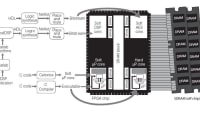

Aerospace & Defense Tech Briefs
Security IP Module
Embedded Technology
Extensible Processing Platforms: Giving Designers the Best of Both Worlds
Sensor Technology
Occupancy Monitoring Pre-Packaged
Tech Briefs
Hardware-Command-Decoding ASIC

Aerospace & Defense Tech Briefs
VITA 90: Small Form Factors for UAVs and Other Space Constrained Platforms
Aerospace & Defense Tech Briefs
Using High-Level Language to Implement Floating-Point Calculations on FPGAs
Aerospace & Defense Tech Briefs
Evaluation of Four Methods of Reconfiguring an FPGA

Tech Briefs
Radiation-Tolerant Dual Data Bus

Electronics & Sensors INSIDER
A New Design Provides the Greatest Precision in Memory to Date


Photonics & Imaging Technology
Rethinking FPGAs for Smart Cameras
Aerospace & Defense Tech Briefs
CompactPCI Serial Space
Electronics & Sensors INSIDER
This Chip Safeguards User Data While Enabling Efficient Computing on a Smartphone
Embedded Technology
Taking the Sting Out of Multiprocessor DSP Application Development
Tech Briefs
COVE: A CubeSat Payload Processor
Tech Briefs
Four-Channel PC/104 MIL-STD-1553 Circuit Board
Aerospace & Defense Tech Briefs
FPGA
Embedded Technology
Embedded Security: Down to the Silicon
Aerospace & Defense Tech Briefs
New Products
Aerospace INSIDER
TEWS Introduces First VITA 93 QMC Modules
Aerospace & Defense Tech Briefs
COM Express: The Architecture to Support the Future of Robotics & Unmanned Systems
Overview
The document titled "Asynchronous Architectures for Large-Integer Processors with Applications to Security," authored by Alain J. Martin, presents a comprehensive exploration of innovative processor architectures aimed at enhancing the performance of large-integer computations, particularly in the context of security applications. The report, dated April 15, 2005, covers the period from April 15, 2004, to April 15, 2005, and is sponsored by the Air Force Research Laboratory.
The primary focus of the report is on asynchronous architectures, which differ from traditional synchronous designs by eliminating the global clock signal. This approach allows for more efficient processing, as components can operate independently and at varying speeds, leading to potential improvements in power consumption and performance. The report discusses the implications of these architectures for cryptographic applications, where large-integer arithmetic is crucial for tasks such as encryption and decryption.
The document outlines the challenges associated with large-integer processing, including the need for high-speed arithmetic operations and the efficient handling of data. It emphasizes the importance of optimizing these operations to meet the demands of modern security protocols. The report also highlights various techniques and methodologies employed in the design of asynchronous processors, including the use of delay-insensitive circuits and self-timed systems, which contribute to improved reliability and performance.
In addition to the technical aspects, the report addresses the potential applications of these architectures in real-world scenarios, particularly in military and defense contexts where secure communications are paramount. The findings suggest that asynchronous architectures could significantly enhance the capabilities of cryptographic systems, making them faster and more energy-efficient.
The report concludes with a discussion of future research directions, emphasizing the need for further exploration of asynchronous designs and their integration into existing systems. It calls for continued innovation in processor architecture to keep pace with the evolving landscape of security threats and computational demands.
Overall, this document serves as a valuable resource for researchers and practitioners in the field of computer architecture and security, providing insights into the potential of asynchronous designs to revolutionize large-integer processing and enhance the security of digital communications.
Top Stories
INSIDERManufacturing & Prototyping
 How Airbus is Using w-DED to 3D Print Larger Titanium Airplane Parts
NewsAutomotive
 Microvision Aquires Luminar, Plans Relationship Restoration, Multi-industry Push
INSIDERAerospace
 A Next Generation Helmet System for Navy Pilots
INSIDERDesign
 New Raytheon and Lockheed Martin Agreements Expand Missile Defense Production
ArticlesAR/AI
 CES 2026: Bosch is Ready to Bring AI to Your (Likely ICE-powered) Vehicle
Road ReadyDesign

Webcasts
Semiconductors & ICs
 Advantages of Smart Power Distribution Unit Design for Automotive...
Unmanned Systems
 Quiet, Please: NVH Improvement Opportunities in the Early Design...
Electronics & Computers
 Cooling a New Generation of Aerospace and Defense Embedded...
Power
 Battery Abuse Testing: Pushing to Failure
AR/AI
 A FREE Two-Day Event Dedicated to Connected Mobility
