




Ceramic Manufacturing Technique Opens New Markets
Traditionally, ceramics have been thought of as hard and brittle, yet able to tolerate high temperatures. Now, Advanced Ceramics Research (ACR) of Tucson, AZ has developed a method of manufacturing ceramic composite materials for longer-lasting industrial cutting tools, as well as drill bits that can dig deep into the ground to search for oil. The company also is applying this method to produce artificial bone.
Seeking high-performance alternative materials for parts such as rocket nozzles, Missile Defense Agency (MDA) predecessor BMDO funded ACR through a Phase II Small Business Innovation Research (SBIR) contract. Additional MDA support for ACR ceramics projects has come through various SBIR and STTR (Small Business Technology Transfer) awards over recent years. Much of MDA’s interest has been in finding new materials for thrusters and rocket motor throats for the Theater High Altitude Air Defense system. Beyond missile defense, makers of aerospace components and industrial machinery could find ACR’s technology useful.
How it Works
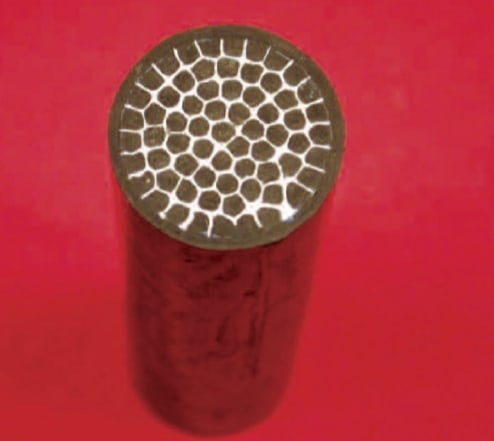
Manufacturing FM ceramics involves encasing strands of a hard material, which are relatively easy to fracture, in a softer, more ductile material and then bundling these into cells. ACR takes ceramics or metal powders and mixes them with a thermoplastic polymer binder. The resulting fiber can be easily manipulated and extruded into a variety of shapes, such as a strong honeycomb configuration. Components made with the process are sintered, or hot-pressed, at temperatures greater than 2,000ºC.
ACR’s process offers a cheaper and faster way of making ceramic composites than standard methods such as chemicalvapor infiltration. Historically, higher costs — compared with industrial metals and other advanced materials — has limited market acceptance of ceramic-based products. Company officials hope that results from ongoing development work will make FM technology an easier sell, especially to aerospace companies, which prefer using rhenium, coated with exotic materials to resist oxidation, for those parts that come into contact with aluminized propellants. But rhenium is a rare metal, and fashioning it into parts can be difficult and lengthy work.
Because ACR’s unique manufacturing process promises lower costs and easier manufacturing, ACR believes FM materials are a good choice for replacing rhenium in nozzles and other rocket parts because they can withstand very high temperatures and offer protection to sensitive components in extreme environments. Compared with rhenium, FM composites are also lighter and exhibit smaller dimensional changes at high temperature.
Where it Stands
ACR has licensed its FM technology to Smith Tool, a subsidiary of Houston-based Smith International, one of the world’s largest suppliers of products and services to the oil industry. The two companies had initially worked with each other under a Department of Energy research project for developing roller-cone bits. ACR also has licensed its FM technology to Japan’s Kyocera, a global leader in ceramics manufacturing. Kyocera has exclusive rights to use FM technology for metal cutting tools.
Possible future products could include FM blades for graders used to make dirt and gravel roads, and FM bed liners for trucks. Beyond aerospace and industrial parts, ACR has been applying its FM ceramic parts manufacturing method to the biomedical field. The company can use the same extrusion process to produce artificial bone from high-strength plastic. ACR calls this experimental product “Plasti-Bone.” The biomedical industry craves new kinds of implants because today’s metal bone replacements, screws, and pins are so hard that over time (5 to 15 years), they can damage adjacent healthy bone through constant friction.
While strong enough to carry body weight, Plasti-Bone is osteoconductive, which means bone cells can grow right on top of it. And it is porous enough so that it will disappear, absorbed into the body, when its job is done. Right now, Plasti- Bone takes nearly 18 months to dissolve, but ACR is working to develop a polymer blend material that would be absorbed in just six months to a year. ACR likely will partner with one or more companies to bring Plasti-Bone to market, because it will need help developing the product and carrying it through the Food and Drug Administration regulatory process.
More Information
For more information on ACR’s ceramic manufacturing method, click here . (Source: Keith Costa/NTTC; MDA TechUpdate, Missile Defense Agency, National Technology Transfer Center Washington Operations)
Top Stories
INSIDERManufacturing & Prototyping
 How Airbus is Using w-DED to 3D Print Larger Titanium Airplane Parts
NewsAutomotive
 Microvision Aquires Luminar, Plans Relationship Restoration, Multi-industry Push
INSIDERAerospace
 A Next Generation Helmet System for Navy Pilots
INSIDERDesign
 New Raytheon and Lockheed Martin Agreements Expand Missile Defense Production
ArticlesAR/AI
 CES 2026: Bosch is Ready to Bring AI to Your (Likely ICE-powered) Vehicle
Road ReadyDesign

Webcasts
Semiconductors & ICs
 Advantages of Smart Power Distribution Unit Design for Automotive...
Unmanned Systems
 Quiet, Please: NVH Improvement Opportunities in the Early Design...
Electronics & Computers
 Cooling a New Generation of Aerospace and Defense Embedded...
Power
 Battery Abuse Testing: Pushing to Failure
AR/AI
 A FREE Two-Day Event Dedicated to Connected Mobility
