




Water Mist System for Shipboard Machinery Space Fires
The water mist system provides an efficient, effective, and non-toxic means to extinguish ship fires.
Water mist has been determined to be a preferred alternative to Halon 1301 total flooding to extinguish fires occurring in ship machinery spaces and pump rooms, because it is toxicologically and physiologically inert. Water mist systems produce a drop size distribution with a range of drop sizes under 1000 μm, while the more conventional sprinkler systems produce much coarser particles. The smaller particle sizes have greater cooling efficiencies because evaporation and cooling are controlled by surface area, and the surface area of a large number of small droplets is greater than that of a small number of large droplets of the same total volume.
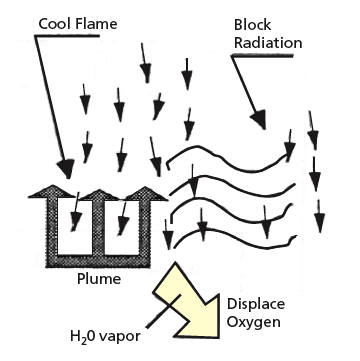
Fire extinguishment through water mist application is controlled by three mechanisms:
- Flame cooling,
- Reduced oxygen concentration by displacement of air by water vapor, and
- Radiant heat attenuation.
Each of these mechanisms is essentially independent, but flame extinguishment generally occurs as a result of a combination of these effects. Three basic parameters that are important in characterizing water mist behavior are flux density, spray momentum, and drop size distribution. Nozzle pressure, flow rate, and obstructions influence these characteristics, but do not themselves characterize the mist. The mist characteristics will also be affected by the presence of a fire, but are initially measured in a non-fire environment.
A number of representative drop-size diameters may be used to characterize sprays. A mist of small-diameter droplets (<50 μm) will exhibit gas-like properties; the droplets following airflow patterns around obstructions and behaving like gaseous fire extinguishants. The main fire extinguishing mechanisms of the smaller water particles are radiant heat attenuation and oxygen displacement. Droplets over 50 μm diameter are projected into the fire zone because of their greater momentum.
The drop-size distribution also varies throughout the protected volume. In a vertically downward spray, the larger particles (particles with greater momentum) will condense as they impact on objects in their path at a faster rate than the smaller particles. As the distance from the nozzle increases, interaction between falling particles will result in particles coalescing and the average particle size increasing. Interaction of sprays from adjoining nozzles will also result in a change in drop-size distribution as will interaction with obstacles.
Entrainment is an important mechanism for directing mist into the flame zone and the region around the flame. The mist particles provide cooling that will slow down the reaction kinetics, which, in the extreme, will cool the liquid fuel to temperatures below the flashpoint. Entrainment of mist into the flame zone may also produce local dilution of the oxygen concentration to a level that will inhibit combustion.
The majority of fire threats in engine rooms, machinery rooms, pump rooms, paint storage rooms, weapons storage rooms, and flammable liquid storage rooms are Class B (flammable and combustible) liquids. Water mist will provide cooling to Class B fires, which will affect ongoing combustion. To achieve extinguishment of liquid fuels by water mist, the particles must cool the flame, cool the fuel or provide a level of oxygen depletion that will alter the fuel/air ratio to one that cannot be ignited. The mist parameters will determine the water particle motion near the flame and throughout the compartment, therefore controlling the cooling and extinguishing behavior. The priority when attempting to achieve flame cooling is to ensure the particles reach the flame. This requires a suitable droplet size distribution to provide the most efficient heat transfer, sufficient particle volume to absorb the heat generated by the fire, and sufficient momentum to drive the particles through the plume.
The system pressure will control the particle velocity and size, and therefore, momentum. However, the benefits of a high supply pressure must be balanced with the weight, power, and volume penalties of these systems. If the pressure from the ship’s fire main is sufficient to produce the appropriate mist parameters for extinguishing, the system can be connected to the fire main without the need to install extra hardware.
This work was done by Ian Burch of the Australian Defence Science and Technology Organisation.
DSTO-0001
This Brief includes a Technical Support Package (TSP).
Water Mist System for Shipboard Machinery Space Fires
(reference DSTO-0001) is currently available for download from the TSP library.
Don't have an account?
More From SAE Media Group
Tech Briefs
Advanced Supercritical Water Oxidation Reactor
Tech Briefs
Process Enables Machines to Thermally “Breathe”
Tech Briefs
Products of Tomorrow
Aerospace & Defense Tech Briefs
Thermal Management Techniques in Avionics Cooling
Sensor Technology
Sensing Hazardous Gases Can Save Lives
Aerospace & Defense Tech Briefs
Rotating Detonation-Wave Engines
Aerospace & Defense Tech Briefs
Approximating the Material Stresses and System Requirements for Hypersonic Flight
Aerospace & Defense Tech Briefs
Thermal Design and Analysis of a Rocket-Engine TAN Injector

Tech Briefs
Deep-Sea Hydrothermal-Vent Sampler
Tech Briefs
Water-Saving Firefighting Nozzle

Aerospace & Defense Tech Briefs
Thermostatic Solutions for Temperature Control Applications
Tech Briefs
Quick Disconnect for High-Pressure Mate/De-Mate
Test & Measurement Tech Briefs
Cooling Test Samples With a Combined Convective and Conductive System to Rapidly Reach 77 K
Tech Briefs
Q&A: Simple Solar-Powered Desalination
Aerospace & Defense Tech Briefs
SAE International Extends Call for Abstracts, Seeks Submissions for AeroTech Conference
Tech Briefs
Extrans Permeation Measurement System
Aerospace & Defense Tech Briefs
Biaxial and Shear Testing Apparatus With Force Controls

Aerospace & Defense Tech Briefs
Sensing for Controls and Propulsion Health Management in Turbine Engines
Motion Design
Conical, Floating-Piston Isolation Valve
Tech Briefs
With Water Jets, Machines 'Breathe' to Cool Down
Automotive Engineering
New Ampere EV Motor Aims for Power, Torque Benchmarks
Tech Briefs
Soft Components for Soft Robotics
Medical Design Briefs
Product Focus: Mechanical Components 2024
Overview
The document titled "Water Mist for Ship Machinery Spaces," authored by Ian Burch and published by the Defence Science and Technology Organisation (DSTO) in April 2006, addresses the critical issue of fire safety in naval vessels, particularly within machinery spaces. These areas are prone to fires due to the presence of flammable fuels and ignition sources, which can lead to severe consequences, including loss of capability, function, life, and potentially the complete loss of the vessel.
The report emphasizes the importance of effective fire suppression systems in machinery spaces, where traditional methods may not be sufficient. It evaluates the suitability of water mist systems as a preferred extinguishing agent for Class B fires, which involve flammable liquids. The document presents findings from extinguishing tests demonstrating that water mist systems can effectively extinguish fires involving fuels with varying flash points, ranging from 60°C (diesel) to -4°C (heptane).
Key sections of the report discuss the mechanisms by which water mist extinguishes fires, including flame cooling, oxygen displacement, and radiant heat attenuation. The characterization of water mist, including parameters such as flux density, spray momentum, and droplet size distribution, is also explored, highlighting how these factors influence the effectiveness of fire suppression.
The report further examines the role of air and mist entrainment in enhancing the extinguishing capabilities of water mist systems. It discusses the behavior of water mists during full-scale fire tests, particularly in machinery spaces, and outlines the capabilities and limitations of total flooding water mist suppression systems.
Additionally, the document addresses the importance of compartment ventilation in fire management and the regulatory framework provided by the International Maritime Organization (IMO) and the Safety of Lives at Sea (SOLAS) standards.
In conclusion, the report advocates for the adoption of water mist systems in naval machinery spaces as a reliable and effective fire suppression method. It underscores the need for ongoing research and development to optimize these systems for various fuel types and fire scenarios, ultimately enhancing the safety and operational readiness of naval vessels.
Top Stories
INSIDERManufacturing & Prototyping
 How Airbus is Using w-DED to 3D Print Larger Titanium Airplane Parts
INSIDERManned Systems
 FAA to Replace Aging Network of Ground-Based Radars
NewsTransportation
 CES 2026: Bosch is Ready to Bring AI to Your (Likely ICE-powered) Vehicle
NewsSoftware
 Accelerating Down the Road to Autonomy
EditorialDesign
 DarkSky One Wants to Make the World a Darker Place
INSIDERMaterials
 Can This Self-Healing Composite Make Airplane and Spacecraft Components Last...
Webcasts
Defense
 How Sift's Unified Observability Platform Accelerates Drone Innovation
Automotive
 E/E Architecture Redefined: Building Smarter, Safer, and Scalable...
Power
 Hydrogen Engines Are Heating Up for Heavy Duty
Electronics & Computers
 Advantages of Smart Power Distribution Unit Design for Automotive...
Unmanned Systems
 Quiet, Please: NVH Improvement Opportunities in the Early Design...
