




Novel Conductive Coatings of Carbon Nanotubes
Electronic devices with a CNT-coated substrate have potential commercial applications such as components for flexible displays, solar cells, or sensors.
Carbon nanotubes (CNTs) are the material of ever-increasing concern due to their excellent electronic and physicochemical properties. Currently, research has been focused towards their applications for use in chemical and biological sensors as well as their use in optoelectronic devices. One of the major challenges is the construction of flexible electronic devices.
Transparent and electrically conductive materials such as oxide semiconductors (indium tin oxide (ITO)) can be used for versatile applications for flexible electronic devices such as displays, solar cells, and sensors. But ITO is in short supply and is becoming very expensive. ITO also is an inorganic, brittle material so it is limited in its use with flexible substrate. Thus, a transparent, flexible, and conductive coating composite built with carbon nanotubes may offer an alternate solution.
The primary objective of this work was to find candidate CNT-based coatings to achieve high electrical conductivity along with high transparency at 400 to 700-nm wavelength range once coated on flexible transparent substrate. The secondary objective was to uncover the fundamentals associated with adhesion of the coating to the surface of the substrate. The third objective was to fabricate sample electronic devices with CNT-coated substrate to test its potential commercial applications.
Among several CNT samples tested, the best performance result was with metallic SWNT (m-SWNT) coated on PEN (poly-ethylene-naphthalate) transparent composite film. It provided conductivity of 130 Ω/sq. with 80% transmittance at 400 to 700-nm wavelength range. In contrast, commercially available single-side, inorganic, brittle ITO-coated PET film gave 88 Ω/sq. with 80% transmittance. The sample mentioned was prepared with double-side coating using a dipping method. Once one side is coated, it is estimated that transmittance can probably reach close to a 90% level. Based on this assumption, we can draw a conclusion that one-side m-SWNT coated substrate is close to meeting requirements of several electronic applications such as EMI, displays, and touchscreens.
It was discovered that NMP (n-methyl-pyrolidone) solvent disperses m-SWNTs well with no use of surfactant. Besides achieving high electrical and optical performance with m-SWNT use, it was also found that CNTs adhere well to PEN (poly-ethylene-naphthalate) film surface and it passes a tape adhesion test.
Sample electronic devices such as PLEDs, solar cells, and methanol sensors were manufactured with the transparent, flexible SWNT-coated substrate. The sample devices show promise that SWNT-coated substrate as a component has the potential to be used for the fabrication of flexible electronic devices.
This work was done by Dr. Duck J. Yang of the University of Texas at Dallas for the Air Force Office of Scientific Research.
AFRL-0100
This Brief includes a Technical Support Package (TSP).
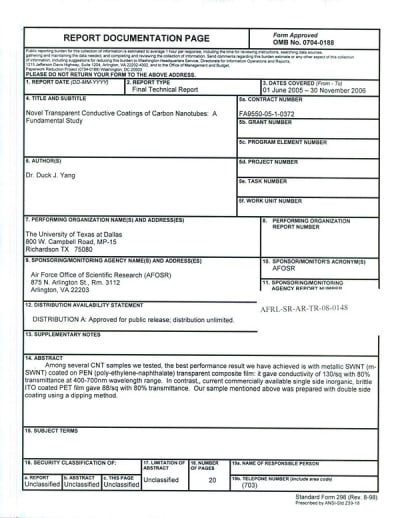
Novel Conductive Coatings of Carbon Nanotubes
(reference AFRL-0100) is currently available for download from the TSP library.
Don't have an account?
More From SAE Media Group
Tech Briefs
Precision CNT Cutting Mechanism
Tech Briefs
Foldable Solar Cells
Aerospace & Defense Tech Briefs
Aligned MWCNTs as Thermal Conductors in Adhesive Joints

Tech Briefs
Copolyimide Surface-Modifying Coating
Aerospace & Defense Tech Briefs
Carbon Nanotube Thermal Interfaces Enhanced with Sprayed-On Nanoscale Polymer Coatings
Medical Design Briefs
3D Printable Polymer Nanocomposite Ink

Tech Briefs
Conductive Carbon Fiber Polymer Composite
Tech Briefs
Transparent Graphene Electrodes
Tech Briefs
3D Printing Stronger Carbon Nanotubes


Air Force Research Laboratory Technology Horizons
Conductive Polymeric Nanocomposite Materials

Tech Briefs
Stretchable, Flexible Biofuel Cell Runs on Sweat

Tech Briefs
Self-Protected, Low-Temperature Nanosolder


Tech Briefs
High Thermally Conductive Polymeric Composites
Medical Manufacturing and Machining
Researchers Develop Ultra-Thin, Ultra-Flexible Electronic Material
Aerospace & Defense Tech Briefs
Silicon Nanowires for Anodes of Rechargeable Li Power Cells
Aerospace & Defense Tech Briefs
Real-Time Intelligent Chemical and Biological Nanosensors on a Flexible Platform

Tech Briefs
Fiber-Metal Laminate Manufacturing Technique
Tech Briefs
Printable Chemical Nanosensor
Overview
The document presents a research report on the development of novel transparent conductive coatings using carbon nanotubes (CNTs), specifically focusing on metallic single-walled carbon nanotubes (m-SWNT). Conducted by Dr. Duck J. Yang and his team at The University of Texas at Dallas, the study spans from June 2005 to December 2007 and aims to identify CNT-based coatings that achieve high electrical conductivity while maintaining high transparency in the 400-700 nm wavelength range.
The primary objective of the research is to find suitable CNT coatings that can be applied to flexible transparent substrates, which are essential for various electronic applications, including flexible displays, solar cells, and sensors. The secondary objective involves understanding the adhesion properties of these coatings to the substrate surfaces.
The report highlights the performance of m-SWNT coated on poly-ethylene-naphthalate (PEN) transparent composite film, which achieved a conductivity of 1300 ohms per square (Ω/sq) with 80% transmittance in the specified wavelength range. This performance is notably superior to that of commercially available indium tin oxide (ITO) coated polyethylene terephthalate (PET) films, which exhibited a conductivity of 88 Ω/sq with the same level of transmittance. The m-SWNT coating was applied using a double-side dipping method, which is suggested to enhance conductivity and transmittance.
The document discusses two key reasons for the excellent performance of m-SWNT: first, the intrinsic higher conductivity of metallic SWNT compared to un-separated CNTs, and second, the absence of surfactants in the dispersion preparation, as surfactants can act as insulators and hinder conductivity.
The findings indicate that m-SWNT coated substrates are close to meeting the requirements for various electronic applications, including electromagnetic interference (EMI) shielding, displays, and touch screens. The research concludes that the innovative use of m-SWNT in transparent conductive coatings holds significant promise for advancing flexible electronic technologies.
Overall, this study contributes valuable insights into the potential of CNTs as a viable alternative to traditional conductive materials, paving the way for future developments in flexible and transparent electronic devices.
Top Stories
INSIDERManufacturing & Prototyping
 How Airbus is Using w-DED to 3D Print Larger Titanium Airplane Parts
NewsAutomotive
 Microvision Aquires Luminar, Plans Relationship Restoration, Multi-industry Push
INSIDERAerospace
 A Next Generation Helmet System for Navy Pilots
INSIDERDesign
 New Raytheon and Lockheed Martin Agreements Expand Missile Defense Production
ArticlesAR/AI
 CES 2026: Bosch is Ready to Bring AI to Your (Likely ICE-powered) Vehicle
Road ReadyDesign

Webcasts
Semiconductors & ICs
 Advantages of Smart Power Distribution Unit Design for Automotive...
Unmanned Systems
 Quiet, Please: NVH Improvement Opportunities in the Early Design...
Electronics & Computers
 Cooling a New Generation of Aerospace and Defense Embedded...
Power
 Battery Abuse Testing: Pushing to Failure
AR/AI
 A FREE Two-Day Event Dedicated to Connected Mobility
